


Palestinians Wary as US-backed Aid Group Begins Operations in Gaza

Trucks carrying aid are seen at the Kerem Shalom crossing between Israel and Gaza, on its Israeli side, May 27, 2025. REUTERS/Shafiek Tassiem
TT

Palestinians Wary as US-backed Aid Group Begins Operations in Gaza

Trucks carrying aid are seen at the Kerem Shalom crossing between Israel and Gaza, on its Israeli side, May 27, 2025. REUTERS/Shafiek Tassiem

Palestinians voiced wariness on Tuesday toward a US-backed foundation set to bring aid to Gaza amid signs of famine, with Hamas warnings about biometric screening procedures keeping many away from distribution points.

The Gaza Humanitarian Foundation said it began operations on Monday, but there was little indication of Palestinians turning up at distribution centers in southern Gaza even after almost three months of Israel blockading the enclave.

Palestinians said there was no known visits to new sites of distribution on Monday, but on Tuesday dozens headed to one of them established in Rafah to get some aid despite the warnings, at least three witnesses told Reuters.

Others stayed away.

"As much as I want to go because I am hungry and my children are hungry, I am afraid," said Abu Ahmed, 55, a father of seven. "I am so scared because they said the company belongs to Israel and is a mercenary, and also because the resistance (Hamas) said not to go," he said in a message on the chat app WhatsApp.

Israel says the Switzerland-based GHF is a US-backed initiative and that its forces will not be involved in the distribution points where food will be handed out.

But its endorsement of the plan, which resembles Israeli schemes floated previously, and its closeness with the US has led many to question the neutrality of the foundation, including its own former chief, who resigned unexpectedly on Sunday.

The United Nations and other international aid groups have boycotted the foundation, which they say undermines the principle that humanitarian aid should be distributed independently of the parties to a conflict, based on need.

"Humanitarian assistance must not be politicized or militarized," said Christian Cardon, chief spokesperson of the International Committee of the Red Cross.

Israel, at war with Gaza's dominant Hamas militant group since October 2023, imposed the blockade in early March accusing Hamas of stealing supplies and using them to entrench its position. Hamas has denied such accusations.

Israeli officials said one of the advantages of the new aid system is the opportunity to screen recipients to exclude anyone found to be connected with Hamas.

Humanitarian groups briefed on the foundation's plans say anyone accessing aid will have to submit to facial recognition technology that many Palestinians fear will end up in Israeli hands to be used to track and potentially target them.

Details of exactly how the system will operate have not been made public.

Israel makes extensive use of facial recognition and other forms of biometric identification in the occupied West Bank and has been reported by Israeli and international media to be using such techniques in Gaza as well.

BEGGING FOR BREAD

Hamas, which has in recent months faced protests by many Palestinians who want the devastating war to end, has also warned residents against accessing GHF sites, saying Israel was using the company to collect intelligence information.

"Do not go to Rafah ...Do not fall into the trap...Do not risk your lives. Your homes are your fortress. Staying in your neighbourhoods is survival, and awareness is your protection," a statement published by the Hamas-linked Home Front said.

"These schemes will be broken by the steadfastness of a people who do not know defeat," it added.

The launch of the new system came days after Israel eased its blockade, allowing a trickle of aid trucks from international agencies into Gaza last week, including World Food Program vehicles bringing flour to local bakeries.

But the amount of aid that has entered the densely populated coastal enclave has been only a small fraction of the 500-600 trucks that UN agencies estimate are needed every day.

"Before the war, my fridge used to be full of meat, chicken, dairy, soft drinks, everything, and now I am begging for a loaf of bread," Abu Ahmed told Reuters via a chat app.

As a small aid flow has resumed, Israeli forces - now in control of large parts of Gaza - have kept up attacks on various targets around the enclave, killing 3,901 Palestinians since a two-month-old ceasefire collapsed in mid-March, according to the Gaza health ministry.

In all, more than 54,000 Palestinians have been killed in Israel's air and ground war, launched following a cross-border Hamas-led attack on October 7, 2023.



Can Iran Legally Impose Tolls on the Strait of Hormuz?

FILE PHOTO: Cargo ships in the Gulf, near the Strait of Hormuz, as seen from northern Ras al-Khaimah, near the border with Oman’s Musandam governance, amid the US-Israeli conflict with Iran, in United Arab Emirates, March 11, 2026. REUTERS/Stringer/File Photo
TT

Can Iran Legally Impose Tolls on the Strait of Hormuz?

FILE PHOTO: Cargo ships in the Gulf, near the Strait of Hormuz, as seen from northern Ras al-Khaimah, near the border with Oman’s Musandam governance, amid the US-Israeli conflict with Iran, in United Arab Emirates, March 11, 2026. REUTERS/Stringer/File Photo

Tehran has sought to tighten its grip over the Strait of Hormuz by charging tolls on vessels to ensure safe passage, in conjunction with Iran's Revolutionary Guard Corps.

The following explains law governing toll collections and actions that countries opposed to tolls might take, according to Reuters.

WHAT IS THE STRAIT OF HORMUZ?

The Strait of Hormuz is ‌a waterway connecting the Gulf with the Gulf of Oman, and located within Iran's and Oman's territorial waters. It is perhaps the world's most important energy shipping lane. About 20% of the world's oil passes through it.

The waterway is about 104 miles (167 km) long. Its width varies, and at its narrowest point provides 2-mile channels for inbound and outbound shipping, separated by a 2-mile buffer zone.

Iran effectively closed the strait following US-Israeli strikes on the country, and has demanded a right ⁠to collect tolls as a precondition to ending the war. The status of any toll collections so far could not immediately be confirmed.

WHAT LAW GOVERNS PASSAGE ON THE STRAIT?

The UN Convention on the Law of the Sea, opens new tab, sometimes known as UNCLOS, was adopted in 1982 and has been in force since 1994.

Article 38 provides vessels a right of unimpeded "transit passage" through more than 100 straits worldwide, including the Strait of Hormuz.

The treaty allows a country bordering a strait to regulate passage within its "territorial sea," up to 12 nautical miles from its border, but shall permit "innocent passage."

Passage is innocent if it is not prejudicial to a country's peace, good order and security. Military action, serious pollution, spying and fishing are not permitted. The concept of innocent passage was key to a 1949 International Court ‌of ⁠Justice case concerning the Corfu Channel, along the coasts of Albania and Greece.

Approximately 170 countries and the European Union have ratified UNCLOS. Iran and the United States have not. This raises the question of whether the treaty's rules affording freedom of maritime navigation have become part of customary international law, or bind only ratifying countries.

Experts say UNCLOS has become or is generally viewed as customary international law. Some non-ratifying countries may ⁠argue that they need not follow the treaty because they persistently and consistently object. Iran has argued that it has made such objections. The United States disputes Iran's authority to charge tolls.

HOW CAN TOLLS BE CHALLENGED?

There is no formal mechanism to enforce UNCLOS. The International Tribunal for the Law ⁠of the Sea in Hamburg, Germany, which the treaty established, and the International Court of Justice in The Hague, Netherlands could issue rulings but cannot enforce them.

Countries and businesses have other potential means to counteract tolls.

A willing state or coalition of states could ⁠try to enforce the treaty. The UN Security Council could pass a resolution opposing tolls.

Companies could redirect shipments away from the Strait of Hormuz, and have begun doing so. Countries could expand sanctions targeting financial transactions believed to benefit Iran's government, by sanctioning companies willing to pay tolls.


How China’s Weapons Transfers to Iran Have Evolved Over Decades

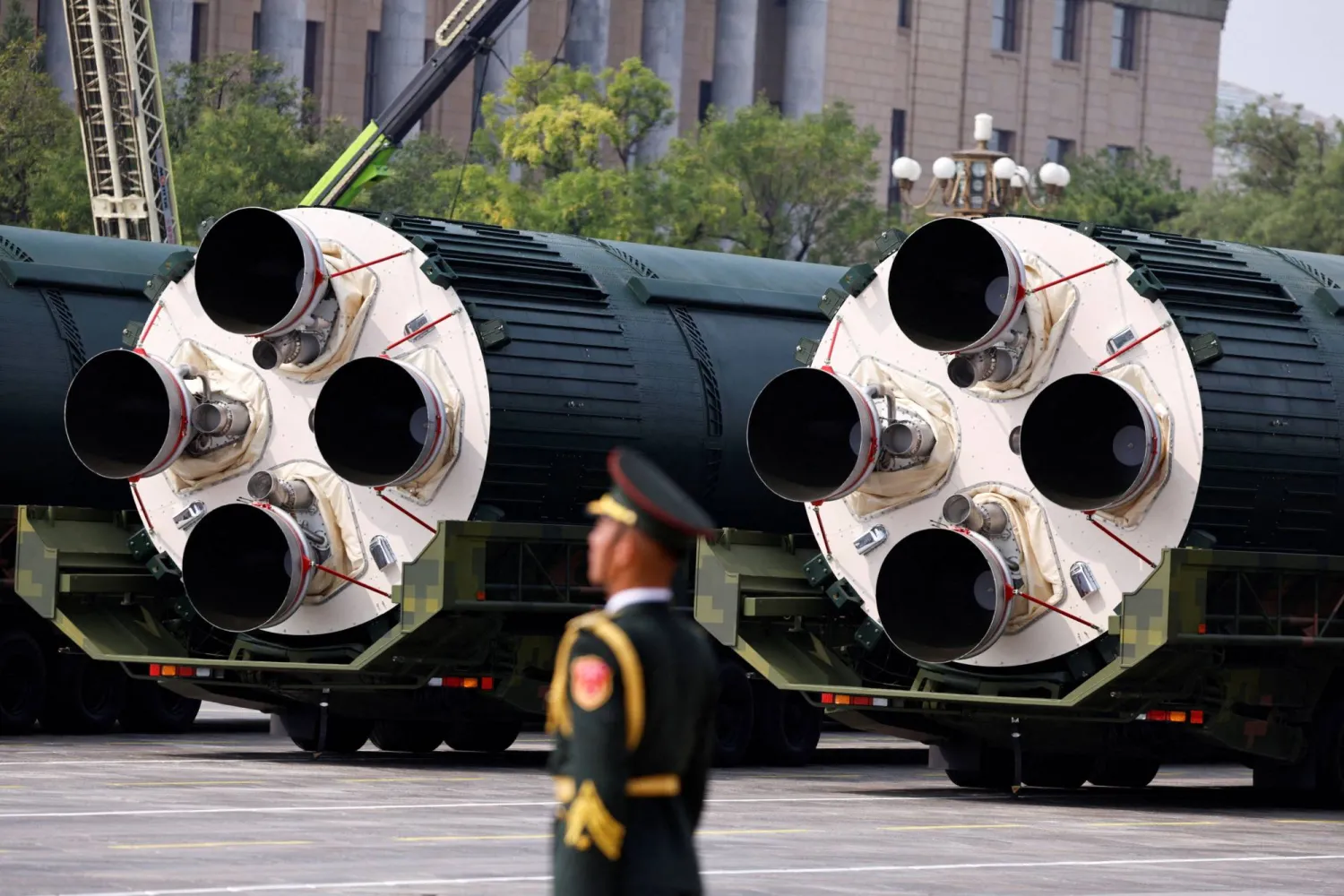
FILE PHOTO: A member of the People's Liberation Army stands as the strategic strike group displays DF-5C nuclear missiles during a military parade to mark the 80th anniversary of the end of World War Two, in Beijing, China, September 3, 2025. REUTERS/Tingshu Wang/File Photo
TT

How China’s Weapons Transfers to Iran Have Evolved Over Decades

FILE PHOTO: A member of the People's Liberation Army stands as the strategic strike group displays DF-5C nuclear missiles during a military parade to mark the 80th anniversary of the end of World War Two, in Beijing, China, September 3, 2025. REUTERS/Tingshu Wang/File Photo

Washington: David Pierson

For much of the last two decades, China has maintained a delicate balance in its military relationship with Iran, offering often indirect assistance instead of arms sales.

That approach is now drawing renewed attention after US officials said intelligence agencies were assessing whether China may have shipped shoulder-fired missiles to Iran in recent weeks. President Trump has said he would impose an additional 50 percent tariff on Chinese goods if the assessment proves accurate. China has denied the claim, calling it “pure fabrication” and has vowed to “resolutely retaliate” if the Trump administration goes through with tariffs.

The American officials said the information obtained by US intelligence agencies was not definitive. But if proven true, it would be a significant tactical change in the way Beijing supports its closest strategic partner in the Middle East.

Chinese arms sales to Iran exploded in the 1980s and have all but vanished in the last decade to comply with a United Nations embargo and US sanctions. Chinese support for Iran in recent years has instead come in the form of components that could be used in both civilian technologies as well as missiles and drones.

China has a major stake in the crisis in Iran. About a third of its total crude oil imports come from the Arabian Gulf.

Here is how China’s military support for Iran has evolved over the years:

The 1980s: The Boom Years

The outbreak of the Iran-Iraq War in 1980 coincided with major market reforms in China when the leader at the time, Deng Xiaoping, ordered state-owned companies to wean themselves off government support and instead seek commercial profit.

Chinese state-run defense companies were suddenly empowered to export their wares. That resulted in a deluge of Chinese missiles, fighter jets, tanks, armored vehicles and assault rifles being sold to Iran starting in 1982 and peaking in 1987, according to the Stockholm International Peace Research Institute.

At the same time, China sold even more arms to Iraq, resulting in a situation in which the two warring sides clashed with each other using the same Chinese weapons.

The Reagan administration opposed China’s arms sales to Iran, particularly Silkworm anti-ship cruise missiles. Tehran used the missiles in attacks in Kuwaiti waters in 1987 that struck an American-owned tanker and an American-registered tanker.

The United States responded by curbing exports of some high-technology products to China. China denied selling arms directly to Iran, but said it would do more to prevent its military exports from reaching Iran through intermediaries.

The 1990s: Technology Transfers

Following the war, Iran set out to develop its own military-industrial base with the help of China. One of its key products was the Noor anti-ship cruise missile, which had been reverse-engineered through purchases of Chinese C-802 cruise missiles.

“China played a major role in supporting Iran’s military modernization for decades, especially in developing Iran’s missile capabilities,” said Brian Hart, a fellow with the China Power Project at the Center for Strategic and International Studies.

Iran also received help from China in building missile-production facilities and even in constructing a missile test range east of Tehran, wrote Bates Gill, a longtime China expert, in the Middle East Review of International Affairs.

Under US pressure to curtail its sale of finished weapons, particularly missiles, to Iran, China began increasing exports of machine tools and components that could be used for both military and civilian purposes.

The 2000s to the Present: Dual-Use Technologies

In 2006, the United Nations imposed sanctions on Iran’s nuclear and ballistic missile programs. China voted in favor of the resolution and largely pivoted away from new, formal arms contracts with Tehran.

The shift was as much about regional strategy as it was about international law. Starting in the mid-2010s, China began deepening its strategic relationships with Gulf countries including Saudi Arabia and the United Arab Emirates, as well as Qatar.

China continued to supply Iran with dual-use technologies and materials that have helped it amass an arsenal of missiles and drones.

That included chemicals used to produce fuel for ballistic missiles and components for drones, such as radio frequency connectors and turbine blades.

But Mr. Hart said China was still “a critical form of support, given Iran’s reliance on ballistic missiles and drones to attack US and Israeli forces and other countries in the region.”

The US Treasury Department has sanctioned Chinese and Hong Kong front companies it says were set up to source parts and ingredients for ballistic missiles and drones for Iran.

Suspicions are also growing that Iran is using its access to China’s BeiDou satellite navigation system, an alternative to the US-owned Global Positioning System, for military purposes. Last month, a US congressional agency said BeiDou may have been used to direct Iran’s drone and missile strikes across the Middle East.

The New York Times


A Look at Sudan’s War by the Numbers

Sudanese refugees, who have fled the violence in their country, line up to receive food rations from World Food Program (WFP), in Adre Chad July 20, 2023. (Reuters)
TT

A Look at Sudan’s War by the Numbers

Sudanese refugees, who have fled the violence in their country, line up to receive food rations from World Food Program (WFP), in Adre Chad July 20, 2023. (Reuters)

Sudan is entering a fourth year of war between the military and paramilitary forces.

The fighting has pushed many people into famine, caused a huge displacement crisis and left over 30 million people in need of humanitarian assistance. Parties have been accused of committing atrocities like ethnic cleansing, extrajudicial killings and sexual violence against civilians.

Here's a look at the war by the numbers:

59,000 At least this many people have been killed, according to the Armed Conflict Location & Event Data, or ACLED. Aid groups say the true toll could be much higher as access to areas of fighting across the vast country remains limited.

4.5 million About this many people have fled the country to places like Egypt, South Sudan, Libya and Chad.

9 million About this many people remain displaced in Sudan.

19 million More than this many people face acute hunger, according to the World Food Program.

24% This is the amount that fuel prices have shot up in Sudan since conflict in the Middle East escalated.

354 This is the number of community kitchens that have closed over the last six months after providing a lifeline for millions of people, according to Islamic Relief.

Over 4,300 About this many children have been killed or maimed in the war, according to UNICEF.

8 million At least this many children are still out of school, according to UNICEF.

11% About this many schools are being used by warring sides or are shelters for displaced people, according to UNICEF.

63% This many of Sudan's health facilities are fully or partially functioning, according to World Health Organization chief Tedros Adhanom Ghebreyesus.

217 This is the number of verified attacks on health facilities since the war began, according to the WHO.

1,032 This was the number of civilians killed by air and drone strikes in 2025, according to ACLED, as a surge in drone strikes took a growing toll.