


Some Facts About the Strongest Earthquakes Ever Recorded 

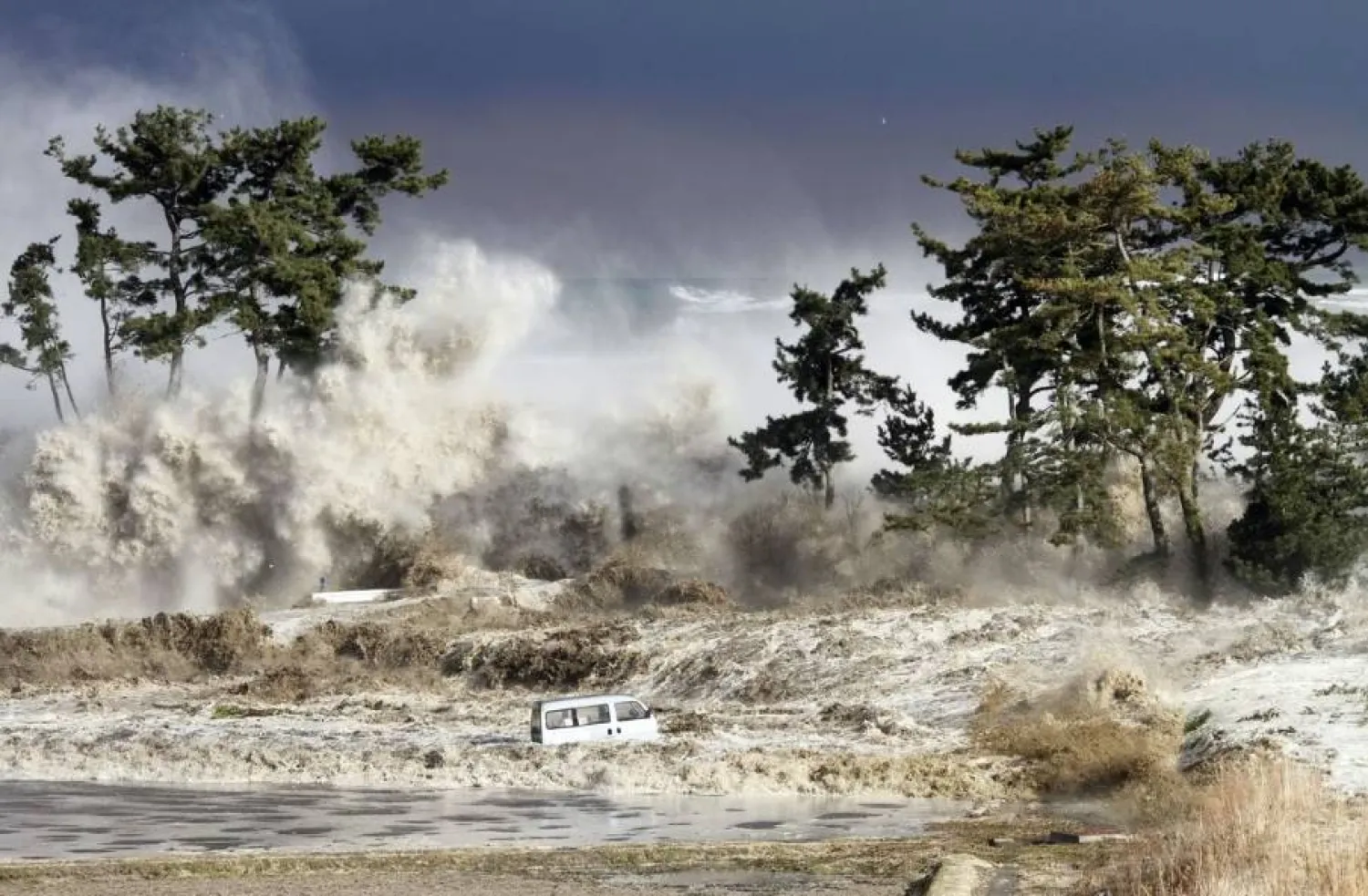
Tsunami waves hit the coast of Minamisoma in Fukushima Prefecture, photographed on March 11, 2011. (Sadatsugu Tomizawa / AFP / Getty Images)
TT

Some Facts About the Strongest Earthquakes Ever Recorded 

Tsunami waves hit the coast of Minamisoma in Fukushima Prefecture, photographed on March 11, 2011. (Sadatsugu Tomizawa / AFP / Getty Images)

One of the strongest earthquakes ever recorded struck Russia’s Far East early Wednesday, causing tsunami waves to wash ashore in Japan and Alaska and calls for people around the Pacific to be on alert or move to higher ground.

The 8.8 magnitude temblor set off warnings in Hawaii, North and Central America and Pacific islands south toward New Zealand, with officials warning that the potential tsunami danger may last for more than a day.

Here's a glance at some of the most powerful earthquakes recorded previously, according to the US Geological Survey.

1. Biobío, Chile

A 9.5 magnitude earthquake struck in a central region of Chile in 1960. Known as the Valdivia earthquake or Great Chilean earthquake, the largest ever recorded temblor resulted in more than 1,600 deaths in the country and beyond, most of which were caused by resulting large tsunami. Thousands of people were injured.

2. Alaska In 1964,

A 9.2 magnitude earthquake jolted Alaska’s Prince William Sound, lasting for almost 5 minutes. More than 130 people were killed in the largest recorded earthquake in the US and subsequent tsunami. There were huge landslides and towering waves that caused severe flooding. The event was followed by thousands of aftershocks for weeks after the initial quake.

3. Sumatra, Indonesia

A 9.1 magnitude earthquake and resulting tsunami devastated Southeast and South Asia and East Africa in 2004, killing 230,000 people. Indonesia alone recorded more than 167,000 deaths as entire communities were wiped out.

4. Tohoku, Japan

A magnitude 9.1 earthquake struck off the coast of northeastern Japan in 2011, triggering a towering tsunami that smashed into the Fukushima nuclear plant. It knocked out power and cooling systems and triggered meltdowns in three reactors. More than 18,000 people were killed in the quake and tsunami, some of whom have never been recovered.

5. Kamchatka, Russia

In 1952, a magnitude 9.0 quake caused significant damage but no reported deaths despite a tsunami that hit Hawaii with 9.1-meter (30-foot) waves.

6. Biobío, Chile

A massive 8.8 magnitude earthquake hit central Chile in 2010, shaking the capital for a minute and half and setting off a tsunami. More than 500 people were killed in the disaster.

7. Esmeraldas, Ecuador

In 1906, an 8.8 magnitude earthquake and resulting tsunami killed about 1,500 people. Its effects were felt for miles along the Central American coast and as far as San Francisco and Japan.

8. Alaska

In 1965, a magnitude 8.7 quake struck Alaska’s Rat Islands, causing an 11-meter (35-foot) -high tsunami. There was some relatively minor damage, including cracks in buildings and an asphalt runway.

9. Tibet

At least 780 people were killed when a magnitude 8.6 earthquake struck in 1950. Dozens of villages were destroyed, including at least one that slid into a river. There were also major landslides that jammed the Subansiri River in India. When the water eventually broke through, it resulted in a deadly 7-meter (23-foot) wave.

10. Sumatra, Indonesia

In 2012, a powerful 8.6 magnitude earthquake struck off the west coast of northern Sumatra in Indonesia. Though the quake caused little damage, it increased pressure on a fault that was the source of the devastating 2004 tsunami.


US, Israel Tactics Diverge on Iran as Trump's Goals Still 'Fuzzy'

Trump, emboldened by his January operation in Venezuela, has held out hope for working with a figure within the Iranian republic -- while Israel has openly declared it will kill any high-ranking Iranian official it sees. Jim WATSON / AFP
TT

US, Israel Tactics Diverge on Iran as Trump's Goals Still 'Fuzzy'

Trump, emboldened by his January operation in Venezuela, has held out hope for working with a figure within the Iranian republic -- while Israel has openly declared it will kill any high-ranking Iranian official it sees. Jim WATSON / AFP

US President Donald Trump and Israeli Prime Minister Benjamin Netanyahu both praise their relationship as excellent, but after three weeks of attacking Iran, their tactics are increasingly diverging -- the result, some experts say, of Trump's ill-defined goals.

Trump said Thursday that he told Netanyahu not to attack Iran's gas fields after an Israeli strike prompted Tehran to retaliate against a major energy hub in Qatar, sending global prices soaring further.

Earlier this month, the United States voiced unease after Israel bombed fuel depots around Tehran, smothering the city of 10 million people with toxic black smoke.

Trump, emboldened by his January operation in Venezuela, has held out hope for working with a figure within the Iranian republic -- while Israel has openly declared it will kill any high-ranking Iranian official it sees.

"The objectives that have been laid out by the president are different from the objectives that have been laid out by the Israelis," Tulsi Gabbard, Trump's director of national intelligence, acknowledged in a congressional hearing this week.

Netanyahu, after the public reproach on the gas fields attack, publicly hailed Trump at a news conference late Thursday, saying that no "two leaders have been as coordinated."

"He's the leader. I'm, you know, his ally," Netanyahu said.

- 'Fuzzy' Trump goal -

But Netanyahu has been far more clear than Trump on what he wants in Iran.

Netanyahu has long described Iran's cleric-run government as the top enemy and has vowed to topple or at least crush it.

"Israel wants some sort of regime change whereas the United States is fuzzy and unclear about what the end state is," said Brian Katulis, a senior fellow at the Middle East Institute in Washington.

Trump has spoken in glowing terms about tactical military successes but also faces mounting pressure at home unlike Netanyahu.

The war is unpopular with the US public, including parts of Trump's base, and has led to higher gas prices for consumers and turbulence on markets months ahead of congressional elections.

Trump also has a close relationship with Gulf Arab states, longtime allies that serve as bases for US troops and are softer targets for Iran than Israel.

Netanyahu, Israel's longest-serving leader, also faces elections this year, in which he is expected to highlight his support from Trump.

Katulis noted that Trump has not hesitated to pressure Israel before -- forcing a ceasefire in Gaza last year after Israel attacked Hamas leaders in Qatar, and angrily demanding that Israel hold fire on Iran last year after he announced a truce.

"It's not unimaginable that Trump sees the cost of this war getting too high and hindering his domestic agenda," Katulis said.

"I don't think Israel under Netanyahu is going to ignore Trump but that would require Trump actually articulating some sort of soft landing."

- New dynamic for Israel -

The conflict marks a watershed for Israel in fighting a war as part of an alliance. In the two wars against Iraq, the United States tried hard to keep Israel out, fearing its presence would alienate Arab allies.

Yossi Mekelberg, a Middle East expert at London-based think tank Chatham House, said that Israel and the United States started with an aim of regime change before encountering the heavy counter-attack by Iran.

"When things go wonderfully well, everyone is happy, you know -- they all praise each other," he said.

"If it starts going really wrong, and we know that Trump is not the sentimental type, then the blame starts flying," he said.

Robert Malley, who negotiated with Iran under former president Joe Biden, said that both Israel and Iran had clear goals, with Israel wanting to sow the Iranian government's collapse and Tehran seeking to survive and to externalize the costs of the war.

The unpredictable actor is Trump, who has said both that the war will be short or will intensify and sees world affairs in deeply personal terms, particularly on whether he can claim victory.

"He's offered a series of shifting goals, not just day by day but often hour by hour," said Malley, now a senior fellow at the Yale Jackson School of Global Affairs.

"In some ways, you need to be more of a psychologist than a policy analyst to be able to understand where we're going," he said.


Ghalibaf: Iran’s New Strongman Running War Effort

12 October 2024, Lebanon, Beirut: Iranian parliament Speaker Mohammad Bagher Ghalibaf speaks during a press conference in Beirut. (Hassan Ibrahim/Lebanese Parliament/dpa)
TT

Ghalibaf: Iran’s New Strongman Running War Effort

12 October 2024, Lebanon, Beirut: Iranian parliament Speaker Mohammad Bagher Ghalibaf speaks during a press conference in Beirut. (Hassan Ibrahim/Lebanese Parliament/dpa)

Mohammad Bagher Ghalibaf, Iran's parliament speaker and a veteran of the Revolutionary Guards, has emerged as the highest-profile political figure in the country after the killing of its leaders.

A pillar of the Iranian establishment for some three decades and one of the regime's most prominent non-clerical figures, Ghalibaf, 64, now appears to be playing a key role spearheading the war effort.

Whereas the son and successor of slain supreme leader Ali Khamenei, Mojtaba Khamenei, has not appeared in public and has issued just three written statements, Ghalibaf has been unleashing regular posts on X and giving multiple interviews.

"We are in an unequal war, with an asymmetrical set-up, we must do something and use equipment with our own culture, design and creativity," he told Iranian television on Wednesday.

In a post on X, he added that after attacks on Iranian energy infrastructure, "an eye-for-an-eye sum is in effect, and a new level of confrontation has begun".

However, possibly aware of the threat to his own security, he did not, unlike the late Larijani, appear in public at pro-government rallies last week in support of the Palestinian cause.

Larijani was killed in an Israeli air strike on Monday, which followed the killing of Khamenei at the start of the war on February 28.

Ghalibaf's varied experience, which spans military and civilian life, has seen him work as commander of the Revolutionary Guards aerospace corps, Tehran police chief, Tehran mayor and now speaker of parliament.

Known to be fiercely ambitious, he has stood for the Iranian presidency on multiple occasions but has never been successful, most notably in 2005 when the ultra-conservative Mahmoud Ahmadinejad, little-known at the time, took the presidency.

A qualified pilot, Ghalibaf is known for boasting that he is able to captain jumbo jets.

Farzan Sabet, a managing researcher at the Geneva Graduate Institute, said that after Larijani's killing Ghalibaf was the "person likely overseeing the war effort and strategy".

"He's the speaker of parliament, a former senior IRGC commander and has strong cross-factional and institutional ties, positioning him well to move into this role," he told AFP.

- 'Very favorable position' -

Ghalibaf fought in the 1980-1988 Iran-Iraq War and rose rapidly through the ranks. He reached the upper echelons of the military establishment in the late 1990s when he became commander of the Guards' fledgling aerospace forces.

He was then named national police commander in 1999, against the backdrop of unprecedented student protests.

He has long coveted the presidency, running in 2005, 2013 and 2024, and briefly entering the 2017 race before withdrawing in favor of another conservative candidate. His strongest showing came in 2013, when he finished second.

After the 2005 presidential election loss, he was elected mayor of Tehran.

During his 12 years as mayor, supporters praised his technocratic approach and focus on urban management, while critics pointed to allegations of financial corruption.

Human rights groups have accused Ghalibaf, in his various functions, of playing a key role in suppressing protests, from the 1999 student demonstrations through to the 2009 Green movement that erupted after a disputed election right up to the nationwide protests that peaked in January 2026.

Ghalibaf was elected speaker of parliament in 2020, at times advocating economic reforms and stronger parliamentary oversight while remaining aligned with the Islamic republic's core institutions.

"Iran's strongest man is now probably Ghalibaf," said Arash Azizi, lecturer at Yale University, describing him as "a rare figure whose portfolio crosses between military, security and political functions of the regime".

"He is known to be running the war effort now," Azizi said, adding that Ghalibaf appeared to be an ally of Mojtaba Khamenei.

"He seems to be in a very favorable position now."

Ghalibaf has predicted the war would reshape the Middle East, but not on Washington's terms.

"The order here will change, but it will not be an order in which the will of the United States prevails," he said in a recorded video interview carried by Tasnim news agency and other media.


As Israel Expands Strikes on Beirut, Delivery Drivers Steer Clear of Danger

 People who work as delivery drivers for the Toters delivery app stand outside a delivery center in Beirut, Lebanon, March 18, 2026. (Reuters)
People who work as delivery drivers for the Toters delivery app stand outside a delivery center in Beirut, Lebanon, March 18, 2026. (Reuters)
TT

As Israel Expands Strikes on Beirut, Delivery Drivers Steer Clear of Danger

 People who work as delivery drivers for the Toters delivery app stand outside a delivery center in Beirut, Lebanon, March 18, 2026. (Reuters)
People who work as delivery drivers for the Toters delivery app stand outside a delivery center in Beirut, Lebanon, March 18, 2026. (Reuters)

Lebanese food courier Hamza Hareb now keeps his distance if he spots a car with tinted windows while on a delivery run in Beirut. Hezbollah is rumored to use such cars, and Hareb wants to steer clear of any Israeli strikes targeting the armed group.

Israel has expanded its air campaign to new parts of Beirut in recent days, hitting apartments and downing entire buildings in strikes it says are targeting Hezbollah, which pulled Lebanon into the regional war on March 2 by firing into Israeli territory.

On Wednesday, Israel struck different neighborhoods in the heart of Beirut, leaving mounds of rubble hundreds of meters away from government buildings, restaurants and roads usually clogged with traffic.

As residents of the capital stay home in fear, they are ordering delivery for dinner - and drivers like Hareb are navigating a maze ‌of risks to ‌make it happen.

"Of course, we are afraid. That is ever-present," said Hareb, one ‌of ⁠3,000 couriers in ⁠Beirut who work for Toters, among Lebanon's most popular delivery apps.

Like most gig workers, Toters drivers are paid per delivery. For many, the job is an economic lifeline in the heavily indebted country, which is suffering from years of economic crisis and political instability following a financial collapse in 2019.

"You don't know when the strikes will come, so we have adapted to everything," Hareb said.

'NAVIGATING INTO UNCERTAINTY'

Israel sometimes issues evacuation warnings before striking, telling residents to leave the area. But three of Wednesday's four strikes on Beirut came without notice.

"Right now they're increasingly ⁠striking without warning, and of course this is instilling a sense of ‌fear among us (since) we spend most of our time out ‌in the street," Hareb told Reuters.

If Beirut is rocked by an unexpected strike, drivers pull over to figure out which ‌neighborhood was targeted and how to amend their routes if needed. If an evacuation warning is issued, ‌drivers pass it on through work channels so colleagues can avoid targeted areas.

Toters' director of operations Roland Ghanem said the company did not deliver to neighborhoods that fall within Israel's evacuation orders and has barred drivers from using risky roads near possible targets.

"These drivers navigate into uncertainty... just to make sure that others can still have access to food ‌and basic needs," Ghanem said. "They understand that behind every order, there is a family that has been displaced, or an elderly person that cannot go to ⁠the store and get ⁠some food, or just a regular person trying to get through the day."

WORKING IN A WAR

Israeli strikes have killed nearly 1,000 people and displaced another million across Lebanon, according to Lebanese authorities.

For some drivers, the war has hit close to home - literally. Mahmoud al-Benne, 34, had to flee his home in Beirut's southern suburbs earlier this month when Israel issued a blanket evacuation order for the entire area and began bombing it heavily.

But he still needs to work.

"Whether you are displaced or not displaced, you need to earn money," Benne said. "You have responsibilities. We are in a state of war, but at the end of the day we want to work."

Marie Katanjian stands out among her colleagues as a rare female delivery driver. Her husband delivers for Toters and she was inspired to do the same.

"We have to work in this situation because we have families. We're helping each other out, hand in hand," she said.

Still, she's yearning to drive safely through her city's streets again.

“We want the war to end, so we can take a breath.”
