
In late July, the spiritual leadership of Syria’s Druze minority in Sweida announced the creation of legal and security committees to run the southern province, a dramatic step that underscored its deepening rift with Damascus and the fragile hold of the country’s new rulers.
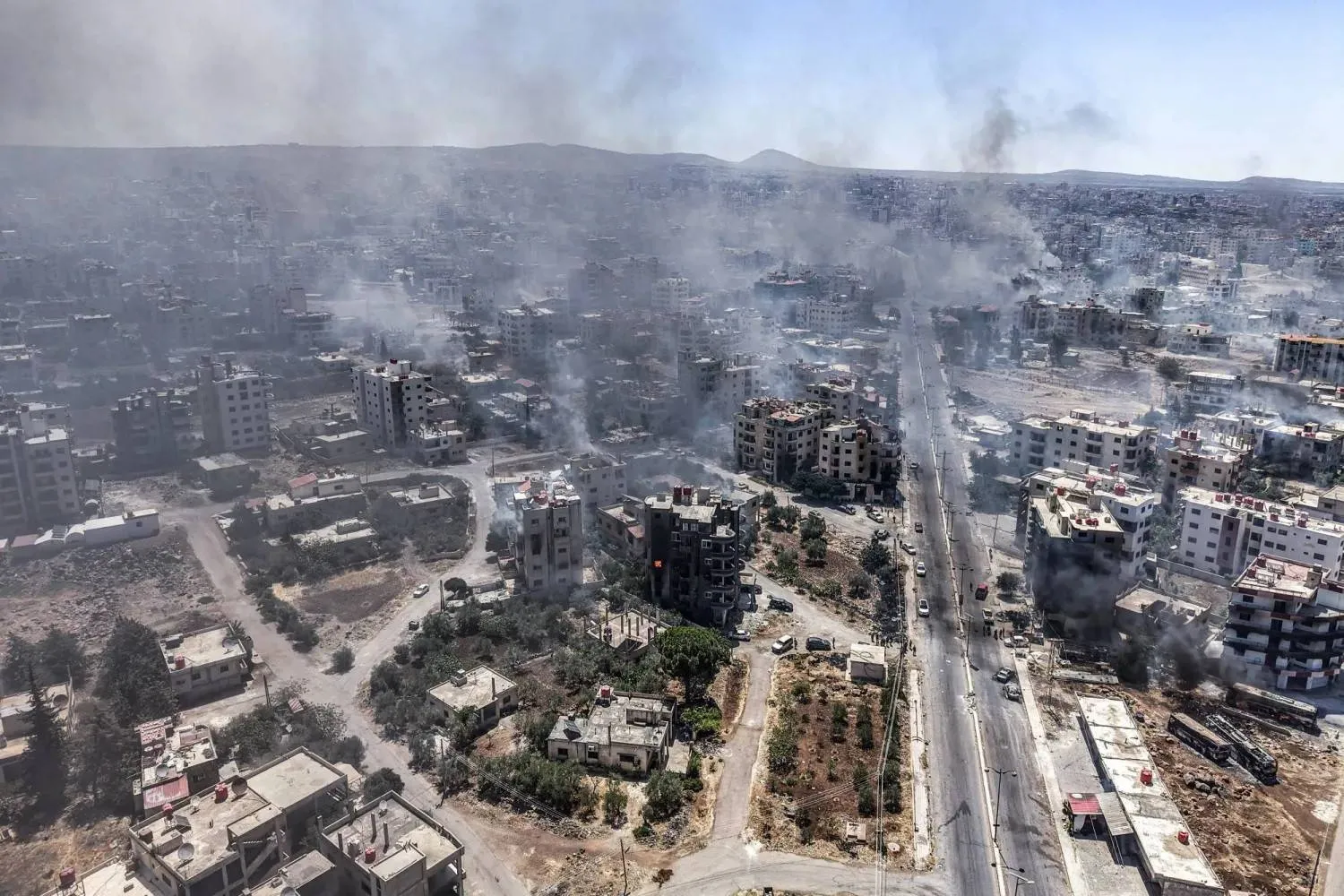
The move came after days of deadly clashes in mid-July, marking a turning point for a province that for more than a decade had remained on the margins of Syria’s war. It has now emerged at the center of a struggle that will test President Ahmed al-Sharaa’s efforts to unify the country after the fall of Bashar al-Assad.
Damascus said its security forces had intervened only to end fighting between Druze and Bedouin tribes. Druze leaders accused the state of trying to reassert control through tribal allies – a claim they said was backed by documents in their possession.
The clashes left dozens dead and brought government troops into Sweida city. But their presence was short-lived: after Israeli airstrikes struck what appeared to be Syrian army positions on the outskirts, Damascus ordered its forces to withdraw. The pullback created a vacuum Druze leaders say they were forced to fill.
Sweida, home to Syria’s majority-Druze community, has long been distinct in the country’s sectarian mosaic. The Druze, who number fewer than 1 million across Syria, Lebanon and Israel, have historically pursued autonomy and avoided entanglement in wider conflicts.
During Syria’s 13-year war, Sweida largely stayed out of direct combat. Local communities resisted conscription into Assad’s army, and the province preserved a degree of autonomy with its own armed groups maintaining order.
That balance fractured last month. Violence between Druze gunmen and Bedouin tribes spiraled, with Damascus portraying its forces as neutral peacekeepers, and Druze leaders insisting the state had tried to impose its authority by force.
The government’s retreat after Israeli airstrikes reinforced local perceptions that the province was left exposed. For Druze leaders, the episode highlighted the need to build their own administrative structures.
Druze Leadership Realigned
The crisis reshaped internal dynamics within the Druze clergy. For years, the leadership was split: Sheikh Hikmat al-Hijri opposed Damascus, while Hammoud al-Hanawi and Youssef Jarboua maintained channels with the state.
In July, that divide closed. Both Hanawi and Jarboua issued statements condemning the government’s conduct and urging international investigations. Hijri followed with a video demanding accountability, calling for an international probe and accusing the state of backing armed factions against Sweida. He went further by publicly thanking Israel for its support.
The alignment of all three authorities marked an unprecedented rupture between Sweida’s Druze and Damascus, turning a once-divided leadership into a united front.
Committees Fill the Vacuum
The withdrawal of state institutions and forces left Sweida’s leadership to create its own mechanisms.
Safaa Joudieh, spokeswoman for the newly formed legal committee, said the bodies were established in response to what she described as the “systematic destruction of infrastructure, power and water cuts, and a blockade of food and medicine.”
“These committees are tasked with running services and easing people’s suffering,” she said. “They are temporary, civil and humanitarian. They carry no political project at this stage.”
But she made clear that ties with Damascus were severed. “Sweida’s people have endured massacres, arson and a suffocating siege,” she said. “Any talks with the government must begin with compensation and lifting the blockade.”
She added that the initiative had broad local support and that Sweida was open to cooperation with other Syrian entities, including the Kurdish-led administration in the northeast, though alliances of a military or political nature were beyond the committee’s mandate.
Independence Calls
Beyond administrative measures, demands from the street went further. On July 16, thousands gathered in Sweida’s al-Karama Square, with protesters calling for independence from Syria – an unprecedented development.
Some waved Druze flags alongside Israeli ones, images that stirred sharp criticism not only from government supporters but also from opposition figures, who said rejecting Damascus did not justify abandoning the country.
Damascus reacted firmly. In a televised speech, President Sharaa ruled out partition. “Syrians categorically reject any project of division,” he said. “Those who call for it are ignorant dreamers. We brought down Assad’s regime in the battle to liberate Syria. Ahead of us now is the battle to unify it.”
He dismissed secessionist calls as unrealistic, saying no party in Syria possessed the means to impose partition and accusing foreign states of exploiting local grievances.
Damascus Treads Carefully
Despite the escalation, Damascus has avoided an all-out confrontation with Sweida. The government has emphasized unity while taking a measured approach on the ground, apparently seeking to contain rather than inflame the situation.
Mustafa al-Naimeh, a Syrian researcher, said the developments in Sweida amounted to “an attempt to control part of the province outside the authority of the state through armed groups supported by foreign agendas.”
He warned that such moves risked “deepening internal divisions and spreading instability beyond Sweida to areas under the influence of US and Kurdish forces.”
Al-Naimeh added that international conditions were not favorable to secessionist experiments. “Global powers today are focused on sustainable development,” he said, describing projects aimed at fragmentation as “regionally funded and internationally rejected.”
He also argued that Israel was “trying to export its internal crisis by fueling tension in Syria,” and that the rise of armed groups in Sweida had worsened humanitarian conditions by keeping the province outside state authority.
Al-Naimeh said Damascus was pursuing “gradual containment” to defuse the crisis, dismantle armed groups and reintegrate Sweida through political and security channels. He noted that the process would be long but described it as “the most effective path to reduce the cost of bloodshed.”