
Türkiye Wary of Israeli Threat Following Airstrike on Hamas in Qatar

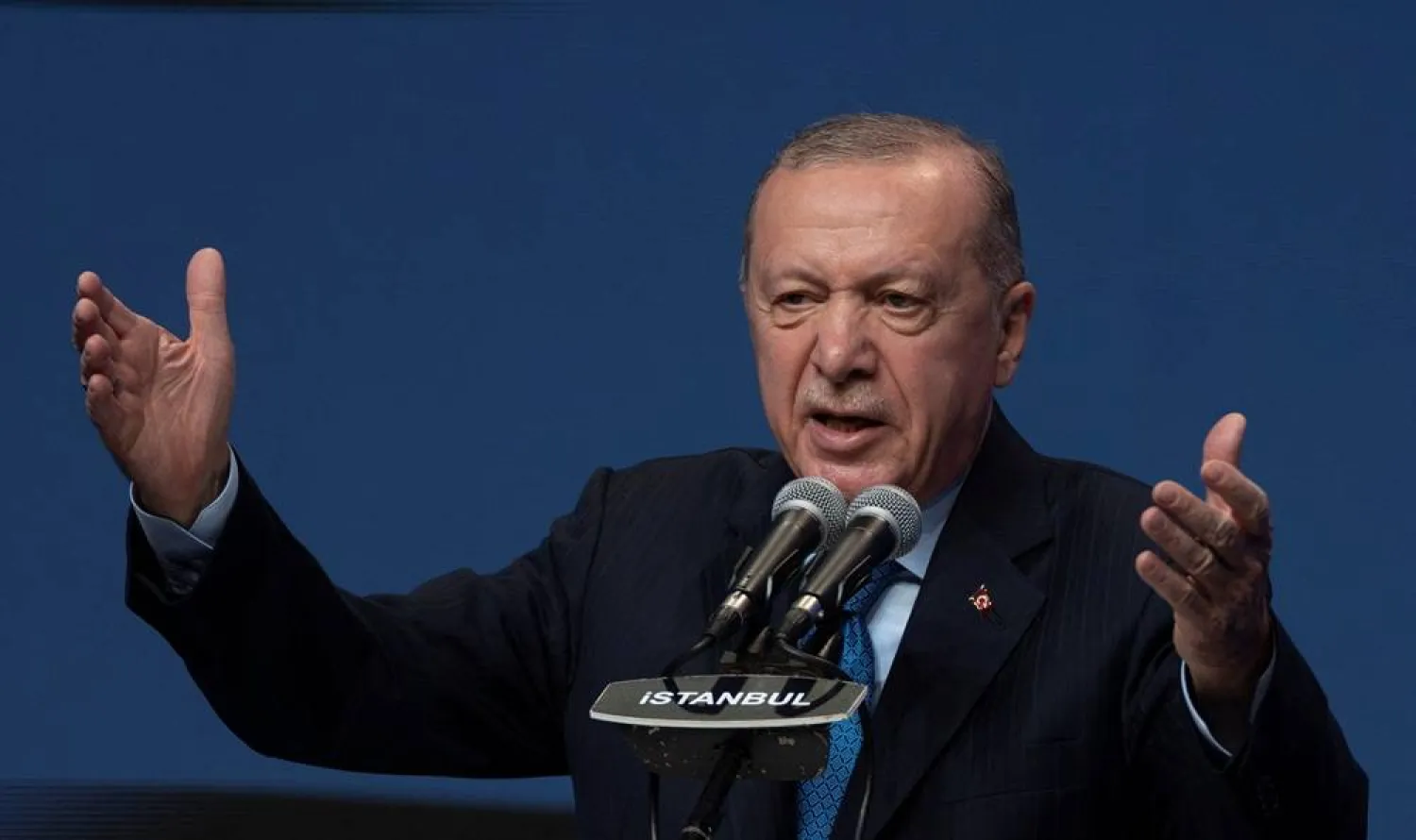
Turkish President Recep Tayyip Erdogan addresses his supporters during a meeting in Istanbul, Türkiye, September 13, 2025. (Reuters)
TT

Türkiye Wary of Israeli Threat Following Airstrike on Hamas in Qatar

Turkish President Recep Tayyip Erdogan addresses his supporters during a meeting in Istanbul, Türkiye, September 13, 2025. (Reuters)

An Israeli strike on a meeting of Hamas officials in Qatar has cast a cloud of growing concern across Türkiye that it could be the next target.

Turkish Defense Ministry spokesman Rear Adm. Zeki Akturk warned in Ankara on Thursday that Israel would “further expand its reckless attacks, as it did in Qatar, and drag the entire region, including its own country, into disaster.”

Israel and Türkiye were once strong regional partners, but ties between the countries ran into difficulties from the late 2000s and have reached an all-time low over the war in Gaza sparked by the Oct. 7, 2023, Hamas-led attack in southern Israel. Tensions also have risen as the two countries have competed for influence in neighboring Syria since the fall of Bashar al-Assad’s government last year.

Turkish President Recep Tayyip Erdogan has been a long-standing supporter of the Palestinian cause and of the Palestinian group Hamas. The Turkish president has criticized Israel, and particularly Prime Minister Benjamin Netanyahu, with strident rhetoric since the start of the Gaza war, accusing Israel of genocide and likening Netanyahu to Nazi leader Adolf Hitler.

Hamas officials regularly visit Türkiye and some have taken up residence there. Israel previously accused Türkiye of allowing Hamas to plan attacks from its territory, as well as carrying out recruitment and fundraising.

After Israel’s attacks on the territory of Iran, Syria, Yemen and now Qatar, Ankara is bound to be concerned by Israel’s ability to freely use the airspace of neighboring states.

“Israel’s ability to conduct strikes with seeming impunity, often bypassing regional air defenses and international norms, sets a precedent that deeply worries Ankara,” said Serhat Suha Cubukcuoglu, director of Trends Research and Advisory’s Türkiye program.

Türkiye sees these attacks as a “broader Israeli strategy to establish a fragmented buffer zone of weak or pacified states around it,” he added.

Türkiye has superior military might In crossing a previously unthinkable line by attacking Qatar, a close American ally that has been serving as a mediator in Gaza ceasefire talks, Israel also has raised the question of how far it will go in pursuing Hamas targets.

Through its NATO membership, Türkiye would seem to have a greater degree of protection against Israeli attack.

Türkiye also boasts significantly greater military might, with its armed forces second in size only to the US among NATO countries and an advanced defense industry.

As tensions rise, Türkiye has boosted its defenses. During Israel’s attacks on Iran’s nuclear facilities in June, Erdogan announced an increase in missile production. Last month he formally inaugurated Türkiye’s “Steel Dome” integrated air defense system, while projects such as the KAAN fifth-generation fighter have been fast-tracked.

Ozgur Unluhisarcikli, director of the German Marshall Fund in Ankara, said an Israeli airstrike on the territory of a NATO member would be “extremely unlikely,” but small-scale bomb or gun attacks on potential Hamas targets in Türkiye by Israeli agents could be a distinct possibility.

Cubukcuoglu, meanwhile, said the Qatar attack could harden Ankara’s support for Hamas.

“This resonates with Turkish anxieties that Israel may eventually extend such operations to Turkish territory,” he said. “The Turkish government calculates that abandoning Hamas now would weaken its regional influence, while standing firm bolsters its role as a defender of Palestinian causes against Israeli aggression.”

Tensions could play out in Syria While attention is focused on tensions surrounding the war in Gaza and Türkiye’s relations with Hamas, Unluhisarcikli warned the greater danger may be in Syria, where he described Israel and Türkiye as being “on a collision course.”

“To think that targeting Turkish troops or Turkish allies or proxies in Syria would be to go too far is wishful thinking,” he said.

Since Syrian opposition factions unseated Assad in December, rising tensions between Türkiye and Israel have played out there. Ankara has supported the new interim government and sought to expand its influence, including in the military sphere.

Israel views the new government with suspicion. It has seized a UN-patrolled buffer zone in southern Syria, launched hundreds of airstrikes on Syrian military facilities and positioned itself as the protector of the Druze religious minority against the authorities in Damascus.

Tensions also could spill into the wider eastern Mediterranean, with Israel potentially drawing closer to Greece and Greek Cypriots to challenge Türkiye’s military presence in northern Cyprus.

Türkiye mixes deterrence and diplomacy Türkiye appears to be pursuing a mixture of military deterrence and diplomacy in Syria aimed at defusing tensions to avoid a direct conflict with Israel.

Turkish and Israeli officials held talks in April to establish a “de-escalation mechanism” in Syria. The move followed Israeli strikes on a Syrian airbase that Türkiye had been purportedly planning to use. Netanyahu said at the time that Turkish bases in Syria would be a “danger to Israel.”

Ankara and Damascus last month signed an agreement on Türkiye providing military training and advice to Syria’s armed forces.

Erdogan also may hope Washington would take a hard line against any Israeli military incursions.

While Netanyahu has sought support from US President Donald Trump in the faceoff with Türkiye, Trump instead lavished praise on Erdogan for “taking over Syria” and urged Netanyahu to be “reasonable” in his dealings with Turkey.

But as the strike in Qatar showed, having strong relations with Washington is not necessarily a safeguard against Israel.

The Qatar attack showed there was “no limit to what the Israeli government can do,” Unluhisarcikli said.

Exiled Syrian Opens up About Death-Defying Smuggling Operation That Showed Proof of Assad’s Cruelty

A Syrian man inspects cells at the prison of Sednaya, north of Damascus, Syria, Dec. 16, 2024. (AFP)
TT

Exiled Syrian Opens up About Death-Defying Smuggling Operation That Showed Proof of Assad’s Cruelty

A Syrian man inspects cells at the prison of Sednaya, north of Damascus, Syria, Dec. 16, 2024. (AFP)

He waited for his brother-in-law to cross the front line smuggling documents stolen from the Syrian dictatorship’s archives. Detection could mean dismemberment or death, but they were committed to exposing the industrial-scale violence used to keep President Bashar al-Assad in power.

Ussama Uthman, now 59, was building a vast record of the brutality — photographs that showed Assad’s government was engaging in systematic torture and extrajudicial killings.

Now, safely in exile in France and with Assad having fallen in a surprise opposition offensive last year, Uthman is sharing how he, his wife and her brother teamed up to smuggle evidence of the horrific crimes out from under Syria’s infamous surveillance apparatus as war tore the country apart.

The photos of broken bodies and torture sites — records were apparently kept to show orders were being followed — began appearing online in 2014. They spurred US sanctions, and are being used to prosecute suspected war crimes and help Syrians find out what happened to family members who disappeared.

“We have hundreds of thousands of mothers waiting for news of their loved ones,” said Uthman.

During a recent interview in northern France — The Associated Press agreed to withhold the exact location for security reasons — the only time Uthman's voice broke was when he recounted sending a woman photos of a brutalized body and asking if she recognized her son.

“I send her five snapshots of her son’s body, torn under Bashar al-Assad’s whips, and she rejoices. She says, ‘Thank God, I have confirmed that he is dead,’” he recalled. “This sadness should have kept our flags at half-staff in Syria for years.”

Family secrets, risks and duty

With the so-called “Arab Spring” uprisings in the Middle East in 2011, protests in the southern city of Daraa inspired demonstrations throughout Syria. The government responded with force, but rather than crushing the demonstrations, the brutality sparked a civil war that spurred foreign intervention and pitted a patchwork of opposition groups against the armor and air power of the military and Assad’s allies.

When news broke that first year of a massacre in Hama, Uthman, a construction engineer from the Damascus suburb of al-Tall, swore he'd help topple Assad. He didn’t know how until he got a call from his wife’s brother Farid al-Mazhan, a military police officer who asked him to meet in person — electronic communications were too risky.

Al-Mazhan showed Uthman gory images taken by photographers in the military forensic pathology department that he helped run. He said he could access more.

The two launched a secret operation that would eventually smuggle more than 53,000 photographs out of Syria showing evidence of torture, disease and starvation in the country's lockups.

The operation was incredibly dangerous but straightforward.

As an officer, Al-Mazhan could pass government-run checkpoints; his connections in the opposition-held town where he lived and eventually Uthman’s secret coordination with the opposition enabled him to cross checkpoints staffed by their fighters.

He would then secretly pass CDs, hard drives and USB sticks containing photos and other documents to Uthman. He also slipped them to his sister, Khawla al-Mazhan, who is married to Uthman. She was the first to suggest using the photos to try to topple Assad.

“Why don’t we use these images to bring down the regime?” Uthman recalled her saying.

Uthman adopted the nom de guerre Sami. Farid al-Mazhan took Caesar. Their operation would become known as the Caesar Files.

Justice for Syria, from exile

Deciding to escape Syria — an estimated 6 million people fled during the war — the team uploaded 55 gigabytes of photos and documents dating from May 2011 to August 2014 to a foreign server. They then began furtively moving their extended families to neighboring countries. Diplomats eventually helped Uthman’s family settle in France in 2014.

Once safely out of Syria, they began publishing the material, sparking immediate and widespread condemnation of Assad.

As families scoured the ghastly archive for signs of what happened to their loved ones, the team gave copies to European prosecutors. Authorities in France, Germany, Belgium, the Netherlands and Switzerland have arrested or initiated legal proceedings against former Syrian officials accused of torture and killings.

The release of the files marked “a key point in Syria’s history,” said Kholoud Helmi, co-founder of the independent Syrian news site Enab Baladi. Both the international community and Syrians were faced with “striking proof” of the Assad government’s crimes.

“Almost nobody believed us or thought we were exaggerating,” said Helmi, who fled during the war.

The Caesar Files team are heroes, said Lina Chawaf, editor-in-chief of Radio Rozana, an independent Syrian media outlet.

“You know the price that you will pay, but it will cost all of your family,” said Chawaf, who also fled Syria.

Hoping to plug the leak, Syrian authorities tightened their grip on their archive. Gradually, the team reorganized and grew to roughly 60 members both inside and outside of Syria. They built a second tranche of evidence, the Atlas Files, from 2014 until 2024.

Late last year, as they were starting to organize this new catalog — it's nearly three times the size of the first — startling news broke: The opposition had seized Syria’s second-biggest city, Aleppo.

Accountability under a new regime

Within 10 days, opposition forces sprinted across government-held territory to take Damascus, forcing Assad to flee to Russia and ending his family's nearly 54-year rule.

The sudden power vacuum bred chaos, with opposition forces flinging open the doors of the country's most feared prisons.

Team members still in Syria and families of the missing rushed to the sites in search of information — more than 130,000 Syrians disappeared during the war, according to international bodies.

Helmi, of the Enab Baladi news site, considers her family lucky to have found proof of her brother Ahmad's execution.

“They killed him 27 days after he was detained, and we’ve been waiting for him for 13 years,” said Helmi, who thinks the new government of President Ahmed al-Sharaa, a former opposition leader, hasn't done enough to help families.

Uthman went further, saying so much evidence was lost in the immediate aftermath of Assad's ouster that it was akin to the new authorities “destroying evidence, tampering with the crime scene.”

Documents lay scattered on rainy streets, psychologically shattered prisoners wandered out of broken jails, and wild dogs chewed on bones in mass graves, he said.

The government — which hopes the US will permanently lift the sanctions imposed for the abuses exposed by the Caesar Files — says it is doing all it can to reckon with Assad’s bloody legacy. During Sharaa’s visit to Washington on Monday, the Treasury announced a waiver of the sanctions had been renewed for another six months.

In a news conference last week in Damascus, Reda al-Jalakhi, who heads the government's National Commission for the Missing, acknowledged that “in the first two days of the liberation, there was some chaos and a lot of documents were lost.”

But he said the authorities quickly took control of Assad's old lockups and is preserving the remaining evidence. He thanked the Caesar Files team for providing some documentation to the commission, but he didn't signal any plans for ongoing cooperation, saying the government would build a centralized database to find the missing.

With a defiant twinkle in his eyes, Uthman said his team's work will continue to fight any impunity in Syria as fresh sectarian violence bloodies the country. The team dreams that one day Assad might face their evidence at trial.


What’s at Stake in Iraq’s Parliamentary Election 

A person votes at a polling station during the parliamentary election in Kirkuk, Iraq, November 11, 2025. (Reuters)
TT

What’s at Stake in Iraq’s Parliamentary Election 

A person votes at a polling station during the parliamentary election in Kirkuk, Iraq, November 11, 2025. (Reuters)

Iraqis were voting on Tuesday in a parliamentary election that comes at a crucial moment for the country and the region. The outcome of the vote will influence whether Prime Minister Mohammed Shia al-Sudani can serve a second term.

The election comes against the backdrop of fears over another war between Israel and Iran and potential Israeli or US strikes on Iran-backed groups in Iraq. Baghdad seeks to maintain a delicate balance in its relations with Tehran and Washington amid increasing pressure from the Trump administration over the presence of Iran-linked armed groups.

Here's a look at what to expect in the vote.

Iraq's electoral system

This year's election is the seventh since the US-led invasion of 2003 that unseated the country's longtime ruler, Saddam Hussein.

In the security vacuum after Saddam's fall, the country fell into years of bloody civil war that saw the rise of extremist groups, including the ISIS group. But in recent years, the violence has subsided. Rather than security, the main concern of many Iraqis now is the lack of job opportunities and lagging public services, including regular power cuts despite the country's energy wealth.

Under the law, 25% of the country's 329 parliamentary seats must go to women, and nine seats are allocated for religious minorities. The position of speaker of Parliament is also assigned to a Sunni according to convention in Iraq’s post-2003 power-sharing system, while the prime minister is always Shiite and the president a Kurd.

Voter turnout has steadily fallen in recent elections. In the last parliamentary election in 2021, turnout was 41%, a record low in the post-Saddam era, down from 44% in the 2018 election, which at the time was an all-time low.

However, only 21.4 million out of a total of 32 million eligible voters have updated their information and obtained voter cards, a decrease from the last parliamentary election in 2021, when about 24 million voters registered.

Unlike past elections, there are no polling stations outside of the country. Early voting was held on Sunday for members of the security forces and displaced people living in camps.

The main players

There are 7,744 candidates competing, most of them from a range of largely sectarian-aligned parties, in addition to some independents.

They include Shiite blocs led by former Prime Minister Nouri al-Maliki, cleric Ammar al-Hakim, and several linked to armed groups; competing Sunni factions led by former Parliament Speaker Mohammed al-Halbousi and current speaker Mahmoud al-Mashhadani; and also the two main Kurdish parties, the Kurdistan Democratic Party and the Patriotic Union of Kurdistan.

Several powerful, Iran-linked Shiite militias are participating in the election via associated political parties. They include the Kataib Hezbollah militia, with its Harakat Huqouq bloc, and the Sadiqoun Bloc, led by the leader of the Asaib Ahl al-Haq militia, Qais al-Khazali.

However, one of the most prominent players in the country's politics is sitting the election out.

The popular Sadrist Movement, led by influential Shiite cleric Moqtada al-Sadr, is boycotting the vote. Al-Sadr’s bloc won the largest number of seats in the 2021 election but later withdrew after failed negotiations over forming a government, amid a standoff with rival Shiite parties. He has since boycotted the political system.

The Sadrist stronghold of Sadr City on the outskirts of Baghdad is home to roughly 40% of Baghdad's population and has long played a decisive role in shaping the balance of power among Shiite factions.

But in the run-up to this election, the usually vibrant streets were almost entirely devoid of campaign posters or banners. Instead, a few signs calling for an election boycott could be seen.

Meanwhile, some reformist groups emerging from mass anti-government protests that began in October 2019 are participating but have been bogged down by internal divisions and lack of funding and political support.

Concerns about the process

There have been widespread allegations of corruption and vote-buying ahead of the election, and 848 candidates were disqualified by election officials, sometimes for obscure reasons such as allegedly insulting religious rituals or members of the armed forces.

Past elections in Iraq were often marred by political violence, including assassinations of candidates, attacks on polling stations and clashes between supporters of different blocs.

While overall levels of violence have subsided, a candidate was also assassinated in the run-up to this year's election.

On Oct. 15, Baghdad Provincial Council member Safaa al-Mashhadani, a Sunni candidate in the al-Tarmiya district north of the capital, was killed by a car bomb. Five suspects have been arrested in connection with the killing, which is being prosecuted as a terrorist act.

Al-Sudani seeks another term

Al-Sudani came to power in 2022 with the backing of a group of pro-Iran parties but has since sought to balance Iraq’s relations with Tehran and Washington. He has positioned himself as a pragmatist focused on improving public services.

While Iraq has seen relative stability during al-Sudani's first term, he does not have an easy path to a second one. Only one Iraqi prime minister, Maliki, has served more than one term since 2003.

The election outcome will not necessarily indicate whether or not al-Sudani stays. In several past elections in Iraq, the bloc winning the most seats has not been able to impose its preferred candidate.

On one side, al-Sudani faces disagreements with some leaders in the pro-Iran Shiite Coordination Framework bloc that brought him to power over control of state institutions. On the other side, he faces increasing pressure from the US to control the country's militias.

A matter of particular contention has been the fate of the Popular Mobilization Forces, a coalition of militias that formed to fight the ISIS group. It was formally placed under the control of the Iraqi military in 2016 but in practice still operates with significant autonomy. Members of the PMF will be voting alongside Iraqi army soldiers and other security forces on Saturday.


El-Mahboub Abdul Salam to Asharq Al-Awsat: Al-Turabi Tasted the Betrayal of his Disciples, Foremost Among them Omar al-Bashir

 
Al-Bashir and al-Turabi (right) after the coup (AP)
TT

El-Mahboub Abdul Salam to Asharq Al-Awsat: Al-Turabi Tasted the Betrayal of his Disciples, Foremost Among them Omar al-Bashir

 
Al-Bashir and al-Turabi (right) after the coup (AP)

Dr. Hassan Abdullah al-Turabi once tasted a bitter truth: that a man’s own disciples may one day betray him. It is almost a law of political life that students eventually turn on their teachers.

Al-Turabi had chosen the young army officer Omar Hassan al-Bashir to lead Sudan, perhaps imagining that he could remain behind the curtain as the guiding hand, a spiritual mentor presiding over the state, as Ayatollah Khomeini had done in Iran. But generals have their own instincts. Power is a feast that tolerates no partners. Soon enough, al-Bashir rebelled, and the master who had raised him was cast aside.

In 2017, a year after al-Turabi’s death, I interviewed Omar al-Bashir on that complicated relationship. When asked who had been the hardest person to deal with in his political life, he immediately named al-Turabi. He described him as a man of “immense charisma,” one who had long dominated the Islamic Movement and triumphed in every internal battle, until his clash with al-Bashir himself, when, for the first time, he lost.

Al-Bashir’s rule was marked by constant shifts and contradictions, none more telling than his oscillating relationship with Iran. In 1992, Sudan was under suffocating sanctions, short of weapons and ammunition, and isolated after Iraq’s decline.

Desperate for aid, Finance Minister Abdul-Rahim Hamdi traveled to Tehran to request assistance. The Iranians, however, demanded that Sudan first repay the debts left by the Jaafar Nimeiri regime. They explained that their priority was to help the newly independent Shiite communities emerging from the collapse of the Soviet Union, and offered instead to send books and sports equipment. Khartoum’s delegation was stunned. When Hamdi recounted the story to al-Turabi, the latter laughed bitterly and said: “Haven’t you read The Book of Misers? Most of it is about the Persians.”

Iran’s stance changed years later. After 2003, it supported the Sudanese army in the war in Darfur, established husayniyyas (Shiite centers), converted a small number of Sudanese to Shiism, and sent hundreds of youths for training in Syria. Iranian engineers helped build military industries south of Khartoum, and weapons were smuggled through Port Sudan to Gaza for Hamas, via Egyptian tunnels. Israeli warplanes would later strike those factories, exposing the secret routes.

I once asked al-Bashir whether he could ever enjoy life as a “former president.” He smiled and said: “Not only would it be easy - it would be a pleasure. People will still call you ‘Your Excellency’ in the street, but you’ll have no responsibilities.” Experience teaches journalists not to take such remarks at face value; similar words are spoken by leaders who never truly imagine leaving office.

Al-Turabi himself seldom condemned other rulers. He counted Muammar Gaddafi among his friends, saying their meetings were always frank and candid. He also believed that Saddam Hussein had undergone a transformation after the first Gulf War, symbolized by adding the phrase Allahu Akbar to Iraq’s flag. Such reflections revealed a man who, despite his ideological fervor, viewed other strongmen as peers in power and survival.

Among those who knew both al-Turabi and al-Bashir closely was Dr. Al-Mahboub Abdul Salam, a Sudanese politician and thinker who lived through the rise and unraveling of their shared project. In his view, the Sudan of today - torn apart by war and bleeding from within - is the direct legacy of that turbulent era.

Abdul Salam said that many Sudanese now live with the haunting fear of becoming people without a homeland. “This is not just a feeling,” he observed. “It’s a psychological reality. Some Sudanese have already begun to rebuild their lives elsewhere. The war has touched everyone - it has destroyed homes, livelihoods, memories, and the very sense of belonging. No one has been spared.”

He noted that the blame for Sudan’s collapse lied with the country’s elites, those of both the left and the right. “The Marxists, the Islamists, and even the centrist politicians share responsibility,” he said. “The military and civilian elites are two faces of the same coin. Tayeb Salih once wrote that in Sudan, some officers wake up one morning and decide to seize power by driving a tank to the radio station. But many civilians have the same hunger for authority. They just wear different clothes.”

Abdul Salam argued that politics became, for many, “a profession for the unqualified.” True politics, he insisted, requires training, study, and deep knowledge of the country and the world. “If you are Sudanese, you must know every corner of Sudan, its regions, its people, its contradictions. But many who rushed into power came from nowhere, driven only by ambition.”

He added that both soldiers and civilians failed equally. “What Sudan suffers today is the meeting of two failures, military and civilian.”

Reflecting on his own past, Abdul Salam admits that even before the 1989 coup, he doubted that the Islamic Movement was ready to govern. “We had capable leaders, scholars, and administrators,” he said, “but a state is far larger than any movement can imagine. Had we let the movement mature within democracy instead of seizing power by force, Sudan’s story might have been different.”

There is no doubt in his mind that Hassan al-Turabi was the mastermind of the 1989 coup that brought al-Bashir to power. “He designed it from start to finish,” Abdul Salam said. Al-Turabi had met al-Bashir only once before the coup, two days before its launch. “Go to the palace as president,” he told the young officer, “and I will go to prison as a captive.” It was a deliberate act of deception meant to mislead Sudan’s political parties and foreign observers into thinking that al-Turabi was uninvolved. For a while, the ruse worked. Egypt and other neighbors welcomed the new regime, unaware of its Islamist core.

Al-Turabi justified his deceit as a wartime tactic. He often said that the world would never accept an Islamic regime, whether it came to power democratically or through a coup. Therefore, he considered the revolution a form of war, where deception was permissible. But the disguise did not last long. The Gulf War exposed Khartoum’s Islamist sympathies when it sided with Saddam Hussein, and Sudan found itself isolated, condemned by its neighbors and the world.

Sudan also became the most vivid example of the “Sheikh and the President” dynamic: a spiritual guide wielding hidden influence while the official ruler executed his will. Al-Turabi and al-Bashir shared an office called the “Leadership Bureau.” Formally, al-Turabi was head of the movement and al-Bashir one of its members. In reality, the former commanded ideological power while the latter held the guns. That dual authority could not endure.

The rupture came on December 12, 1999, when the famous Mufasala, the Great Split, tore the movement apart. For al-Turabi, it was a personal and moral betrayal. He believed they were united by a sacred project to transform history, and that conspiracies could never achieve such a mission. But his own disciples, both civilian and military, had conspired behind his back. The “Memorandum of Ten,” drafted by his opponents within the movement, marked the beginning of the end.

Abdul Salam believes that al-Bashir began to see al-Turabi as a burden as early as 1993, when the latter demanded that the Revolutionary Command Council be dissolved and that the officers return to their barracks. This was the first real collision between al-Turabi’s strategic vision and the generals’ lust for permanence. Yet external pressures - international isolation and domestic opposition - forced them to remain together for several more years. “They knew any split at that time would destroy the regime entirely,” Abdul Salam explained. “Besides, al-Turabi still commanded loyalty even within the military.”

Over time, however, the state’s intelligence services began spying on al-Turabi himself. “They claimed it was their duty,” Abdul Salam said, “but we objected. We believed he deserved independent protection - just as Western leaders have their own special security apart from intelligence agencies.”

Looking back on Sudan’s modern history, Abdul Salam described Jaafar Nimeiri as a charismatic but authoritarian ruler. “A strong leader, yes, but a dictator nonetheless.”

As for Sadiq al-Mahdi, the long-time leader of the National Umma Party, Abdul Salam described him as “deeply intelligent, highly charismatic, but born into an environment that sanctified leadership.” Al-Mahdi saw himself as destined to rule, yet lacked the decisiveness of a true statesman. “He was a thinker, a lecturer, a man of ideas - more suited to opposition and intellectual debate than to governance.”

Abdul Salam spent a decade as al-Turabi’s chief of staff, witnessing firsthand the man’s ambition and complexity. “He changed the face of Sudanese politics,” he said. “Before him, the political arena was divided between two religious sects - the Umma Party of Sadiq al-Mahdi and the Democratic Unionist Party of Muhammad Uthman al-Mirghani. Al-Turabi broke that monopoly. He became, in a sense, the ‘third saint’ of Sudanese politics.”

When al-Turabi joined Nimeiri’s government after seven years in prison, some were shocked. He used to smile and say: “We are Islamizing the system, step by step.” His goal, Abdul Salam explained, was to ensure that his movement could organize freely in society - among students, women, farmers, and professionals - while cooperating with power from within.

He even likened politics to a “game” governed by its own rules and fouls. Nimeiri tolerated him, believing the Islamists would never rule until long after his death. But during those years of so-called “national reconciliation,” the Islamist movement built its real foundations.

For al-Turabi, prison had been a university. He said he never suffered from solitude, reading hundreds of books and writing new theories of Islamic jurisprudence. “He read four hundred volumes on economics alone,” Abdul Salam recalled. “He used prison as others might use a library.”

Exposure to Western thought also shaped al-Turabi profoundly. Educated in Britain and France, he brought to the Islamist project a rare sophistication. “He produced the most advanced version of the Muslim Brotherhood’s ideology,” Abdul Salam remarked, “one that tried to engage modernity rather than reject it.” Yet that same intellect drove him to think in terms of long-term strategy. He divided the movement’s progress into stages: secrecy, preparation, empowerment, and eventual control of the state - by elections if possible, by revolution if necessary. From the 1960s onward, he had already imagined that a coup might one day be the vehicle.

Sudan’s October Revolution of 1964, which overthrew a military regime, had convinced many - including Communist leader Abdul Khaliq Mahjoub - that the army would never again seize power. But when Nimeiri did exactly that in 1969, the lesson was clear: the temptation of power never dies.

According to Abdul Salam, the relationship between Hassan al-Turabi and Sadiq al-Mahdi combined intimacy with rivalry. Both came from Islamic traditions and shared views on freedom, women’s rights, and economic openness. Early on, they appeared almost as one political family. Al-Mahdi, confident in his vast popular base, saw al-Turabi and other intellectuals as tools to modernize the Umma Party and assumed al-Turabi’s role would never exceed that of a minister. But al-Turabi’s ambitions were far greater: he sought to found his own movement, a third force in Sudanese politics. Had that partnership endured, Sudan might have gained a powerful current capable of bringing lasting stability.