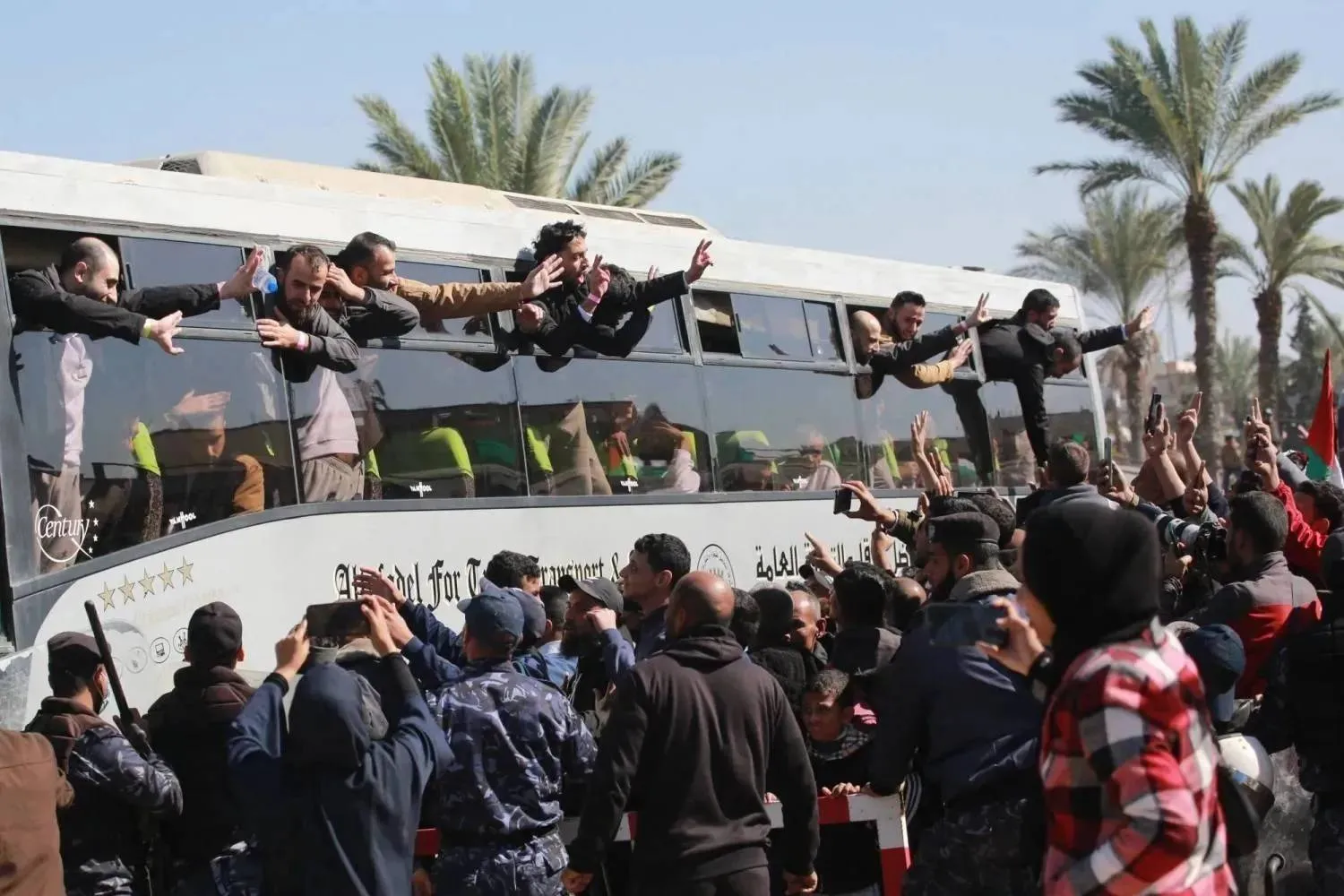

Israel’s release of nearly 2,000 Palestinian prisoners, a win for Hamas and a blow for Israel, has exposed the frailties of both sides as they try to soften the fallout from the war, according to people involved and analysts.
The two sides tried to postpone a final decision throughout the talks, but when compelled to address the issue to secure a deal, they emerged from the negotiations wounded.
In the end Israel freed 1,950 Palestinian prisoners, including about 250 who were serving multiple life sentences, a substantial number in absolute terms, but small compared with the 2011 Gilad Shalit exchange.
In that deal Hamas won the release of 1,027 prisoners for one Israeli soldier. In the related Sharm el-Sheikh arrangement, Palestinians were freed in return for 20 live Israeli captives, most of them soldiers, and 28 dead detainees, including the Israeli military commander responsible for the Gaza Strip, who held the rank of lieutenant colonel.
The number of Palestinians held in Israeli prisons was about 5,500 before Oct. 7, 2023, and has risen to roughly 11,100 today. If one of the stated goals of Hamas’s Oct. 7 offensive was to secure the release of Palestinians, the outcome was paradoxical. Still, freeing scores of long-term prisoners is not a trivial achievement.
Israel is well aware that the prisoner issue is highly sensitive for Palestinians: securing the release of even a single captive gains prestige and lifts the morale of inmates and young activists outside the prisons. For that reason, Israel tried to blunt the political impact of the releases, and a fierce, behind-the-scenes fight erupted over the composition of the list.
Hamas sought to portray itself as acting with national responsibility and asked that high-profile prisoners from across the Palestinian political spectrum be included, notably Marwan Barghouti, a leading Fatah figure, and Ahmad Saadat, the secretary-general of the Popular Front for the Liberation of Palestine, along with several other so-called heavyweight leaders of the prisoners’ movement.
Israel rejected that demand outright to ensure that “the majority of those released would be from Hamas,” officials and negotiators said.
In a last-minute swap, Israel removed 11 names of men affiliated with Fatah from the release list and replaced them with 11 Hamas prisoners.
Israeli officials called the changes a technical adjustment; the move nevertheless left a bitter impression and prompted one Fatah leader to complain: “What message are these fools sending us? They are telling Fatah: if you want your prisoners freed, you must kidnap Israelis. We in the Palestinian Authority hand over any Israeli who enters our territory by mistake, and we are punished by having our prisoners kept in solitary.”
This round also saw Israel set new criteria for who could be freed. It asserted a veto over selections, and it said age would be a factor — giving preference to detainees over 60 provided they did not have more than 13 life sentences.
Under Israeli military courts, life terms are routinely imposed on those convicted of killing Israeli civilians, settlers or soldiers; prisoners convicted of murdering more than 13 people were excluded from release. That rule ruled out figures such as Abdullah Barghouti, Ibrahim Hamed, Hassan Salameh and Abbas al-Sayyed, each serving many life terms.
The age-and-sentence rule did not apply, however, to Marwan Barghouti and Saadat. Both are over 60 — Barghouti is serving five life sentences and Saadat a 30-year term — but they belong to the Palestine Liberation Organization, which signed the Oslo accords with Israel and is seen by Israeli officials as committed, at least nominally, to a two-state settlement.
Releasing them, Israel feared, would boost the PLO’s standing on the streets and pressure Israel back toward negotiations on a two-state solution. For that reason Barghouti effectively remained behind a red line, Israeli sources said; Saadat was treated the same way, in part because an Israeli court convicted him in the assassination of minister Rehavam Ze’evi.
The dispute also revealed a rift between Israel’s security establishment and Prime Minister Benjamin Netanyahu’s office. Security agencies argued that freed prisoners should be allowed to live in the West Bank, where they could remain under surveillance and could be re-arrested or targeted if they resumed militant activity.
If they were sent to Gaza, however, senior factional leaders among the released prisoners could help rebuild Hamas’s structure there — as happened after the 2011 Shalit deal, when Yahya Sinwar, who was released then, later became Hamas’s leader in the Gaza Strip.
Netanyahu objected to the prospect of released prisoners being greeted as heroes in their hometowns and insisted they be expelled to Gaza or to third countries willing to accept them. That became a deciding factor in the final arrangements.