


Iran is Out in the Cold as the Mideast Unites in Support of the Gaza Ceasefire

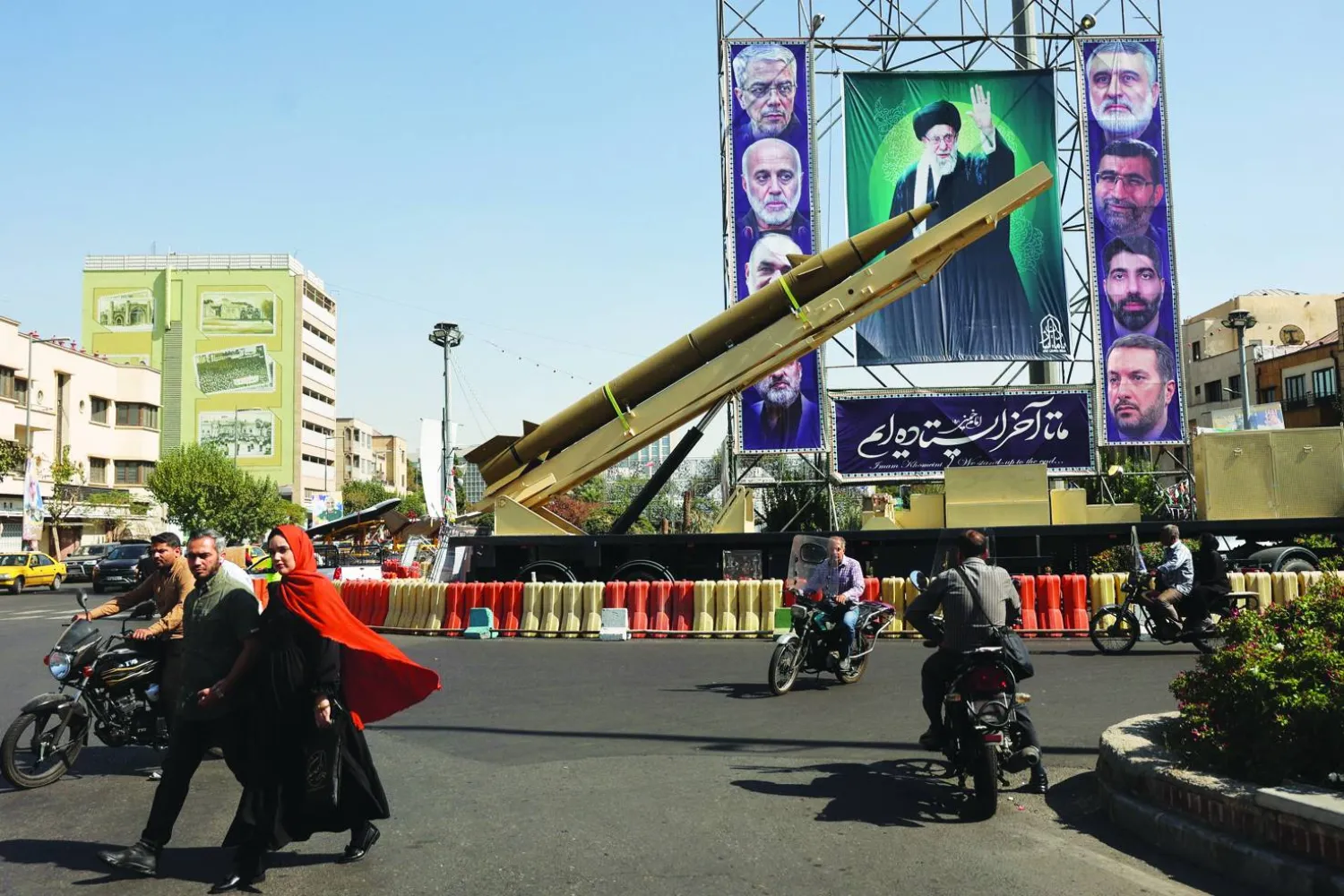
An Iranian missile system is displayed next to a banner with a picture of Iran's Supreme Leader Ali Khamenei during the Iranian Defense Week, in a street in Tehran, Iran, September 25, 2025. Majid Asgaripour/WANA (West Asia News Agency) via REUTERS
TT

Iran is Out in the Cold as the Mideast Unites in Support of the Gaza Ceasefire

An Iranian missile system is displayed next to a banner with a picture of Iran's Supreme Leader Ali Khamenei during the Iranian Defense Week, in a street in Tehran, Iran, September 25, 2025. Majid Asgaripour/WANA (West Asia News Agency) via REUTERS

As the Middle East broadly welcomes a ceasefire in the Israel-Hamas war in Gaza, Iran finds itself at one of its weakest moments since its 1979 Iranian Revolution.

Tehran has operated its self-described “Axis of Resistance” over several decades, supporting militant groups and nations allied with it against Israel and the United States. But as Israel bombed the Gaza Strip, it also turned its crosshairs toward top leaders abroad in militant groups like Hamas, Lebanon's Hezbollah and even the top echelon within Iran's military and nuclear program — killing many and disrupting their ability to fight back.

As President Donald Trump prepares for a Middle East trip that likely will see him praised by Israel and Arab nations, Iran won't be at the table as it still struggles to recover from June's 12-day war, The Associated Press said.

How Tehran's theocracy responds in the weeks and months ahead, whether that means lashing out or trying to rebuild its hobbled economy at home, will be crucial.

“Undoubtedly this is a not a proud moment for Iran," said Ali Vaez, the Iran project director at the International Crisis Group. “Its alliance system in the region is in ruins but it doesn’t mean that the 'Axis of Resistance' is no more.”

'Like a bankrupt gambler' Iranian state media has sought to describe the Gaza ceasefire as a victory for Hamas, despite the war destroying the Gaza Strip and killing over 67,000 Palestinians, according to Gaza's Health Ministry, which doesn't differentiate between civilians and combatants but says around half the dead are women and children.

Iran's Foreign Ministry welcomed “any decision ... that guarantees halting the genocide of Palestinians.” Iranian Foreign Minister Abbas Araghchi reiterated that on Saturday, telling state television that Hamas decided to accept the deal and that Tehran has "always supported any plan, any action that led to the halt of crimes, genocide” by Israel against the people of Gaza.

But perhaps more tellingly, an adviser to Iran's 86-year-old Supreme Leader Ali Khamenei suggested the ceasefire would only lead to conflict elsewhere in the region.

“The start of the ceasefire in Gaza may be the behind-the-scenes end of the ceasefire somewhere else!” Ali Akbar Velayati, an adviser to Khamenei, wrote on X, referencing Hezbollah, Yemen's Iranian-backed Houthis and Iraq.

The fear of further Israeli strikes, particularly on Iran, remains acute in the public's mind as much of Iranian air defenses likely were destroyed by Israel in June. Khamenei has not resumed his usual routine of weekly speeches to audiences. Without explanation, Iran avoided holding a major military commemoration marking the end of the Iran-Iraq war in September, which typically sees top officials watch drones and missile launchers parade past them.

Iran's economy also has suffered under international sanctions and as global energy prices fall.

“Iran has always focused on its interests, we do not have resources anymore, our economy has weakened," said Tehran-based analyst Saeed Leilaz. "Our support to Hamas was a reaction to US to divert conflicts from our borders.”

Others are less optimistic.

“Iran is like a bankrupt gambler after winning some small money in the first rounds," said Amir Kazemi, a university student in Tehran. "When Hamas attacked Israel, Iran was happy about it. But now, after the ceasefire, Iran finds nothing in its pocket.”

Mideast looks far different In the immediate years after Iran's revolution, its theocratic government sought to export its Shiite revolutionary ideology more widely in the Middle East. That morphed following its devastating 1980s war with Iraq into more of an effort to provide a level of deterrence as Arab nations around it purchased sophisticated American bombs, warplanes and tanks that Tehran couldn't access due to sanctions.

The peak of the “Axis of Resistance” came in the chaotic years after the 2003 US-led invasion of Iraq and Yemen's subsequent collapse into a civil war. Then, it could count on Hezbollah, Syrian autocrat Bashar Assad, the Houthis, Iraqi militant groups and even Hamas.

Today, the Mideast looks far different.

In Syria, the opposition overthrew Assad last year, Israeli strikes killed Hezbollah and Hamas' top leaders, while Iraqi militant groups faded into the background. Yemen's Houthis, while still capable of launching attacks on Israel and commercial shipping in the Red Sea corridor, find themselves now targeted by increasingly precise Israeli strikes.

And the 12-day war in June left Iran likely no longer enriching uranium for its nuclear program, which the West long has worried could be weaponized.

‘Collapsing regional clout’ Iran, meanwhile, has yet to receive any major support from either China or Russia, despite providing Beijing with likely discounted oil and Moscow with the drones it uses in its war on Ukraine. Tehran has also shied away from confronting women who are increasingly abandoning the hijab, or headscarf, instead executing prisoners it already holds at a rate unseen in decades.

“The ceasefire is reflective of Tehran’s collapsing regional clout following the unraveling of its long-powerful ‘Axis of Resistance’ since 2024,” said Ali Fathollah-Nejad, the director of the Berlin-based Center for Middle East and Global Order. “The ceasefire will free Israeli military capacities that would now be used against Iranian interests — whether in Lebanon against Hezbollah or directly against Iran.”

For his part, Trump seized on Iran accepting the ceasefire as “terrific" news. However, there's been no move toward renewed public negotiations with Tehran over its nuclear program.

“Time is not on Iran’s side but their problem is no one is really giving them an exit ramp,” Vaez said. But whether Tehran would take the ramp also remains in question as its leaders still debate what turn to now take.



West Bank’s Ancient Olive Tree a ‘Symbol of Palestinian Endurance’ 

Salah Abu Ali, 52, official guardian of Palestinians alleged oldest olive tree, between 3,000 and 5,000 years old poses for a portrait under it in Al-Walajah, occupied West Bank on November 4, 2025. (AFP)
TT

West Bank’s Ancient Olive Tree a ‘Symbol of Palestinian Endurance’ 

Salah Abu Ali, 52, official guardian of Palestinians alleged oldest olive tree, between 3,000 and 5,000 years old poses for a portrait under it in Al-Walajah, occupied West Bank on November 4, 2025. (AFP)

As guardian of the occupied West Bank's oldest olive tree, Salah Abu Ali prunes its branches and gathers its fruit even as violence plagues the Palestinian territory during this year's harvest.

"This is no ordinary tree. We're talking about history, about civilization, about a symbol," the 52-year-old said proudly, smiling behind his thick beard in the village of Al-Walajah, south of Jerusalem.

Abu Ali said experts had estimated the tree to be between 3,000 and 5,500 years old. It has endured millennia of drought and war in this parched land scarred by conflict.

Around the tree's vast trunk and its dozen offshoots -- some named after his family members -- Abu Ali has cultivated a small oasis of calm.

A few steps away, the Israeli separation wall cutting off the West Bank stands five meters (16 feet) high, crowned with razor wire.

More than half of Al-Walajah's original land now lies on the far side of the Israeli security wall.

Yet so far the village has been spared the settler assaults that have marred this year's olive harvest, leaving many Palestinians injured.

Israel has occupied the West Bank since 1967, and some of the 500,000 Israelis living in the Palestinian territory have attacked farmers trying to access their trees almost every day this year since the season began in mid-October.

The Palestinian Authority's Colonization and Wall Resistance Commission, based in Ramallah, documented 2,350 such attacks in the West Bank in October.

- 'Rooted in this land' -

Almost none of the perpetrators have been held to account by the Israeli authorities.

Israeli forces often disperse Palestinians with tear gas or block access to their own land, AFP journalists witnessed on several occasions.

But in Al-Walajah for now, Abu Ali is free to care for the tree. In a good year, he said, it can yield from 500 to 600 kilograms (1,100 to 1,300 pounds) of olives.

This year, low rainfall led to slim pickings in the West Bank, including for the tree whose many nicknames include the Elder, the Bedouin Tree and Mother of Olives.

"It has become a symbol of Palestinian endurance. The olive tree represents the Palestinian people themselves, rooted in this land for thousands of years," said Al-Walajah mayor Khader Al-Araj.

The Palestinian Authority's agriculture ministry even recognized the tree as a Palestinian natural landmark and appointed Abu Ali as its official caretaker.

Most olive trees reach about three meters in height when mature. This one towers above the rest, its main trunk nearly two meters wide, flanked by a dozen offshoots as large as regular olive trees.

- 'Green gold' -

"The oil from this tree is exceptional. The older the tree, the richer the oil," said Abu Ali.

He noted that the precious resource, which he called "green gold", costs four to five times more than regular oil.

Tourists once came in droves to see the tree, but numbers have dwindled since the start of the war in Gaza in October 2023, Abu Ali said, with checkpoints tightening across the West Bank.

The village of Al-Walajah is not fully immune from the issues facing other West Bank communities.

In 1949, after the creation of Israel, a large portion of the village's land was taken, and many Palestinian families had to leave their homes to settle on the other side of the so-called armistice line.

After Israel's 1967 occupation, most of what remained was designated Area C -- under full Israeli control -- under the 1993 Oslo Accords, which were meant to lead to peace between Palestinians and Israelis.

But the designation left many homes facing demolition orders for lacking Israeli permits, a common problem in Area C, which covers 66 percent of the West Bank.

"Today, Al-Walajah embodies almost every Israeli policy in the West Bank: settlements, the wall, home demolitions, land confiscations and closures," mayor Al-Araj told AFP.

For now, Abu Ali continues to nurture the tree. He plants herbs and fruit trees around it, and keeps a guest book with messages from visitors in dozens of languages.

"I've become part of the tree. I can't live without it," he said.


French Migrant Unit Faces Quiet Standoff With Damascus

A circulated image shows the Ghuraba camp in Harem in Idlib’s countryside
TT

French Migrant Unit Faces Quiet Standoff With Damascus

A circulated image shows the Ghuraba camp in Harem in Idlib’s countryside

The latest clashes in Idlib’s countryside between a French armed faction known as the Ghuraba and Syrian government forces have revived one of the most sensitive and contentious questions in Syria’s new landscape.

In the Harem area north of Idlib, the fighting was not a standalone security incident. It appeared instead to be a test of Damascus’s approach to thousands of foreign fighters who remained on Syrian territory after years of war.

The clearest reading among analysts is that the events marked the start of a more serious engagement with the foreign fighters file.

The issue has returned to the forefront after the emerging Syrian state moved to build trust with the international community by preventing foreigners from assuming leadership posts in the new Syrian army.

How the Story Began

The incident began on October 22 when internal security forces moved into a camp in the town of Harem, where French fighters under the command of Omar Diaby, known as Omar Omsen, live.

The raid was carried out after complaints of serious violations, including the kidnapping of a girl by a group led by Diaby. Officials said Diaby refused to surrender. The operation, according to the official narrative, aimed to enforce the law and assert state authority over the camp.

Diaby’s Response

Diaby, a French commander of African origin, denied the accusations. He accused French intelligence of orchestrating what he described as political targeting. Paris views Diaby as one of the main recruiters of French-speaking jihadists. Washington designated him a global terrorist in 2016.

Ceasefire and Mediation

The clashes ended after a reconciliation meeting mediated by Uzbek, Tajik and Turkestan faction leaders inside the Harem camp. The Ghuraba announced on Telegram that it had reached a ceasefire and thanked what it called migrant and local brothers who supported them.

The Ghuraba’s Composition

The Ghuraba comprises about 70 French fighters living with their families in a fortified camp directly on the Turkish border.

This made the security raid difficult. The six-point agreement reached after the clashes required a ceasefire, opening the camp to the government, referring Diaby’s case to the Sharia court under the justice ministry, withdrawing heavy weapons and guaranteeing that participants in the clashes would not be pursued.

Foreign Fighters in the New State

The number of foreign fighters is estimated at more than five thousand. Most have joined the ministry of defense within the 84th Division. The Syrian government faces pressure from western capitals to keep them away from senior positions. Officials have sought to reassure global partners that these fighters pose no threat to regional or international stability.

Syrian President Ahmed Al Sharaa said fighters who once fought with the opposition are part of the new society and that Syria will deal with them through reconciliation rather than exclusion.

A number of them have already received military ranks and official posts in the army as part of an integration policy. Military officials later stressed that the Harem incident does not signal a change in this policy.

The Military’s Position

A Syrian army official, who requested anonymity, told Asharq Al-Awsat that what happened in Harem did not target foreign fighters who stood with the revolution. He said relations with them are based on mutual commitment. Many of them have formally joined the ministry of defense.

He denied that the operation was a campaign against them. It was simply enforcement of the law. He added that the new Syrian army operates under a clear system of discipline and military orders that applies to all personnel, whether Syrian or migrant.

The Debate Over Terminology

Away from the official version, observers and former military commanders said the crisis reflects deeper questions about state-building and identity.

Abu Yahya Al Shami, a former commander in an Islamic faction, told Asharq Al-Awsat that the core issue is terminology. He argued that describing the fighters as foreigners is neither accurate nor fair because the term carries negative implications.

He prefers calling them migrants, saying this acknowledges the legitimacy they earned through their sacrifices. He believes they have already integrated socially and politically, and that their concerns mirror those of Syrians.

He said the handling of the Harem incident was flawed. The media and security escalation was a mistake. Reconciliation prevented the situation from sliding into a dangerous confrontation. He stressed the need for calm, noting that migrants have legitimate fears of prosecution, deportation or marginalization after the war.

Al Shami rejected describing what happened as a revolt. He said the French fighters are part of the Syrian army. Dialogue and mediation, he added, strengthen state authority more than armed confrontation.

Structural Challenges

Researcher Wael Alwan said the episode revealed deep structural challenges for the Syrian state. He told Asharq Al-Awsat that integration of migrants into state institutions remains incomplete and that the coming phase will test whether the integration is genuine.

Some foreign fighters may never integrate. The state may have to either facilitate their organized departure or prevent them from becoming a threat to stability. Alwan said the authorities will need to balance security and stability with the goals of integration and disbanding armed formations.

He said the government has no option but to dismantle armed groups, Syrian or migrant, because this is necessary for reasserting state authority. The reconciliation approach in Harem, he said, was deliberate and meant to contain the crisis with minimal cost.

Alwan added that some segments of fighters, Syrian and migrant, are dissatisfied with state policies. He said the state now needs a new religious narrative that speaks to these groups, and that steps in this direction have recently begun.

Diverging Views Among Migrant Fighters

To understand the ideological differences among migrants themselves, Asharq Al-Awsat interviewed two commanders serving under the defense ministry. Their views reflected a clear divide.

Abu Muhajir, an Arab national, said he is part of the ministry and fights under its banner. He said migrants came to defend Syrians, not to rule them. With the revolution victorious and the new state established, he said their role is now to follow state policy. They are now part of the Syrian army and abide by all ministry decisions.

In contrast, Abu Muthanna, also a ministry member, expressed reservations about the state’s direction. He said the state had kept regime loyalists in influential positions and tolerated public wrongdoing.

He said this is the opposite of the goals for which many fighters died. Still, he insisted they would not rebel. Their duty, he said, is to advise and warn from within, not to bear arms against the state.

The Ideological Layer

Abdullah Khaled, a former Sharia official in Hayat Tahrir Al Sham and now an adviser in the new Syrian army, explained the divide between these two camps.

Migrants, he said, are driven by convictions deeply rooted in their faith. This commitment is what led them to leave comfortable lives in Europe for what was once one of the most dangerous places in the world.

During the war, factional religious discourse was emotional and mobilizing, suited to fighting and confrontation. But after the fall of the regime and the transition from revolution to state, the discourse of governance naturally changed.

Khaled said the new approach fits the logic of governing a population rather than commanding a fighting group.

This shift, however, clashes with the deeply held beliefs of many migrants and some Syrians. For those who reject the new direction, the options are limited. According to Khaled, they must choose between confrontation, withdrawal into silence, or acceptance and adaptation. The state will not permit a return to the old factional model.


Syrians Furious at Major Hike in Electricity Prices

A view shows electricity pylons in Kiswah, Damascus suburbs, Syria September 8, 2021. Picture taken September 8, 2021. REUTERS/Yamam al Shaar/File Photo
TT

Syrians Furious at Major Hike in Electricity Prices

A view shows electricity pylons in Kiswah, Damascus suburbs, Syria September 8, 2021. Picture taken September 8, 2021. REUTERS/Yamam al Shaar/File Photo

In his workshop near the Syrian capital, Ghassan Aama is at a loss following a recent decision to massively hike electricity prices, even as much of the country continues to face extensive outages.

Last month, the energy ministry raised prices by at least 60 times compared to the previous tariff, sending shockwaves through a population already reeling from decades of sanctions and 14 years of war.

"We were surprised to see electricity prices rise, as our income is limited," said Aama, a blacksmith, AFP reported.

"If the bills are high, we might not be able to make ends meet," he added.

Aama already pays a subscription to a private generator so he can run his workshop -- a common practice in the country's whose electricity sector has been ravaged by the civil war, with power cuts reaching up to 20 hours a day.

"We are coming out of a war, and our homes are destroyed... we were hoping things would get better, not worse," he added.

Since the toppling of longtime ruler Bashar al-Assad in December, Syria has slowly begun to emerge from decades of political and economic isolation.

The new authorities are hoping to attract funding and investments for reconstruction, which the World Bank estimated could cost more than $216 billion.

The government's decision to hike tariffs is part of a policy of liberalisation that the government seems to have adopted at the start of the year, said Jihad Yazigi, editor of economic publication The Syria Report.

"What they are doing, basically, is just trying to cut costs and to remove subsidies," he added.

Contrary to what Assad claimed, Yazigi said the Syrian economy was "obviously not a socialist economy".

It was "relatively liberal... and here (they) are liberalizing further", he said, as they also lifted subsidies on bread earlier this year.

But having born the brunt of the country's crippled economy for years, Syrians are struggling to accept yet another blow.

"After liberation, we expected people to return and reconstruction to take place quickly," said Muhieddine Salam, a real estate agent.

"Now, if rent is $200 and the electricity tariff is between $200 and $400, what will I do?"

Vendor Alaa Mussa shared his frustration, arguing that "no one will pay, no one has the money".

"Let them turn the electricity off, it would be better," she told AFP.

"There are no jobs, and all factories are closed... (At first) everyone was happy, we thought money would start coming in, but no one expected this to happen."

Syria previously announced major investment agreements with countries in the region to rebuild infrastructure.

It also announced major agreements with Qatar and Türkiye to supply it with gas for electricity production.

But these projects have yet to make a dent in the daily lives of Syrians.

Nine out of 10 people in the country live in poverty, and one in four is unemployed, according to the United Nations.

Many of them resort to informal, temporary jobs to survive, like Umm al-Zein, 43, who sells bread on the street.

"I can barely afford to pay my son's university tuition and my daughter's private lessons for the high school exam," she said.

"The electricity barely comes on for an hour, and if the electricity doesn't come, the water doesn't come either.

"We will be warming ourselves under blankets in the winter."