


After Hostages and Prisoners are Freed, Complex Issues Remain for Israel-Hamas Ceasefire

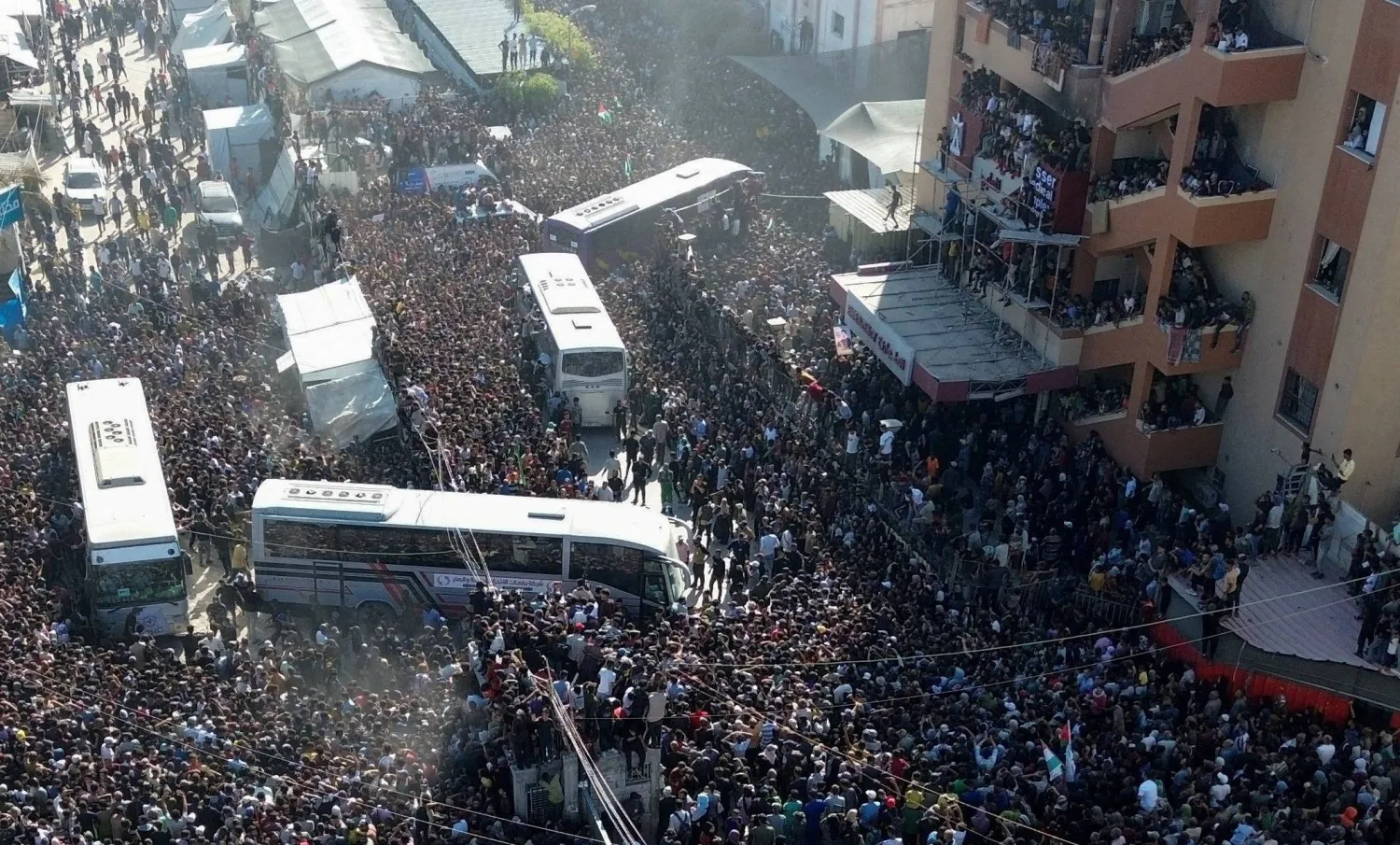
A drone view shows people gathering at Nasser hospital as they welcome freed Palestinian prisoners released by Israel as part of a hostages-prisoners swap and a ceasefire deal between Hamas and Israel, in Khan Younis in the southern Gaza Strip, October 13, 2025. REUTERS/Stringer
TT

After Hostages and Prisoners are Freed, Complex Issues Remain for Israel-Hamas Ceasefire

A drone view shows people gathering at Nasser hospital as they welcome freed Palestinian prisoners released by Israel as part of a hostages-prisoners swap and a ceasefire deal between Hamas and Israel, in Khan Younis in the southern Gaza Strip, October 13, 2025. REUTERS/Stringer

Israel and Hamas moved ahead on a key first step of the tenuous Gaza ceasefire agreement on Monday by freeing hostages and prisoners, raising hopes that the US-brokered deal might lead to a permanent end to the two-year war that ravaged the Palestinian territory.

But thornier issues such as whether Hamas will disarm and who will govern Gaza — and the question of Palestinian statehood — remain unresolved, highlighting the fragility of an agreement that for now only pauses the deadliest conflict in the history of Israel and the Palestinians, The Associated Press said.

For Israelis, the release of the 20 remaining living hostages brought elation and a sense of closure to a war many felt they were forced into by Hamas, although many pledged to fight on for the return of deceased hostages still in Gaza. But with the living hostages freed, the urgency with which many were driven to call for an end to the war will likely diminish, easing pressure on Israeli Prime Minister Benjamin Netanyahu to advance the next phases of the agreement.

Four deceased hostages were returned to Israel on Monday, and another 24 are supposed to be turned over as part of the first phase of the ceasefire, which also requires Israel to allow a surge of food and other humanitarian aid into Gaza.

While there was an outburst of joy in Gaza for prisoners returning from Israel and hope that the fighting may wind down for good, the torment drags on for war-weary Palestinians. Gaza has been decimated by Israeli bombardment; there is little left of its prewar economy, basic services are in disarray and many homes have been destroyed. It remains unclear who will pay for reconstruction, a process that could take years.

Israel says the deal achieves its war objectives US President Donald Trump traveled to the region to celebrate the deal. In an address to Israel's parliament, he urged lawmakers to seize a chance for broader peace in the region. In Egypt, he and other world leaders gathered to set the trickier parts of the deal into motion.

Netanyahu, who according to his office did not join the meeting in Egypt because of a Jewish holiday, told parliament that he was committed to the agreement, saying it “ends the war by achieving all our objectives.” Israel had said it would not end the war until all the hostages were freed and Hamas was defeated. Critics accused Netanyahu of allowing the war to drag on for political reasons, which he denied.

The war began with Hamas’ Oct. 7, 2023, attack, when militants killed 1,200 people and took 251 captives. Israel’s retaliatory campaign killed more than 67,000 people, according to Gaza’s Health Ministry, which does not differentiate between combatants and civilians in its count. The ministry is part of the Hamas-run government. Its figures are seen as a reliable estimate by the UN and many independent experts.

The war has rippled across the Middle East, with conflict erupting between Israel and the Lebanese Hezbollah, Iranian-backed rebels in Yemen and Iran itself.

Israel is elated by the return of the living hostages Israelis watched with jubilation in public screenings attended by thousands as the 20 living hostages, all male, reunited with their families. Crowds broke into cheers, as tears of joy streamed down relieved faces.

“You are alive! Two arms and two legs,” said Zvika Mor, upon seeing his son Eitan for the first time in two years.

When Bar Kupershtein was reunited with his family, his father, Tal, who uses a wheelchair after a car accident and stroke, fulfilled a promise to himself by standing up for a few minutes to embrace his freed son.

Unlike previous releases, Hamas held no ceremonies for the captives before freeing them. Instead, families received video calls from masked militants who allowed them a first glimpse at their loved ones before they came home.

The plight of the hostages had widespread support in Israel, where thousands would join the families for weekly protests demanding Israel secure their release.

The fate of the hostages was a central driver of a movement in Israel to end the war. Many Israelis viewed Netanyahu’s twin goals of freeing the captives and defeating Hamas as incompatible.

Israeli Defense Minister Israel Katz said any delay by Hamas in retuning the remaining bodies of deceased hostages would be viewed as a violation of the ceasefire deal.

Israel frees some 1,900 Palestinian prisoners

Large crowds greeted freed prisoners in Beitunia in the Israeli-occupied West Bank and in Khan Younis in Gaza. The prisoners flashed V-for-victory signs as they descended from buses that took them either to the West Bank, Gaza or into exile.

“Praise be to God, our Lord, who has honored us with this release and this joy,” said Mahmoud Fayez, who was returned to Gaza after being detained early last year in an Israeli raid on the main Shifa Hospital.

The prisoners include 250 people serving life sentences for convictions in attacks on Israelis, in addition to 1,700 seized from Gaza during the war and held without charge.

The fate of the prisoners is a sensitive issue in Palestinian society, where almost everyone knows or is related to someone who has been imprisoned by Israel. They are viewed by Palestinians as freedom fighters.

Trump celebrates the deal in Israel and Egypt

In his Knesset speech, Trump told Israeli lawmakers their country must now work toward peace.

“Israel, with our help, has won all that they can by force of arms,” Trump said. “Now it is time to translate these victories against terrorists on the battlefield into the ultimate prize of peace and prosperity for the entire Middle East.”

His speech was briefly interrupted when two Knesset members staged a protest and were subsequently removed from the chamber. One held up a small sign reading, “Recognize Palestine.”

In Egypt, President Abdel-Fattah al-Sissi and Trump attended a summit with leaders from more than 20 countries on the future of Gaza and the broader Middle East. Palestinian leader Mahmoud Abbas, who administers parts of the West Bank, also attended.

Despite Trump's optimism, many thorny issues remain

Among the most difficult issues left to resolve is Israel’s insistence that a weakened Hamas disarm. Hamas refuses to do that and wants to ensure Israel pulls its troops completely out of Gaza.

So far, the Israeli military has withdrawn from much of Gaza City, the southern city of Khan Younis and other areas. Troops remain in most of the southern city of Rafah, towns of Gaza’s far north, and along the length of Gaza’s border with Israel.

The future governance of Gaza remains unclear. Under the US plan, an international body will govern the territory, overseeing Palestinian technocrats running day-to-day affairs. Hamas has said Gaza’s government should be worked out among Palestinians.

The plan envisions an eventual role for Abbas’ Palestinian Authority — something Netanyahu has long opposed — but it requires the authority to undergo reforms.

The plan calls for an Arab-led international security force in Gaza, along with Palestinian police. Israeli forces would leave areas as those forces deploy. About 200 US troops are in Israel to monitor the ceasefire.

The plan also mentions the possibility of a future Palestinian state, another nonstarter for Netanyahu.

TV Soaps and Diplomacy as Bangladesh and Türkiye Grow Closer

The success of Turkish shows in Bangladesh, challenging the popularity of Indian television dramas, shows signs of shifting alliances. Syed Mahamudur RAHMAN / AFP
TT

TV Soaps and Diplomacy as Bangladesh and Türkiye Grow Closer

The success of Turkish shows in Bangladesh, challenging the popularity of Indian television dramas, shows signs of shifting alliances. Syed Mahamudur RAHMAN / AFP

In a recording studio in Dhaka, voiceover artist Rubaiya Matin Gity dubs the latest Turkish soap opera to become a megahit in Bangladesh -- a pop-culture trend that reflects growing ties between the two countries.

"Yasmeen! Yasmeen! I have fallen in love..." the 32-year-old actor cried in Bangla, her eyes fixed on the screen playing new episodes of Turkish drama "Kara Sevda", or "Endless Love", which has captivated millions of viewers in the South Asian nation.

The success of Turkish shows, challenging the once-unrivalled popularity of Indian television dramas, is the sign of a change that extends far beyond Bangladeshi screens, said AFP.

It mirrors shifting alliances and expanding diplomatic, trade and defense relations between the two Muslim-majority nations, 5,000 kilometers (3,000 miles) apart.

More Turkish restaurants are opening in Bangladesh and there is a general interest in learning the language, coupled with rekindled warmth between the two governments, set against increasingly fractious relations between Dhaka and New Delhi.

An interim government has led Bangladesh since an uprising last year toppled the autocratic rule of Sheikh Hasina -- who fled to old ally India, where she has resisted extradition, turning relations between the two neighbors icy.

Ties between Ankara and Dhaka have not always been smooth, but they "are growing stronger now," said Md Anwarul Azim, professor of international relations at the University of Dhaka.

"The relationship faltered twice," he said, first in 1971 when Bangladesh separated from Pakistan, and then in 2013, when Dhaka hanged men accused of war crimes during the independence struggle.

Bilateral trade remains modest, but Azim noted that Türkiye offers Bangladesh an alternative to its reliance on China as its main weapons supplier.

Ankara's defense industry boss Haluk Gorgun visited Dhaka in July, and Bangladesh's army chief General Waker-Uz-Zaman is expected in Türkiye later this month to discuss production of military equipment.

Bangladesh has also shown interest in Turkish drones, technology Ankara has reportedly supplied to Pakistan, India's arch-enemy.

Dhaka's interim leader, Nobel Peace Prize winner Muhammad Yunus, said he was "focused on further deepening" ties with Ankara, after meeting a Turkish parliamentary delegation this month.

"Bangladesh stands ready to work hand in hand with Turkiye to unlock new opportunities for our people," Yunus said.

Alongside formal ties, cultural links are also deepening.

Ezaz Uddin Ahmed, 47, head of programming at the channel that pioneered Turkish dramas in Bangladesh, said that Deepto TV has "a dedicated team of translators, scriptwriters, voice artists and editors" working to meet the growing demand.

Its breakout hit came in 2017 with a historical epic that eclipsed Indian serials and "surpassed all others" in terms of popularity, Ahmed said.

Riding on that success, Deepto TV and other Bangladeshi broadcasters snapped up more Turkish imports -- from Ottoman sagas to contemporary family dramas.

Interest in the Turkish language has followed suit, with several leading institutions now offering courses.

"I have 20 students in a single batch," said Sheikh Abdul Kader, a trainer and economics lecturer at Jagannath University. "There is growing demand."

For some, the love for all things Turkish doesn't end there.

Business owner Tahiya Islam, 33, has launched a Turkish-themed clothing line, and inspired by Ottoman traditions, even took up horseback riding.

"During the Ottoman era, couples used to go out on horseback," she said. "Now, my husband rides too -- and I even have my own horse."


Tehran Taps Run Dry as Water Crisis Deepens Across Iran

People shop water storage tanks following a drought crisis in Tehran, Iran, November 10, 2025. Majid Asgaripour/WANA (West Asia News Agency) via REUTERS
TT

Tehran Taps Run Dry as Water Crisis Deepens Across Iran

People shop water storage tanks following a drought crisis in Tehran, Iran, November 10, 2025. Majid Asgaripour/WANA (West Asia News Agency) via REUTERS

Iran is grappling with its worst water crisis in decades, with officials warning that Tehran — a city of more than 10 million — may soon be uninhabitable if the drought gripping the country continues.

President Masoud Pezeshkian has cautioned that if rainfall does not arrive by December, the government must start rationing water in Tehran.

"Even if we do ration and it still does not rain, then we will have no water at all. They (citizens) have to evacuate Tehran," Pezeshkian said on November 6, AFP reported.

The stakes are high for Iran's clerical rulers. In 2021, water shortages sparked violent protests in the southern Khuzestan province. Sporadic protests also broke out in 2018, with farmers in particular accusing the government of water mismanagement.

WATER PRESSURE REDUCTIONS BEING APPLIED

The water crisis in Iran after a scorching hot summer is not solely the result of low rainfall.

Decades of mismanagement, including overbuilding of dams, illegal well drilling, and inefficient agricultural practices, have depleted reserves, dozens of critics and water experts have told state media in the past days as the crisis dominates the airwaves with panel discussions and debates.

Pezeshkian's government has blamed the crisis on various factors such as the "policies of past governments, climate change and over-consumption".

While there has been no sign of protests yet this time over the water crisis, Iranians are already struggling under the weight of a crippled economy, chiefly because of sanctions linked to the country’s disputed nuclear program.

Coping with persistent water shortages strains families and communities even further, intensifying the potential for unrest, when the clerical establishment is already facing international pressure over its nuclear ambitions. Iran denies seeking nuclear weapons.

Across Iran, from the capital’s high-rise apartments to cities and small towns, the water crisis is taking hold.

When the taps went dry in her eastern Tehran apartment last week, Mahnaz had no warning and no backup.

"It was around 10 p.m., and the water didn’t come back until 6 a.m.,” she said. With no pump or storage, she and her two children were forced to wait, brushing teeth and washing hands with bottled water.

Iran’s National Water and Wastewater Company has dismissed reports of formal rationing in Tehran, but confirmed that nightly water pressure reductions were being applied in Tehran and could drop to zero in some districts, state media reported.

Pezeshkian also warned against over-consumption in July. The water authorities said at the time 70% of Tehran residents consumed more than the standard 130 litres a day.

TEHRAN'S RESERVOIRS AT AROUND HALF CAPACITY

Iranians have endured recurrent electricity, gas and water shortages during peak demand months in the past years.

"It’s one hardship after another — one day there’s no water, the next there’s no electricity. We don’t even have enough money to live. This is because of poor management," said schoolteacher and mother of three Shahla, 41, by phone from central Tehran.

Last week, state media quoted Mohammadreza Kavianpour, head of Iran’s Water Research Institute, as saying that last year’s rainfall was 40% below the 57-year average in Iran and forecasts predict a continuation of dry conditions towards the end of December.

The capital depends entirely on five reservoirs fed from rivers outside the city. But inflow has plummeted. Behzad Parsa, head of Tehran’s Regional Water Company, said last week that water levels had fallen 43% from last year, leaving the Amir Kabir Dam at just 14 million cubic meters — 8% of capacity.

He said Tehran’s reservoirs, which collectively could once store nearly 500 million cubic meters, now hold barely 250 million, a drop of nearly half, which at current consumption rates, could run dry within two weeks.

The crisis extends far beyond Tehran. Nationwide, 19 major dams — roughly 10% of Iran’s total — have effectively run dry. In the city of Mashhad, Iran’s second-largest city, with a population of 4 million, water reserves have plunged below 3%.

"The pressure is so low that literally we do not have water during the day. I have installed water tanks but how long we can continue like this? It is completely because of the mismanagement," said Reza, 53, in Mashhad. He said it was also affecting his business of carpet cleaning.

Like the others Reuters spoke to, he declined to give his family name.

CLIMATE CHANGE INTENSIFIED WATER LOSS

The crisis follows record-breaking temperatures and rolling power outages. In July and August, the government declared emergency public holidays to reduce water and energy consumption, shutting down some public buildings and banks as temperatures topped 50 degrees Celsius (122 degrees Fahrenheit) in some areas.

Climate change has intensified the problem, authorities say, with rising temperatures accelerating evaporation and groundwater loss.

Some newspapers have criticized the government’s environmental policies, citing the appointment of unqualified managers and the politicization of resource management. The government has rejected the claims.

Calls for divine intervention have also resurfaced.

"In the past, people would go out to the desert to pray for rain,” said Mehdi Chamran, head of Tehran’s City Council, state media reported. "Perhaps we should not neglect that tradition."

Authorities are taking temporary measures to conserve what remains, including decreasing the water pressure in some areas and transferring water to Tehran from other reservoirs.

But these are stopgap measures, and the public has been urged to install storage tanks, pumps, and other devices to avoid major disruption.

"Too little, too late. They only promise but we see no action," said a university teacher in the city of Isfahan, who asked not to be named. "Most of these ideas are not doable."


Exiled Syrian Opens up About Death-Defying Smuggling Operation That Showed Proof of Assad’s Cruelty

A Syrian man inspects cells at the prison of Sednaya, north of Damascus, Syria, Dec. 16, 2024. (AFP)
TT

Exiled Syrian Opens up About Death-Defying Smuggling Operation That Showed Proof of Assad’s Cruelty

A Syrian man inspects cells at the prison of Sednaya, north of Damascus, Syria, Dec. 16, 2024. (AFP)

He waited for his brother-in-law to cross the front line smuggling documents stolen from the Syrian dictatorship’s archives. Detection could mean dismemberment or death, but they were committed to exposing the industrial-scale violence used to keep President Bashar al-Assad in power.

Ussama Uthman, now 59, was building a vast record of the brutality — photographs that showed Assad’s government was engaging in systematic torture and extrajudicial killings.

Now, safely in exile in France and with Assad having fallen in a surprise opposition offensive last year, Uthman is sharing how he, his wife and her brother teamed up to smuggle evidence of the horrific crimes out from under Syria’s infamous surveillance apparatus as war tore the country apart.

The photos of broken bodies and torture sites — records were apparently kept to show orders were being followed — began appearing online in 2014. They spurred US sanctions, and are being used to prosecute suspected war crimes and help Syrians find out what happened to family members who disappeared.

“We have hundreds of thousands of mothers waiting for news of their loved ones,” said Uthman.

During a recent interview in northern France — The Associated Press agreed to withhold the exact location for security reasons — the only time Uthman's voice broke was when he recounted sending a woman photos of a brutalized body and asking if she recognized her son.

“I send her five snapshots of her son’s body, torn under Bashar al-Assad’s whips, and she rejoices. She says, ‘Thank God, I have confirmed that he is dead,’” he recalled. “This sadness should have kept our flags at half-staff in Syria for years.”

Family secrets, risks and duty

With the so-called “Arab Spring” uprisings in the Middle East in 2011, protests in the southern city of Daraa inspired demonstrations throughout Syria. The government responded with force, but rather than crushing the demonstrations, the brutality sparked a civil war that spurred foreign intervention and pitted a patchwork of opposition groups against the armor and air power of the military and Assad’s allies.

When news broke that first year of a massacre in Hama, Uthman, a construction engineer from the Damascus suburb of al-Tall, swore he'd help topple Assad. He didn’t know how until he got a call from his wife’s brother Farid al-Mazhan, a military police officer who asked him to meet in person — electronic communications were too risky.

Al-Mazhan showed Uthman gory images taken by photographers in the military forensic pathology department that he helped run. He said he could access more.

The two launched a secret operation that would eventually smuggle more than 53,000 photographs out of Syria showing evidence of torture, disease and starvation in the country's lockups.

The operation was incredibly dangerous but straightforward.

As an officer, Al-Mazhan could pass government-run checkpoints; his connections in the opposition-held town where he lived and eventually Uthman’s secret coordination with the opposition enabled him to cross checkpoints staffed by their fighters.

He would then secretly pass CDs, hard drives and USB sticks containing photos and other documents to Uthman. He also slipped them to his sister, Khawla al-Mazhan, who is married to Uthman. She was the first to suggest using the photos to try to topple Assad.

“Why don’t we use these images to bring down the regime?” Uthman recalled her saying.

Uthman adopted the nom de guerre Sami. Farid al-Mazhan took Caesar. Their operation would become known as the Caesar Files.

Justice for Syria, from exile

Deciding to escape Syria — an estimated 6 million people fled during the war — the team uploaded 55 gigabytes of photos and documents dating from May 2011 to August 2014 to a foreign server. They then began furtively moving their extended families to neighboring countries. Diplomats eventually helped Uthman’s family settle in France in 2014.

Once safely out of Syria, they began publishing the material, sparking immediate and widespread condemnation of Assad.

As families scoured the ghastly archive for signs of what happened to their loved ones, the team gave copies to European prosecutors. Authorities in France, Germany, Belgium, the Netherlands and Switzerland have arrested or initiated legal proceedings against former Syrian officials accused of torture and killings.

The release of the files marked “a key point in Syria’s history,” said Kholoud Helmi, co-founder of the independent Syrian news site Enab Baladi. Both the international community and Syrians were faced with “striking proof” of the Assad government’s crimes.

“Almost nobody believed us or thought we were exaggerating,” said Helmi, who fled during the war.

The Caesar Files team are heroes, said Lina Chawaf, editor-in-chief of Radio Rozana, an independent Syrian media outlet.

“You know the price that you will pay, but it will cost all of your family,” said Chawaf, who also fled Syria.

Hoping to plug the leak, Syrian authorities tightened their grip on their archive. Gradually, the team reorganized and grew to roughly 60 members both inside and outside of Syria. They built a second tranche of evidence, the Atlas Files, from 2014 until 2024.

Late last year, as they were starting to organize this new catalog — it's nearly three times the size of the first — startling news broke: The opposition had seized Syria’s second-biggest city, Aleppo.

Accountability under a new regime

Within 10 days, opposition forces sprinted across government-held territory to take Damascus, forcing Assad to flee to Russia and ending his family's nearly 54-year rule.

The sudden power vacuum bred chaos, with opposition forces flinging open the doors of the country's most feared prisons.

Team members still in Syria and families of the missing rushed to the sites in search of information — more than 130,000 Syrians disappeared during the war, according to international bodies.

Helmi, of the Enab Baladi news site, considers her family lucky to have found proof of her brother Ahmad's execution.

“They killed him 27 days after he was detained, and we’ve been waiting for him for 13 years,” said Helmi, who thinks the new government of President Ahmed al-Sharaa, a former opposition leader, hasn't done enough to help families.

Uthman went further, saying so much evidence was lost in the immediate aftermath of Assad's ouster that it was akin to the new authorities “destroying evidence, tampering with the crime scene.”

Documents lay scattered on rainy streets, psychologically shattered prisoners wandered out of broken jails, and wild dogs chewed on bones in mass graves, he said.

The government — which hopes the US will permanently lift the sanctions imposed for the abuses exposed by the Caesar Files — says it is doing all it can to reckon with Assad’s bloody legacy. During Sharaa’s visit to Washington on Monday, the Treasury announced a waiver of the sanctions had been renewed for another six months.

In a news conference last week in Damascus, Reda al-Jalakhi, who heads the government's National Commission for the Missing, acknowledged that “in the first two days of the liberation, there was some chaos and a lot of documents were lost.”

But he said the authorities quickly took control of Assad's old lockups and is preserving the remaining evidence. He thanked the Caesar Files team for providing some documentation to the commission, but he didn't signal any plans for ongoing cooperation, saying the government would build a centralized database to find the missing.

With a defiant twinkle in his eyes, Uthman said his team's work will continue to fight any impunity in Syria as fresh sectarian violence bloodies the country. The team dreams that one day Assad might face their evidence at trial.