


EU Scramble for Anti-Russia ‘Drone Wall’ Hits Political, Technical Hurdles 

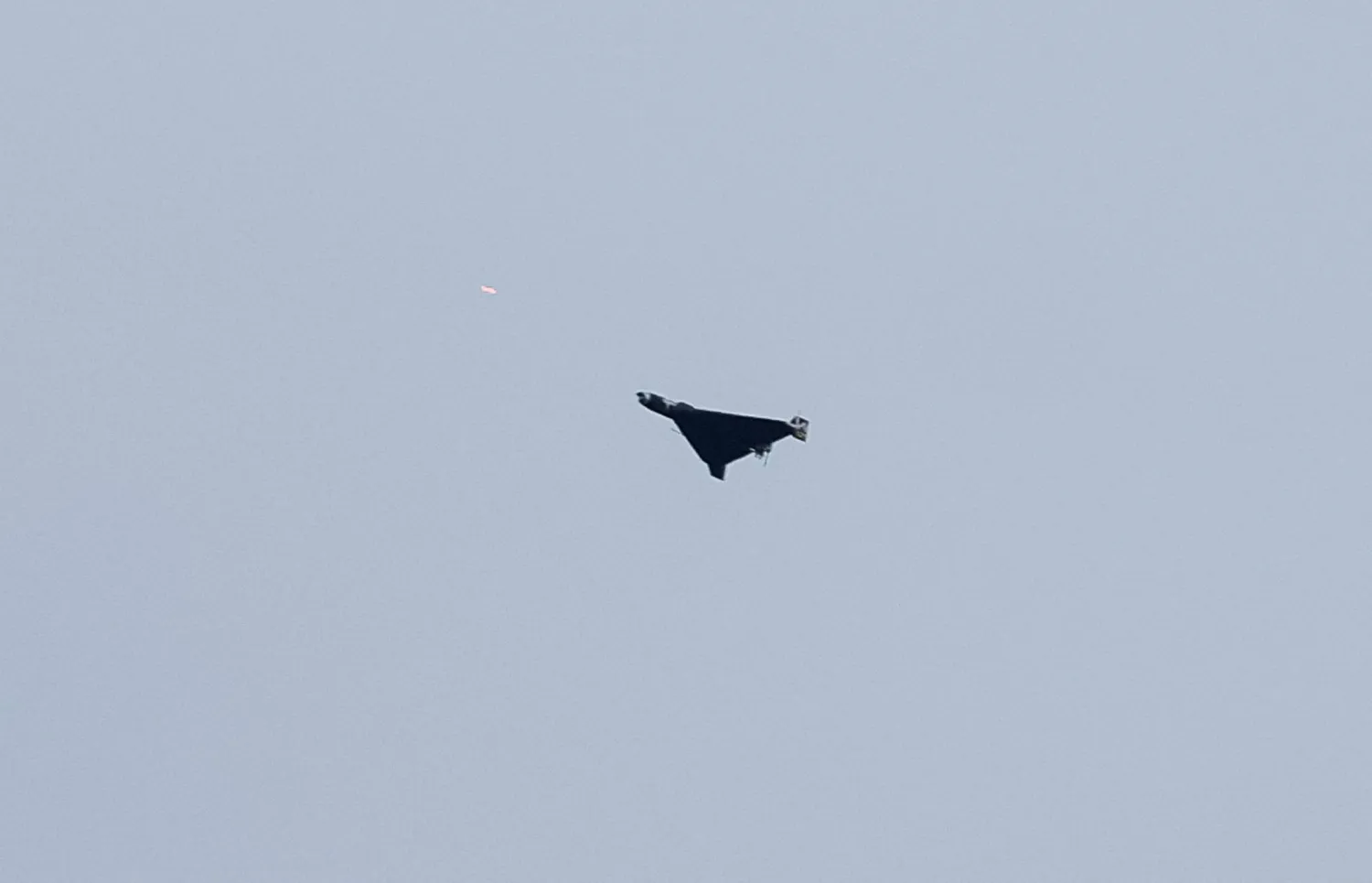
A Russian drone flies over the city as Ukrainian servicemen fire towards it during Russian drone and missile strikes, amid Russia's attack on Ukraine, in Kyiv, Ukraine September 28, 2025. (Reuters)
TT

EU Scramble for Anti-Russia ‘Drone Wall’ Hits Political, Technical Hurdles 

A Russian drone flies over the city as Ukrainian servicemen fire towards it during Russian drone and missile strikes, amid Russia's attack on Ukraine, in Kyiv, Ukraine September 28, 2025. (Reuters)

Just hours after some 20 Russian drones entered Polish airspace last month, European Commission President Ursula von der Leyen said it was time for Europe to build a "drone wall" to protect its eastern flank.

Drone incidents over airports in Denmark and Germany in the following weeks reinforced European leaders’ view that the continent urgently needs better protection against such threats.

But the "drone wall" proposal remains in flux, according to more than half a dozen officials and diplomats familiar with internal EU deliberations who spoke to Reuters about the project.

"Our capabilities are really, for the time being, quite limited," said European Defense Commissioner Andrius Kubilius, who is playing a leading role in fleshing out the proposal.

Kubilius told Reuters the EU would need to draw heavily on Ukrainian expertise, honed over nearly four years countering waves of Russian drones.

The drone project is a test of the EU's ambitions to play a greater role in defense – traditionally the preserve of national governments and NATO – as well as Europe's ability to take more responsibility for its own security, as demanded by US President Donald Trump.

The Commission, the EU’s executive body, has been trying to win over southern and western European governments, which argued the original idea was too focused on the bloc’s eastern border when drones could pose a threat across the whole continent.

The proposal is also caught up in a power struggle over who should control major European defense projects, with Germany and France wary of handing power to the Commission, diplomats say.

Some EU officials questioned the name "drone wall", arguing it implies a false promise of security when no system will be able to repel every drone.

To try to win more support, the Commission has broadened the original concept – from an integrated thicket of sensors, jamming systems and weapons along the eastern border to a continent-wide web of anti-drone systems.

As first reported by Reuters on Tuesday, the Commission plans to switch to the term "European Drone Defense Initiative" in a defense policy "roadmap" to be unveiled on Thursday.

If it goes ahead, the project would be a bonanza for makers of anti-drone systems – from startups in the Baltic states to bigger defense industry players such as Germany’s Helsing and Rheinmetall.

The Commission has not said how much the proposal would cost, but geopolitical consultancy RANE said it could generate billions of euros in orders.

But without broad support from European governments, the plan will struggle to secure access to EU funding, experts said.

"The path to realization remains long and fraught with constraints," said Matteo Ilardo, RANE’s lead Europe analyst, pointing to big challenges “in terms of cost, scale and cross-border integration”.

JETS VS DRONES

Baltic countries, along with Poland and Finland, pitched the idea of a “drone wall” to the European Commission last year, a spokesperson for Estonia's border guard told Reuters.

The countries applied for funding from an EU civilian border management fund, with the aim of deploying sensors and drones to combat people smuggling, the spokesperson said.

The project initially failed to gain traction at EU level.

But the idea evolved into a more defense-focused concept after Ukrainian Deputy Prime Minister Mykhailo Fedorov gave a presentation to von der Leyen in April in Brussels on how Ukraine counters Russian drone attacks, EU officials said.

The Russian incursion into Polish airspace on September 9 highlighted how ill-prepared EU countries currently are to tackle the threat posed by swarms of drones, adding to the sense of urgency.

NATO deployed F-35 and F-16 fighter jets, helicopters and a Patriot air defense system collectively worth billions of dollars to respond to Russian Gerbera drones - based on Iranian Shahed models – that cost a tiny fraction of the price.

"A 10,000-euro drone shot down with a million-euro missile - that's not sustainable," Kubilius told a defense conference in Brussels on Tuesday.

FRENCH, GERMAN SCEPTICISM

Once the Commission has fleshed out its proposal, EU governments will decide whether to give it the green light.

Diplomats say smaller countries see more value in having the Commission as a coordinator on such projects. But big countries such as France and Germany, which are used to handling large procurement initiatives themselves, want to retain control.

Neither German Chancellor Friedrich Merz nor French President Emmanuel Macron has so far embraced the proposal.

At an EU summit in Copenhagen earlier this month, Macron said the threat of drones was “more sophisticated, more complex” than the idea of a drone wall suggested.

Countries wanting to cooperate on an anti-drone system can use national budgets and the EU’s 150-billion-euro SAFE loans scheme for defense projects.

But if the EU gives the project the status of a European Defense Project of Common Interest, countries involved would have access to a broader range of EU funding.

The EU would also have to agree on who would run the project – member countries, the Commission, another EU body or some combination of all of those.

MACHINE GUNS, CANNONS AND ROCKETS

Drawing on lessons from Ukraine, the sensors for the project would likely include cameras, acoustic systems that can detect drone engine noise, specialist radars and radio-frequency detectors, according to interviews with more than a dozen EU officials and industry executives.

“We need to have a layered system that is able to detect, classify, engage and eliminate the target,” said Leet Rauno Lember, chief operating officer of Estonia's Marduk Technologies.

Weapons to counter any attack would include a mix of machine guns and cannons, rockets, missiles and interceptor drones – which can slam into enemy drones or explode close to them – as well as electronic jamming systems and lasers, they said.

Artificial Intelligence is already being used to help identify and target incoming drones and its use in the field is expected to grow, industry executives said.

“There is no one-size-fits-all solution. There is no single technology silver bullet,” said Dominic Surano, director of special projects at Nordic Air Defense, a Stockholm-based firm that has developed a ground-based mobile interception system.

Defense experts said the project would require constant updates as drone warfare is evolving rapidly, with each side constantly adapting to changes made by the other.

It is a story of “counteraction against counteraction,” said Taras Tymochko, a specialist in interceptor drones at Come Back Alive, a Ukrainian charity that has purchased hundreds of millions of dollars worth of military equipment for the country’s armed forces.

Tymochko said Ukrainian forces are experienced users of interceptor drones, which destroy targets by exploding next to them. But they had to evolve quickly.

The first Ukrainian interceptor drone to destroy a Shahed in early 2025 stopped being effective after four months because the Russians realized they could outrun it by increasing the Shahed’s speed from 170 kph to more than 200 kph, Tymochko said.

Now interceptors need to be able to fly between 30 and 50 kph faster than enemy drones to catch them, he said.

Tymochko said training and time on the job was also vital. Top interceptor pilots succeeded because of their experience more than reliance on automated guidance systems, he said.

FIRMS LINING UP

Defense and tech companies have swiftly embraced the drone wall concept, pushing their products as part of the solution.

Some – such as Germany’s Alpine Eagle and Quantum Systems - have even drawn up their own blueprints of how layers of ground and air-based systems would work.

Rheinmetall, Germany’s largest defense company, said a major challenge is detecting small drones and defending against swarm attacks, which have become a feature of the war in Ukraine.

“Cannon-based drone defense must be the focus, as this is the only cost-effective measure,” the company said.

Rheinmetall said it received recent orders from Germany, Denmark, Hungary and Austria for its mobile Skyranger system, which combines sensors and a cannon.

Drone producer Nordyn Group argued that using drones to intercept others was a cost-effective solution.

Ossian Vogel, a co-founder of the German company, warned against developing a “zoo” of different systems that soldiers would have to learn to use.

Many of the systems being proposed are already on the market, so the EU and its member countries would have to determine which systems to buy, where to use them and how to link them all together, officials and industry executives said.

Any such setup would have to fit into NATO’s broader air and missile defense systems, experts said.

“The EU and NATO need to work hand in glove on this one,” said Camille Grand, a former senior NATO official who is now Secretary General of the European Aerospace, Security and Defense Industries Association.

Some officials and executives, like Jan-Hendrik Boelens, CEO of Alpine Eagle, which has developed an airborne early-warning and interception system, said the EU idea could be “up and running within a year if the political will is available”.

Others are more skeptical.

“We are not talking about a concept which will be realized within the next three or four years ... (or) even more,” German Defense Minister Boris Pistorius told a security forum in Warsaw last month.



Beirut’s Commodore Hotel, a Haven for Journalists During Lebanon’s Civil War, Shuts Down

People stand outside the closed Commodore hotel, in Beirut, Lebanon, Sunday, Jan. 11, 2026. (AP)
TT

Beirut’s Commodore Hotel, a Haven for Journalists During Lebanon’s Civil War, Shuts Down

People stand outside the closed Commodore hotel, in Beirut, Lebanon, Sunday, Jan. 11, 2026. (AP)

During Lebanon’s civil war, the Commodore Hotel in western Beirut's Hamra district became iconic among the foreign press corps.

For many, it served as an unofficial newsroom where they could file dispatches even when communications systems were down elsewhere. Armed guards at the door provided some sense of protection as sniper fights and shelling were turning the cosmopolitan city to rubble.

The hotel even had its own much-loved mascot: a cheeky parrot.

The Commodore endured for decades after the 15-year civil war ended in 1990 — until this week, when it closed for good.

The main gate of the nine-story hotel with more than 200 rooms was shuttered Monday. Officials at the Commodore refused to speak to the media about the decision to close.

Although the country’s economy is beginning to recover from a protracted financial crisis that began in 2019, tensions in the region and the aftermath of the Israel-Hezbollah war that was halted by a tenuous ceasefire in November 2024 are keeping many tourists away. Lengthy daily electricity cuts force businesses to rely on expensive private generators.

The Commodore is not the first of the crisis-battered country’s once-bustling hotels to shut down in recent years.

But for journalists who lived, worked and filed their dispatches there, its demise hits particularly hard.

“The Commodore was a hub of information — various guerrilla leaders, diplomats, spies and of course scores of journalists circled the cafes and lounges,” said Tim Llewellyn, a former BBC Middle East correspondent who covered the civil war. “On one occasion (late Palestinian leader) Yasser Arafat himself dropped in to sip coffee with” with the hotel manager's father, he recalled.

A line to the outside world

At the height of the civil war, when telecommunications were dysfunctional and much of Beirut was cut off from the outside world, it was at the Commodore where journalists found land lines and Telex machines that always worked to send reports to their media organizations around the globe.

Across the front office desk in the wide lobby of the Commodore, there were two teleprinters that carried reports of The Associated Press and Reuters news agencies.

“The Commodore had a certain seedy charm. The rooms were basic, the mattresses lumpy and the meal fare wasn’t spectacular,” said Robert H. Reid, the AP’s former Middle East regional editor, who was among the AP journalists who covered the war. The hotel was across the street from the international agency’s Middle East head office at the time.

“The friendly staff and the camaraderie among the journalist-guests made the Commodore seem more like a social club where you could unwind after a day in one of the world’s most dangerous cities,” Reid said.

Llewellyn remembers that the hotel manager at the time, Yusuf Nazzal, told him in the late 1970s “that it was I who had given him the idea” to open such a hotel in a war zone.

Llewellyn said that during a long chat with Nazzal on a near-empty Middle East Airlines Jumbo flight from London to Beirut in the fall of 1975, he told him that there should be a hotel that would make sure journalists had good communications, “a street-wise and well-connected staff running the desks, the phones, the teletypes.”

During Israel's 1982 invasion of Lebanon and a nearly three-month siege of West Beirut by Israeli troops, journalists used the roof of the hotel to film fighter jets striking the city.

The parrot

One of the best-known characters at the Commodore was Coco the parrot, who was always in a cage near the bar. Patrons were often startled by what they thought was the whiz of an incoming shell, only to discover that it was Coco who made the sound.

AP’s chief Middle East correspondent Terry Anderson was a regular at the hotel before he was kidnapped in Beirut in 1985 and held for seven years, becoming one of the longest-held American hostages in history.

Videos of Anderson released by his kidnappers later showed him wearing a white T-shirt with the words “Hotel Commodore Lebanon.”

With the kidnapping of Anderson and other Western journalists, many foreign media workers left the predominantly-Muslim western part of Beirut, and after that the hotel lost its status as a safe haven for foreign journalists.

Ahmad Shbaro, who worked at different departments of the hotel until 1988, said the main reason behind the Commodore’s success was the presence of armed guards that made journalists feel secure in the middle of Beirut’s chaos as well as functioning telecommunications.

He added that the hotel also offered financial facilities for journalists who ran out of money. They would borrow money from Nazzal and their companies could pay him back by depositing money in his bank account in London.

Shbaro remembers a terrifying day in the late 1970s when the area of the hotel was heavily shelled and two rooms at the Commodore were hit.

“The hotel was full and all of us, staffers and journalists, spent the night at Le Casbah,” a famous nightclub in the basement of the building, he said.

In quieter times, journalists used to spend the night partying by the pool.

“It was a lifeline for the international media in West Beirut, where journalists filed, ate, slept, and hid from air raids, shelling, and other violence,” said former AP correspondent Scheherezade Faramarzi.

“It gained both fame and notoriety,” she said, speaking from the Mediterranean island of Cyprus.

The hotel was built in 1943 and kept functioning until 1987 when it was heavily damaged in fighting between Shiite and Druze militiamen at the time. The old Commodore building was later demolished and a new structure was build with an annex and officially opened again for the public in 1996.

But Coco the parrot was no longer at the bar. The bird went missing during the 1987 fighting. Shbaro said it is believed he was taken by one of the gunmen who stormed the hotel.


Key Details of Greenland’s Rich but Largely Untapped Mineral Resources

Houses covered by snow are seen on the coast of a sea inlet of Nuuk, Greenland, on Monday, Jan. 12, 2026. (AP)
TT

Key Details of Greenland’s Rich but Largely Untapped Mineral Resources

Houses covered by snow are seen on the coast of a sea inlet of Nuuk, Greenland, on Monday, Jan. 12, 2026. (AP)

The Danish and Greenlandic foreign ministers will meet US Vice President JD Vance and Secretary of State Marco Rubio on Wednesday after President Donald Trump recently
stepped up threats to take over Greenland.

The autonomous territory of Denmark could be useful for the ​United States because of its strategic location and rich mineral resources. A 2023 survey showed that 25 of 34 minerals deemed "critical raw materials" by the European Commission were found in Greenland.

The extraction of oil and natural gas is banned in Greenland for environmental reasons, while development of its mining sector has been snarled in red tape and opposition from indigenous people.

Below are details of Greenland's main mineral deposits, based on data from its Mineral Resources Authority:

RARE EARTHS
Three of Greenland's biggest deposits are located in the southern province of Gardar.

Companies ‌seeking to ‌develop rare-earth mines are Critical Metals Corp, which bought the ‌Tanbreez ⁠deposit, ​Energy Transition Minerals, ‌whose Kuannersuit project is stalled amid legal disputes, and Neo Performance Materials.

Rare-earth elements are key to permanent magnets used in electric vehicles (EV) and wind turbines.

GRAPHITE
Occurrences of graphite and graphite schist are reported from many localities on the island.
GreenRoc has applied for an exploitation license to develop the Amitsoq graphite project.
Natural graphite is mostly used in EV batteries and steelmaking.

COPPER
According to the Mineral Resources Authority, most copper deposits have drawn only limited exploration campaigns.

Especially interesting are the underexplored areas ⁠in the northeast and center-east of Greenland, it said.

London-listed 80 Mile is seeking to develop the Disko-Nuussuaq deposit, which has ‌copper, nickel, platinum and cobalt.

NICKEL
Traces of nickel accumulations are numerous, ‍according to the Mineral Resources Authority.

Major miner ‍Anglo American was granted an exploration license in western Greenland in 2019 and has ‍been looking for nickel deposits, among others.

ZINC
Zinc is mostly found in the north in a geologic formation that stretches more than 2,500 km (1,550 miles).

Companies have sought to develop the Citronen Fjord zinc and lead project, which had been billed as one of the world's largest undeveloped zinc resources.

GOLD
The most prospective ​areas for gold potential are situated around the Sermiligaarsuk fjord in the country's south.

Amaroq Minerals launched a gold mine last year in Mt Nalunaq in ⁠the Kujalleq Municipality.

DIAMONDS
While most small diamonds and the largest stones are found in the island's west, their presence in other regions may also be significant.

IRON ORE
Deposits are located at Isua in southern West Greenland, at Itilliarsuk in central West Greenland, and in North West Greenland along the Lauge Koch Kyst.

TITANIUM-VANADIUM
Known deposits of titanium and vanadium are in the southwest, the east and south.

Titanium is used for commercial, medical and industrial purposes, while vanadium is mainly used to produce specialty steel alloys. The most important industrial vanadium compound, vanadium pentoxide, is used as a catalyst for the production of sulfuric acid.

TUNGSTEN
Used for several industrial applications, tungsten is mostly found in the central-east and northeast of the country, with assessed deposits in the south and west.

URANIUM
In 2021, ‌the then-ruling left-wing Inuit Ataqatigiit party banned uranium mining, effectively halting development of the Kuannersuit rare-earths project, which has uranium as a byproduct.


The West Bank Football Field Slated for Demolition by Israel

Israeli army bulldozers pass buildings during a military operation in Nur Shams refugee camp, near the West Bank city of Tulkarem, 12 January 2026. (EPA)
TT

The West Bank Football Field Slated for Demolition by Israel

Israeli army bulldozers pass buildings during a military operation in Nur Shams refugee camp, near the West Bank city of Tulkarem, 12 January 2026. (EPA)

Israeli authorities have ordered the demolition of a football field in a crowded refugee camp in the occupied West Bank, eliminating one of the few ​spaces where Palestinian children are able to run and play.

"If the field gets demolished, this will destroy our dreams and our future. We cannot play any other place but this field, the camp does not have spaces," said Rital Sarhan, 13, who plays on a girls' soccer team in the Aida refugee camp near Bethlehem.

The Israeli military ‌issued a demolition ‌order for the field on ‌December ⁠31, ​saying ‌it was built illegally in an area that abuts the concrete barrier wall that Israel built in the West Bank.

"Along the security fence, a seizure order and a construction prohibition order are in effect; therefore, the construction in the area was carried out unlawfully," the Israeli military said in a statement.

Mohammad Abu ⁠Srour, an administrator at Aida Youth Center, which manages the field, said the ‌military gave them seven days to demolish ‍the field.

The Israeli military ‍often orders Palestinians to carry out demolitions themselves. If they ‍do not act, the military steps in to destroy the structure in question and then sends the Palestinians a bill for the costs.

According to Abu Srour, Israel's military told residents when delivering ​the demolition order that the football field represented a threat to the separation wall and to Israelis.

"I ⁠do not know how this is possible," he said.

Israeli demolitions have drawn widespread international criticism and coincide with heightened fears among Palestinians of an organized effort by Israel to formally annex the West Bank, the area seized by Israel in the 1967 Middle East war.

Israel accelerated demolitions in Palestinian refugee camps in early 2025, leading to the displacement of 32,000 residents of camps in the central and northern West Bank.

Human Rights Watch has called the demolitions a war crime. ‌Israel has said they are intended to disrupt militant activity.
