
Gen Z Protests against Corruption and Inequality are Shaking Morocco. Here's What to Know

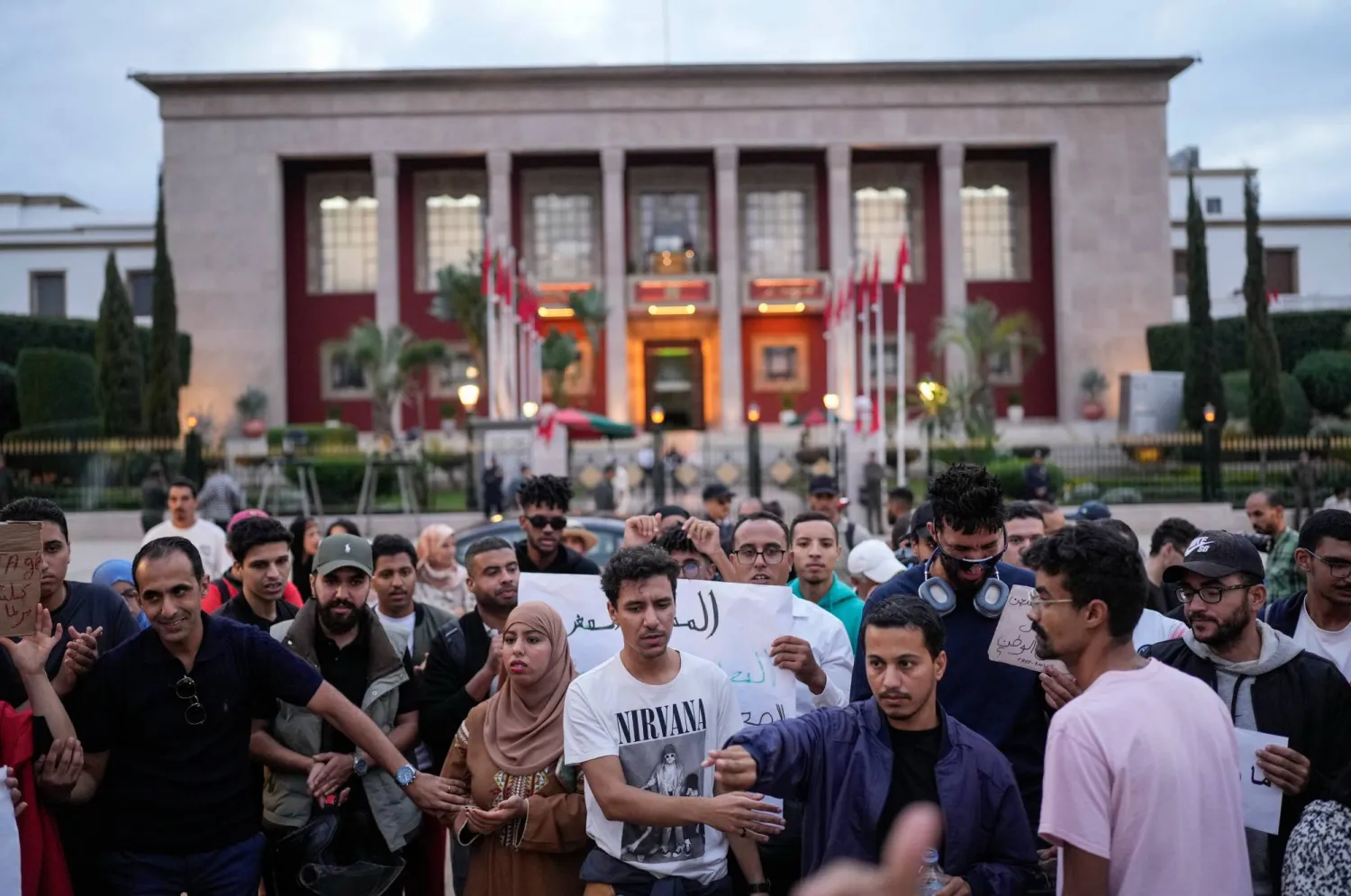
People take part in a youth-led protest against corruption and calling for education and healthcare reforms, in Rabat, Morocco, Thursday, Oct. 9, 2025. (AP Photo/Mosa'ab Elshamy)
TT

Gen Z Protests against Corruption and Inequality are Shaking Morocco. Here's What to Know

People take part in a youth-led protest against corruption and calling for education and healthcare reforms, in Rabat, Morocco, Thursday, Oct. 9, 2025. (AP Photo/Mosa'ab Elshamy)

Demonstrations in more than a dozen cities have jolted Morocco for weeks, with the young people behind them showing they can translate digital discontent into a real-world movement that authorities can’t ignore.

The North African nation is the latest to be rocked by “Gen Z” protests against corruption, lack of opportunity and business as usual. New protests are expected Saturday, said The Associated Press.

Similar movements have risen in countries such as Madagascar, Kenya, Peru and Nepal. They differ in origin but share a common refusal to go through institutions like political parties or unions to be heard.

In Morocco, anger has boiled over contrasts between government spending on stadiums in the lead-up to the 2030 FIFA World Cup and a subpar health system that lags behind countries with similarly sized economies.

Here’s what to know:

Meet the protesters

A leaderless collective called Gen Z 212 — named after Morocco’s dialing code — is the engine behind the protests. Members debate strategy on Discord, a chat app popular with gamers and teens. The core group has about 180,000 members, but spinoffs have also sprouted, organizing demonstrations in towns independently.

Like other nations swept by Gen Z protests, Morocco is experiencing a youth bulge, with more than half of the population under 35. Yet, as the country pours billions into infrastructure and tourism, unemployment for Moroccans ages 15-24 has climbed to 36%. And with opportunity lacking, more than half of Moroccans under 35 say they have considered emigrating, according to a June survey from non-partisan research network Afrobarometer.

When demonstrations turned violent earlier this month, officials said most participants were minors and rights groups said many detained were under 18.

What they are protesting

Morocco is Africa’s most visited country, appealing to tourists from around the world with its medieval palaces, bustling markets and sweeping mountain and desert landscapes. But not far from tourist routes, the daily reality for most of Morocco’s 37 million people includes soaring costs of living and stagnating wages.

The North African Kingdom has made significant strides in lifting standards of living, but development has been uneven and critics say it has exacerbated inequities.

Morocco boasts Africa’s only high-speed rail line and is constructing seven new stadiums and renovating seven others in preparation for the World Cup. It plans to spend more than $5 billion on infrastructure for the event, some from the private sector. Yet with a monthly minimum wage of around $300, many languish in poverty in areas where roads are unpaved, hospitals lack doctors and classrooms are underfunded and overcrowded.

Morocco has only 7.7 medical professionals per 10,000 inhabitants and far fewer in parts of the south and east where protests have become most heated. The public health system provides more than 80% of care, but accounts for only 40% of spending, with the rest coming from private or out-of-pocket costs.

Before Gen Z 212, localized protests against regional inequities and government priorities erupted, including in Al Haouz, where many remain in tents more than two years after a deadly 2023 earthquake. Anger boiled in September after eight women died giving birth in a public hospital in the coastal city of Agadir. Despite its renovated airport and reputation as a destination for tourists, the city is the capital of one of Morocco’s poorest provinces where residents have decried a lack of doctors and quality medical care.

Protesters, angry over corruption, have targeted Prime Minister Aziz Akhannouch and Health Minister Amine Tahraoui, his former business associate. Akhannouch, one of Morocco’s richest men, controls most of the country’s gas stations, and one of his companies recently won controversial government contracts for new desalination projects.

Morocco’s business interests, including the royal family’s investment fund Al Mada, have also projected substantial profits from World Cup-related developments, including new stadiums, train lines and hotels, according to the magazine Jeune Afrique.

Gen Z's key chants Protesters have chanted “Stadiums are here, but where are the hospitals?" in a jab at Morocco’s spending on spectacle projects for the World Cup and what many see as the government's blindness to everyday hardship.

“Freedom, dignity and social justice" is another slogan carried over from past movements denouncing limited political freedoms and economic exclusion, without offering specific demands for reform.

The protesters' demands Gen Z 212 published a letter addressed to King Mohammed VI asking him to dismiss the government and corrupt political parties, release detainees and convene a government forum to hold officials accountable.

The political demands diverged from earlier nebulous calls for dignity and social justice, and reflected a broad sentiment that Morocco has not made serious strides to overcome problems that the king vowed to address during 2017 mass demonstrations. At the time, he acknowledged development had not adequately trickled down to benefit all.

Though the king is the country’s highest authority, Gen Z protesters directed their ire at government officials and called on him to oversee reforms. Many on the streets shouted: “The people want the King to intervene."

In an address to Parliament this month, the king defended Morocco’s vision for the future, arguing that large-scale projects and social programs can advance together. He mirrored some of the protesters’ grievances but didn’t address the movement directly.

“Social justice is not a temporary priority,” he said. “There should be no contradiction or competition between major national projects and social programs, as both share the same goal: developing the country and improving the living conditions of citizens wherever they may be."

How the government has responded

Security forces have alternated between crackdown and retreat.

Riot police and plainclothes officers arrested demonstrators en masse on the weekend of Sept. 27 and 28. Police in a small town outside of Agadir fired on demonstrators they claimed were storming one of their posts in early October, killing three, and a police van rammed into protesters in the eastern city of Oujda, injuring one.

But elsewhere, security forces eased their presence, standing aside as rioters and looters set cars ablaze and smashed storefronts.

Moroccan courts have handed down a string of convictions tied to the protests, with sentences ranging from four to 20 years for vandalism and incitement, according to Human Rights Watch.

After the initial protests, Akhannouch and several of his Cabinet members said the government was open to dialogue with protesters and suggested fortifying existing hospitals with additional staff and opening new medical facilities.

But as Moroccans watch stadiums being built in a matter of months, promised changes have rung hollow to many demonstrators since no official has yet proposed redirecting stadium funds to social services.

“The government is taking patchwork measures to ease the pressure," Youssef, a 27-year-old demonstrator, said. "Their reforms will take years.”


The West Bank Football Field Slated for Demolition by Israel

Israeli army bulldozers pass buildings during a military operation in Nur Shams refugee camp, near the West Bank city of Tulkarem, 12 January 2026. (EPA)
TT

The West Bank Football Field Slated for Demolition by Israel

Israeli army bulldozers pass buildings during a military operation in Nur Shams refugee camp, near the West Bank city of Tulkarem, 12 January 2026. (EPA)

Israeli authorities have ordered the demolition of a football field in a crowded refugee camp in the occupied West Bank, eliminating one of the few ​spaces where Palestinian children are able to run and play.

"If the field gets demolished, this will destroy our dreams and our future. We cannot play any other place but this field, the camp does not have spaces," said Rital Sarhan, 13, who plays on a girls' soccer team in the Aida refugee camp near Bethlehem.

The Israeli military ‌issued a demolition ‌order for the field on ‌December ⁠31, ​saying ‌it was built illegally in an area that abuts the concrete barrier wall that Israel built in the West Bank.

"Along the security fence, a seizure order and a construction prohibition order are in effect; therefore, the construction in the area was carried out unlawfully," the Israeli military said in a statement.

Mohammad Abu ⁠Srour, an administrator at Aida Youth Center, which manages the field, said the ‌military gave them seven days to demolish ‍the field.

The Israeli military ‍often orders Palestinians to carry out demolitions themselves. If they ‍do not act, the military steps in to destroy the structure in question and then sends the Palestinians a bill for the costs.

According to Abu Srour, Israel's military told residents when delivering ​the demolition order that the football field represented a threat to the separation wall and to Israelis.

"I ⁠do not know how this is possible," he said.

Israeli demolitions have drawn widespread international criticism and coincide with heightened fears among Palestinians of an organized effort by Israel to formally annex the West Bank, the area seized by Israel in the 1967 Middle East war.

Israel accelerated demolitions in Palestinian refugee camps in early 2025, leading to the displacement of 32,000 residents of camps in the central and northern West Bank.

Human Rights Watch has called the demolitions a war crime. ‌Israel has said they are intended to disrupt militant activity.


In 'Big Trouble'? The Factors Determining Iran's Future

In this frame grab from video taken by an individual not employed by The Associated Press and obtained by the AP outside Iran shows people blocking an intersection during a protest in Tehran, Iran, Thursday Jan. 8, 2026. (UGC via AP)
TT

In 'Big Trouble'? The Factors Determining Iran's Future

In this frame grab from video taken by an individual not employed by The Associated Press and obtained by the AP outside Iran shows people blocking an intersection during a protest in Tehran, Iran, Thursday Jan. 8, 2026. (UGC via AP)

Over two weeks of protests mark the most serious challenge in years to Iran's theocratic leadership in their scale and nature but it is too early to predict the immediate demise of the Iranian republic, analysts say.

The demonstrations moved from protesting economic grievances to demanding a wholesale change from the clerical system that has ruled Iran since the 1979 revolution that ousted the shah.

The authorities have unleashed a crackdown that, according to rights groups, has left hundreds dead while the rule of supreme leader Ali Khamenei, now 86, remains intact.

"These protests arguably represent the most serious challenge to Iran in years, both in scale and in their increasingly explicit political demands," Nicole Grajewski, professor at the Sciences Po Centre for International Studies in Paris told AFP.

She said it was unclear if the protests would unseat the leadership, pointing to "the sheer depth and resilience of Iran's repressive apparatus".

The Iranian authorities have called their own counter rallies, with thousands attending on Monday.

Thomas Juneau, professor at the University of Ottawa, said: "At this point, I still don't assess that the fall of the regime is imminent. That said, I am less confident in this assessment than in the past."

These are the key factors seen by analysts as determining whether Iran’s leadership will hold on to power.

- Sustained protests -

A key factor is "simply the size of protests; they are growing, but have not reached the critical mass that would represent a point of no return," said Juneau.

The protest movement began with strikes at the Tehran bazaar on December 28 but erupted into a full-scale challenge with mass rallies in the capital and other cities from Thursday.

The last major protests were the 2022-2023 demonstrations sparked by the death in custody of Mahsa Amini who had been arrested for allegedly violating the dress code for women. In 2009, mass rallies took place after disputed elections.

But a multi-day internet shutdown imposed by Iranian authorities has hampered the ability to determine the magnitude of the current demonstrations, with fewer videos emerging.

Arash Azizi, a lecturer at Yale University, said "the protesters still suffer from not having durable organized networks that can withstand oppression".

He said one option would be to "organize strikes in a strategic sector" but this required leadership that was still lacking.

- Cohesion in the elite -

While the situation on the streets is of paramount importance, analysts say there is little chance of a change without cracks and defections in the security forces and leadership.

So far there has been no sign of this, with all the pillars of Iran from parliament to the president to the Revolutionary Guards (IRGC) lining up behind Khamenei's defiant line expressed in a speech on Friday.

"At present, there are no clear signs of military defections or high-level elite splits within the regime. Historically, those are critical indicators of whether a protest movement can translate into regime collapse," said Sciences Po's Grajewski.

Jason Brodsky, policy director at US-based group United Against Nuclear Iran, said the protests were "historic".

But he added: "It's going to take a few different ingredients for the regime to fall," including "defections in the security services and cracks in the Islamic republic's political elite".

Israeli or US military intervention

US President Donald Trump, who has threatened military retaliation over the crackdown, announced 25 percent tariffs on Monday against Iran's trading partners.

The White House said Trump was prioritizing a diplomatic response, and has not ruled out strikes, after having briefly joined Israel's 12-day war against Iran in June.

That war resulted in the killing of several top Iranian security officials, forced Khamenei to go into hiding and revealed Israel's deep intelligence penetration of Iran.

US strikes would upend the situation, analysts say.

The Iranian foreign ministry said on Monday it has channels of communication open with Washington despite the lack of diplomatic relations.

"A direct US military intervention would fundamentally alter the trajectory of the crisis," said Grajewski.

Juneau added: "The regime is more vulnerable than it has been, domestically and geopolitically, since the worst years of the Iran-Iraq war" that lasted from 1980-1988.

- Organized opposition -

The US-based son of the ousted shah, Reza Pahlavi, has taken a major role in calling for protests and pro-monarchy slogans have been common chants.

But with no real political opposition remaining inside Iran, the diaspora remains critically divided between political factions known for fighting each other as much as the Iranian republic.

"There needs to be a leadership coalition that truly represents a broad swathe of Iranians and not just one political faction," said Azizi.

- Khamenei's health -

Khamenei has now been in power since 1989 when he became supreme leader, a post for life, following the death of revolutionary founder Khomeini.

He survived the war with Israel and appeared in public on Friday to denounce the protests in typically defiant style.

But uncertainty has long reigned over who could succeed him, with options including his shadowy but powerful son Mojtaba or power gravitating to a committee rather than an individual.

Such a scenario between the status quo and a complete change could see "a more or less formal takeover by the Revolutionary Guards", said Juneau.


What to Know about the Protests Shaking Iran as Govt Shuts Down Internet and Phone Networks

Mourners carry coffins during a funeral procession for members of security forces and civilians said to be killed in protests on Sunday, amid evolving anti-government unrest, in Tehran, Iran, in this screengrab from a video released on January 11, 2026.  IRIB/Handout via REUTERS
Mourners carry coffins during a funeral procession for members of security forces and civilians said to be killed in protests on Sunday, amid evolving anti-government unrest, in Tehran, Iran, in this screengrab from a video released on January 11, 2026. IRIB/Handout via REUTERS
TT

What to Know about the Protests Shaking Iran as Govt Shuts Down Internet and Phone Networks

Mourners carry coffins during a funeral procession for members of security forces and civilians said to be killed in protests on Sunday, amid evolving anti-government unrest, in Tehran, Iran, in this screengrab from a video released on January 11, 2026.  IRIB/Handout via REUTERS
Mourners carry coffins during a funeral procession for members of security forces and civilians said to be killed in protests on Sunday, amid evolving anti-government unrest, in Tehran, Iran, in this screengrab from a video released on January 11, 2026. IRIB/Handout via REUTERS

Nationwide protests in Iran sparked by the country’s ailing economy are putting new pressure on its theocracy as it has shut down the internet and telephone networks.

Tehran is still reeling from a 12-day war launched by Israel in June that saw the United States bomb nuclear sites in Iran. Economic pressure, which has intensified since September when the United Nations reimposed sanctions on the country over its atomic program, has sent Iran's rial currency into a free fall, now trading at over 1.4 million to $1.

Meanwhile, Iran's self-described “Axis of Resistance” — a coalition of countries and militant groups backed by Tehran — has been decimated since the start of the Israel-Hamas war in 2023.

A threat by US President Donald Trump warning Iran that if Tehran “violently kills peaceful protesters” the US “will come to their rescue," has taken on new meaning after American troops captured Venezuela's Nicolás Maduro, a longtime ally of Tehran.

“We're watching it very closely,” Trump has warned. “If they start killing people like they have in the past, I think they're going to get hit very hard by the United States.”

Here's what to know about the protests and the challenges facing Iran's government.

How widespread the protests are

More than 500 protests have taken place across all of Iran’s 31 provinces, the US-based Human Rights Activists News Agency reported early Monday. The death toll had reached at least 544, it said, with more than 10,600 arrests. The group relies on an activist network inside of Iran for its reporting and has been accurate in past unrest.

The Iranian government has not offered overall casualty figures for the demonstrations. The Associated Press has been unable to independently assess the toll, given that internet and international phone calls are now blocked in Iran.

Understanding the scale of the protests has been difficult. Iranian state media has provided little information about the demonstrations. Online videos offer only brief, shaky glimpses of people in the streets or the sound of gunfire. Journalists in general in Iran also face limits on reporting such as requiring permission to travel around the country, as well as the threat of harassment or arrest by authorities. The internet shutdown has further complicated the situation.

But the protests do not appear to be stopping, even after Supreme Leader Ali Khamenei said “rioters must be put in their place.”

Why the demonstrations started

The collapse of the rial has led to a widening economic crisis in Iran. Prices are up on meat, rice and other staples of the Iranian dinner table. The nation has been struggling with an annual inflation rate of some 40%.

In December, Iran introduced a new pricing tier for its nationally subsidized gasoline, raising the price of some of the world’s cheapest gas and further pressuring the population. Tehran may seek steeper price increases in the future, as the government now will review prices every three months.

Meanwhile, food prizes are expected to spike after Iran’s Central Bank in recent days ended a preferential, subsidized dollar-rial exchange rate for all products except medicine and wheat.

The protests began in late December with merchants in Tehran before spreading. While initially focused on economic issues, the demonstrations soon saw protesters chanting anti-government statements as well. Anger has been simmering over the years, particularly after the 2022 death of 22-year-old Mahsa Amini in police custody that triggered nationwide demonstrations.

Some have chanted in support of Iran's exiled Crown Prince Reza Pahlavi, who called for protests Thursday and Friday night.

Iran's alliances are weakened

Iran's “Axis of Resistance," which grew in prominence in the years after the 2003 US-led invasion and subsequent occupation of Iraq, is reeling.

Israel has crushed Hamas in the devastating war in the Gaza Strip. Hezbollah, the Shiite militant group in Lebanon, has seen its top leadership killed by Israel and has been struggling since. A lightning offensive in December 2024 overthrew Iran’s longtime stalwart ally and client in Syria, President Bashar Assad, after years of war there. Yemen's Iranian-backed Houthis also have been pounded by Israeli and US airstrikes.

China meanwhile has remained a major buyer of Iranian crude oil, but hasn't provided overt military support. Neither has Russia, which has relied on Iranian drones in its war on Ukraine.

The West worries about Iran’s nuclear program Iran has insisted for decades that its nuclear program is peaceful. However, its officials have increasingly threatened to pursue a nuclear weapon. Iran had been enriching uranium to near weapons-grade levels before the US attack in June, making it the only country in the world without a nuclear weapons program to do so.

Tehran also increasingly cut back its cooperation with the International Atomic Energy Agency, the UN's nuclear watchdog, as tensions increased over its nuclear program in recent years. The IAEA's director-general has warned Iran could build as many as 10 nuclear bombs, should it decide to weaponize its program.

US intelligence agencies have assessed that Iran has yet to begin a weapons program, but has “undertaken activities that better position it to produce a nuclear device, if it chooses to do so.”

Iran recently said it was no longer enriching uranium at any site in the country, trying to signal to the West that it remains open to potential negotiations over its atomic program to ease sanctions. But there's been no significant talks in the months since the June war.

Why relations between Iran and the US are so tense

Iran decades ago was one of the United States’ top allies in the Mideast under Shah Mohammad Reza Pahlavi, who purchased American military weapons and allowed CIA technicians to run secret listening posts monitoring the neighboring Soviet Union. The CIA fomented a 1953 coup that cemented the shah’s rule.

But in January 1979, the shah fled Iran as mass demonstrations swelled against his rule. Then came the Iranian Revolution led by Khomeini, which created Iran’s theocratic government.

Later that year, university students overran the US Embassy in Tehran, seeking the shah’s extradition and sparking the 444-day hostage crisis that saw diplomatic relations between Iran and the US severed.

During the Iran-Iraq war of the 1980s, the US backed Saddam Hussein. During that conflict, the US launched a one-day assault that crippled Iran at sea as part of the so-called “Tanker War,” and later shot down an Iranian commercial airliner that the US military said it mistook for a warplane.

Iran and the US have seesawed between enmity and grudging diplomacy in the years since. Relations peaked with the 2015 nuclear deal, which saw Iran greatly limit its program in exchange for the lifting of sanctions. But Trump unilaterally withdrew America from the accord in 2018, sparking tensions in the Mideast that intensified after Hamas' Oct. 7, 2023, attack on Israel.