


Mamdani Victory Fires up Europe’s Left Against Right-Wing Surge at Home

Mayor-Elect Zohran Mamdani speaks during a press conference at the Unisphere on November 05, 2025 in the Queens borough of New York City. (Getty Images via AFP)
TT

Mamdani Victory Fires up Europe’s Left Against Right-Wing Surge at Home

Mayor-Elect Zohran Mamdani speaks during a press conference at the Unisphere on November 05, 2025 in the Queens borough of New York City. (Getty Images via AFP)

The blistering rise of Zohran Mamdani to become mayor of New York City has offered encouragement to left-wing parties across Europe that an unabashedly radical agenda could help turn the tide against right-wing forces at home.

Parties from London to Berlin cheered Mamdani, a 34-year-old self-described democratic socialist whose viral videos and promise of rent controls and taxing the rich in a city seen as a beacon of global capitalism struck a chord with voters.

Parties like Germany's The Left party and Britain's Greens hope to garner momentum from Mamdani's win, signaling they would not dilute their policies or be sucked into the right-wing battleground of migration. It could also give food for thought to established left-wing parties like Britain's ruling Labour party, which has tanked in the polls since its landslide election victory last year, and Germany's Social Democrats (SPD).

Zack Polanski, who this year became the first Jewish leader of the Green Party of England and Wales, has drawn comparisons to Mamdani for his use of social media and calls for a wealth tax to reduce inequality.

An ecstatic Polanski told Reuters that Mamdani's victory shows "hope has triumphed over hate".

"This is important - not just because it's important for New York but actually I think this resonates throughout the world. But this is about improving people's lives, recognizing the inequality that lies both at the heart of New York, but frankly, around much of the world."

"And this is about saying: let's lower people's bills and tax multimillionaires and billionaires," said Polanski, whose party has risen in the polls after winning just four seats in 2024.

Cost of living is a major focus in Britain where food price inflation for example hit 19% in March 2023, the highest in 45 years, and finance minister Rachel Reeves has signaled "hard choices" and possible tax rises to come.

LEFT WANTS TO BUILD MOMENTUM

In a polarized political landscape, Germany's Left party was a surprise package in federal elections in February and hopes to build on its strong showing next year in local elections, including in the capital Berlin. Like other European leftists, its members visited New York during the campaign.

"The problems people in New York face are very similar to those we hear about at people’s doorsteps here in Germany. Rents are unaffordable, and prices for food, electricity, heating, and public transport are rising faster than wages," Jan van Aken, head of Germany's Left party, told Reuters.

"We are in close contact with Zohran Mamdani and his team and are learning from each other. His campaign is like a blueprint for next year's elections in Berlin," he said in an email. "Zohran Mamdani's victory gives us momentum."

Set to become New York's first Muslim mayor and the youngest since 1892, Mamdani's social media posts resonated on both sides of the Atlantic with voters hit by rising inflation and stretched public services since the pandemic.

"I'm freezing ... your rent," Mamdani told New Yorkers after plunging into icy waters off Coney Island in January in suit and tie.

Germany's Left is also pushing rent controls and free or heavily subsidized transport, and uses blunt messaging. "We're taking on the rich. Nobody else is doing that," said one of its campaign posters.

Leftists in France, which is gearing up for presidential elections by 2027, were also inspired.

"Finally, a lesson for the left everywhere: it is not by watering down economic liberalism that we win, but by fighting it tooth and nail," Manon Aubry, from the far-left France Unbowed party (LFI), wrote on X.

COST OF LIVING FOCUS

Asked what lessons left-wing parties should draw from Mamdani's victory, Polanski said the cost of living mattered above all else and that progressive parties must offer real solutions to it.

More established mainstream parties have also taken heart from Mamdani's victory.

"For us in the SPD, this means we must refocus more strongly on what is at the heart of our work – social policies for the majority of society," SPD lawmaker Rasha Nasr told Reuters. The SPD, while still in power, scored its worst result since World War Two at the last election.

"In the last federal election campaign, we too often tried to engage in debates that were, by that point, hardly winnable on a factual basis, for example, regarding migration policy."

Philipp Koeker, political scientist at the University of Hanover, said it showed parties who want to win elections "or do not want to lose voters to the populist far right – should stick to their own core issues and present their own solutions to current problems rather than imitate the far right by adopting anti-immigration policies."

Having won on a radical agenda, Mamdani will face challenges putting his pledges into action. US President Donald Trump has threatened to cut funding to New York City. Some, including on Wall Street, hope and expect Mamdani will be unable to force through drastic change.

"Now comes the hard part," said James Schneider, former director of strategic communications for Labour under Jeremy Corbyn.

"Turning that electoral majority into real power — improving lives from City Hall while transforming his 100,000-strong volunteer army into community organizers in every neighborhood of the city."



Siege of Balad Base May Prelude ‘Doomsday’ Scenario in Iraq

A US military handout image shows the Balad Air Base in Iraq in 2011.
TT

Siege of Balad Base May Prelude ‘Doomsday’ Scenario in Iraq

A US military handout image shows the Balad Air Base in Iraq in 2011.

An American contractor responsible for operating Iraq’s F-16 fighter jets has withdrawn its staff from an Iraqi air base after attacks by Iran-aligned factions, leaving Baghdad racing to find replacements before its most advanced aircraft risks becoming “scrap,” officials and sources said.

The attacks cap years of what sources describe as “infiltration and espionage attempts” targeting US technology acquired by Iraq about a decade ago, culminating in what they called a “doomsday scenario” to seize Iraqi military assets.

The Iraqi government had tried to persuade staff from V2X to remain at Balad Air Base despite repeated strikes. A senior Iraqi official said that although the attacks caused no major damage, “the company’s employees insisted on leaving for their own safety.”

According to a foreign contractor, security personnel and employees, the evacuation followed an intense wave of drone attacks and was carried out during a temporary truce to secure what one source described as a “high-risk flight.”

Since the outbreak of war involving the US-Israeli war on Iran, the Balad Air Base has come under attack from three directions, most of which failed to cause significant damage, sources said.

During the first term of President Donald Trump, Iran-aligned groups forced a previous American contractor to leave the same base after the US strike that killed Qassem Soleimani in January 2020.

Dozens of staff from Sallyport were reported to have departed after deadly attacks.

The pattern now appears to be repeating with V2X during Trump’s second term, but in a broader regional war.

Drone attacks strain operations

The first attack in the current escalation occurred on March 2, the third day of the war. Subsequent strikes followed a pattern, often between midnight and early dawn, sometimes involving paired drones.

Local residents filmed smoke rising near the base. A nearby farmer told Asharq Al-Awsat that most drones fell within or just outside the perimeter, close to the security fence.

A security source said around 10 attacks were recorded in the first month of the war, causing no casualties or damage, including to the F-16 fleet.

But the attacks disrupted daily operations. “We had to stay in fortified rooms for hours,” one contractor said, adding that foreign staff feared a repeat of the 2012 US consulate attack in Libya.

Iraqi staff downplayed the threat, saying operations continued as normal.

Evacuation under truce

Baghdad’s efforts to retain the American team failed. The official said the logistical support program for the F-16s was essential to keeping Iraq’s fighter squadron operational, but the staff chose to leave.

Sources said dozens of foreign personnel were evacuated overnight aboard a military C-130 aircraft to a neighboring country, in coordination with the US military. The operation was timed with a brief truce in the final week of March.

Some advisers had already withdrawn in late February, citing early warnings of rising risks.

V2X did not respond to requests for comment. A New York Stock Exchange filing shows its contract was renewed in June 2025 with an initial value of $118 million.

The base now lacks a specialized team to operate Iraq’s F-16s, and the government lacks the funds to maintain them, the Iraqi official said.

Aircraft at risk

Retired Colonel Salam Asaad said the aircraft would likely become inoperable without American expertise. “Local crews lack the experience to manage such a strategic system,” he said.

He added that the jets delivered to Iraq had been modified, with the United States removing some systems and not equipping them with long-range missiles.

Even during the war against ISIS, Iraqi F-16s relied on coalition aircraft to strike targets, he said.

Although the US Central Command has pointed to improved Iraqi self-sufficiency in recent years, the combination of technical dependence and sustained attacks has exposed vulnerabilities.

The attacks on Balad are part of a broader campaign since early March targeting US and Iraqi facilities. A source close to armed factions said the initial goal was to pressure US forces, but “when they withdrew, the targets expanded.”

The source said Iran’s Revolutionary Guards sought to isolate adversaries from the F-16 fleet and prevent its use during the conflict.

A former Iraqi official involved in procurement said Iran-aligned groups had long shown a strong interest in the aircraft, suggesting Tehran was uneasy with Iraq possessing such capabilities because it would view it as a threat.

‘Doomsday scenario’

An Iraqi official said a prolonged intelligence struggle had taken place between the US and Iranian sides over access to the aircraft’s systems, with armed groups repeatedly attempting to gather sensitive information.

Figures within Iraq’s ruling pro-Iran Coordination Framework warned of a potential “coup against what remains of the state.”

One figure said that after the war, factions could move toward a “doomsday scenario,” consolidating control over state military assets with political backing and institutional presence.

On March 30, head of the IRGC’s Quds Force Esmail Qaani said the “resistance’s joint operations room” had contributed to shaping a new regional order.

A former Iraqi official said earlier attempts by armed groups to penetrate military infrastructure had failed, but could now be seen as “a long rehearsal,” with Iraq being exposed to the Iranians during the war.


Facts about Strait of Hormuz Shipping Blockade

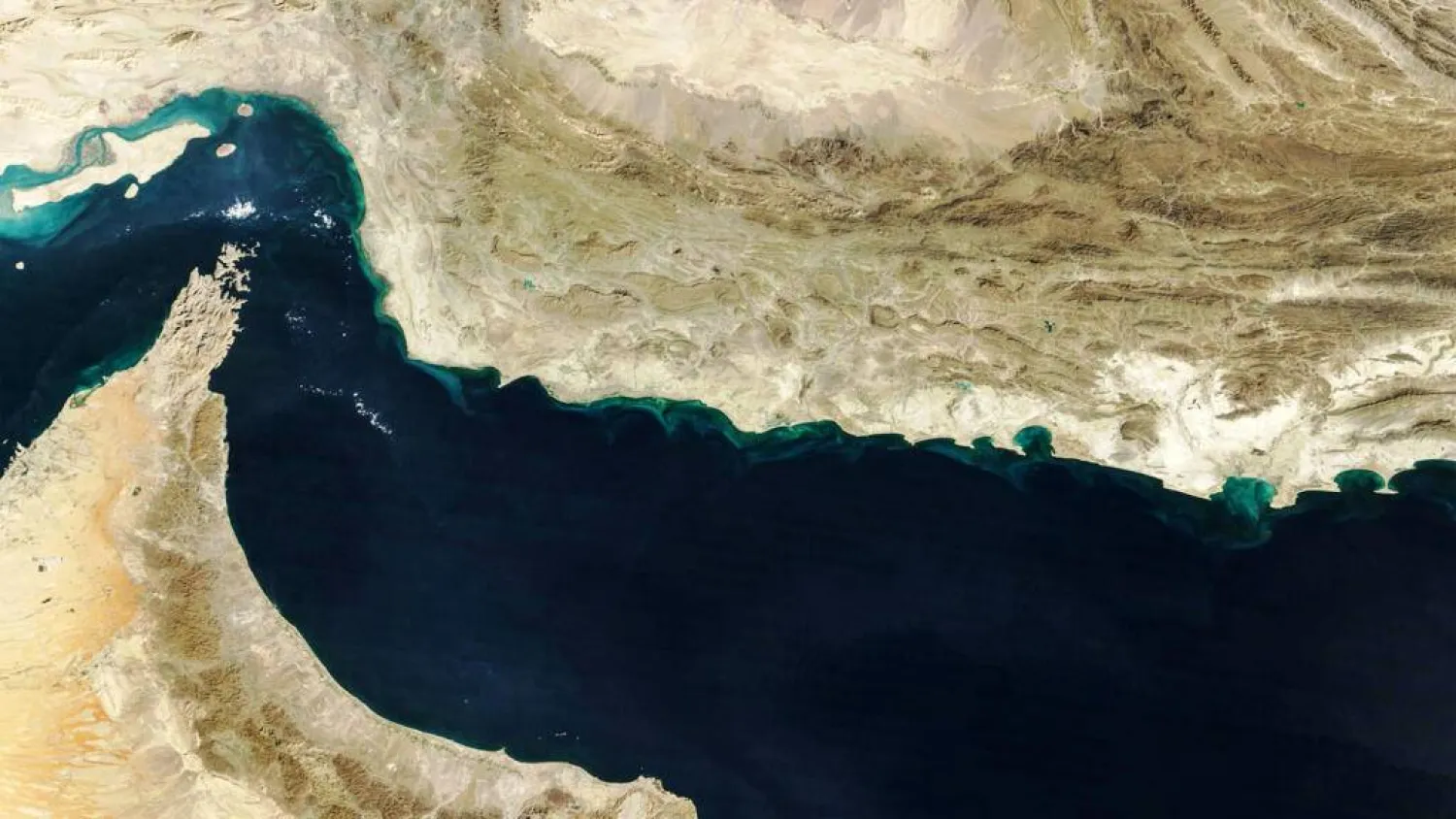
Around a fifth of global crude oil and liquefied natural gas passes through the Strait of Hormuz in peacetime. NASA Earth Observatory/AFP/File
TT

Facts about Strait of Hormuz Shipping Blockade

Around a fifth of global crude oil and liquefied natural gas passes through the Strait of Hormuz in peacetime. NASA Earth Observatory/AFP/File

Here are the latest key facts and figures about the blockage of the Strait of Hormuz, a crucial shipping route virtually paralyzed by the Middle East war.

Around a fifth of global crude oil and liquefied natural gas passes through the waterway in peacetime.

The war erupted on February 28 when the United States and Israel began bombing Iran, prompting Tehran to retaliate with strikes across the region and sharply restrict access to the strait.

First incident reported in over a week

The Express Rome, a Liberia-flagged container vessel, reported on Monday that two unknown projectiles splashed next to the moving ship within an hour of each other. All crew were reported safe.

The ship was 22 nautical miles northeast of the Ras Tanura port in Saudi Arabia, according to the British maritime security agency UKMTO and maritime security firm Vanguard Tech.

Iran's Revolutionary Guards previously claimed to have attacked the vessel on March 11, in a press release published by the ISNA news agency.

Monday's was the first such incident, attack or suspicious activity reported by the UKMTO since March 22.

Since March 1, 2026, 25 commercial vessels, including 11 tankers, have been attacked or reported incidents in the Gulf, the Strait of Hormuz or the Gulf of Oman, according to the UKMTO.

Drones struck fuel tanks at Oman's Salalah port on Saturday, injuring one worker and disrupting operations but hitting no vessels.

Eight sea workers killed

Since the conflict began, at least eight seafarers or dock workers have died in incidents in the region, according to the International Maritime Organization (IMO).

A further four remained missing and 10 were injured.

Around 20,000 seafarers are affected in the region, according to the IMO.

Handful of crossings

Seventeen commodities vessels crossed the strait over the weekend, 12 of them on Saturday, making it one of the busiest days for crossings since March 1, according to maritime intelligence firm Kpler.

From March 1 to 30 as of 1700 GMT Monday, commodities carriers made just 196 crossings, according to Kpler data -- a decrease of 95 percent from peacetime.

Of these, 120 were by oil tankers and gas carriers and most were travelling east out of the strait.

Chinese container ships pass

On Monday, two further ships -- ultra-large container vessels owned by Chinese shipping giant Cosco -- appeared to have successfully crossed the strait after an aborted attempt last week, maritime tracker MarineTraffic said on X.

It interpreted their passage as "signaling a potential shift in conditions for commercial shipping".

Steel, soybeans shipped

Nine of the commodities ships passing through the strait over the weekend were dry bulk carriers transporting metals, iron ore pellets and soybean meal.

Four vessels were liquified petroleum gas tankers and the rest were liquid tankers.

The channel in peacetime sees around 120 daily transits, according to shipping industry intelligence site Lloyd's List.

2,000 ships in Gulf

Around 2,142 vessels have sent transponder signals in the Gulf west of the Strait of Hormuz in the past day, according to Bloomberg data.

Of those, 298 were tankers, including 10 very large gas carriers and 55 very large crude carriers.

Iran-approved route

Recent crossings appeared to have mainly used a route apparently approved by Iran around Larak Island just off the country's coast.

Leading shipping journal Lloyd's List last week said at least 34 ships had been tracked using it.

The Revolutionary Guards said the route was closed to vessels travelling to and from ports linked to Iran's "enemies".

45% sanctioned ships

Since the war started, 45 percent of the crossings have been by ships under US, EU or UK sanctions, according to an AFP analysis of passage data.

Of the crossings by oil and gas tankers, 62 percent were by vessels under sanctions.


What Could Trump Achieve by Threatening Iran's Kharg Island?

Some 90 percent of Iran's crude exports pass through Kharg Island, making it a potentially crucial pressure point for Tehran. EUROPEAN SPACE AGENCY/AFP
TT

What Could Trump Achieve by Threatening Iran's Kharg Island?

Some 90 percent of Iran's crude exports pass through Kharg Island, making it a potentially crucial pressure point for Tehran. EUROPEAN SPACE AGENCY/AFP

A scrubby island in the Gulf that is roughly one third the size of Manhattan, Kharg Island is the nerve center of the Iranian oil industry -- and at the heart of US President Donald Trump's latest efforts to pressure Tehran.

On Monday Trump vowed that a failure by Iran to agree a deal to end the war could see the United States "completely obliterating" the export hub.

A day earlier, he had said the United States could take the island, eyed by the Pentagon for ground operations, "very easily".

So what are Trump's options, and how might Iran react if he presses on this pressure point?

What is Kharg Island?

It may be a mere scrap of land, but Kharg handles around 90 percent of Iran's crude exports, according to a report by US bank JP Morgan.

Located in the north of the Gulf, around 30 kilometers (20 miles) from the Iranian coast and more than 500 kilometers from the Strait of Hormuz, it has no oil wells.

But it has Iran's largest oil terminal, oil pipelines, storage tanks and related infrastructure.

It also has military facilities, some of which have already been hit by Israeli-US strikes.

On March 13, "US forces executed a large-scale precision strike on Kharg Island", Centcom, the US military command for the region, said.

"The strike destroyed naval mine storage facilities, missile storage bunkers and multiple other military sites. US forces successfully struck more than 90 Iranian military targets on Kharg Island, while preserving the oil infrastructure."

Sources close to US intelligence services told US broadcaster CNN Iran had deployed additional troops and defense systems to the area in recent weeks, including MANPAD-type surface-to-air missiles and mines.

Trump's options?

There appear to be three routes for US forces wishing to seize the island -– an airborne attack; an amphibious operation; or a combination of the two.

The Pentagon is currently moving US paratroopers and Marines into the area.

"(The) US combat force build-up sets the stage for (a) potential ground offensive in Iran," said US think tank Soufan.

Centcom former commander General Joseph Votel told The War Zone website this month it would not take that many soldiers to seize Kharg.

"On a small island like Kharg, I imagine you'd need a battalion of Marines. We are therefore talking about a force of 800 to 1,000 men, perhaps a little fewer, certainly not much more," he said.

But taking Kharg and holding onto it "are two different things", stressed Professor Phillips O'Brien of the University of St Andrews in Scotland.

He said the US military would struggle to retain the island within range of Iranian missiles and drones.

Just 60 kilometers away is the city of Bushehr, an important military center "from which the Iranians defend the entire northern part of the Gulf, including Kharg", noted Pierre Razoux of French research center FMES.

Why do it?

Trump's war goals remain hazy. It is unclear whether he primarily wants to force Iran to reopen shipping lanes in the Strait of Hormuz; force regime change in Tehran; coerce the Iranians into concessions on their nuclear or ballistic missile programs.

In the short term, capturing Kharg could give Washington leverage to force Iran to negotiate -– presumably on Trump's terms, given the country's dependence on oil revenue, the Soufan Center said.

It might not have much effect in reopening the Gulf to shipping, however, because Iran controls a string of other islands in the Strait of Hormuz.

And if the Iranians choose not to cede to Trump's demands, "What does the US do?", O'Brien wondered.

"Does the US then, out of spite, level all the economic facilities on Kharg?

"That could easily boomerang back in American faces. It means oil prices skyrocket even more and stay high for much longer," he said.

"It also means Iran will be incentivized to shut down the traffic in the Straits for even longer. If they cannot get their own oil out, why let anyone else's?"