Assad’s ‘Trap’: A Night That Shook Tehran’s Allies in Baghdad

A defaced portrait of Syria's ousted President Bashar al-Assad hangs on a wall in the capital Damascus on June 2, 2025. (AFP)
TT

Assad’s ‘Trap’: A Night That Shook Tehran’s Allies in Baghdad

A defaced portrait of Syria's ousted President Bashar al-Assad hangs on a wall in the capital Damascus on June 2, 2025. (AFP)

A senior Iraqi security official urged his driver to pick up speed as they raced toward Damascus airport. He needed to catch a flight back to Baghdad, while alerts kept lighting up his phone.

One message stood out: “The Syrian factions are on their way to the capital.”

It was Saturday evening, December 7, 2024, and the official had just wrapped up a routine mission in northeastern Syria to coordinate border security. But Syria itself was on the edge of a dramatic shift, its old order crumbling and a new one taking shape in the ruins.

At the outskirts of Damascus, the official’s convoy halted, waiting for “extraordinary arrangements” with the emerging authorities. A flurry of sudden, unexpected contacts unfolded between the two sides.

A former Syrian official from the Military Operations Directorate said it was “the first time that Hayat Tahrir al-Sham group communicated with an official in the Iraqi government.”

An Iraqi security officer who was present during the arrangements said that “the process went ahead with unexpected ease at the time, and we entered Damascus” alongside members of the group on the morning of December 8, 2024. Then a message arrived like a lightning strike: “Bashar al-Assad has fled.”

Damascus airport was a ghostly stage. Even the officers of the Air Transport Brigade whom the Iraqi official knew had disappeared. No one asked for a ticket or a passport. The diplomatic lane was wide open to the wind. The man boarded a special flight to Baghdad.

As the plane climbed through daylight, the Iraqi security official carried a bag full of questions about the new Syria.

On the same route, but on the ground, Iraqi militias that had been stationed in Syria since 2011 were withdrawing. Convoys moved from the Damascus countryside toward Al-Bukamal near the Iraqi border, making a final one-way journey for hundreds of fighters, leaving behind 15 years of a “Resistance Axis” now collapsing like a mountain of sand.

Exclusive testimonies gathered by Asharq Al-Awsat from Iraqi figures involved in the Syrian file before Assad’s escape reveal how militias withdrew from Syria without coordination or prior arrangements.

The accounts describe what unfolded behind the scenes, including how they viewed the events, and later showed that Tehran, Moscow and Assad had each made separate decisions not to fight in Syria, failing to share essential information with their Iraqi allies until late.

The testimonies also shed light on the reactions of Shiite groups following the collapse of the Assad regime, including calls to strengthen the influence of armed factions in Iraq’s political process and reinforce what became known as “Shiite governance” in Baghdad, in order to “absorb the shock felt by those who had been left behind in Syria.”
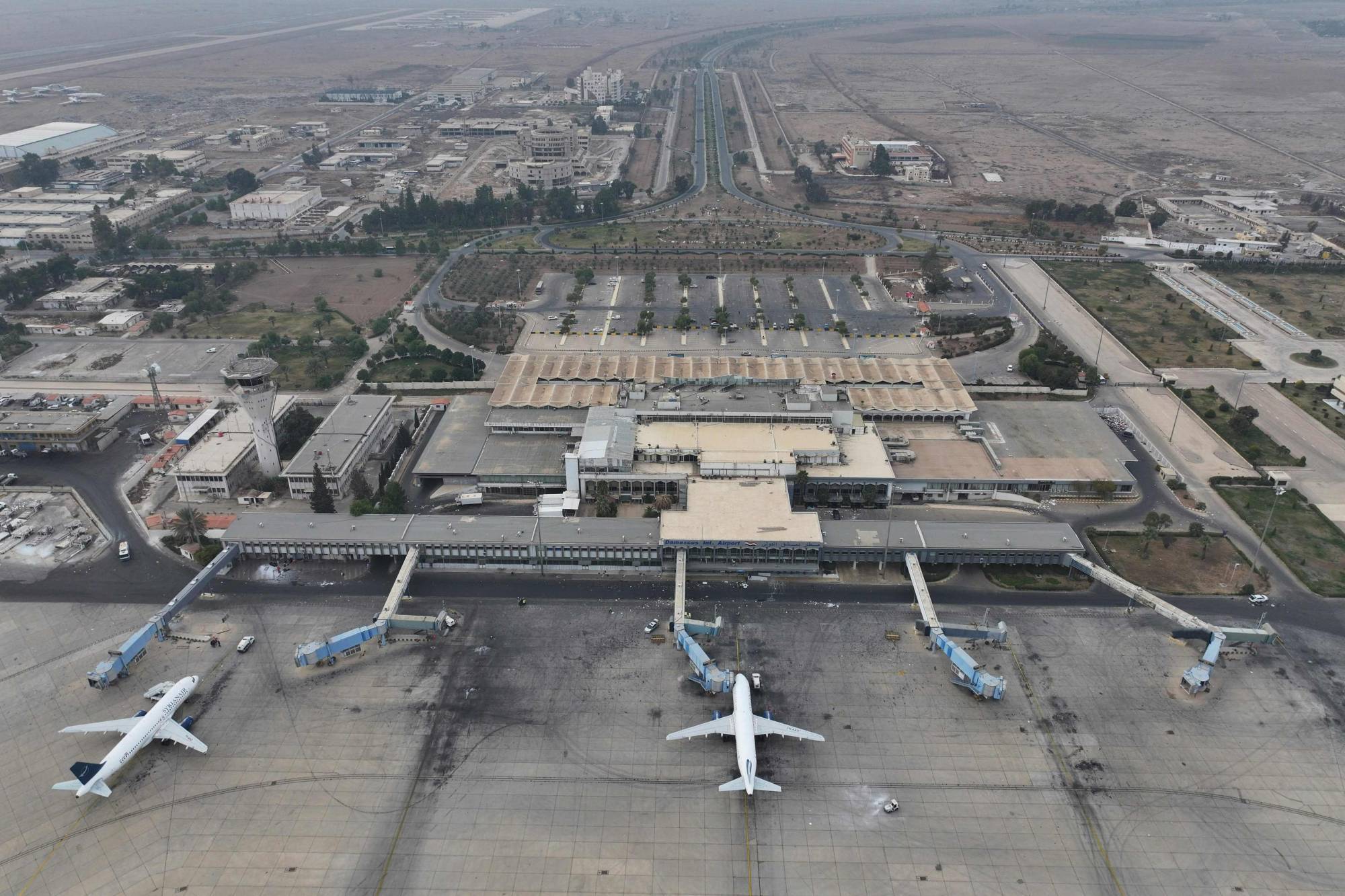
Damascus airport after the collapse of the Assad regime. (AFP file)

‘It was not a maneuver... we were deceived’

On November 30, 2024, three days after the launch of Operation Deterrence of Aggression to topple the Syrian regime, Iraqi Prime Minister Mohammed Shia al-Sudani held a phone call with Syrian President Bashar al-Assad.

At that time, Syrian opposition factions had seized control of the Aleppo countryside. Sudani told Assad that “Syria’s security is tied to Iraq’s national security.” The following day, the opposition encircled Hama. Sudani did not call Assad again.

In Nineveh, the northern Iraqi province that borders Syria, Shiite militia leaders attempted to send reinforcements to Syria, since “as the Syrian factions advanced, the number of Iran-aligned fighters was far smaller than in previous years.” A militia official in Nineveh said they told their fighters, “You must protect the Shiites and the shrines in Syria,” and many volunteers were eager to join.

Kadhim al-Fartousi, spokesman for Kataib Sayyid al-Shuhada, which had been active in Syria since 2013, said the group withdrew in late 2023. “Our mission was over,” he said.

Until 2018, Syria was crowded with more than 150,000 fighters from Iran’s Revolutionary Guard, Hezbollah and Iraqi militias, according to Iraqi and Syrian security estimates. The Syrian army under the former regime appeared smaller than the foreign forces operating on its territory. By December 2023, something had changed.

The Revolutionary Guard allowed several Shiite groups to leave after consultations with Assad. It was widely said that a “regional deal” had driven this shift.

As part of the partial withdrawal of Iranian-backed forces from Syria in 2023, Assad was attempting to regain Syria’s seat in the Arab League. It required significant time and diplomatic maneuvering to prepare for an almost impossible reintegration with the Arab world, which ultimately did not materialize.

When Operation Deterrence of Aggression began in November 2024, the number of Iranian groups in Syria had fallen to several thousand, but Assad’s return to the Arab fold was not complete.

As opposition factions advanced toward Damascus, the prevailing belief was that Shiite groups were moving to plug a gap that no one had noticed.

On December 2, 2024, dozens of fighters infiltrated Syria at night via an unofficial military road, but United States aircraft struck their convoys near Al-Bukamal. After that, it became clear that those who had been eager to enter Syria were backing off.

The next morning, Syrian opposition forces seized 14 towns in Hama and turned to the battle for Homs. That day, Iraq’s Kataib Hezbollah said “it is too early to decide on sending military support to Syria.”

A senior member of a Shiite armed group said he asked his superiors in Baghdad about the first days of Operation Deterrence of Aggression. “Do not worry... Syria may fall to the opposition, but Damascus will hold,” they told him, referring to Assad’s grip on the capital.

“A week later,” he added, “we could no longer comprehend what had happened.”

Before the opposition reached Homs, Shiite groups assumed the advance would stop there. A commander said intelligence reports reviewed by officials in Iraq’s National Security Service, the Popular Mobilization Forces leadership and militia commanders indicated that Russia and Iran would halt the opposition’s momentum and that Homs would be the decisive point.

But Russia used its air superiority sparingly. As opposition factions moved from Hama toward Homs on December 6, 2024, aircraft believed to be Russian struck the Al-Rastan bridge linking the two cities with destructive force, but not enough to prevent convoys from crossing.

Later aerial footage showed Sukhoi jets armed with missiles sitting unused at Russia’s Hmeimim airbase as opposition fighters crossed the bridge into Homs, which was fully taken by dawn on December 7.

At this point, many within the so-called Resistance Axis became convinced that the swift advance of the opposition was not a mere maneuver. The militia commander said they realized “the Iranians had given us conflicting signals... maybe they were deceived too.”

Questions about the roles of Tehran and Moscow remained unresolved. Shiite factions had no clear answers in the months following Assad’s escape.

Today, Fartousi, the Kataib Sayyid al-Shuhada spokesman, believes that “the Russian and Iranian position only shifted after the Assad regime retreated, the forces holding the ground collapsed and the battle turned into a confrontation with the people.”

But sources from factions active in Syria since 2013 spoke of “a decision taken early by Iran not to wage a battle in Syria due to far more complex regional calculations.”

According to these sources, “Iran was not confident of favorable outcomes had it confronted the opposition’s advance, because it realized too late that Moscow was acting independently in Syria.”

In the end, the pillars of the alliance between Moscow, Tehran and Assad appeared to be drifting apart, taking separate battlefield decisions that enabled the opposition’s rapid advance and Assad’s even faster escape. What is certain, the Shiite commander said, is that “the Iraqi groups were not central to the discussions that led to what happened.”

By then, more than ten Iraqi factions had spent over a decade on the Syrian front, during which thousands of fighters were drawn into a sea of blood.
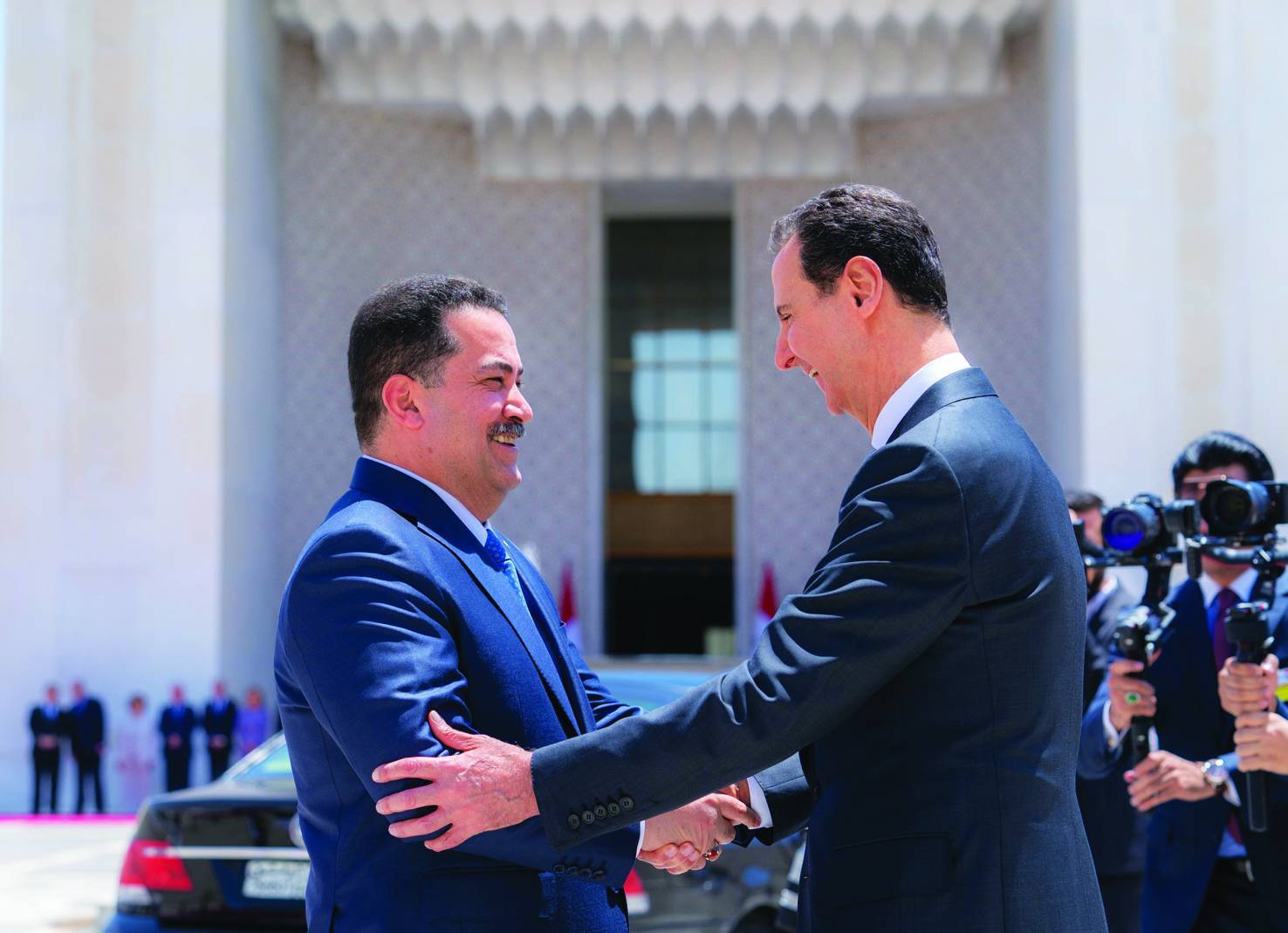
Assad shakes hands with Iraqi PM Mohammed Shia al-Sudani in Damascus. (File photo)

‘And the wheel turns’

At six in the morning on December 8, 2024, former Iraqi Prime Minister Adel Abdulmahdi posted on X about how tables turn and the “aggressor” is overtaken by events. Shock swept through Shiite political forces in Baghdad. Assad had fled and the regime had fallen.

Two days after the liberation, all factions had left Syrian territory and Assad was in Moscow. On December 12, 2024, Nouri al-Maliki, leader of the State of Law Coalition and a long-time ally of Assad, declared that “the goal of what happened in Damascus is to stir the street in Baghdad.” Public opinion erupted with questions.

Shiite political circles in Baghdad struggled to absorb the shock. Private discussions intensified around “the future of the Shiites in Iraq,” dominated by deep confusion, according to participants in closed-door meetings held in the weeks following Assad’s escape.

They said Shiite decision-makers found no answers regarding what had happened in Syria or Iran’s role, and many struggled to answer how Iraq and the region would change after Assad.

One participant in a private session held in January 2025 said the crisis in Syria was not about Assad’s escape or the collapse of the Resistance Axis, but for Iraqi Shiites it was about “redefining their role after old alliances and balances had crumbled.”

Secondary effects of this difficult debate emerged within Shiite groups. Many within the resistance environment began promoting the concept of a “Shiite federation” stretching from Iraq’s Samarra to Basra on top of vast oil reserves. The idea faded quickly, like cold ash.

Talk of “Shiite governance” intensified. A militia commander said: “Shiite forces in recent months focused on strengthening the domestic scene and consolidating their presence in political life, which explains their active participation in the elections held on November 11, 2025, and the victory of armed factions in seats in the new parliament.”

It appeared that all those who had fought in Syria won seats in the new legislature. Asaib Ahl al-Haq, led by Qais al-Khazali, secured 28 seats. The Badr Organization, led by Hadi al-Amiri, won 18. The Rights bloc, linked to Kataib Hezbollah, won six. A list affiliated with Kataib Imam Ali won three. The Services Alliance, led by Shibl al-Zaidi, won nine seats.

These groups are now proposing a transitional project built on new Shiite roles, driven by the growing ambition of leaders such as Khazali to craft an umbrella that shields Shiite groups from fragmentation by expanding their influence in both the legislative and executive branches of the state.

In March 2025, Khazali was asked about the new Syria. He said: “It is the duty and interest of the Iraqi state to engage with it, as long as those governments represent their countries.”

A Shiite leader said the moment Assad fled was not a Syrian event as much as “an earthquake in Shiite consciousness inside Iraq,” pushing everyone to reconsider the alliances that had shaped the region for years.

But beneath this transformation lie lingering questions and doubts about “the future of the Iranian doctrine itself,” now facing major disruption after four decades of uninterrupted influence across the region.

“The answer,” the commander said, “has not yet matured.”


New Political, Military Reality in Lebanon a Year after Assad’s Ouster 

People raise the Syrian flag during the one-year anniversary marking the ouster of Bashar al-Assad in Tripoli, Lebanon.
TT

New Political, Military Reality in Lebanon a Year after Assad’s Ouster 

People raise the Syrian flag during the one-year anniversary marking the ouster of Bashar al-Assad in Tripoli, Lebanon.

The collapse of Bashar al-Assad's regime in Syria in December 2024 created major political, security and economic changes in Lebanon. Beirut also rid itself of what remained of Damascus’ influence - after Syria withdrew its forces from Lebanon in 2005 following 30 years of military and political hegemony - through Assad’s allies, namely Hezbollah.

With the ouster Assad, Lebanon became free to make its political decisions away from the influence of Damascus and its allies. Lebanon and Syria can establish mutual official relations, secure their shared border and improve the trade exchange between them.

Tehran-Beirut route severed

Head of Lebanon’s Saydet al-Jabal Gathering, former MP Fares Souaid told Asharq Al-Awsat: “Lebanon has changed. The most important thing that happened was that the new Syria severed the Tehran-Beirut route that used to supply Hezbollah with all of its security, military and financial means.”

Now, the party has to resort to smuggling to get what it needs, he added. “That option is not secured by military units working for Iran, forcing Hezbollah to approach the new situation in Lebanon with a lot more pragmatism than before.”

He said the party has been forced to take a “humble” approach to “critical issues.”

“We saw how Hezbollah did not quit the government even though it objected to cabinet decisions, especially the one related to imposing state monopoly over arms,” he explained. The decision effectively calls on Hezbollah to disarm.

The party was unable to take any steps to counter the decision because the “real route that has been feeding it has been cut,” Souaid stressed.

Developments, past and present, have shown that anything negative or positive taking place in Syria will impact Lebanon, he went on to say. “If Syria is well, then Lebanon is well.”

He said Lebanon still believes that Syria under President Ahmed al-Sharaa has a promising future and relations between Beirut and Damascus will also be promising.

The relations are already on the right track with the establishment of joint security and military committees sponsored by Saudi Arabia, he remarked. Efforts have already been exerted to secure the shared border between them ahead of demarcation starting from the Shebaa Farms.

Such coordination between Lebanese and Syrian security and military agencies “never happened under Assad rule. So, this is a new development for both countries,” he revealed.

Treaties with Syria

The neighbors currently appeared focused on reshaping their relations in a way that preserves their mutual interests. Souaid acknowledged, however, that pending complex issues remain.

He underlined the need to annul all political, security and economic treaties that were signed during Syria’s hegemony over Lebanon.

Lebanon has appointed an ambassador to Damascus, while the latter has yet to name an envoy to Beirut, he noted.

He also said that the Syrians are prioritizing resolving the issue of Syrian detainees held in Lebanese jails.

The issue is a “black mark” in the relations between the two countries. Lebanon’s justice minister must resolve this file so that it does not complicate efforts to forge good ties, Souaid urged.

Pending files

Lebanon has been perceived as dealing “coolly” with Syria’s insistence on resolving the detainee file.

Some Lebanese officials have for years also complained about Syrian refugees in Lebanon and the burden they have on the state. An informed security source told Asharq Al-Awsat that with Assad’s collapse, this issue was no longer a “major crisis”.

It revealed that half of the Syrian refugees who were in Arsal and the northern Akkar region in Lebanon have returned to their home country. This has been felt by the drop in the numbers of Syrian laborers in Lebanon.

The shared border is another issue of pressing concern for the neighbors.

After Assad’s ouster, Lebanon’s northern and eastern borders are no longer open to the regime’s allies and outlaws, especially drug and other smugglers.

The source said: “The most important achievement on the security level has been curbing the smuggling of weapons from Syria to Lebanon and money from Lebanon to Syria.”

“Captagon factories along both sides of the border have also been destroyed, leading to the dismantling of drug smuggling networks and culminating in the arrest of Lebanon’s most wanted drug smuggler, Noah Zeiter, who was seeking refuge in Syria before Assad’s ouster,” added the source.


A ‘New Syria’ Becomes the Clearest Example of Israel’s Hostility Toward Its Neighbors

Israeli Prime Minister Benjamin Netanyahu visits the buffer zone with Syria on Nov. 19, accompanied by senior defense, foreign affairs, and security officials. (Government Press Office)
TT

A ‘New Syria’ Becomes the Clearest Example of Israel’s Hostility Toward Its Neighbors

Israeli Prime Minister Benjamin Netanyahu visits the buffer zone with Syria on Nov. 19, accompanied by senior defense, foreign affairs, and security officials. (Government Press Office)

On a rainy November night in 2025, as Ramallah groaned under an Israeli military assault just meters from the presidential compound, a senior Palestinian official smiled bitterly. “I don’t want to talk about Palestine,” he said. “Nor do I wish to repeat slogans about Israel being a colonial state without borders. What I want to talk about now is Syria.”

For this official, Syria has become the starkest proof that Israeli Prime Minister Benjamin Netanyahu not only rejects any genuine peace, but also appears unwilling to tolerate neighboring states at all.

He argued that this is evident even after the new political leadership in Damascus declared openly that it sought neither war nor hostility with Israel. Yet Israel, he said, has continued to violate Syrian sovereignty with increasingly blunt military operations.

The official’s point was simple: Israel’s hostility, in his view, is not confined to Palestinians. “If Hamas launched a war on Israel on Oct. 7, 2023, and Hezbollah started firing its own strikes, and the Houthis joined Iran’s so-called ‘support front,’ Syria did the opposite: it stayed out of the picture, and even more than that.”

‘No threat to Israel’

After coming to power, Syria’s new leadership declared that it posed “no threat to any neighboring state, including Israel.”

The fall of Bashar al-Assad in December 2024 cost Iran one of its most important strategic hubs in the region - Syria. This should have created common ground for Syrian-Israeli understandings, the official noted.

“I fear the Israelis have forgotten these facts, especially now that Syrian territory is no longer a playground for Iranian militias,” the Palestinian official said.

The United States, Türkiye, and Azerbaijan offered to mediate talks and expressed readiness to broker security arrangements ensuring a stable border. Even when Israel grumbled about indirect contacts, Damascus agreed to direct meetings. Six rounds were held between Syrian Foreign Minister Assad al-Shaibani and Israeli Strategic Affairs Minister Ron Dermer.

According to Israeli sources, Damascus signaled significant flexibility: it was prepared to negotiate a comprehensive peace treaty in exchange for the return of all territory lost in 1967 and 2024, while also showing openness to interim proposals, such as leasing the Golan Heights to Israel for up to 15 years or reverting to 1974 security understandings.

Those same sources also claimed Syria was willing to join the Abraham Accords, effectively extending an unprecedented hand of peace to Israel.

Raids and ground incursions

Israel’s response, however, took a different direction. Since December 2024, before Damascus could stabilize its new order, Israel carried out roughly 500 airstrikes on Syrian military airports and bases, destroying an estimated 85 percent of Syria’s defensive capabilities.

Israeli forces seized around 450 square kilometers of territory, from Mount Hermon’s summit to parts of Daraa province, penetrating up to 20 kilometers inside Syria and establishing nine military sites.

Israel also inflamed internal tensions under the claim of “protecting Druze allies,” despite long-standing accusations of discrimination against Druze citizens inside Israel itself.

Israeli officials questioned the new Syrian leadership’s intentions by invoking old links to the Al-Nusra Front, even though Israeli field hospitals in Safed, Haifa, and Tel Aviv had, in past years, treated numerous Nusra fighters.

Who can restrain Netanyahu?

In recent days, Israeli reports claimed US President Donald Trump “rebuked” Israel and Netanyahu over their approach to the new Syria, urging a strategic shift.

Responding, reportedly, to appeals from Saudi Arabia and Prince Mohammed bin Salman, Crown Prince and Prime Minister, Trump appears inclined to pursue a constructive course with Damascus.

Many now believe the White House is the only actor capable of restraining Netanyahu’s Syria policy.

But until any real change appears on the ground, analysts continue to ask: What message is Israel sending to its region through its handling of Syria?


Four Iranian Narratives on the Collapse of the ‘Resistance’ in Syria  

Iran's General Qassem Soleimani makes a phone call near the historic Citadel of Aleppo, winter 2016. (Fars)
TT

Four Iranian Narratives on the Collapse of the ‘Resistance’ in Syria  

Iran's General Qassem Soleimani makes a phone call near the historic Citadel of Aleppo, winter 2016. (Fars)

One hundred and ninety-two days separated the last meeting between Iran’s Supreme Leader Ali Khamenei and Syria’s ousted President Bashar al-Assad in Tehran from the moment the Syrian regime fell to the opposition in December 2024.

That interval was no footnote in the Syrian war. It became a sharp mirror inside Tehran, reflecting the magnitude of the wager Iran’s leadership had placed on Assad, and the limits of its ability to anticipate the trajectory of the conflict and shifts in the regional balance of power.

At that meeting, Khamenei laid out the essence of his “Syrian doctrine” amid changing realities across the “Axis of Resistance.” Syria, he argued, was no ordinary state but one with a “special place” because its identity, in his view, stemmed from its role in this axis.

Since “resistance is Syria’s defining identity and must be preserved,” he addressed Assad not as a political ally but as a partner in that identity. He praised Assad for once saying that “the cost of resistance is lower than the cost of compromise” and that “whenever we retreat, the other side advances.” Thus, Khamenei reaffirmed his full - if belated – gamble on the regime’s survival, even as signs of collapse were unmistakable on the ground.

Less than seven months later, the regime would fall. Assad’s collapse would yield several Iranian narratives: the Supreme Leader’s, the Revolutionary Guard’s, the diplomatic narrative, and a fourth voiced from within the system itself, one that raised blunt questions about the price of Iran’s Syrian gamble.

Khamenei’s narrative

In his first speech after Assad’s fall, Khamenei offered a hard-edged explanation: the event, he said, was the product of a “joint American-Zionist plot,” aided by neighboring states. He spoke of factors that he claimed prevented Iran from providing the necessary support, including Israeli and US strikes inside Syria and the closure of air and land corridors to Iranian supplies.

He concluded that the decisive flaw lay within Syria itself, where the “spirit of resistance” had eroded in state institutions.

He stressed that the regime’s fall did not mean the fall of the idea of “resistance,” predicting that “patriotic Syrian youth” would one day revive it in a new form.

This narrative rejects the notion of strategic defeat: for Khamenei, what happened is not the end of the struggle, but a harsh phase in a longer one.

Revolutionary Guard’s narrative

The Islamic Revolutionary Guard Corps (IRGC) adopted a language closer to national security logic than pure ideology, though it drew from the same lexicon. In 2013, cleric Mehdi Taeb, head of the IRGC’s Ammar Headquarters think tank, framed the equation starkly: “Syria is our 35th province... If the enemy attacks Syria or Khuzestan, our priority is to keep Syria.”

With that shocking sentence, Syria was elevated to the level of Iranian strategic geography, sometimes above parts of Iran itself.

Late General Qassem Soleimani, then commander of the Quds Force, became the chief architect of this approach: confronting threats abroad by building multinational militia networks and using the “protection of shrines” as a mobilizing slogan that fused ideology with national security calculations.

A month after Assad’s fall, at a memorial for Soleimani, Khamenei reaffirmed this school of thought, linking the defense of shrines in Damascus and Iraq to the defense of “Iran as a sanctuary,” aiming to bind various fronts into a single cross-border security-sectarian struggle.

After the Syrian regime’s collapse, this narrative preserved its core: success or failure is not defined by who sits in Damascus, but by whether the IRGC’s influence networks remain intact and whether Iran still has access to Syrian depth.

Full withdrawal would amount, in this logic, to admitting that the “35th province” had slipped from the map, so the IRGC will continue to search for any possible foothold.

Diplomatic narrative

Iran’s diplomatic apparatus sought to tell a softer story. Weeks before the fall, Khamenei dispatched his adviser Ali Larijani to Damascus and Beirut with reassuring messages for Assad and other allies, publicly asserting that events in Syria and Lebanon “directly concern Iran’s national security.”

Days later, Foreign Minister Abbas Araghchi visited Damascus just six days before the collapse, even posing with shawarma in a downtown restaurant to signal “normalcy” and dismiss talk of impending downfall as “psychological warfare.”

It was the peak of the gap between diplomatic messaging and a disintegrating reality.

Afterward, the Foreign Ministry adopted a defensive formula: Iran had “responded to the request of an allied government”, but “cannot decide on behalf of peoples.” Thus, responsibility was shifted toward Syrian internal failures and the external “conspiracy” often invoked by Khamenei.

This narrative treats Syria as one file among many, not an existential arena as seen by the IRGC and the Leader.

‘Open account’ narrative

The fourth narrative emerged, unexpectedly, from within the establishment itself. For the first time, semi-public acknowledgments surfaced that the economic return on Iran’s Syrian adventure was nearly nil and that the political-security “investment” had resulted in something resembling a net loss.

In 2020, former member of the Iranian parliamentary national security and foreign policy committee, Heshmatollah Falahatpisheh revealed that Tehran had spent “$20-30 billion” in Syria, insisting: “This is the people’s money and must be recovered.”

Five years later, he returned with a more bitter charge: Syria’s debts to Iran were effectively settled through “land without oil, cow farms without cows, and empty promises.”

This view is no outlier. Over a decade, Iranian protest slogans increasingly linked “Gaza, Lebanon, Syria” with bread, fuel, and economic hardship at home.

With Assad gone, critics more easily argue that Iran spent tens of billions and paid a human cost among its fighters and proxies, only to end up with almost no influence in Damascus.

For decision-makers, this narrative becomes domestic pressure against any large-scale return to Syria.

Four scenarios for Tehran

Taken together, these narratives reveal a deep contradiction: the IRGC and Khamenei refuse to concede that Iran “lost Syria,” treating the episode as one phase in a longer struggle. Meanwhile, the diplomatic and economic narratives acknowledge, implicitly, that the previous intervention model is no longer sustainable.

Four broad scenarios emerge. The first is a return through proxies, closest to the IRGC’s logic: Iran would rebuild influence from the ground up through militias - old or newly recruited - to pressure any future authority in Damascus.

The second is regional repositioning without Syria, in which Iran shifts resources to arenas where it still holds leverage, including Lebanon, Iraq, Yemen and Gaza, while limiting its role in Syria to preventing hostile entrenchment.

The third is a “gray” re-entry: a gradual, negotiated, non-confrontational return through localized deals or modest economic and security projects, allowing Tehran to claim continued presence without the cost of backing a single ruler.

The fourth is institutionalizing the loss: Iran accepts Syria’s departure from its strategic depth, but repackages the outcome within a narrative of “conspiracy and steadfastness,” using it to tighten internal control while maintaining symbolic presence through shrine rhetoric and minimal diplomacy.

Across all scenarios, one fact remains. Syria, which was once described as more vital than Khuzestan and the “distinct identity of resistance”, is no longer what it was before December 8, 2024 when the regime collapsed.

Tehran can invoke time, the IRGC can search for openings, diplomats can polish their statements, and critics can lament “land without oil.” But one question looms over every debate in Iran: Can Tehran afford a second Syrian-sized gamble after emerging from the first still trying to convince itself that the “resistance factor” remains standing, even as its Syrian pillar has broken?