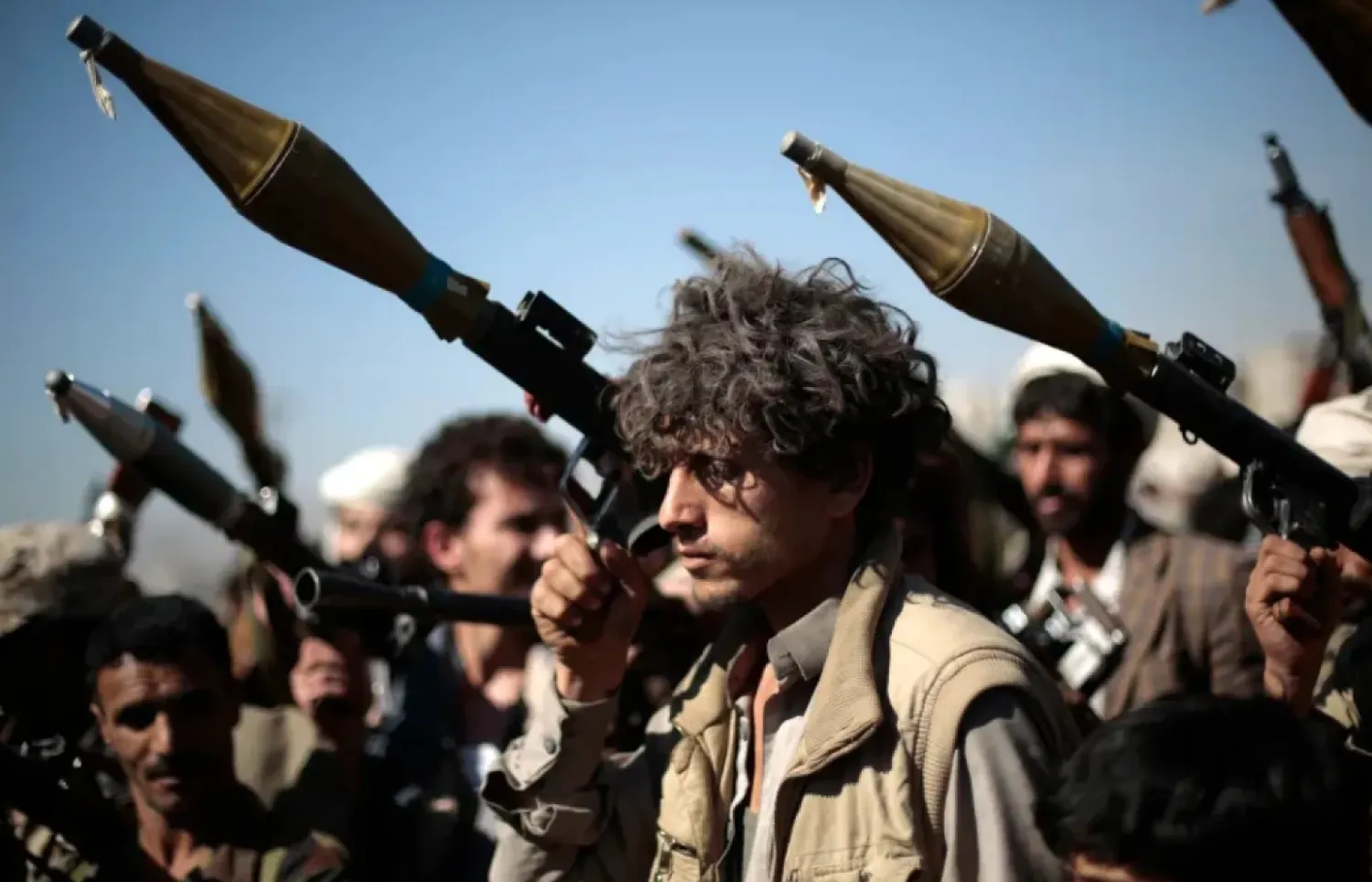

As US military movements intensify in the Middle East and the possibility of strikes on Iran looms, Yemen’s Houthi group has continued military preparations, mobilizing fighters and establishing new weapons sites.
The Houthi mobilization comes at a time when the group is widely viewed as one of Iran’s most important regional arms for retaliation.
Although the Iran-backed group has not issued any official statement declaring its position on a potential US attack on Iran, its leaders have warned Washington against any military action and against bearing full responsibility for any escalation and its consequences.
They have hinted that any response would be handled in accordance with the group’s senior leadership's assessment, after evaluating developments and potential repercussions.
Despite these signals, some interpret the Houthis’ stance as an attempt to avoid drawing the attention of the current US administration, led by President Donald Trump, to the need for preemptive action in anticipation of a potential Houthi response.
The Trump administration previously launched a military campaign against the group in the spring of last year, inflicting heavy losses.
Islam al-Mansi, an Egyptian researcher specializing in Iranian affairs, said Iran may avoid burning all its cards unless absolutely necessary, particularly given US threats to raise the level of escalation should any Iranian military proxies intervene or take part in a confrontation.
Iran did not resort to using its military proxies during its confrontation with Israel or during a limited US strike last summer because it did not perceive an existential threat, al-Mansi said.
That calculation could change in the anticipated confrontation, potentially prompting Houthi intervention, including targeting US allies, interests, and military forces, he told Asharq Al-Awsat.
Al-Mansi added that although Iran previously offered, within a negotiating framework, to abandon its regional proxies, including the Houthis, this makes it more likely that Tehran would use them in retaliation, noting that Iran created these groups to defend its territory from afar.
Many intelligence reports suggest that Iran’s Revolutionary Guard has discussed with the Houthis the activation of alternative support arenas in a potential US-Iran confrontation, including the use of cells and weapons not previously deployed.
Visible readiness
In recent days, Chinese media outlets cited an unnamed Houthi military commander as saying the group had raised its alert level and carried out inspections of missile launch platforms in several areas across Yemen, including the strategically important Red Sea region.
In this context, Yemeni political researcher Salah Ali Salah said the Houthis would participate in defending Iran against any US attacks, citing the group’s media rhetoric accompanying mass rallies, which openly supports Iran’s right to defend itself.
While this rhetoric maintains some ambiguity regarding Iran, it repeatedly invokes the war in Gaza and renews Houthi pledges to resume military escalation in defense of the besieged enclave’s population, Salah told Asharq Al-Awsat.
He noted that Iran would not have shared advanced and sophisticated military technologies with the Houthis without a high degree of trust in their ability to use them in Iran’s interest.
In recent months, following Israeli strikes on the unrecognized Houthi government and several of its leaders, hardline Houthi figures demonstrating strong loyalty to Iran have become more prominent.
On the ground, the group has established new military sites and moved equipment and weapons to new locations along and near the coast, alongside the potential use of security cells beyond Yemen’s borders.
Salah said that if the threat of a military strike on Iran escalates, the Iranian response could take a more advanced form, potentially including efforts to close strategic waterways, placing the Bab al-Mandab Strait within the Houthis’ target range.
Many observers have expressed concern that the Houthis may have transferred fighters and intelligence cells outside Yemen over recent years to target US and Western interests in the region.
Open options
After a ceasefire was declared in Gaza, the Houthis lost one of their key justifications for mobilizing fighters and collecting funds. The group has since faced growing public anger over its practices and worsening humanitarian conditions, responding with media messaging aimed at convincing audiences that the battle is not over and that further rounds lie ahead.
Alongside weekly rallies in areas under their control in support of Gaza, the Houthis have carried out attacks on front lines with Yemen’s internationally recognized government, particularly in Taiz province.
Some military experts describe these incidents as probing attacks, while others see them as attempts to divert attention from other activities.
In this context, Walid al-Abara, head of the Yemen and Gulf Studies Center, said the Houthis entered a critical phase after the Gaza war ended, having lost one of the main justifications for their attacks on Red Sea shipping.
As a result, they may seek to manufacture new pretexts, including claims of sanctions imposed against them, to maintain media momentum and their regional role.
Al-Abara told Asharq Al-Awsat that the group has two other options. The first is redirecting its activity inward to strengthen its military and economic leverage, either to impose its conditions in any future settlement or to consolidate power.
The second is yielding to international and regional pressure and entering a negotiation track, particularly if sanctions intensify or its economic and military capacity declines.
According to an assessment by the Yemen and Gulf Studies Center, widespread protests in Iran are increasingly pressuring the regime’s ability to manage its regional influence at the same pace as before, without dismantling its network of proxies.
This reality is pushing Tehran toward a more cautious approach, governed by domestic priorities and cost-benefit calculations, while maintaining a minimum level of external influence without broad escalation.
Within this framework, al-Abara said Iran is likely to maintain a controlled continuity in its relationship with the Houthis through selective support that ensures the group remains effective.
However, an expansion of protests or a direct military strike on Iran could open the door to a deeper Houthi repositioning, including broader political and security concessions in exchange for regional guarantees.