


What to Know About Iran’s Supreme Leader Ali Khamenei

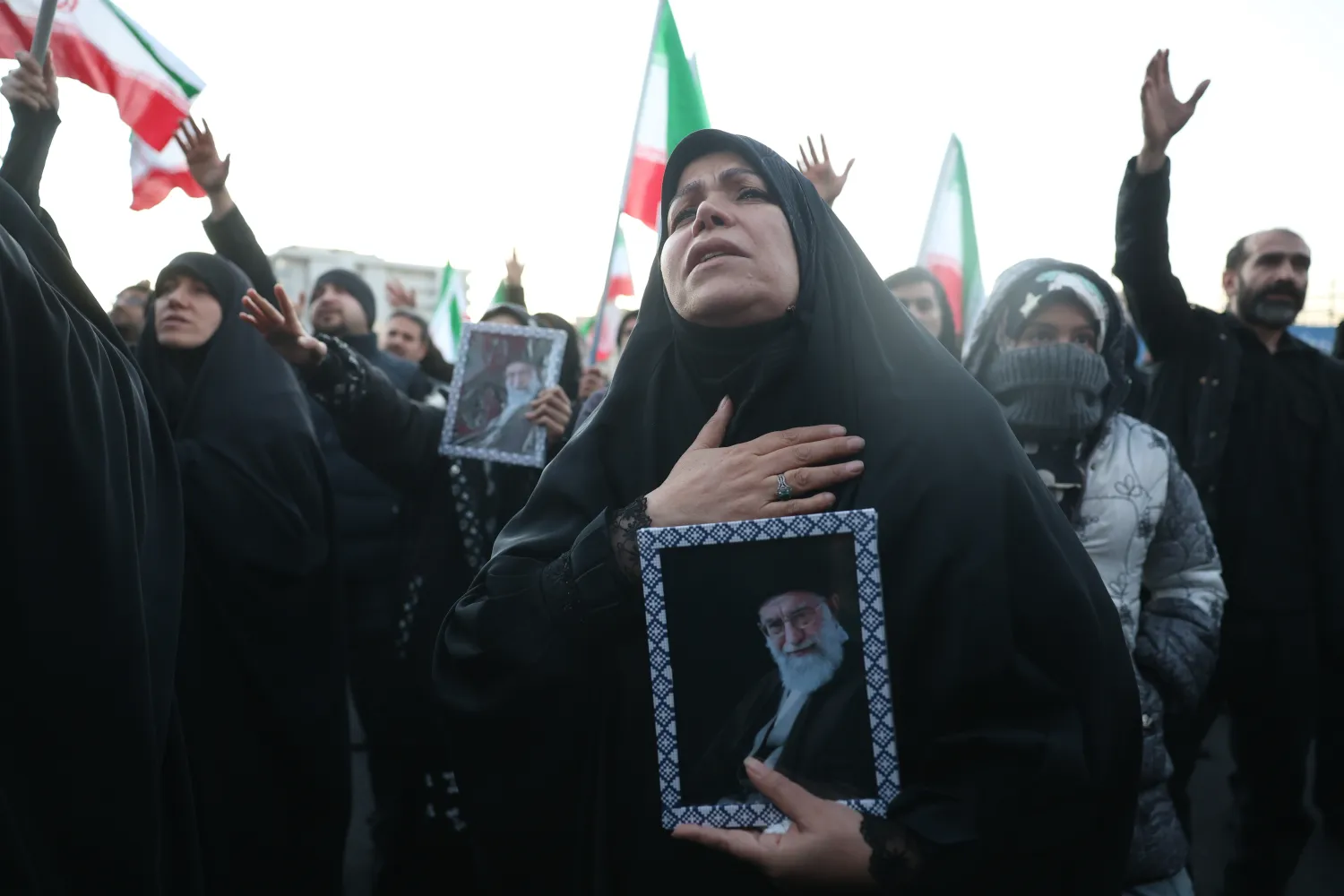
Mourners hold pictures of Iranian Supreme Leader Ali Khamenei following his death; at Enqelab Square in Tehran, Iran, 01 March 2026. (EPA)
TT

What to Know About Iran’s Supreme Leader Ali Khamenei

Mourners hold pictures of Iranian Supreme Leader Ali Khamenei following his death; at Enqelab Square in Tehran, Iran, 01 March 2026. (EPA)

In one of his final public displays of power, Iran’s Supreme Leader Ali Khamenei unleashed the bloodiest crackdown of his nearly four-decade rule to crush nationwide protests in which people dared to shout “Death to Khamenei.”

Now a US or Israeli military strike has sent Iran spinning into the unknown. The 86-year-old supreme leader is dead, with no designated successor.

Iranian state media confirmed his death without giving details early Sunday, hours after President Donald Trump said Khamenei was killed in a major new attack by US and Israeli forces. Trump also urged Iranians to topple the theocracy. As rumors of the death spread, some cheered from rooftops in Tehran.

Long before the supreme leader’s compound was among the first targets on Saturday, Khamenei was under growing pressure.

In the past year he was effectively put on warning, with Trump saying he could have killed him if he wanted to and rejecting an Israeli plan to do just that in last year's 12-day war.

In recent weeks the supreme leader tried to avert strikes as the US built up its military presence in the region to pressure Tehran over its nuclear program. He warned that if the US struck, a regional war would ensue. At the same time, he allowed Iran to enter negotiations with the US over its nuclear program.

Khamenei's suppression of the protests, with thousands of people killed, was a sign of the threat that popular anger represented. Years of sanctions, economic mismanagement and corruption have gutted Iran’s economy.

Israeli and US bombardment during last summer’s 12-day war had heavily damaged Iran’s nuclear program, missile systems and military capabilities. Iran's network of regional proxies, including Hamas in Gaza, Hezbollah in Lebanon and the Houthis in Yemen, has been weakened by Israeli and US attacks since the war in Gaza began, along with Tehran’s influence across the Middle East.

Here’s what to know about Khamenei:

Transforming the country

When he rose to power in 1989, Khamenei had to overcome deep doubts about his authority. A low-level cleric at the time, Khamenei lacked the religious credentials of his predecessor, Khomeini, the leader of the Islamic Revolution.

But Khamenei ruled three times longer than the late Khomeini and shaped Iran perhaps even more dramatically.

He entrenched the system of rule by the mullahs, or Shiite clerics. Under the republic, clerics stand atop the hierarchy, drawing the lines to which the civilian government, the military and the intelligence and security establishment must submit.

In the eyes of hard-liners, Khamenei stood as the unquestionable authority.

At the same time, Khamenei built the paramilitary Revolutionary Guard into the dominant player in military and internal politics. It boasts Iran’s most elite military and oversees its ballistic missile program. Khamenei also gave the Guard a free hand to build a network of businesses and dominate the economy.

In return, the Guard became his loyal shock force.

Domestic challenges

The first major threat to Khamenei’s grip was the reform movement that swept into a parliamentary majority and the presidency soon after he became supreme leader. It advocated for giving greater power to elected officials, which Khamenei’s hard-line supporters feared would lead to dismantling the republic system.

Khamenei rallied the clerical establishment, and unelected bodies run by mullahs shut down major reforms and barred reform candidates from elections.

Since then, waves of popular protests have been crushed.

Huge nationwide demonstrations erupted in 2009 over allegations of vote-rigging. Under the weight of sanctions, economic protests broke out in 2017 and 2019. More came in 2022 over the death of Mahsa Amini, who was detained by police for not wearing her mandatory headscarf properly.

Crackdowns against the protesters killed hundreds, and hundreds more were arrested amid reports of detainees tortured to death or raped in prison.

The deadliest crackdown yet

The latest demonstrations touched off in late December in Tehran’s traditional bazaar after the country's currency, the rial, currency plunged to a record low of 1.42 million to the US. dollar. Protests quickly spread across the country.

“Rioters must be put in their place,” Khamenei declared. When hundreds of thousands took to the streets Jan. 8 and 9, security forces fired on crowds, and veterans of past demonstrations said they were stunned by the firepower unleashed.

Activists said they documented more than 7,000 killed and were working to verify more. The government has acknowledged more than 3,000 dead, which is still higher than the toll from past crackdowns.

Nuclear negotiations

By agreeing to nuclear negotiations, Khamenei likely sought to buy time to avert US strikes. But Iran opposed Washington's main demands that it halt all nuclear enrichment and surrender its uranium stocks.

Trump initially threatened strikes to stop Khamenei and Iran’s other leaders from killing peaceful protesters. He then wielded the threat to push Tehran to engage seriously in nuclear negotiations.

Some in Iran and the large Iranian diaspora expressed hope that the US would use military force to bring down Khamenei. But there were also strong voices even among Khamenei opponents who were against foreign intervention to topple the theocracy.

No successor

Officially a panel of Shiite clerics is tasked with choosing one of their own to succeed Khamenei, and multiple names have been touted among including his son.

Danny Citrinowicz, an Iran expert at Israel’s Institute for National Security Studies, told The Associated Press this week that a key lesson Tehran drew from last year’s war was the need to ensure regime continuity in case of Khamenei’s death. He added that power could shift to a small committee of top officials until hostilities subside.

“It is possible that Khamenei has indicated a preferred successor behind closed doors,” Citrinowicz said. “However automatic implementation of a preselected successor will increase internal friction during war.”

But the Revolutionary Guard has grown to become Iran’s most powerful body. Khamenei's death could prompt Guard commanders or its regular military to seize power more overtly. And that could set off a bloody conflict over control of the oil-rich country of 85 million people.


A Look at Iran’s Key Political and Religious Figures

This combo of file photos show Iran's key political and religious figures, top row, from left, Supreme Leader Ali Khamenei, President Masoud Pezeshkian, Foreign Minister Abbas Araghchi, Khamenei Adviser on Public Policy Ali Larijani, Chief Justice Gholam Hossein Mohseni Ejehi, Head of Assembly Experts Mohammad-Ali Movahedi Kermani and Secretary of Guardian Council Ahmad Jannati, bottom row, from left, Khamenei's Chief of Staff Mohammad Golpayegani, Khamenei Adviser on International Affairs Ali Akbar Velayati, Khamenei Adviser on Foreign Policy Kamal Kharazi, First Vice President Mohammad Reza Aref, Parliament Speaker Mohammad Bagher Ghalibaf, Tehran Friday Prayer Imam Ahmad Khatami and Son of Supreme Leader Mojtaba Khamenei. (AP Photo/File)
TT

A Look at Iran’s Key Political and Religious Figures

This combo of file photos show Iran's key political and religious figures, top row, from left, Supreme Leader Ali Khamenei, President Masoud Pezeshkian, Foreign Minister Abbas Araghchi, Khamenei Adviser on Public Policy Ali Larijani, Chief Justice Gholam Hossein Mohseni Ejehi, Head of Assembly Experts Mohammad-Ali Movahedi Kermani and Secretary of Guardian Council Ahmad Jannati, bottom row, from left, Khamenei's Chief of Staff Mohammad Golpayegani, Khamenei Adviser on International Affairs Ali Akbar Velayati, Khamenei Adviser on Foreign Policy Kamal Kharazi, First Vice President Mohammad Reza Aref, Parliament Speaker Mohammad Bagher Ghalibaf, Tehran Friday Prayer Imam Ahmad Khatami and Son of Supreme Leader Mojtaba Khamenei. (AP Photo/File)

The US and Israel launched a major attack on Iran on Saturday, and US President Donald Trump called on the Iranian public to “seize control of your destiny” by rising up against the regime leadership that has ruled the nation since 1979.

Supreme Leader Ali Khamenei died in the attack, along with other high-ranking military officials. Trump on social media called it “the single greatest chance for the Iranian people to take back their Country” hours before Iranian state media reported the death, without elaborating on a cause.

Yet even if Iran’s top leaders were killed, regime change is not guaranteed.

Here is a look at Iran's top political and spiritual leaders.

Supreme Leader Ali Khamenei

In 1989, Khamenei became Iran's supreme leader after the death of Khomeini, the founder of the Islamic Republic of Iran. Khamenei played an important role in the movement that overthrew Shah Mohammad Reza Pahlavi in the 1979 revolution.

The 86-year-old Khamenei is Iran's commander-in-chief, who has the final say on all policy and religious matters. Iran's paramilitary Revolutionary Guard, the force that safeguards the republic, answers directly to him.

Khamenei has been in charge during previous crackdowns on protesters in Iran. He recently said Iran was ready to retaliate against any American attack.

One of the first strikes Saturday hit near Khamenei's offices. Iranian state television and the state-run IRNA news agency reported the 86-year-old’s death on Sunday, hours after Trump said Khamenei was killed in a joint American-Israeli operation.

President Masoud Pezeshkian

The president of Iran is broadly seen as a reformist. A former heart surgeon, Pezeshkian took office on July 28, 2024. The president is the second-highest ranking official in Iran, acting as the head of government that handles daily administration, economic policy and implements the Supreme Leader's decrees.

Iranians elect a president and parliament for four-year terms.

Foreign Minister Abbas Araghchi

Iran's foreign minister is a longtime diplomat and was a key negotiator in the now-defunct 2015 nuclear deal. He was appointed on Aug. 21, 2024.

Days before Saturday's attack, Araghchi warned that a conflict with the US would be “a devastating war” and reiterated Tehran’s interest in a peaceful solution ahead of this week's high-stakes talks.

Khamenei Adviser on Public Policy Ali Larijani

Larijani hails from one of Iran's most famous political families. A former parliamentary speaker and senior policy adviser, he was appointed to advise Khamenei on strategy in nuclear talks with the Trump administration.

In January, the US imposed additional sanctions against Iranian officials, including Larijani, who were accused of repressing nationwide protests challenging Iran’s theocratic government.

The US Treasury Department accused him of being one of the first officials to call for violence against Iranian protesters.

Chief Justice Gholam Hossein Mohseni Ejehi

A conservative jurist and hard-line prosecutor, Mohseni Ejehi has been chief justice since 2021. He is widely regarded as a Khamenei loyalist.

Mohseni Ejehi was quoted by state media in January as saying that there would be “no leniency” for those behind the wave of unrest.

Head of Assembly of Experts Mohammad-Ali Movahedi Kermani

Movahedi Kermani is the head of the 88-seat clerical body responsible for appointing the next Supreme Leader. The Assembly of Experts is Iran's version of the Vatican's College of Cardinals.

Secretary of Guardian Council Ahmad Jannati

Jannati is the de facto leader of Iran's Guardian Council, a 12-member body that vets candidates for office as well as legislation, and rules out individuals it believes are incompatible with Iran’s theocratic system. It consists of six Islamic theologians and six legal experts.

The council can disqualify presidential candidates who are perceived as not being aligned with the Supreme Leader.

Khamenei's Chief of Staff Mohammad Golpayegani

Golpayegani is a cleric and longtime confidant of Khamenei. He heads the Supreme Leader's office.

Khamenei Adviser on International Affairs Ali Akbar Velayati

A physician by training, Velayati was previously Iran's foreign minister, and is a top adviser to Khamenei on international affairs. He is involved in the country's nuclear policy.

Khamenei Adviser on Foreign Policy Kamal Kharazi

Kharazi is a trusted adviser to Khamenei on foreign policy, especially during the recent nuclear talks with Washington.

A former diplomat and foreign minister, Kharazi previously represented Iran at the United Nations. He has held numerous governmental, diplomatic and academic posts.

First Vice President Mohammad Reza Aref

Aref serves as one of the primary deputies to the president and leads cabinet meetings when the president is absent. He liaises between the president and parliament.

Parliament Speaker Mohammad Bagher Ghalibaf

A former mayor of Tehran and Revolutionary Guard general, Ghalibaf was reelected parliamentary speaker on May 27, 2025. He is a conservative politician who was linked to student crackdowns in 1999 and 2003.

Tehran Friday Prayer Imam Ahmad Khatami

Khatami belongs to Iran's 12-member Guardian Council and is an influential prayer leader and religious figure loyal to the Supreme Leader. He is a member of Iran’s Assembly of Experts and has long been known for his hard-line views.

In January, Khatami called for the death penalty for protesters detained in a nationwide crackdown, and described those taking part in the unrest as “butlers” of Israeli Prime Minister Benjamin Netanyahu and “Trump’s soldiers.”

Son of Supreme Leader Mojtaba Khamenei

Khamenei's second-eldest son is a midranking cleric and the Supreme Leader's rumored successor. He has close ties with Iran's Revolutionary Guard. Mojtaba served in the armed forces during the Iran-Iraq war, and is said to wield influence behind the scenes as his father's gatekeeper.

Defense Minister Aziz Nasirzadeh

Nasirzadeh became defense minister in 2024 after serving in leadership roles in Iran's army and air force and was among the Iranian ministers who threatened retaliatory strikes on US bases in the Middle East, including before last June's US and Israeli strikes on Iranian nuclear facilities.

Israel said on Saturday that he was killed in the war's opening strikes that hit locations where military leaders were gathered. Iranian state television confirmed his death on Sunday, along with Iran’s chief of army staff, Gen. Abdol Rahim Mousavi.


Khamenei: Ruthless Revolutionary Atop Iran’s Regime

03 April 2024, Iran, Tehran: Iranian Supreme Leader Ali Khamenei speaks during a meeting with with politicians, the Iranian government, and military officials in Tehran. (Iranian Supreme leader's Office/dpa)
TT

Khamenei: Ruthless Revolutionary Atop Iran’s Regime

03 April 2024, Iran, Tehran: Iranian Supreme Leader Ali Khamenei speaks during a meeting with with politicians, the Iranian government, and military officials in Tehran. (Iranian Supreme leader's Office/dpa)

Iran's supreme leader Ali Khamenei, whose death was confirmed by state media on Sunday, was a pillar of the country's theocratic system since the revolution and saw off multiple crises over the decades, remaining defiant to the very end.

US President Donald Trump posted on his Truth Social site that "Khamenei, one of the most evil people in history, is dead" after the United States and Israel launched a massive wave of strikes targeting sites across Iran, including the supreme leader's Tehran compound.

Hours later, Iranian state television announced Khamenei's death, without referring to the attacks on the compound.

Aged 86, Khamenei dominated Iran since taking on the post for life in 1989 following the death of revolutionary founder Khomeini.

He remained in power after overcoming 1999 student demonstrations, 2009 mass protests sparked by disputed presidential elections and 2019 demonstrations that were brutally suppressed.

He also survived the 2022-2023 "Woman, Life, Freedom" movement sparked by the death in custody of Iranian Kurdish woman Mahsa Amini, who had been arrested for allegedly violating the strict dress code for women.

Khamenei was forced to go into hiding during the 12-day war against Israel in June, which exposed deep Israeli intelligence penetration of the country that led to the killing of key security officials in air strikes.

But he survived that war and, after nationwide protests again shook Iran earlier this year, he emerged defiant as ever.

- Tight security -

Khamenei lived under the tightest security, and his relatively infrequent public appearances were never announced in advance or broadcast live.

As supreme leader, he never set foot outside the country, a precedent set by his predecessor Khomeini following his triumphant return to Tehran from France in 1979.

Khamenei's last known foreign trip was an official visit to North Korea in 1989 as president, where he met Kim Il Sung.

There had long been speculation about his health given his age, but there was nothing in his most recent appearance to fuel any new rumors.

Khamenei's right arm was partially paralyzed following an assassination attempt in 1981 that authorities have always blamed on the People's Mujahedin of Iran (MEK) group, one-time allies of the revolution now outlawed in the country.

- 'I am opposed' -

Repeatedly arrested under the shah for his anti-imperial activism, Khamenei shortly after the revolution became Friday prayer leader of Tehran and also served on the front line during the Iran-Iraq war.

He was elected president in 1981 following the assassination of Mohammad Ali Rajai, another attack blamed on the MEK.

During the 1980s, Khomeini's most likely successor was seen as the senior cleric Hossein Ali Montazeri, but the revolutionary leader changed his mind shortly before his death after Montazeri objected to the mass executions of MEK members and other dissidents.

When Khomeini died and the republic's top clerical body -- the Assembly of Experts -- met, it was Khamenei they chose as leader.

Khamenei famously initially rejected the nomination, putting his head in his hands in a show of despair and declaring, "I am opposed". But the clerics stood in unison to seal his nomination and his grip on power never slackened.

Khamenei worked with six elected presidents, a far less powerful position than supreme leader, including more moderate figures such as Mohammad Khatami who were allowed to make stabs at cautious reform and rapprochement with the West.

But in the end, Khamenei always came down on the side of hardliners.

He was believed to have six children, although only one, Mojtaba, gained public prominence. He was placed under US sanctions in 2019 and is one of the most powerful backstage figures in Iran.

A family dispute also caught attention: his sister Badri fell out with her family in the 1980s and fled to Iraq in the war to join her husband, a dissident cleric.

Some of their children, including a nephew who is now in France, became vehement critics.


Iran’s Supreme Leader Khamenei in Dates

08 February 2025, Iran, Tehran: Iranian Supreme Leader tollah Ali Khamenei speaks during a meeting with the high-ranking Hamas delegation in Tehran. )Iranian Supreme Leader's Office/dpa)
TT

Iran’s Supreme Leader Khamenei in Dates

08 February 2025, Iran, Tehran: Iranian Supreme Leader tollah Ali Khamenei speaks during a meeting with the high-ranking Hamas delegation in Tehran. )Iranian Supreme Leader's Office/dpa)

Ali Khamenei had been Iran's hardline spiritual guide and top political authority since 1989, when he succeeded Khomeini as supreme leader.

Here is a look at his life in key dates:

- July 17, 1939: Khamenei is born in the shrine city of Mashhad to parents from Iran's Azeri minority.

- 1957: Meets Khomeini, who will emerge as a key influence.

- 1977: After several stays in prison due to his opposition to the shah, he is exiled to Iranshahr, a remote desert city close to the Pakistan border. He returns to Mashhad in 1979 for the revolution.

- 1979: His rapid ascent to power begins when he is named deputy defense minister and subsequently head of the elite Revolutionary Guards by Khomeini.

- 1981: Becomes the first cleric to be elected president of the Islamic republic. Re-elected in 1985.

- June 27, 1981: Survives a bomb attack by the outlawed People's Mujahedeen group in a Tehran mosque, but his right hand is never the same. Learns to write with his left.

- June 4, 1989: Upon the death of Khomeini, he is elected supreme leader just a year after the end of the war with Iraq (1980-1988).

- January 2005: Confirms the "death sentence" fatwa handed down on writer Salman Rushdie by Khomeini.

- September 8, 2014: Undergoes prostate surgery after two decades of speculation about his health.

- July 14, 2015: Supports the Vienna accord with world powers on Iran's nuclear program.

- January 17, 2020: Leads Friday prayers in Tehran for the first time since 2012. Uses the occasion to condemn anti-government protests.

- October 3, 2022: Blames the United States and Israel for fomenting the widespread nationwide unrest sparked by the death of Mahsa Amini.

- June 13-24, 2025: Going into hiding during the 12-day war with Israel, which the United States briefly joins, but emerges from the conflict unscathed.

- January 17, 2026: Says "Iran must break the back of the seditionists" as the clerical authorities brutally repress the biggest protests against the regime in more than three years.

- February 28, 2026: Killed in the wave of strikes launched by the United States and Israel.