


After Attacks on Iran’s Oil Facilities, Toxic Black Rain Endangers the Public

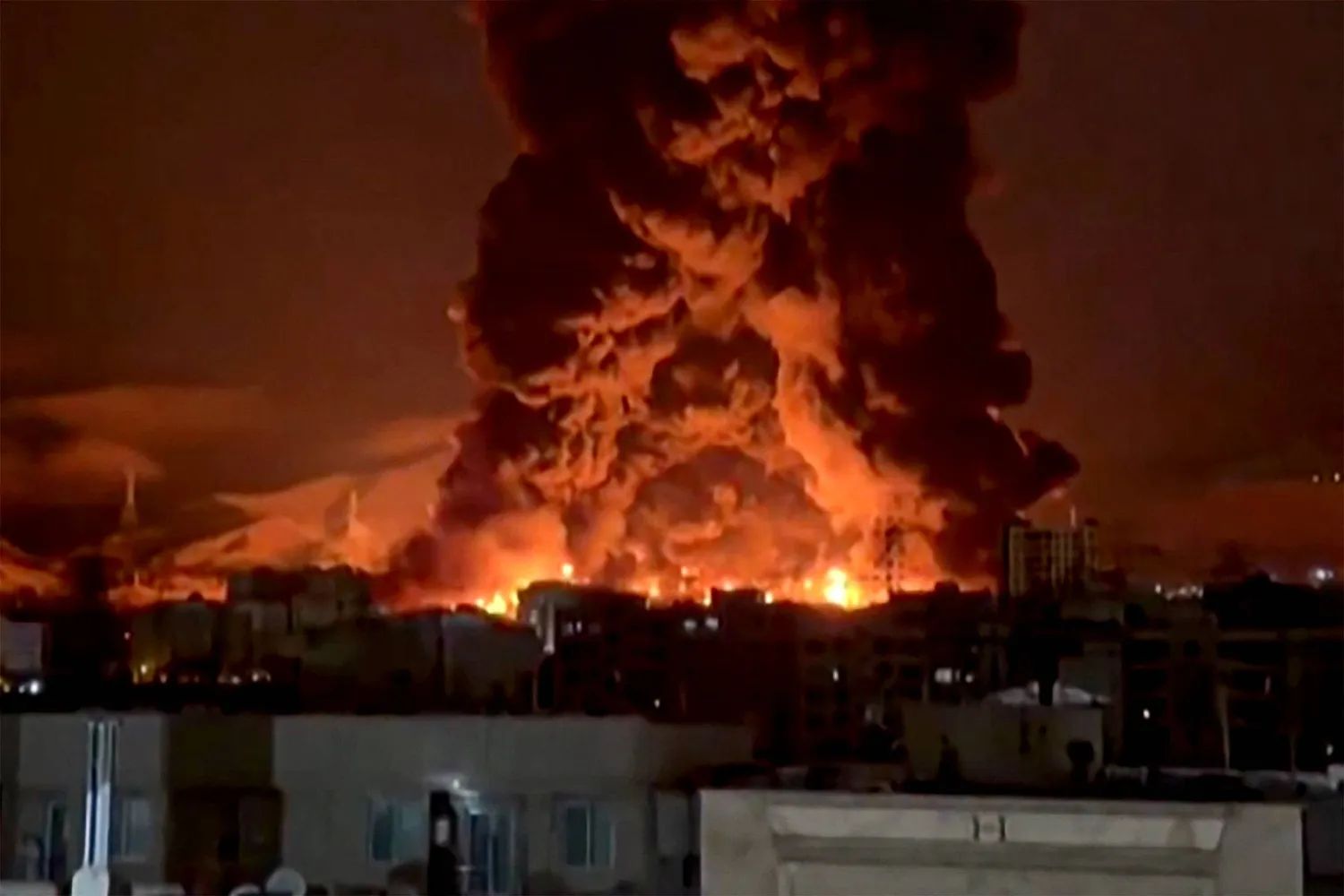
This video grab taken from UGC images posted on social media on March 7 and 8, 2026 shows fire erupting at an oil depot in Iran's capital Tehran. (UGC / AFP)
TT

After Attacks on Iran’s Oil Facilities, Toxic Black Rain Endangers the Public

This video grab taken from UGC images posted on social media on March 7 and 8, 2026 shows fire erupting at an oil depot in Iran's capital Tehran. (UGC / AFP)

Clouds of toxic smoke unleashed into the atmosphere by US-Israeli airstrikes on Iranian oil facilities made a dangerous return to Earth in the form of “black rain,” prompting international health officials to warn of serious risks to the public.

Residents in Tehran complained last week of burning eyes and difficulty breathing when the dark and oily precipitation fell near the Iranian capital after several fuel oil depots and a refinery were struck.

Plumes of dark smoke have also been seen across other parts of the region over two weeks of war, as Iran retaliates against US-Israeli airstrikes by firing drones and missiles at the oil and natural gas facilities of its Gulf neighbors.

Rain washes hazardous chemicals out of the atmosphere in a relatively short period of time, experts said, but people exposed to black rain should take precautions to avoid short- and long-term health risks.

Here's what to know:

What is black rain? It occurs when soot, ash and toxic chemicals combine with water droplets in the atmosphere, then fall back to Earth when it rains. It's common after oil refineries or oil fields catch fire, and also can be caused by wildfires, volcanic eruptions and industrial pollution.

In Iran, microscopic soot formed when hydrocarbons in the fuel oil burned incompletely, experts said. Burning oil also forms compounds called polycyclic aromatic hydrocarbons, or PAHs, as well as toxic gases such as sulfur dioxide and nitrogen oxides, which cause acid rain, said Peter Adams, a civil and environmental engineering professor at Carnegie Mellon University.

What are the health risks of exposure? Microscopic soot, whose particles are about 40 times smaller than the width of a human hair, can lodge deep in the lungs and enter the bloodstream, causing breathing and heart problems that can lead to premature death, experts said. Exposure to PAHs can increase cancer risk.

In Iran, the World Health Organization and the country's health and environmental officials advised people to stay indoors and wear masks. They warned that the rainfall was highly acidic and could burn the skin and cause lung damage.

“We can definitely expect acute health effects from an event like this,” said V. Faye McNeill, a chemical engineering professor at Columbia University who specializes in atmospheric chemistry.

Even regular air pollution events can trigger health problems and lead to more hospitalizations, especially among the elderly, children and people who already had health problems, she said. “But this is a higher level, so there likely are health problems going on right now because of it.”

Some Iranians fear the polluted rain, which also contains heavy metals, could contaminate drinking-water reservoirs and waterways.

How long do the chemicals last in the atmosphere? It usually takes only hours for fuel tanks to burn out. But — as happened in Kuwait during the Gulf War 25 years ago — oil fields can burn for months, said Adams.

For fires that burn out more quickly, most of the soot and chemicals will disperse on the wind and wash out of the atmosphere in about three to seven days, Adams said.

“So if we don’t create more problems, at least what’s in the atmosphere is going to go away,” even if long-term health risks haven't, Adams said.

“But we don’t know what’s going to happen with future strikes and whether other tanks will be struck or whether oil fields will be struck,” he added. “I'm less concerned about longer-term or regional stuff, but it's a real mess for the people in the immediate vicinity.”


Israel Could Wean Itself off US Defense Aid, but Not Yet

 Israeli soldiers stand guard during a weekly settlers' tour in Hebron, in the Israeli-occupied West Bank, May 16, 2026. (Reuters)
Israeli soldiers stand guard during a weekly settlers' tour in Hebron, in the Israeli-occupied West Bank, May 16, 2026. (Reuters)
TT

Israel Could Wean Itself off US Defense Aid, but Not Yet

 Israeli soldiers stand guard during a weekly settlers' tour in Hebron, in the Israeli-occupied West Bank, May 16, 2026. (Reuters)
Israeli soldiers stand guard during a weekly settlers' tour in Hebron, in the Israeli-occupied West Bank, May 16, 2026. (Reuters)

Prime Minister Benjamin Netanyahu's call to gradually end Israel's reliance on US military aid could boost strategic flexibility, analysts said, though a full break from Washington's support remains unlikely anytime soon.

The United States currently provides Israel with $3.8 billion annually under a 10-year memorandum of understanding signed in 2016 under Barack Obama's administration.

The vast majority of the funds must be spent on American-made equipment, according to the agreement.

Negotiations on the next agreement, which would cover the period from 2028 onwards, are expected to begin in the coming months.

But last week, Netanyahu said he had urged US President Donald Trump to gradually reduce this support to "zero".

"I think that it's time that we weaned ourselves from the remaining military support," he told CBS News's 60 Minutes.

Since its founding in 1948, Israel has received more than $300 billion, adjusted for inflation, in US economic and military assistance, according to figures from the Council on Foreign Relations. That is far more than any other country has received since 1946.

"In 2024, US military aid to Israel soared to its highest level in decades during Israel's ongoing war with Hamas in Gaza," the Washington-based think tank said.

Netanyahu's remarks come at a moment of dwindling support for Israel among US voters.

A Pew Research Center survey conducted in March showed that roughly 60 percent of US adults now hold an unfavorable view of Israel.

"As American public opinion, both on the left and right, for different reasons, is turning against the aid, it's always good to stop yourself before you're being forced," Israeli military historian Danny Orbach told AFP.

"Netanyahu understands it very well."

- 'Sparta' -

His push also reflects mounting concern inside Israel over the vulnerabilities created by heavy reliance on foreign suppliers.

On Tuesday, Israel's state comptroller released a scathing report accusing successive governments of neglecting domestic weapons production and failing to maintain critical raw material reserves.

The report said Israel's supply chain faltered under the pressure of wartime demand.

Recent battlefield setbacks have intensified those concerns.

A malfunction in the David's Sling aerial interceptor system allowed two Iranian ballistic missiles to hit southern Israel in March, injuring dozens.

Reports later suggested that stocks of the more advanced Arrow interceptor system had fallen dangerously low.

American aid currently accounts for less than eight percent of Israel's projected 2026 defense budget, which has expanded to approximately 143 billion shekels ($49 billion) during wartime.

"It wouldn't be wise to give it up immediately... but it is not impossible to give it up gradually," said Orbach.

Israel's military establishment still depends heavily on the United States for advanced combat platforms, including fighter aircraft, submarines and critical spare parts.

That makes complete self-sufficiency -- an idea Netanyahu previously invoked when he said Israel should become more like "Sparta" -- unrealistic for now.

Yet Israel's economic transformation over the past decade has changed the equation significantly.

Yaki Dayan, Israel's former consul general in Los Angeles and an expert on US-Israeli relations, said that Israel's GDP has more than doubled since the current aid agreement was signed in 2016.

It has risen from roughly $320 billion to a projected $720 billion in 2026, according to IMF estimates.

The financial dependency on the US has therefore decreased considerably.

- Greater flexibility -

Dayan also argued that the relationship has never been one-sided.

Israel has served as a real-world testing ground for American weapons systems, providing operational feedback that has helped US defense companies refine and improve their technologies.

The cooperation has grown "to such a large scale that it eventually provided the US billions of dollars", Dayan said.

"American industries are gaining a lot from this cooperation."

Reducing dependence on Washington could also give Israel greater flexibility to diversify its procurement strategy while maintaining its core alliance with the Pentagon.

"We are not likely to purchase from China or Russia but, you know, countries like India or Serbia or Greece. We should be able to give up aid in return for more freedom," Orbach said.

A stronger domestic defense industry could further boost Israel's already thriving arms export industry.

Germany has already agreed to purchase the Arrow missile-defense system in a multi-billion-dollar deal, and Israeli officials say talks with other potential buyers are continuing.

Still, few experts believe Israel can fully detach itself from the United States in the foreseeable future.

Given the ongoing geopolitical reality, ending Washington's military alliance completely would significantly harm Israel's national security, Israel defense expert and retired Colonel Adi Bershadsky told AFP.

"Israel is a very small country surrounded by threats with no strategic depth and no collective defense alliance, such as NATO," Bershadsky said.

"And, we are in a region where peace is, unfortunately, not on the horizon."


Report: US May Ask Israel to Put Palestinian Tax Money Toward Trump’s Gaza Plan

Palestinians walk along a street surrounded by buildings destroyed during the Israel Hamas war, in Gaza City, Friday, May 15, 2026. (AP)
TT

Report: US May Ask Israel to Put Palestinian Tax Money Toward Trump’s Gaza Plan

Palestinians walk along a street surrounded by buildings destroyed during the Israel Hamas war, in Gaza City, Friday, May 15, 2026. (AP)

The US is considering asking Israel to give some tax money it is withholding from the Palestinian Authority to Donald Trump's Board of Peace to fund the US president's post-war plan for Gaza, five sources familiar with the matter said, according to Reuters.

The Trump administration has not yet decided whether to make a formal request to Israel, said three of the sources, officials with knowledge of US deliberations with Israel. The two other sources, Palestinians with knowledge of the deliberations, said that under the proposal a portion of the tax money would go to a US-backed transitional government for Gaza and other funds to the PA if it makes reforms.

The PA puts the amount of tax being withheld at $5 billion.

The prospect of the Palestinians' own tax money being repurposed toward Trump's Gaza rebuilding plan, over which their government has had no input, could further ‌sideline the Western-backed PA ‌even as Israel's withholding of the funds begets a financial crisis in the occupied ‌West ⁠Bank.

The PA exercises ⁠limited self-rule in the West Bank but has not had any sway over Gaza since it was exiled from the territory after a brief war with the Hamas movement in 2007.

Trump's plan for Gaza, shattered after more than two years of war, has been held up by a refusal by Hamas to lay down their weapons and by continued Israeli attacks in Gaza that have undermined an October ceasefire.

'MONEY HELD IN A BANK DOES NOTHING'

The Board of Peace declined to comment on whether a proposal to use Palestinian tax money was under consideration.

A Board official said it had asked all parties ⁠to leverage resources to support Trump's rebuild plan, estimated to cost $70 billion.

"That includes the Palestinian ‌Authority and Israel. There is no doubt that money held in a ‌bank does nothing to further the President's 20-Point Plan," the official said.

That appeared to refer to the PA tax revenue ‌that Israel has withheld from the body in a long-running dispute over payments it makes to Palestinians held in ‌Israeli jails.

Israel collects taxes on imported goods on behalf of the PA and is meant to transfer the revenue under a longstanding arrangement. The PA uses the funds to pay civil servants and fund public services.

The sources did not say how much of the tax money Washington was considering asking Israel to transfer to the Board.

The US State Department, Israeli government and PA did not immediately ‌respond to requests for comment.

The US and Israel have long pressured the PA to abolish payments to Palestinian prisoners and families of those killed by Israeli forces, ⁠arguing it encourages violence.

Palestinians ⁠consider them a form of welfare for inmates they regard as national heroes. In response to US pressure, the PA in February 2025 said it was reforming the payment system, but the US said those changes did not go far enough.

As punishment, Israel has withheld taxes it collects on the PA's behalf, an amount that Palestinian officials say has reached $5 billion - well over half of the PA's annual budget.

That has set off a financial crisis in the West Bank, with the PA slashing salaries of thousands of civil servants.

Israel accepted a US invitation to join the Board of Peace. The PA was not invited.

Under Trump's plan, a group of Palestinian technocrats dubbed the National Committee for the Administration of Gaza would take control of Gaza from Hamas as the militants lay down their weapons.

Nickolay Mladenov, Trump's Board of Peace envoy for Gaza, said during a press conference in Jerusalem on Wednesday that reconstruction planning was in advanced stages.

"We're doing it sector by sector. We're costing things. We're coordinating with donors and we're ready to begin in earnest once the conditions allow it," Mladenov said, without mentioning the tax issue.


‘Happiest Day of Our Lives’: Gazans Hold Mass Wedding Among Ruins

 Brides waiting to be wed look on during a mass-wedding celebration for Palestinian couples organized by the Turkish Humanitarian Relief Foundation (IHH) in Gaza City on May 11, 2026. (AFP)
Brides waiting to be wed look on during a mass-wedding celebration for Palestinian couples organized by the Turkish Humanitarian Relief Foundation (IHH) in Gaza City on May 11, 2026. (AFP)
TT

‘Happiest Day of Our Lives’: Gazans Hold Mass Wedding Among Ruins

 Brides waiting to be wed look on during a mass-wedding celebration for Palestinian couples organized by the Turkish Humanitarian Relief Foundation (IHH) in Gaza City on May 11, 2026. (AFP)
Brides waiting to be wed look on during a mass-wedding celebration for Palestinian couples organized by the Turkish Humanitarian Relief Foundation (IHH) in Gaza City on May 11, 2026. (AFP)

Wearing traditional Palestinian dresses, the white fabric intricately embroidered in a rainbow of colors, dozens of smiling brides clutched red bouquets as they walked with their grooms past the tents and ruined buildings of Gaza City.

To the tune of popular songs played from loudspeakers in a city square, the couples whose marriages had been long-delayed by war and displacement, sat on stage with joy written across their faces.

Thousands turned out to watch the mass wedding against the backdrop of buildings gutted by Israeli strikes over the course of the devastating two-year war.

Attendees clapped and smiled as a troupe performed the dabke, an Arabic folk dance, while women's ululations echoed through the crowd.

"I can't quite believe that I'm finally getting married," Ali Mosbeh told AFP at the start of the ceremony.

"I was sitting in the tent when my phone rang... I couldn't believe it. I'm still in shock," he said, recounting the moment he received the call informing him that he was among the 50 young men selected.

The mass wedding is one of many to have been organized since a ceasefire took effect in Gaza in October. This particular event was organized and funded by the Turkish humanitarian organization IHH.

The smartly-dressed grooms wore traditional Palestinian kuffiyeh scarves adorned with the Turkish organization's logo, while the brides' bouquets were dotted with small Turkish flags.

For Mosbeh and his bride Huda al-Kahlout, the high cost of weddings had also posed an obstacle to tying the knot.

"I never imagined I'd get married in such circumstances," he said.

People gather during a mass-wedding celebration for Palestinian brides and grooms organised by the Turkish Humanitarian Relief Foundation (IHH) in Gaza City on May 11, 2026. (AFP)

- 'Carry on living' -

Most of Gaza's population was displaced at least once during the war between Israel and Hamas, with hundreds of thousands still living in tents or makeshift shelters.

Mosbeh said he would now share a tent with his wife while hoping to find a job -- something that has become near impossible in Gaza.

"Our future is uncertain; we depend on aid to survive," admitted Kahlout, but said that despite "war, loss and death... Marriage remains a beautiful milestone for us young people".

"Most of the buildings around the venue have been destroyed and reduced to rubble, with the martyrs buried beneath them," said fellow bride, Fayqa Abu Zeid.

But she added: "We are trying, despite everything, to find joy and carry on living."

Before the war, "the newlyweds would move into a flat with new furniture. Today, we move into a tent, if there is one," she said.

But despite the devastation, her husband Mohammed al-Ghossain was smiling.

"We are very happy," he said. "It is the happiest day of our lives."