


With Top Figures Dead, Who Is Now Running Iran?

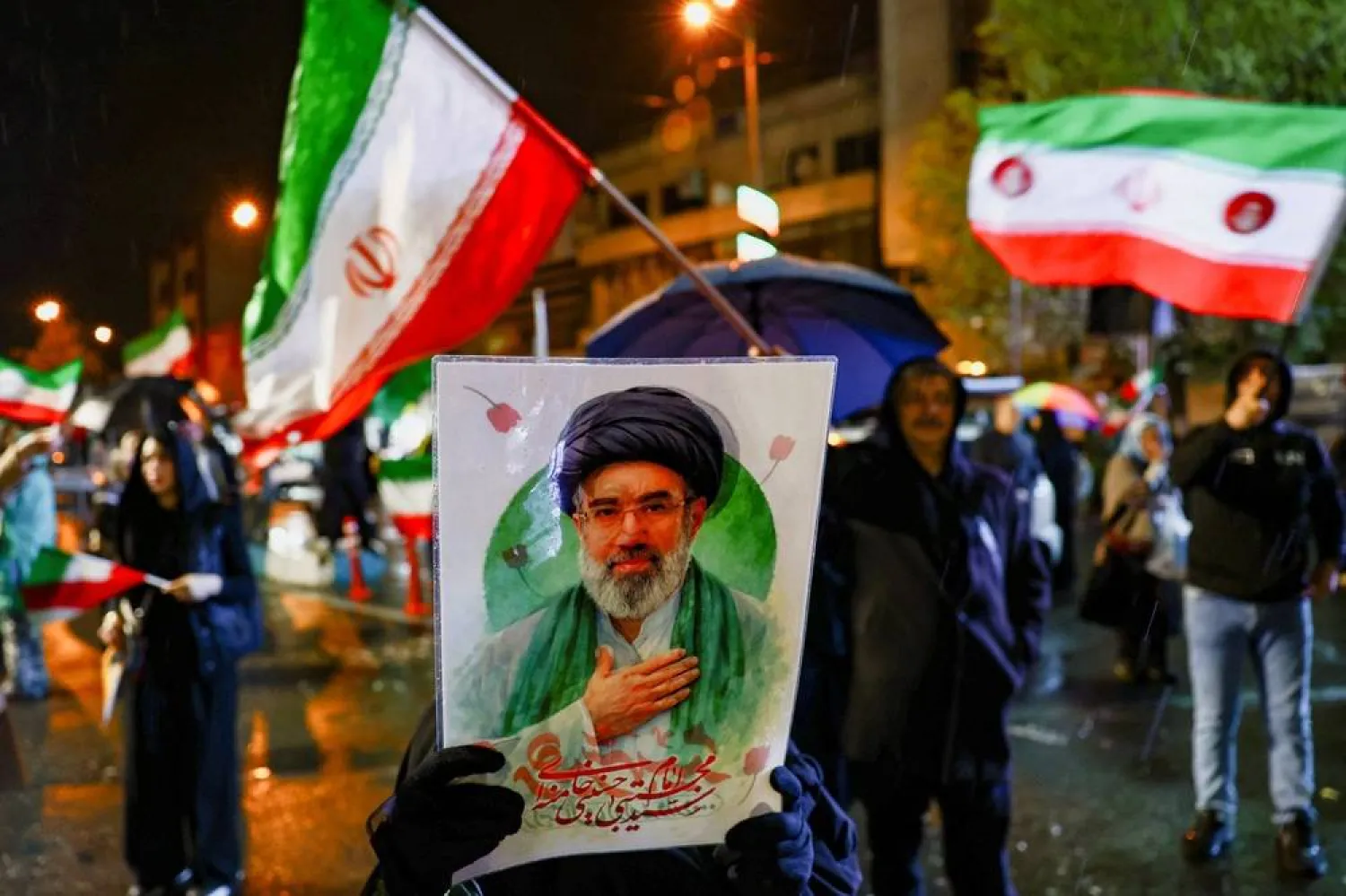
A woman holds a poster depicting Iran’s new Supreme Leader Mojtaba Khamenei during an anti-US and anti-Israeli rally, amid the US-Israeli conflict with Iran, in Tehran, Iran, March 26, 2026. Majid Asgaripour/WANA (West Asia News Agency) via Reuters
TT

With Top Figures Dead, Who Is Now Running Iran?

A woman holds a poster depicting Iran’s new Supreme Leader Mojtaba Khamenei during an anti-US and anti-Israeli rally, amid the US-Israeli conflict with Iran, in Tehran, Iran, March 26, 2026. Majid Asgaripour/WANA (West Asia News Agency) via Reuters

Iran's veteran ‌supreme leader and a host of other top figures and Revolutionary Guards commanders have been killed in US-Israeli strikes, but the ruling system has maintained its ability to strategize and operate in the war that began on February 28.

Born from a 1979 revolution, the Iranian regime built a complex power structure with layered institutions buttressed by a shared commitment to the survival of the theocratic system rather than relying on a small number of individuals.

Here is a guide to who now wields power and influence in a depleted but resilient hierarchy:

IS THE SUPREME LEADER REALLY IN CHARGE?

Iran's veteran Supreme Leader Ali Khamenei was killed in one of the first strikes of the war. In office since 1989 he enjoyed unquestioning obedience throughout the system and the last say on all major issues.

Under Iran's official ideology of velayat-e faqih, or “rule of the Islamic jurist”, the supreme leader is a learned cleric wielding temporal power on behalf of Shiite Islam's 12th imam, who disappeared in the ninth century.

The leader's office, known as the bayt, has a large staff that shadows other parts of Iran's government, allowing the leader to intervene directly across the bureaucracy.

The new leader, Khamenei's son Mojtaba, has inherited the role and its extensive formal powers, but he lacks the automatic authority enjoyed by his father.

The choice of the Revolutionary Guards, he may also be beholden to the hardline military corps.

He was wounded in ‌the strikes, and has ‌been referred to on state TV as a "janbaz", or "wounded veteran" of the current conflict.

More than three weeks after ‌his appointment ⁠he has not been ⁠seen in any photograph or video clip by Iranians and has only issued two written statements, raising questions over his condition.

HOW CENTRAL IS THE REVOLUTIONARY GUARDS CORPS?

The Guards have been growing in influence for decades, but in the midst of a war and after the killing of Ali Khamenei and installation of Mojtaba Khamenei, they have assumed an even more central role in strategic decision-making.

Long prepared to withstand decapitation of their leadership, the Guards have a "mosaic" organizational structure with a line of replacements already named for each commander, and every unit able to operate independently according to set plans.

Many top-ranking Guards commanders were killed early on - following a long list of senior commanders killed in strikes last year - but they have been replaced with other experienced men who have so far proven able to manage a complex war effort.

That resilience reflects the command depth of a corps that took the ⁠lead in the devastating 1980-88 war with Iraq and has spearheaded Iran's close involvement with groups fighting in a host ‌of other conflicts around the Middle East for decades.

WHAT ROLE DOES THE POLITICAL LEADERSHIP PLAY?

Iran's political system ‌merges clerical rule with an elected president and parliament, and they all have a significant role in running the country along with the Guards.

The killing of the late Khamenei's ‌main adviser Ali Larijani was a real blow to the ruling authorities given his extensive experience, his ability to operate between Iran's different power centers and his skills ‌negotiating with the outside world.

Other capable, experienced political figures remain but the more prominent ones likely to step into the shoes of Larijani and other assassinated individuals may be more hardline than those who have been killed.

The death of Revolutionary Guards naval head Alireza Tangsiri, an experienced commander in place since 2018, was another significant blow. Tangsiri had reportedly played a significant part in Iran's closure of the Strait of Hormuz.

WHO ARE SOME OF THE BIG NAMES LEFT?

Revolutionary Guards head Ahmad Vahidi: The corps' latest commander was appointed after his two immediate predecessors were ‌killed. Influential in the Guards for years, he fought in the Iran-Iraq war, ran the Qods Force, served as defense minister and helped crush internal dissent.

Revolutionary Guards' Quds Force chief Esmail Qaani: A secretive figure, he has ⁠managed Iran's ties with proxies and allies across ⁠the region since taking over the unit in 2020 when its veteran leader Qassem Soleimani was killed by a US drone strike ordered by US President Donald Trump.

Parliament Speaker Mohammad Baqer Qalibaf: A former Revolutionary Guards commander, Tehran mayor and failed presidential candidate, Qalibaf may be the biggest political heavyweight still alive. He has been increasingly vocal over recent weeks, setting out Iran's stance as the war has developed and was said by an Israeli official and a source familiar with the matter to have been negotiating with the US over recent days.

Judiciary Head Gholamhossein Mohseni-Ejei: A former intelligence head sanctioned for his role in the deadly repression of mass protests in 2009, Mohseni-Ejei is widely seen as a hardliner.

President Masoud Pezeshkian: While Iran's presidency is far less important than it once was, Pezeshkian is the most senior directly elected figure in Iran, giving him an important voice. The limits of his influence were starkly illustrated earlier this month when he incurred the Guards' ire by apologizing to Gulf states for Iranian attacks on their territory and he had to partially retract his comments.

Former Supreme National Security chief Saeed Jalili: An injured veteran of the Iran-Iraq war and one of the most hardline figures in Iranian politics, he was the losing 2024 presidential candidate and uncompromising former nuclear negotiator.

Guardian Council member Alireza Arafi: The senior cleric is a leading member of the Guardian Council, the body that chooses which candidates to exclude from elections, and was so well trusted that he was chosen to join the three-man interim council running Iran after Khamenei's death.

Foreign Minister Abbas Araqchi: The veteran diplomat has conducted high-stakes negotiations with Iran's Western foes for years, as well as with global powers Russia and China, which have a better relationship with Tehran, and with Iran's Arab neighbors and rivals.

In Final Moments Before Truce, Israeli Strike Kills Lebanese Man’s Family

 A woman reacts as emergency personnel search for survivors at the site of an Israeli strike carried out just before a 10-day ceasefire between Lebanon and Israel, in Tyre, Lebanon, April 17, 2026. (Reuters)
A woman reacts as emergency personnel search for survivors at the site of an Israeli strike carried out just before a 10-day ceasefire between Lebanon and Israel, in Tyre, Lebanon, April 17, 2026. (Reuters)
TT

In Final Moments Before Truce, Israeli Strike Kills Lebanese Man’s Family

 A woman reacts as emergency personnel search for survivors at the site of an Israeli strike carried out just before a 10-day ceasefire between Lebanon and Israel, in Tyre, Lebanon, April 17, 2026. (Reuters)
A woman reacts as emergency personnel search for survivors at the site of an Israeli strike carried out just before a 10-day ceasefire between Lebanon and Israel, in Tyre, Lebanon, April 17, 2026. (Reuters)

Hassan Abu Khalil's family miraculously survived six weeks of war in southern Lebanon, but tragedy struck in the final minutes before a ceasefire came into force. An Israeli strike late on Thursday killed 13 of his relatives, leaving him the sole survivor.

Abu Khalil, 36, stepped out to see friends just before midnight, when a US-brokered truce between Lebanon and Israel was meant to halt fighting that had raged since March 2 between Israel and armed group Hezbollah.

“I heard a very powerful strike, and when I came ‌back to the neighborhood, ‌I found this had happened," Abu Khalil told Reuters on ‌Friday ⁠as he watched ⁠a bulldozer dig through the mountains of pulverized concrete that was once his home in the southern Lebanese port city of Tyre.

"In this building, more than 13 members of my family are missing under the rubble. What then, Israel? Just before the ceasefire, it was one massacre after another against us," he said.

Later on Friday, Lebanon's state news agency said rescue teams had recovered 13 bodies and pulled 35 wounded survivors from the ruins ⁠of the building that was hit the previous evening. It ‌reported that 15 other people were unaccounted for.

The ‌Israeli military did not immediately respond to a request for comment on the strike.

Lebanon's health ministry ‌says 2,294 people have been killed between March 2 and Thursday, when the ‌ceasefire came into force. The toll includes 177 children and 274 women.

'MY FUTURE IS GONE'

On Friday, thousands of Lebanese streamed through Tyre on the way to their southern villages. They crossed over a dirt berm that Lebanese soldiers had erected over the ruins of a main bridge ‌destroyed by Israel earlier on Thursday. Many were relieved to return to their southern villages, even if they were destroyed.

But ⁠Abu Khalil spent ⁠the first day of the ceasefire in a haze of despair, unable to eat or sleep.

He stood wringing his hands next to a bulldozer working through the ruins, his eyes locked on the gaping hole that rescuers were searching.

"Since the strike, I've been here and haven't gone anywhere. Every time they pull someone out, we run over to see what happened, who it is - my friend I grew up with, my friend's mother, my friend's father," Abu Khalil said.

He said he had been living in the United Kingdom but returned to Lebanon to be with his extended family.

"Who is left? No one is left. I wish I had never gone out for that coffee and had stayed with them," he said.

“My future is gone here. This was my life, this was my family - what now? What more is there after this?"


Can Iran Legally Impose Tolls on the Strait of Hormuz?

FILE PHOTO: Cargo ships in the Gulf, near the Strait of Hormuz, as seen from northern Ras al-Khaimah, near the border with Oman’s Musandam governance, amid the US-Israeli conflict with Iran, in United Arab Emirates, March 11, 2026. REUTERS/Stringer/File Photo
TT

Can Iran Legally Impose Tolls on the Strait of Hormuz?

FILE PHOTO: Cargo ships in the Gulf, near the Strait of Hormuz, as seen from northern Ras al-Khaimah, near the border with Oman’s Musandam governance, amid the US-Israeli conflict with Iran, in United Arab Emirates, March 11, 2026. REUTERS/Stringer/File Photo

Tehran has sought to tighten its grip over the Strait of Hormuz by charging tolls on vessels to ensure safe passage, in conjunction with Iran's Revolutionary Guard Corps.

The following explains law governing toll collections and actions that countries opposed to tolls might take, according to Reuters.

WHAT IS THE STRAIT OF HORMUZ?

The Strait of Hormuz is ‌a waterway connecting the Gulf with the Gulf of Oman, and located within Iran's and Oman's territorial waters. It is perhaps the world's most important energy shipping lane. About 20% of the world's oil passes through it.

The waterway is about 104 miles (167 km) long. Its width varies, and at its narrowest point provides 2-mile channels for inbound and outbound shipping, separated by a 2-mile buffer zone.

Iran effectively closed the strait following US-Israeli strikes on the country, and has demanded a right ⁠to collect tolls as a precondition to ending the war. The status of any toll collections so far could not immediately be confirmed.

WHAT LAW GOVERNS PASSAGE ON THE STRAIT?

The UN Convention on the Law of the Sea, opens new tab, sometimes known as UNCLOS, was adopted in 1982 and has been in force since 1994.

Article 38 provides vessels a right of unimpeded "transit passage" through more than 100 straits worldwide, including the Strait of Hormuz.

The treaty allows a country bordering a strait to regulate passage within its "territorial sea," up to 12 nautical miles from its border, but shall permit "innocent passage."

Passage is innocent if it is not prejudicial to a country's peace, good order and security. Military action, serious pollution, spying and fishing are not permitted. The concept of innocent passage was key to a 1949 International Court ‌of ⁠Justice case concerning the Corfu Channel, along the coasts of Albania and Greece.

Approximately 170 countries and the European Union have ratified UNCLOS. Iran and the United States have not. This raises the question of whether the treaty's rules affording freedom of maritime navigation have become part of customary international law, or bind only ratifying countries.

Experts say UNCLOS has become or is generally viewed as customary international law. Some non-ratifying countries may ⁠argue that they need not follow the treaty because they persistently and consistently object. Iran has argued that it has made such objections. The United States disputes Iran's authority to charge tolls.

HOW CAN TOLLS BE CHALLENGED?

There is no formal mechanism to enforce UNCLOS. The International Tribunal for the Law ⁠of the Sea in Hamburg, Germany, which the treaty established, and the International Court of Justice in The Hague, Netherlands could issue rulings but cannot enforce them.

Countries and businesses have other potential means to counteract tolls.

A willing state or coalition of states could ⁠try to enforce the treaty. The UN Security Council could pass a resolution opposing tolls.

Companies could redirect shipments away from the Strait of Hormuz, and have begun doing so. Countries could expand sanctions targeting financial transactions believed to benefit Iran's government, by sanctioning companies willing to pay tolls.


How China’s Weapons Transfers to Iran Have Evolved Over Decades

FILE PHOTO: A member of the People's Liberation Army stands as the strategic strike group displays DF-5C nuclear missiles during a military parade to mark the 80th anniversary of the end of World War Two, in Beijing, China, September 3, 2025. REUTERS/Tingshu Wang/File Photo
TT

How China’s Weapons Transfers to Iran Have Evolved Over Decades

FILE PHOTO: A member of the People's Liberation Army stands as the strategic strike group displays DF-5C nuclear missiles during a military parade to mark the 80th anniversary of the end of World War Two, in Beijing, China, September 3, 2025. REUTERS/Tingshu Wang/File Photo

Washington: David Pierson

For much of the last two decades, China has maintained a delicate balance in its military relationship with Iran, offering often indirect assistance instead of arms sales.

That approach is now drawing renewed attention after US officials said intelligence agencies were assessing whether China may have shipped shoulder-fired missiles to Iran in recent weeks. President Trump has said he would impose an additional 50 percent tariff on Chinese goods if the assessment proves accurate. China has denied the claim, calling it “pure fabrication” and has vowed to “resolutely retaliate” if the Trump administration goes through with tariffs.

The American officials said the information obtained by US intelligence agencies was not definitive. But if proven true, it would be a significant tactical change in the way Beijing supports its closest strategic partner in the Middle East.

Chinese arms sales to Iran exploded in the 1980s and have all but vanished in the last decade to comply with a United Nations embargo and US sanctions. Chinese support for Iran in recent years has instead come in the form of components that could be used in both civilian technologies as well as missiles and drones.

China has a major stake in the crisis in Iran. About a third of its total crude oil imports come from the Arabian Gulf.

Here is how China’s military support for Iran has evolved over the years:

The 1980s: The Boom Years

The outbreak of the Iran-Iraq War in 1980 coincided with major market reforms in China when the leader at the time, Deng Xiaoping, ordered state-owned companies to wean themselves off government support and instead seek commercial profit.

Chinese state-run defense companies were suddenly empowered to export their wares. That resulted in a deluge of Chinese missiles, fighter jets, tanks, armored vehicles and assault rifles being sold to Iran starting in 1982 and peaking in 1987, according to the Stockholm International Peace Research Institute.

At the same time, China sold even more arms to Iraq, resulting in a situation in which the two warring sides clashed with each other using the same Chinese weapons.

The Reagan administration opposed China’s arms sales to Iran, particularly Silkworm anti-ship cruise missiles. Tehran used the missiles in attacks in Kuwaiti waters in 1987 that struck an American-owned tanker and an American-registered tanker.

The United States responded by curbing exports of some high-technology products to China. China denied selling arms directly to Iran, but said it would do more to prevent its military exports from reaching Iran through intermediaries.

The 1990s: Technology Transfers

Following the war, Iran set out to develop its own military-industrial base with the help of China. One of its key products was the Noor anti-ship cruise missile, which had been reverse-engineered through purchases of Chinese C-802 cruise missiles.

“China played a major role in supporting Iran’s military modernization for decades, especially in developing Iran’s missile capabilities,” said Brian Hart, a fellow with the China Power Project at the Center for Strategic and International Studies.

Iran also received help from China in building missile-production facilities and even in constructing a missile test range east of Tehran, wrote Bates Gill, a longtime China expert, in the Middle East Review of International Affairs.

Under US pressure to curtail its sale of finished weapons, particularly missiles, to Iran, China began increasing exports of machine tools and components that could be used for both military and civilian purposes.

The 2000s to the Present: Dual-Use Technologies

In 2006, the United Nations imposed sanctions on Iran’s nuclear and ballistic missile programs. China voted in favor of the resolution and largely pivoted away from new, formal arms contracts with Tehran.

The shift was as much about regional strategy as it was about international law. Starting in the mid-2010s, China began deepening its strategic relationships with Gulf countries including Saudi Arabia and the United Arab Emirates, as well as Qatar.

China continued to supply Iran with dual-use technologies and materials that have helped it amass an arsenal of missiles and drones.

That included chemicals used to produce fuel for ballistic missiles and components for drones, such as radio frequency connectors and turbine blades.

But Mr. Hart said China was still “a critical form of support, given Iran’s reliance on ballistic missiles and drones to attack US and Israeli forces and other countries in the region.”

The US Treasury Department has sanctioned Chinese and Hong Kong front companies it says were set up to source parts and ingredients for ballistic missiles and drones for Iran.

Suspicions are also growing that Iran is using its access to China’s BeiDou satellite navigation system, an alternative to the US-owned Global Positioning System, for military purposes. Last month, a US congressional agency said BeiDou may have been used to direct Iran’s drone and missile strikes across the Middle East.

The New York Times