
Trump’s Germany Troop Cuts Show Limits of NATO Efforts to Keep US on Board

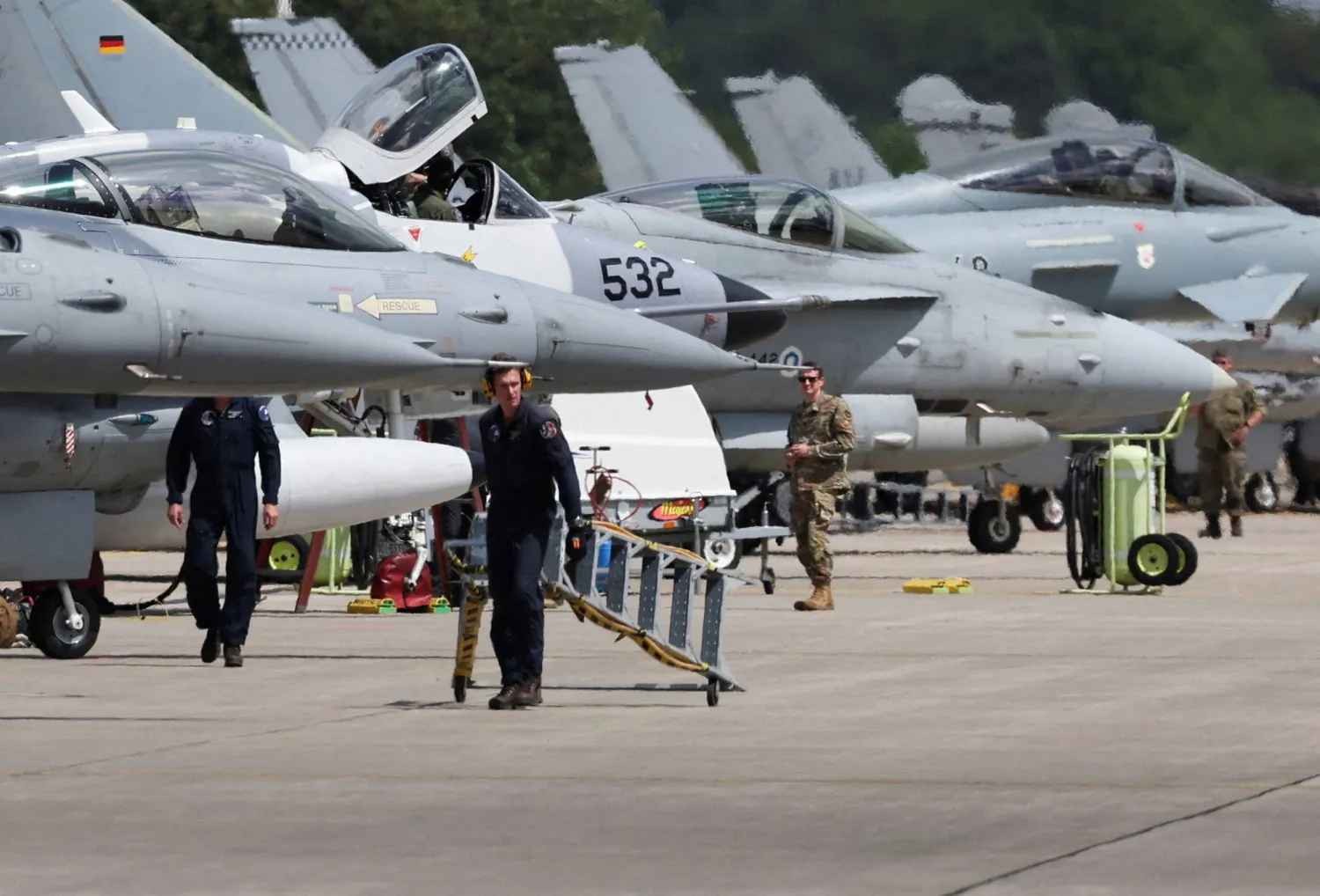
Combat aircraft from a NATO country stand in front of a hangar during a fighter plane maneuver exercise at the American military's Ramstein Air Base, near Ramstein-Miesenbach, Germany, June 6, 2024. (Reuters)
TT

Trump’s Germany Troop Cuts Show Limits of NATO Efforts to Keep US on Board

Combat aircraft from a NATO country stand in front of a hangar during a fighter plane maneuver exercise at the American military's Ramstein Air Base, near Ramstein-Miesenbach, Germany, June 6, 2024. (Reuters)

European officials have been working on ways to convince Donald Trump to keep the United States in NATO despite severe tensions over the Iran war. But his abrupt move to cut US forces in Germany is the latest sign that such efforts have their limits and are far from certain to succeed.

The substance of the decision announced on Friday to remove 5,000 troops from Germany did not come as a surprise to NATO officials. European leaders have agreed with the US president that Europeans will take over more responsibility for their own security from US forces.

Dropping a plan to deploy long-range US Tomahawk missiles to Germany was more concerning for Berlin. But even that was not a huge shock, as that deal was made by Trump’s predecessor, Joe Biden, and US Tomahawk stocks have been depleted by the US-Israeli war against Iran.

More alarming for European governments was how the move was made – with little prior notification or consultation and with US officials linking it to Trump’s displeasure at German Chancellor Friedrich Merz’s criticism of US conduct of the Iran war.

“What is worrying is not ‌the figure of ‌5,000 troops, but the political signal from Washington that longstanding, absolutely reliable partnerships no longer seem to count ‌for ⁠anything and appear to ⁠be subject to arbitrary decisions,” said Siemtje Moeller, a senior lawmaker from Germany’s Social Democrats, who are part of Merz’s governing coalition.

The move followed accusations by Trump that US allies have not been doing enough to support the US in the Iran war and suggestions by him that this meant Washington no longer needs to honor the alliance’s Article 5 mutual defense clause.

Trump also pushed the alliance to the brink by threatening to take Greenland from Denmark, a fellow NATO member. NATO Secretary General Mark Rutte helped to defuse that crisis but the underlying dispute has not been resolved.

European diplomats say they fear Trump may make further moves that could test the alliance before a summit of its 32 national leaders in Ankara in July, especially if the Iran war is not over by ⁠then and he is still venting anger at allies.

"The longer game for NATO and European allies ‌is getting through Ankara," said a European diplomat, speaking on condition of anonymity. "We need to do ‌things with the Americans if we can, and without them if we must.”

EUROPEANS PUSH BACK ON TRUMP CRITICISM

Defense experts say Europeans have little choice but to ‌try to keep the US on board, given their heavy reliance on the United States to deter any possible attack by Russia.

As part of ‌their efforts to convince Trump of the value of European allies, officials have said many European countries are honoring agreements to allow US forces to use bases on their soil and fly in their airspace during the Iran campaign - even if they are not keen to advertise the fact, given Trump and the war are deeply unpopular in much of Europe.

While Spain has banned the use of bases on its territory, Rutte said countries including Britain, Croatia, France, Germany, Greece, Italy, Montenegro, Portugal and ‌Romania were delivering on their commitments.

European officials are also working to make a broader case to Trump, other US officials, lawmakers and Republican-friendly think tanks that it is in their interests to stick with the North ⁠Atlantic Treaty Organization.

Their efforts include highlighting ⁠support for a post-war mission in the Strait of Hormuz, underlining the military and economic value of European allies and demonstrating that Europe is taking on a greater role within NATO, diplomats say.

DIFFERENCES AMONG NATO LEADERS ON IRAN WAR

While there is broad support for these efforts across the alliance, the crisis has also exposed stark differences among European NATO leaders over how to respond to the war on Iran.

Leaders of Western European countries such as Spain, France and Germany have voiced blunt criticism, reflecting domestic public opinion but risking Trump’s ire.

Rutte, by contrast, has made clear he sees anti-war rhetoric as unhelpful. Some eastern European countries, fearing any weakening of NATO will embolden Russia, have taken a similar view, diplomats say.

“When European countries are saying ‘this is not our war’, it irritated the hell out of me,” Rutte told "What the Hell is Going on", a podcast hosted by the American Enterprise Institute think tank, after meeting Trump in Washington last month.

On Monday, Rutte also said several countries were "pre-positioning essential logistical and other support" such as minehunters and minesweepers near the Gulf to be ready for a possible Strait of Hormuz mission after the war ends.

The Netherlands, Belgium and Germany have said they are sending ships that could be part of such a mission. France, which is leading planning of a potential mission with Britain, also has ships in the Middle East that could take part.

"European leaders have gotten the message, they’ve heard the message from the US loud and clear," Rutte told reporters at a summit of European leaders in Armenia.


‘Happiest Day of Our Lives’: Gazans Hold Mass Wedding Among Ruins

 Brides waiting to be wed look on during a mass-wedding celebration for Palestinian couples organized by the Turkish Humanitarian Relief Foundation (IHH) in Gaza City on May 11, 2026. (AFP)
Brides waiting to be wed look on during a mass-wedding celebration for Palestinian couples organized by the Turkish Humanitarian Relief Foundation (IHH) in Gaza City on May 11, 2026. (AFP)
TT

‘Happiest Day of Our Lives’: Gazans Hold Mass Wedding Among Ruins

 Brides waiting to be wed look on during a mass-wedding celebration for Palestinian couples organized by the Turkish Humanitarian Relief Foundation (IHH) in Gaza City on May 11, 2026. (AFP)
Brides waiting to be wed look on during a mass-wedding celebration for Palestinian couples organized by the Turkish Humanitarian Relief Foundation (IHH) in Gaza City on May 11, 2026. (AFP)

Wearing traditional Palestinian dresses, the white fabric intricately embroidered in a rainbow of colors, dozens of smiling brides clutched red bouquets as they walked with their grooms past the tents and ruined buildings of Gaza City.

To the tune of popular songs played from loudspeakers in a city square, the couples whose marriages had been long-delayed by war and displacement, sat on stage with joy written across their faces.

Thousands turned out to watch the mass wedding against the backdrop of buildings gutted by Israeli strikes over the course of the devastating two-year war.

Attendees clapped and smiled as a troupe performed the dabke, an Arabic folk dance, while women's ululations echoed through the crowd.

"I can't quite believe that I'm finally getting married," Ali Mosbeh told AFP at the start of the ceremony.

"I was sitting in the tent when my phone rang... I couldn't believe it. I'm still in shock," he said, recounting the moment he received the call informing him that he was among the 50 young men selected.

The mass wedding is one of many to have been organized since a ceasefire took effect in Gaza in October. This particular event was organized and funded by the Turkish humanitarian organization IHH.

The smartly-dressed grooms wore traditional Palestinian kuffiyeh scarves adorned with the Turkish organization's logo, while the brides' bouquets were dotted with small Turkish flags.

For Mosbeh and his bride Huda al-Kahlout, the high cost of weddings had also posed an obstacle to tying the knot.

"I never imagined I'd get married in such circumstances," he said.

People gather during a mass-wedding celebration for Palestinian brides and grooms organised by the Turkish Humanitarian Relief Foundation (IHH) in Gaza City on May 11, 2026. (AFP)

- 'Carry on living' -

Most of Gaza's population was displaced at least once during the war between Israel and Hamas, with hundreds of thousands still living in tents or makeshift shelters.

Mosbeh said he would now share a tent with his wife while hoping to find a job -- something that has become near impossible in Gaza.

"Our future is uncertain; we depend on aid to survive," admitted Kahlout, but said that despite "war, loss and death... Marriage remains a beautiful milestone for us young people".

"Most of the buildings around the venue have been destroyed and reduced to rubble, with the martyrs buried beneath them," said fellow bride, Fayqa Abu Zeid.

But she added: "We are trying, despite everything, to find joy and carry on living."

Before the war, "the newlyweds would move into a flat with new furniture. Today, we move into a tent, if there is one," she said.

But despite the devastation, her husband Mohammed al-Ghossain was smiling.

"We are very happy," he said. "It is the happiest day of our lives."


Hantavirus Outbreak Tests Post-COVID Health Communications Playbook

The cruise ship MV Hondius, affected by a hantavirus outbreak, leaves the port of Granadilla de Abona, Tenerife, Spain on May 11. (Reuters)
TT

Hantavirus Outbreak Tests Post-COVID Health Communications Playbook

The cruise ship MV Hondius, affected by a hantavirus outbreak, leaves the port of Granadilla de Abona, Tenerife, Spain on May 11. (Reuters)

A rodent-borne virus with a scary name. A mid-ocean cruise ship in quarantine. Several people dead and more falling sick.

It is no wonder that an outbreak of the Andes strain of hantavirus on a luxury liner in the Atlantic has revived some COVID-era trauma and panic online.

That has presented a dilemma to health officials: how to communicate quickly and clearly about a virus which is not new and unlikely to cause a pandemic, but where knowledge gaps remain - without inadvertently fomenting fear.

"Hantavirus thread incoming," posted the health department of Illinois state in the US earlier this week about a risk-free case unrelated to the MV Hondius cruise ship outbreak.

"But you have to promise to read this whole thread before panic-texting your group chat. Deal?"

In interviews with Reuters, half a dozen health officials said they were trying to learn from mistakes around COVID, providing information on hantavirus with more empathy while addressing uncertainties and tackling falsehoods.

"We spend half of our time discussing how we will communicate," said Gianfranco Spiteri, emergencies lead at the EU's European Center for Disease Prevention and Control.

During COVID, many governments were slow to react or in denial, public messaging was sometimes confusing and contradictory, restrictions and vaccine rollouts were applied differently round the world, and misinformation and politicization proliferated.

That helped fuel modern mistrust of institutions. For example, faith in public health institutions declined in 20 of 27 EU countries ‌between 2020 and ‌2022, one study showed.

JUGGLING THE COMMUNICATIONS

Spiteri and others at the forefront of the hantavirus response spoke about the need ‌to balance ⁠explanations of why ⁠it is a serious global health event with reassurances that risks to the public are low and honesty over the open questions about a virus that has rarely spread among humans before.

"There are people who say we are overdoing it, and on the other extreme, that we’re not doing enough," he said. "We always base our messages on the evidence we have."

From a look at social media, their efforts are still a work in progress, with many people needlessly fretting about a return to lockdowns, social distancing and masks.

"We have kind of lost perspective," said Gustavo Palacios, a professor at Icahn School of Medicine at Mount Sinai in the US who is originally from Argentina and a hantavirus expert.

An outbreak can be a major public health event deserving attention and action but without becoming a pandemic, he noted.

Some posts online falsely present hantavirus as a bigger existential threat than COVID, or promote ⁠protections like the ivermectin anti-parasite drug, vitamin D and zinc without scientific evidence.

False conspiracy theories are popping up too - that it ‌is a side effect of the Pfizer vaccine or a hoax to boost pharmaceutical profits.

Sander van der Linden, ‌a psychology professor at England's University of Cambridge and misinformation expert, said the public needed more support in how to interpret information, including potentially showing them conspiracy theories they may face in ‌the event of an outbreak.

"We need to do more preparatory work to create resilience in the population," he said.

As of Thursday, there had been three deaths ‌from 11 reported hantavirus cases in the outbreak, all people who had been on board the Hondius. Dozens of other passengers are being monitored as they return to around 20 countries.

Unlike COVID, there are established measures to control hantavirus' spread, officials said. The strain has circulated in parts of Argentina and Chile for decades and the ship samples show no meaningful variation from that virus.

"I'm definitely seeing improvements," said Gabby Stern, former head of communications at the World Health Organization until September last year, referring particularly to sharing what you know when you know it.

"It seems like ‌the public health community has absorbed crucial lessons, although not all of them."

'EMOTIONAL REACTION' TO CRUISE SHIP

The WHO was quick to reassure the public, holding regular press conferences, issuing alerts and tackling misinformation in social media Q&As since the ⁠outbreak was disclosed on May 3.

WHO chief ⁠Dr. Tedros Adhanom Ghebreyesus even took the unusual step of an open letter to the people of Tenerife, where the Hondius docked on Sunday.

"But I need you to hear me clearly: this is not another COVID," he wrote. "The current public health risk from hantavirus remains low. My colleagues and I have said this unequivocally, and I will say it again to you now."

Some started more slowly: in the US, the Centers for Disease Control and Prevention put out its first information on May 8, five days after the news broke, but has since increased the pace of communications.

"One of the things this is teaching us is a lesson we should have learned from COVID: What we say is really important," said Michael Osterholm, an infectious diseases expert at the University of Minnesota.

The cruise ship hantavirus narrative has not helped, echoing the infamous outbreak on the Diamond Princess docked off Japan early in the COVID pandemic in 2020 where 14 people died and nearly a quarter of the 3,000 passengers and crew became infected.

"The whole cruise ship thing ... is a very significant memory from the beginning of COVID," said Krutika Kuppalli, associate professor of medicine at the University of Texas Southwestern Medical Center.

"There’s an emotional reaction that is stirring people."

The resemblance was not lost on Laura Millán, 40, in Tenerife, as passengers began to disembark at the beginning of this week under strict infection-control measures.

Seeing WHO boss Tedros arrive on the island with Spanish officials to help oversee the hantavirus response took her back.

"It gave me the impression that this isn’t just the flu – otherwise all these people wouldn’t be coming," she said at a playground, adding that overall she understood their involvement helped ensure the right measures.


Mines ‘Draining Türkiye's Water Sources’, Environmentalists Warn

This aerial view shows protesters during a protest march against mining at the Aybasti Plateau in Ordu Province, northeastern Türkiye, on May 8, 2026. (AFP)
TT

Mines ‘Draining Türkiye's Water Sources’, Environmentalists Warn

This aerial view shows protesters during a protest march against mining at the Aybasti Plateau in Ordu Province, northeastern Türkiye, on May 8, 2026. (AFP)

Guney was once a water-rich village fed by 50 springs in Türkiye's western Usak province, but since a gold mine opened 20 years ago, they have all dried up.

"Before, you only had to drill 60 meters to find water," said Ugur Sumer, environmental activist and resident of Guney, which is about 170 kilometers (100 miles) east of the resort city of Izmir.

"Today, even drilling 400 meters yields nothing. The mine has used all our water."

With Türkiye hosting COP31 in November, its own environmental record is being scrutinized, and activists have warned about the growing number of water-intensive mining projects as resources dry up.

Since 2000, Türkiye has rapidly expanded the number of drilling and mining permits granted, notably for gold and coal. The number reached 410,000 last year after the procedures were streamlined by a new law adopted in July.

"I am convinced this law will speed up the arrival of foreign investment in Türkiye," Energy Minister Alparslan Bayraktar said in March while visiting Canada.

While there, he met officials from the Tuprag gold mine in Usak, which is owned by Vancouver-based Eldorado Gold.

Türkiye is hoping to hike its gold production from 28 tons to 100 tons per year "without compromising human health and the environment", Bayraktar said. It also wants to be a major player in global rare earths.

But experts and environmentalists warn this explosion in mining permits is endangering water resources and the economies of rural areas.

Not only does the extraction of metals like gold involve large amounts of water, but it also uses cyanide and releases other pollutants, posing major environmental and health risks.

According to official data, in 2024 mining used 5.8 percent of Türkiye's 20.3 billion cubic meters of water consumption -- four times the amount used in 2016.

This photograph shows harvested hazelnuts in the province of Ordu, in northeast Türkiye on May 7, 2026. (AFP)

- Farmers' protest -

On the Aybasti plateau in the northeastern Ordu province, villagers turned out en masse earlier this month to protest plans to mine an area they use for farming.

"Our pastures have been closed off because of an exploratory drilling plan for a gold mine," said Nuriye Dilek, a 48-year-old livestock farmer.

"What are we supposed to do if we can no longer raise livestock? Are we supposed to abandon our land and leave?"

Farming and animal husbandry are the main sources of income for locals in this region known for its hazelnuts, which are exported across the world.

"Once the gold mine opens, we won't be able to grow hazelnuts here anymore," says Omer Aydin, a nut producer and exporter.

"What's above ground here is more valuable than what's underground. The real gold is the hazelnuts this country produces," he said.

"We are hearing that 80 percent of Ordu's land has been declared a mining site," he told AFP.

"We're extremely concerned."

Last month, the government's anti-disinformation unit Center for Combating Disinformation denied claims "a large portion of land" was being actively used for mining.

It said the total area corresponded to "only 0.18 percent of Türkiye's surface area", denouncing efforts to "tarnish the mining sector".

- 'Excessive use of water, chemicals' -

But the increase in mining permits has infuriated environmentalists, including Ozer Akdemir, who says investment in the sector is being prioritized at the expense of pollution risks and harm to local economies.

"Mining uses excessive water and chemicals. The water isn't just used, it's also polluted," explained hydrologist Erol Kesici.

"The whole world is experiencing a prolonged drought, but Türkiye is also facing a severe hydrological drought," he said of a phenomenon where rainfall shortages hit the wider water system, depleting water bodies and groundwater.

"Our lakes, rivers and groundwater reserves have dried up as a direct consequence of poor water management," said Kesici.

He recently resigned from Türkiye's National Water Council over its "inaction".

Protesters stand next to placards reading “No to the mine” during a protest march against mining at the Aybasti Plateau in Ordu Province, northeastern Türkiye, on May 8, 2026. (AFP)

"When mountains are levelled to dig mines, the ecosystem is destroyed. Heat islands form, reducing rainfall and consequently groundwater levels," he explained.

"How is it possible to grant so many mining permits? Türkiye is suffering from over-exploitation," he said.

For lawyer and activist Arif Ali Cangi, the legislation approved in July, which allows companies to expropriate or rezone agricultural land for mining, will only aggravate the situation.

"Environmental impact assessments and oversight mechanisms are now completely ineffective," he told AFP.

"There are now no longer any obstacles to mining operations being set up anywhere."

- 'Pollution is killing farming' -

Using emergency procedures, mining permit requests can be fast-tracked so companies can immediately seize land, a move that seeks to hobble the growing protest movement across Türkiye, Cangi said.

Among them are villagers from Ikizkoy in the Mugla region, who have mobilized to protect their olive groves from plans to expand a nearby brown coal lignite mine.

Back in Guney, local resident Sumer said the issue of protecting water sources from overexploitation or pollution was ultimately a matter of survival.

"In 2006, nearly 2,000 residents suffered from vertigo, sight problems and nausea after it rained in Guney, with blood tests showing cyanide in their blood," he said.

"Pollution is killing livestock farming and grape harvests, once the backbone of the local economy," he said.

"We wonder how we're going to survive."