
Netanyahu’s Coalition Alliances with Religious Parties Put His Reelection at Risk

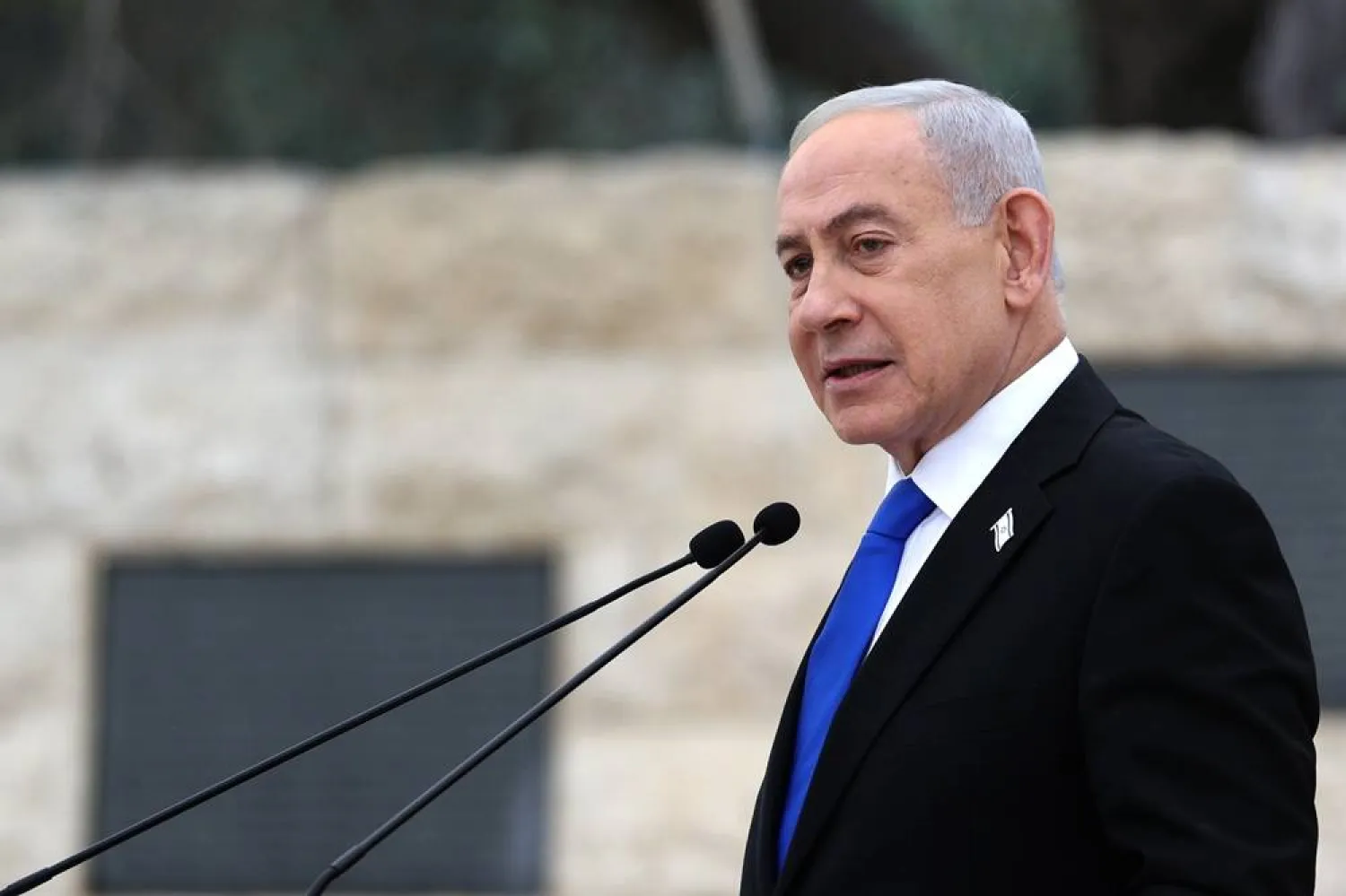
Israel's Prime Minister Benjamin Netanyahu attends a ceremony at the Military Cemetery on Mount Herzl in Jerusalem, April 21, 2026. (AFP)
TT

Netanyahu’s Coalition Alliances with Religious Parties Put His Reelection at Risk

Israel's Prime Minister Benjamin Netanyahu attends a ceremony at the Military Cemetery on Mount Herzl in Jerusalem, April 21, 2026. (AFP)

Israeli Prime Minister Benjamin Netanyahu has remained in power for most of the past 17 years due in part to a tight alliance with ultra-Orthodox religious parties.

But that alliance is tearing apart his governing coalition and proving to be another major liability for the long-serving Israeli leader as the country heads to elections later this year. The Oct. 7, 2023, attack — and the inconclusive wars that have followed — are also weighing on him.

After 2 1/2 years of active fighting in multiple countries, much of it involving reservists, many Israelis are tired of a longstanding system that has allowed ultra-Orthodox men to skip military service. That anger has spread to Netanyahu’s own base.

The ultra-Orthodox are meanwhile furious at his failure to legalize their exemptions. They withdrew their support for the coalition two weeks ago, leading to an initial vote to dissolve parliament, known as the Knesset, on Wednesday.

That set in motion a process that could move elections up from October to September.

Here’s a closer look.

The clock is ticking

Netanyahu is still trying to pass a bill that would legalize the exemptions and fulfill a promise to his religious partners, but that appears to be a long shot given the strident opposition of many within his own coalition.

Deputy Foreign Minister Sharren Haskel, who served for three years in a combat unit and is a vocal supporter of Netanyahu, said she was among at least seven members of the coalition who will not support the draft bill, rendering it impassable.

“The ultra-Orthodox are trying to extort us. It’s immoral. It’s not fair,” said Haskel, who wore her military uniform at the dissolution vote on Wednesday to highlight her opposition and highlight her own service.

Two major ultra-Orthodox parties deserted Netanyahu earlier this month after he told them he did not expect to be able to pass the exemptions bill. That left his coalition without a parliamentary majority, and is one of the main reasons for the bill to dissolve the Knesset.

“He made a promise to his most loyal allies in the coalition, and he could not deliver, he kept postponing,” said Shmuel Rosner, a senior fellow at the Jewish People Policy Institute, a Jerusalem think tank.

Yitzhak Pindrus, a lawmaker from one of the factions, told The Associated Press on Tuesday that it has no plans to return to the coalition.

“We need the draft bill,” he said.

The ultra-Orthodox can make or break Netanyahu's coalition

Israel's political landscape is highly fragmented, and no one party has ever won a majority in the 120-member Knesset.

Instead, parties must build alliances to cobble together a majority, which often involves bargaining that gives smaller parties outsized influence.

The ultra-Orthodox currently have 18 seats in the Knesset, a similar number to previous years, but have long been indispensable to Netanyahu. In exchange for his support for government subsidies and the draft exemptions, they have stood by him through regional crises and longstanding corruption allegations.

Netanyahu has long relied on “automatic support” from the ultra-Orthodox, said Gilad Malach, an expert on the ultra-Orthodox at the Israel Democracy Institute, a research group in Jerusalem.

That support helped Netanyahu remain in power through the worst attack in Israel’s history.

The coalition, which also includes ultra-nationalist parties, “was much more stable than I ever imagined,” said Rosner. “Maybe it's because they realized in a new election, they're going to get defeated, and that's why they stuck together.”

Imploding the coalition from within If

Netanyahu somehow passes some form of the draft exemption bill, it could dramatically alter the electoral map. It would push large sectors of the population, who have previously supported Netanyahu but are buckling under hundreds of days of reserve duty, to vote for rival parties that promise equal service, Malach said.

Netanyahu appears to stand little chance of remaining prime minister after October's elections without ultra-Orthodox support. And he is probably their only hope of a bill that would avoid mandatory enlistment coming up for discussion in the next government.

But sticking with the ultra-Orthodox risks harming Netanyahu's standing with the broader public, leaving him in a bind as the country heads toward elections.

Why the ultra-Orthodox reject military service

Most Jewish men are required to serve nearly three years of military service, followed by years of reserve duty. Jewish women serve two mandatory years.

Each year, roughly 13,000 ultra-Orthodox men reach the conscription age of 18, but less than 10% enlist, according to a parliamentary committee.

Faced with a severe shortages of soldiers, the military is looking to extend the period of mandatory service.

The ultra-Orthodox, who make up roughly 13% of Israeli society and are the fastest growing sector, have traditionally received exemptions if they are studying full-time in religious seminaries. The exemptions date back to the birth of the state in 1948, when a small number of students sought to revive the Jewish scholarship system after it was decimated by the Holocaust.

Those exemptions — and the government stipends many seminary students receive up to the age of 26 — have infuriated many Israelis.

Israel is currently maintaining a simultaneous military presence in Gaza, Lebanon, and Syria, in addition to fighting a war with Iran, which has stretched its robust military to the breaking point.

The Supreme Court said the exemptions were illegal in 2017, but repeated extensions and government delay tactics have left them in place.

Among Israel’s Jewish majority, mandatory military service is largely seen as a melting pot and rite of passage. Many in the insular ultra-Orthodox community fear that military service would expose young people to secular influences.


Report: Early War Goal Was to Install Ahmadinejad as Iran’s Leader

Former Iranian President Mahmoud Ahmadinejad (AFP)
TT

Report: Early War Goal Was to Install Ahmadinejad as Iran’s Leader

Former Iranian President Mahmoud Ahmadinejad (AFP)

Washington: By Mark Mazzetti, Julian E. Barnes, Farnaz Fassihi and Ronen Bergman

Days after Israeli strikes killed Iran’s supreme leader and other top officials in the opening salvos of the war, President Trump mused publicly that it would be best if “someone from within” Iran took over the country.

It turns out that the United States and Israel went into the conflict with a particular and very surprising someone in mind: Mahmoud Ahmadinejad, the former Iranian president known for his hard-line, anti-Israel and anti-American views.

But the audacious plan, developed by the Israelis and which Mr. Ahmadinejad had been consulted about, quickly went awry, according to the US officials who were briefed on it.

Mr. Ahmadinejad was injured on the war’s first day by an Israeli strike at his home in Tehran that had been designed to free him from house arrest, the American officials and an associate of Mr. Ahmadinejad said. He survived the strike, they said, but after the near miss he became disillusioned with the regime change plan.

He has not been seen publicly since then and his current whereabouts and condition are unknown.

To say that Mr. Ahmadinejad was an unusual choice would be a vast understatement. While he had increasingly clashed with the regime’s leaders and had been placed under close watch by the Iranian authorities, he was known during his term as president, from 2005 to 2013, for his calls to “wipe Israel off the map.” He was a strong supporter of Iran’s nuclear program, a fierce critic of the United States and known for violently cracking down on internal dissent.

How Mr. Ahmadinejad was recruited to take part remains unknown.

The existence of the effort, which has not been previously reported, was part of a multistage plan developed by Israel to topple Iran’s theocratic government. It underscores how Mr. Trump and Prime Minister Benjamin Netanyahu of Israel went into the war not only misjudging how quickly they could achieve their objectives but also gambling to some degree on a risky plan for leadership change in Iran that even some of Mr. Trump’s aides found implausible. Some American officials were skeptical in particular about the viability of putting Mr. Ahmadinejad back into power.

“From the outset, President Trump was clear about his goals for Operation Epic Fury: destroy Iran’s ballistic missiles, dismantle their production facilities, sink their navy, and weaken their proxy,” Anna Kelly, a White House spokeswoman, said in response to a request for comment about the regime change plan and Ahmadinejad. “The United States military met or exceeded all of its objectives, and now, our negotiators are working to make a deal that would end Iran’s nuclear capabilities for good.”

A spokesperson for Mossad, the Israeli foreign intelligence agency, declined to comment.
US officials spoke during the early days of the war about plans developed with Israel to identify a pragmatist who could take over the country. Officials insisted that there was intelligence that some within the Iranian regime would be willing to work with the United States, even if those people couldn’t be described as “moderates.”

Mr. Trump was enjoying the success of the raid by US forces to capture Venezuela’s leader, Nicolas Maduro, and the willingness of his interim replacement to work with the White House — a model that Mr. Trump appeared to think could be replicated elsewhere.

In recent years, Mr. Ahmadinejad has clashed with regime leaders, accusing them of corruption, and rumors have swirled about his loyalties. He was disqualified from numerous presidential elections, his aides were arrested and Mr. Ahmadinejad’s movements were increasingly restricted to his home in the Narmak section of eastern Tehran.

That American and Israeli officials saw Mr. Ahmadinejad as a potential leader of a new government in Iran is further evidence that the war in February was launched with the hopes of installing more pliable leadership in Tehran. Mr. Trump and members of his cabinet have said that the goals of the war were narrowly focused on destroying Iran’s nuclear, missile and military capabilities.

There are many unanswered questions about how Israel and the United States planned to put Mr. Ahmadinejad in power, and the circumstances surrounding the airstrike that injured him. American officials said that the strike — carried out by the Israeli Air Force — was meant to kill the guards watching over Mr. Ahmadinejad as part of a plan to release him from house arrest.

On the first day of the war, Israeli strikes killed Ali Khamenei, Iran’s supreme leader. The strike at Khamenei’s compound in central Tehran also blew up a meeting of Iranian officials, killing some officials whom the White House had identified as more willing to negotiate over a change in government than their bosses.

There were also initial reports at the time in the Iranian media that Mr. Ahmadinejad had been killed in the strike on his home.

The strike did not significantly damage Mr. Ahmadinejad’s house at the end of a dead-end street. But the security outpost at the entrance to the street was struck. Satellite imagery shows that building was destroyed.

In the days that followed, official news agencies clarified that he had survived but that his “bodyguards” — in actuality Revolutionary Guard Corps members who were both guarding him and holding him under house arrest — were killed.

An article in The Atlantic in March, citing anonymous associates of Mr. Ahmadinejad, said that the former president had been freed from government confinement after the strike at his house, which the article described as “in effect a jailbreak operation.”

After that article, an associate of Mr. Ahmadinejad confirmed to The New York Times that Mr. Ahmadinejad saw the strike as an attempt to free him. The associate said the Americans viewed Mr. Ahmadinejad as someone who could lead Iran, and had the capability to manage “Iran’s political, social and military situation.”

Mr. Ahmadinejad would have been able to “play a very important role” in Iran in the near future, the associate said, suggesting that the United States saw him as similar to Delcy Rodriguez, who took power in Venezuela after American forces seized Mr. Maduro and has since worked closely with the Trump administration, the person said.

During his presidency, Mr. Ahmadinejad was known both for his hard-line policies and his often outlandish fundamentalist pronouncements, such as his declaration that there was not a single gay person in Iran and his denial of the Holocaust. He spoke at a conference in Tehran called “A World Without Zionism.”

Western satirists lampooned these views, and Mr. Ahmadinejad became something of an unwitting pop culture curiosity, even the subject of Saturday Night Live parodies.

He also presided over the country at a time when Iran was accelerating the enrichment of uranium it could one day use for making a nuclear bomb should it choose to weaponize its program. An American intelligence assessment in 2007 concluded that Iran had, years earlier, frozen its work on building a nuclear device but was continuing the enrichment of nuclear fuel it could use for a nuclear weapon if it changed its mind.

After Mr. Ahmadinejad left office he gradually became something of an open critic of the theocratic government, or at least at odds with Khamenei.

Three times — 2017, 2021, and 2024 — Mr. Ahmadinejad tried to run for his previous job, but each time Iran’s Guardian Council, a group of civilian and Islamic jurists, blocked his presidential campaign. Mr. Ahmadinejad has accused senior Iranian officials of corruption or bad governance and become a critic of the government in Tehran. While he never was an overt dissident, the regime began to treat him as a potentially destabilizing element.
Mr. Ahmadinejad’s ties to the West are far murkier.

In a 2019 interview with The New York Times, Mr. Ahmadinejad praised President Trump and argued for a rapprochement between Iran and the United States.

“Mr. Trump is a man of action,” Mr. Ahmadinejad said. “He is a businessman and therefore he is capable of calculating cost-benefits and making a decision. We say to him, let’s calculate the long-term cost-benefit of our two nations and not be shortsighted.”

People close to Mr. Ahmadinejad have been accused of having too close ties to the West, or even spying for Israel. Esfandiar Rahim Mashai, Mr. Ahmadinejad’s former chief of staff, was put on trial in 2018 and the judge in the case publicly asked about his links to British and Israeli spy agencies, an accusation publicized by state media.

In the past few years Mr. Ahmadinejad has made trips out of Iran that further fueled speculation.

In 2023, he traveled to Guatemala and in 2024 and 2025 he went to Hungary, trips detailed by New Lines magazine. Both countries have close ties to Israel.

The Hungarian prime minister at the time, Viktor Orban, has a close relationship with Mr. Netanyahu. During the trips to Hungary, Mr. Ahmadinejad spoke at a university connected to Mr. Orban.

He returned from Budapest just days before Israel began attacking Iran last June. When that war broke out, he kept a low public profile and posted only few statements on social media.

His relative silence about a war with a country that Mr. Ahmadinejad had long viewed as Iran’s main enemy was noted by many on Iranian social media.

Discussion of Mr. Ahmadinejad on Iranian social media picked up after reports of his death, according to an analysis by FilterLabs, a company that tracks public sentiment. But the discussion declined in the weeks following, mainly amounting to confusion about his whereabouts.

At the outset, Israel envisioned the war unfolding in several phases, starting with air assaults by the United States and Israel plus the killing of Iran’s supreme leaders and the mobilization of Kurds to fight Iranian forces, according to two Israeli defense officials familiar with the operational planning.

Then, the Israeli plan foresaw a combination of influence campaigns carried out by Israel and the Kurdish invasion creating political instability in Iran and a sense that the regime was losing control. In a third stage, the regime, under intense political pressure and the weight of damage to key infrastructure like electricity, would collapse, allowing for what the Israelis referred to as an “alternative government” to be established.

Other than the air campaign and the killing of the supreme leader, little of the plan played out as the Israelis had hoped, and much of it appears in retrospect to have profoundly misjudged Iran’s resilience and the capacity of the United States and Israel to exert their will.

But even after it became clear that Iran’s theocratic government had survived the first months of the war, some Israeli officials continued to express belief in their vision of imposing regime change in Tehran.

David Barnea, Mossad’s chief, told associates in several discussions that he still thought that the agency’s plan, based on decades of intelligence collection and operational activity in Iran, had a very good chance of succeeding had it received approval to move forward.

The New York Times


In Iran's Capital, Weapons Are Demonstrated and Missiles Adorn Wedding Stage

A member of the Revolutionary Guard's volunteer Basij force, left, gives instructions on how to handle a Kalashnikov-style assault rifle during a weapons training class in Tehran, Iran, Tuesday, May 19, 2026. (AP Photo/Vahid Salemi)
TT

In Iran's Capital, Weapons Are Demonstrated and Missiles Adorn Wedding Stage

A member of the Revolutionary Guard's volunteer Basij force, left, gives instructions on how to handle a Kalashnikov-style assault rifle during a weapons training class in Tehran, Iran, Tuesday, May 19, 2026. (AP Photo/Vahid Salemi)

Iranian Revolutionary Guard members now regularly show the public in Tehran how to handle Kalashnikov-style assault rifles. Parades through the capital feature military vehicles mounted with belt-fed Soviet-era machine guns. And at one mass wedding, a ballistic missile, like the one that rained down cluster munitions on Israel, adorned the stage.

Weapons are now regularly brandished in Tehran, an increasing show of defiance as US President Donald Trump threatens he could restart the war with Iran should negotiations break down and Iran refuses to release its grip on the Strait of Hormuz.

The weapons displays reflect the genuine threat Iran faces: Trump has suggested American forces could seize Iran’s stockpile of highly enriched uranium by force and previously said that he sent arms to Kurdish fighters to pass onto anti-government protesters.

But they also offer reassurance and motivation to hard-liners and provide rare entertainment at a time of great uncertainty, when Iranians are facing mass layoffs, business closures and spiraling prices for food, medicine and other goods, The Associated Press reported.

A man tries to assemble a Kalashnikov-style assault rifle during a weapons training class led by members of the Revolutionary Guard's volunteer Basij force in Tehran, Iran, Tuesday, May 19, 2026. (AP Photo/Vahid Salemi)

Suggesting more hard-liners will be armed could also help suppress any new demonstrations against Iran's theocracy, which violently put down nationwide protests in January in a crackdown that activists say killed over 7,000 people and saw tens of thousands detained.

“This is necessary for all our people to get trained because we are in a war situation these days," said Ali Mofidi, a 47-year-old Tehran resident at a weapons training Tuesday night. "If necessary, everyone should be available and know how to use a gun.”

For months, state television and government-sponsored text messages have bombarded the public with calls to join the “Janfada,” or the “ones who sacrifice their lives.” At one point, hard-liners encouraged families with boys as young as 12 to send them to the Revolutionary Guard to work checkpoints — which Amnesty International denounced as a war crime.

Government officials say more than 30 million people in Iran — home to a population of some 90 million — have volunteered via an online form or at public gatherings to lay down their lives for Iran's theocracy. There is no way to confirm that figure and there's been no sign of a mass mobilization yet, like the one that Ukraine underwent in the days before Russia’s full-scale 2022 invasion, in which officials handed out rifles and people banded together to make gasoline bombs.

But there have been several public announcements and presenters have appeared armed during live programs on state TV, as part of efforts to feed the fervor.

“Looking back at the moment I registered my name, I realize I wasn’t truly contemplating the dangers of fighting on the front lines. In that moment, like everyone else, my thoughts were solely on Iran,” wrote journalist Soheila Zarfam in a column for the state-owned Tehran Times newspaper. “My life might end, but Iran would endure, and that was all that truly mattered.”

Iranian Nobel Peace Prize laureate Shirin Ebadi has criticized the public weapons demonstrations, particularly footage of young boys handling assault rifles, saying: “Scenes like these are reminiscent of child hostage-taking and arming by groups such as Boko Haram in Nigeria, and militias in Sudan and Congo.”

A man jokes while holding a Kalashnikov-style assault rifle during a weapons training class led by members of the Revolutionary Guard's volunteer Basij force in Tehran, Iran, Tuesday, May 19, 2026. (AP Photo/Vahid Salemi)

A recent government-organized demonstration by nomads in Iran saw them carrying everything from bolt-action Lee–Enfield rifles of the British Empire to a blunderbuss, a predecessor of the shotgun more familiar to the age of pirates on the high seas.

But during weeks of an unsteady ceasefire, most of the weapon demonstrations appear focused on Tehran, not the rural areas where there is a tradition of keeping rifles and shotguns at home.

At a demonstration Tuesday night in Tehran, male and female participants divided into separate classes. Hadi Khoosheh, a member of the Revolutionary Guard’s all-volunteer Basij force and trainer, demonstrated how to handle a folding-stock Kalashnikov-style assault rifle.

“At the end of the training those who completed the course will receive a card titled 'Janfada,' proving they have received basic and preliminary training for this type of gun and they are able to use it if, God forbid, something happens to our country," Khoosheh said.

However, the weapons training was rudimentary at best for the young boys and older men gathered. One struggled to insert the rifle's magazine and inadvertently pointed the barrel of the unloaded weapon at others — a major safety breach that people are taught to avoid in basic firearms training.

“Definitely we will stand against (the Americans) and won’t give up even an inch of our soil," said Mofidi, the man at the training. "No matter if they come from the sea or land, we will stand by our flag.”


Shot for Throwing Stones: Israeli Forces Killing West Bank Teens Weekly

Palestinian Sameh Shtayyeh, the father of 15-year-old Youssef Sameh Shtayyeh who was killed on April 23, by Israeli soldiers in the city of Nablus, hugs his son as they visit his grave at the cemetery in the village of Till, west of Nablus, in the Israeli-occupied Palestinian West Bank on May 12, 2026. (AFP)
TT

Shot for Throwing Stones: Israeli Forces Killing West Bank Teens Weekly

Palestinian Sameh Shtayyeh, the father of 15-year-old Youssef Sameh Shtayyeh who was killed on April 23, by Israeli soldiers in the city of Nablus, hugs his son as they visit his grave at the cemetery in the village of Till, west of Nablus, in the Israeli-occupied Palestinian West Bank on May 12, 2026. (AFP)

Youssef Shtayyeh came home from school on an April afternoon, dropped his bag in the hallway and headed straight back out to join his friends.

Minutes later, he was dead -- shot by an Israeli soldier, just 100 meters (yards) from his home.

He was 15. His is not an isolated case.

Since Israel launched a major military operation against armed Palestinian groups in the northern West Bank in January 2025, one Palestinian minor has been killed every week on average across the territory, up from one every three weeks in 2021, according to UNICEF.

Seventy teenagers, mostly aged 15 to 16, have been killed to date, 65 of them by Israeli forces, according to a UNICEF report dated May 12.

Then came Youssef Kaabnah, 16, killed on May 13.

Then Fahd Oweis, 15, two days later.

The Israeli military said both had "hurled stones" at soldiers.

It is almost certainly what Shtayyeh had been doing too, on April 23, in Nablus -- the largest city in the northern West Bank, a Palestinian territory occupied by Israel since 1967.

Youssef and his friends were on a side street above a main road when a couple passing in a car spotted them throwing stones -- and the military convoy below.

One jeep stopped. Then the others.

"A soldier got out, then two more. They started shooting at the kids," the passing driver told AFP, declining to be named for safety reasons.

- 'Designed to kill' -

A neighbor filmed what followed.

Two shots. Then screams. Youssef grabbed the car door.

"He said, 'Please don't leave me, I'm scared. Take me to my father, take me home,'" the driver recalled.

Youssef's father Sameh Shtayyeh, a 48-year-old building contractor, told AFP he had no idea what had caused the soldiers to open fire on his son as he "wasn't there".

In a panic, the driver told the boy to get in the car and sped to the hospital.

By the time they reached the facility, the boy was silent. Youssef's heart had stopped.

"A gunshot wound -- entry in the back, exit through the chest," surgeon Bahaa Fattouh, who treated him, told AFP.

Doctors resuscitated him and rushed him to the operating theater. His heart stopped again.

This time, it did not revive.

"Earlier, we used to treat minor injuries -- legs, arms, rubber bullets," said Fattouh.

But since the Hamas attack on Israel on October 7, 2023, "we only see lethal wounds -- chest, head."

Wounds, Fattouh said, that were "designed to kill".

"Most patients die on the operating table."

- 'Standard procedure' -

AFP contacted the Israeli military on the day of the incident, and again after returning from Nablus last week.

The response was identical, word for word: "A terrorist threw stones at soldiers. The soldiers applied the standard arrest procedure, which ended with fire being directed at the suspect."

Israeli daily Haaretz recently quoted the military's commander for the West Bank, Major General Avi Bluth, saying troops had killed 42 Palestinians for throwing stones in 2025.

He described stone-throwing as "terrorism".

Standing at the spot where his son fell, Sameh Shtayyeh stares down at the road below.

"Whether he threw stones or not -- what does it matter? Where is the danger to an army patrol?" he asks bitterly.

In protests "in Israel, in France, people throw stones and bins" and face nothing worse than arrest, he said.

He buried Youssef in the family village of Tell, five kilometers (three miles) from Nablus.

Weeks later, women were still holding a vigil at the flower-covered grave, topped with a portrait of the teenager showing him on a football pitch with a ball at his feet.

His father had promised to take him to Saudi Arabia to watch Cristiano Ronaldo play.

Now, each time Sameh comes home, Youssef is not there to greet him.

His eldest son returns from school -- but Youssef is not there. He glances at the back seat of his car. Youssef is not there.