
Khan al-Ahmar: Last Tent in Battle for Greater Jerusalem

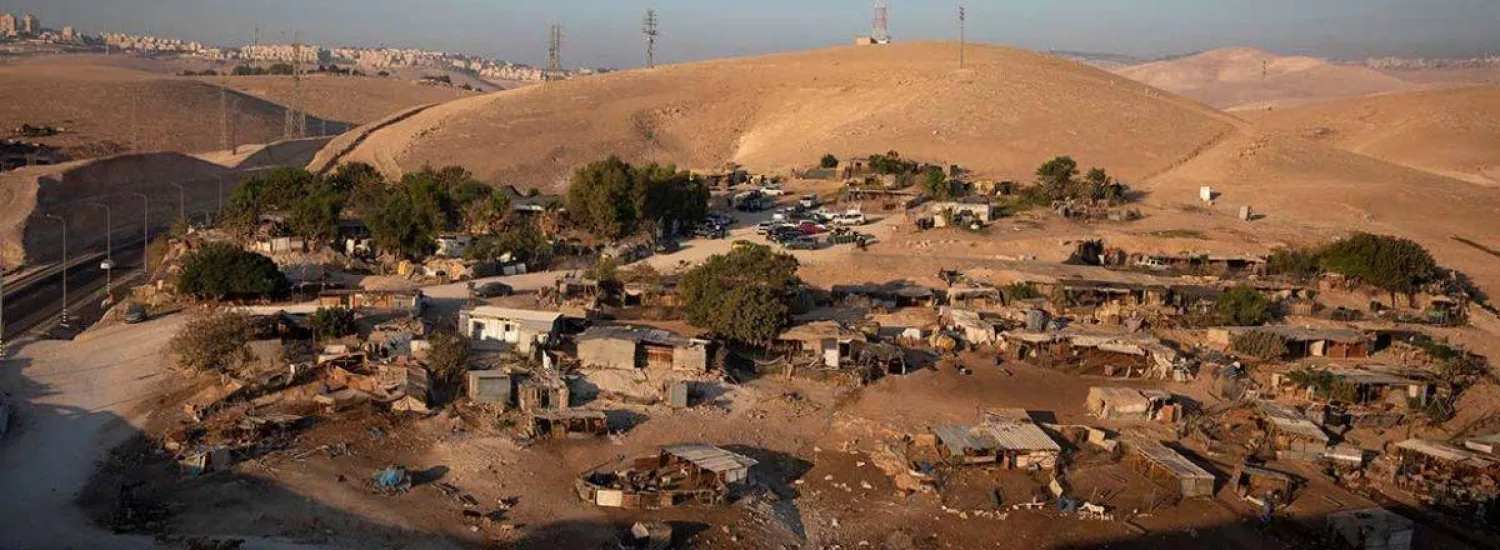
Khan al-Ahmar community in the heart of the West Bank (Israeli Information Center for Human Rights in the Occupied Territories - B’Tselem)
TT

Khan al-Ahmar: Last Tent in Battle for Greater Jerusalem

Khan al-Ahmar community in the heart of the West Bank (Israeli Information Center for Human Rights in the Occupied Territories - B’Tselem)

On the road to the impoverished Bedouin community of Khan al-Ahmar, in the heart of the West Bank, the upscale Israeli settlement of Maale Adumim occupies a large, elevated and commanding stretch of land.

But that is no longer enough for Israel’s far-right government, which now plans to annex everything, Maale Adumim, Khan al-Ahmar and the surrounding area, to Jerusalem under the controversial E1 project.

The plan aims, among other things, to realize the dream of Greater Jerusalem, the most important step in a project to change the face of the West Bank by cutting through it with a settlement belt.

That would strengthen the presence of settlers and settlements in what Palestinians describe as a new state of settlers, end the dream of a contiguous Palestinian state, and isolate Jerusalem, the hoped-for capital, from it.

No one in the West Bank has faced more demolition orders and threats than the residents of Khan al-Ahmar, which now finds itself in a battle larger than itself. Over many long years, they have fought several legal battles and ground confrontations, holding on to their land and tents and trusting in victory.

That confidence has been shaken only by Israel’s fierce and sweeping assault on everything Palestinian since Oct. 7.

“The situation is different”

Tension hung over Khan al-Ahmar days after a decision by Bezalel Smotrich. Eid al-Jahalin, also known as Abu Khamis, the head of the Bedouin council, had no clear answers for hundreds of calls, messages and questions from journalists and activists, some of whom came to the area to document what was happening inside and around the temporary tents and structures.

He told Asharq Al-Awsat that he did not know exactly what would happen.

Abu Khamis, who speaks several languages, including English and Hebrew, was trying hard to deliver one message: that demolishing this simple and poor place would open the door to the most dangerous plan in the West Bank, “Greater Jerusalem.”

In his modest tent, among many others, there are maps, a coffee pot, journalists, visitors, solidarity activists and foreign delegations. He has grown used to such scenes with every Israeli threat to demolish Khan al-Ahmar. This time, however, he is more worried than ever.

“The situation this time is completely different and very dangerous,” Abu Khamis said. “In 2018, all Palestinians were with us. The government and civil society were sleeping here. I had 5,000 people with me. International pressure was strongly present, and our cause was at the top of the Middle East agenda. Today, the situation is different.”

Explaining his fears, he said: “After Oct. 7, Israel became more aggressive, and the West Bank has been turned into a state of settlers. This is a state war against us, not a problem caused by individuals. In the West Bank, we now have a thousand Khan al-Ahmars: killing, displacement and fire consuming every part of the West Bank, while the Palestinian effort is scattered.

“Internationally, too, there is the Gaza war, the war in Lebanon and the Hormuz war. The world is also busy and distracted. Governments have changed in America, Israel and elsewhere.”

He said the occupation believes this is the right time.

For Abu Khamis, Smotrich’s latest decision “was issued for actual implementation, and only real international pressure will stop it.”

Evacuation order and declared war

Smotrich, who is leading what Israelis describe as a revolution to change the status quo in the West Bank, signed an evacuation order for Khan al-Ahmar last month as part of the “beginning of a war” he declared against the Palestinian Authority.

He accused the PA of being behind a secret arrest warrant issued by the International Criminal Court, which had earlier rejected the matter.

Speaking at a news conference about 10 days ago, against the backdrop of reports that the ICC in The Hague had issued a secret request for an arrest warrant against him, Smotrich said: “The hands are the hands of The Hague, but the voice is the voice of the Palestinian Authority, the terrorist organization wrongly called the Palestinian Authority.”

Smotrich claimed that issuing arrest warrants against Prime Minister Benjamin Netanyahu, former Defense Minister Yoav Gallant, and himself amounted to “a declaration of war.”

“In the face of a declaration of war, we will respond with an all-out war,” he said.

“I am not a submissive Jew, no. The Palestinian Authority has started a war, and it will get a war. From today, any economic or other target that falls within my powers as finance minister and as a minister in the Defense Ministry, and that I can harm, will be attacked. There will be no words and slogans, only actions.”

He added: “I announce here the first target. As soon as I finish speaking here, I will sign an order to evacuate Khan al-Ahmad under my powers as a minister in the Defense Ministry. I promise all our enemies: this is only the beginning.”

Smotrich immediately signed the decision to evacuate Khan al-Ahmar and ordered that “all necessary measures” be taken to demolish it.

The decision to demolish Khan al-Ahmar can only be seen as part of a campaign Smotrich has led for years against Palestinians in the West Bank.

It has included seizing large areas of land, changing laws related to control, ownership, land registration procedures and possession of property, as well as powers related to law enforcement.

It has also included his relentless work to weaken and dismantle the Palestinian Authority and turn the West Bank into a state of settlers by advancing major settlement plans and giving settlers a free hand in the area.

But Khan al-Ahmar’s significance is exceptional because it is a major obstacle to implementing the huge E1 settlement project, which involves a dangerous linking of a group of large surrounding Israeli settlements with Jerusalem, forming Greater Jerusalem.

The plan would connect Jerusalem to the large settlement of Maale Adumim in the central West Bank, in a way that Israeli rights group B’Tselem has said would severely threaten the possibility of a future Palestinian state and entrench a binational apartheid state.

The Palestinian National Information Center said that, in addition to the historically declared goal of linking Maale Adumim settlement with Jerusalem and excluding Palestinian neighborhoods from their natural development space, the plan serves the broader vision of “Greater Jerusalem,” covering about 600 square kilometers, or around 10% of the West Bank, through road belts, industrial zones and new neighborhoods.

Implementation depends on the settlement project known as the “fabric of life” road and alternative routes to separate Palestinian movement from the center of the West Bank, while connecting nearby Palestinian areas through controlled corridors in tunnels.

An old plan revived

Since 2009, Israel has sought to demolish the site. Each time it came close, however, it faced a storm of Palestinian, Arab and international reactions and criticism, until Khan al-Ahmar became a symbol of the conflict.

Israel therefore avoided demolishing it, even though an Israeli court gave the green light for the demolition.

Every time the court asked for an explanation as to why the site had not been demolished despite a judicial ruling, the Israeli government offered a different explanation for not evacuating the residential compound.

Yedioth Ahronoth said the evacuation of Khan al-Ahmar, which has become a global symbol, had turned into a diplomatic headache for the government because of international public opinion.

Even this time, 85 members of the US House of Representatives called on President Donald Trump’s administration to use all available diplomatic tools to halt the Israeli colonial construction project known as E1, warning that implementing it would impose a permanent reality on the ground and undermine the prospects of a two-state solution.

The appeal came in a letter from the lawmakers to US Secretary of State Marco Rubio.

The signatories said the E1 area, which extends over about 12 square kilometers east of Jerusalem, is one of the most sensitive areas in the West Bank because settlement construction there would separate the northern West Bank from its south and strengthen geographic contiguity between Jerusalem and the settlement of Maale Adumim, entrenching Israeli control over a strategic area in the heart of the West Bank.

They also pointed to other Israeli measures linked to the project, including plans to build what is known as the “Sovereignty Road,” as well as steps targeting the Bedouin community in Khan al-Ahmar. They said these measures were part of an accelerating process aimed at imposing new facts on the ground that would be difficult to reverse in the future.

In the view of the lawmakers, implementing the E1 settlement project would undermine the possibility of establishing a geographically contiguous Palestinian state. They called on the US State Department to clearly inform the Israeli government that moving ahead with the project contradicts declared US positions on the future of the West Bank.

Before them, more than 400 ministers, ambassadors and European officials called in an open letter to European Union leaders to “act now” against Israel’s “illegal annexation” of the occupied West Bank through the E1 project, under which it plans to build thousands of homes.

The 448 signatories, including former European Commission Vice President Josep Borrell and former Belgian Prime Minister Guy Verhofstadt, wrote: “The EU and its member states, in cooperation with their partners, must take immediate steps to deter Israel from continuing its illegal annexation of Palestinian land in the West Bank.”

The signatories said that “at a minimum, the EU must impose targeted sanctions, including visa bans and bans on conducting business activities in the EU, against all persons involved in illegal settlement operations, especially those promoting, participating in tenders for and implementing the plan related to the E1 area.”

These calls came after Israel took another practical step toward beginning the plan by issuing an official notice to demolish 50 structures and commercial premises in the town of al-Eizariya, southeast of occupied Jerusalem, that fall within the settlement plan.

These repeated international positions are what currently complicate the demolition of Khan al-Ahmar.

The decision to demolish may not be in Smotrich’s hands alone, according to Yedioth. It goes back to Prime Minister Benjamin Netanyahu, in coordination with Defense Minister Israel Katz and the Israeli army, and would require explicit approval from the cabinet because of its consequences, which could complicate matters for Israel, embroil it politically and lead to very severe sanctions against it by the European Union.

But Meir Deutsch, director-general of Regavim, the movement founded by Smotrich that petitioned the High Court on the issue months ago, said: “The situation is different now and there is an opportunity.”

“Over the past two years, the Israeli government has taken unprecedented and historic decisions to ensure the future of the State of Israel,” he added. “Now, more than ever, the time has come to enforce the law against the aggressors in this field, and thus thwart the Palestinian Authority’s plan to seize this important site as part of establishing a terrorist state in the heart of the country.”

The Palestinian Authority understands this situation better than anyone. In previous years, when the situation was very different, the PA threatened to cancel agreements if Israel proceeded with the E1 project because it would kill the Palestinian state. It organized major campaigns to maintain a presence at the site, unlike what is happening now.

Geopolitical significance

Attorney Hassan Mlihat, the general supervisor of the Al-Baidar Organization for the Defense of Bedouin Rights, told Asharq Al-Awsat that “what must be understood is that Khan al-Ahmar is an area of enormous geopolitical importance. It is located northeast of occupied Jerusalem, specifically on the vital road linking Jerusalem and Jericho.”

“The extreme danger of this area lies in the fact that it falls within the E1 settlement plan, the most dangerous project targeting the Palestinian cause and the West Bank in the history of the conflict,” he added.

Mlihat said the danger of the project also lies in the fact that it would form Greater Jerusalem by taking control of 12,000 dunams in the heart of the West Bank and create continuous geographic contiguity between Jerusalem and Maale Adumim settlement all the way to the Dead Sea. This, he said, is the practical implementation of the Greater Jerusalem project.

For Mlihat, the project has other catastrophic consequences because it “re-engineers the demographic composition of these areas by expelling Palestinians and replacing them with settlers, and divides the West Bank into two separate parts, north and south. This means that the establishment of any geographically contiguous Palestinian entity or state would become impossible. The occupation’s success in this area would also become a starting point for isolating and targeting the rest of the West Bank.”

“This is a dangerous and huge project, and Khan al-Ahmar is the biggest obstacle,” he said.

Khan al-Ahmar at the heart of Greater Jerusalem

But it is not only Khan al-Ahmar. Mlihat believes the assault on Khan al-Ahmar is part of a wider attack on Palestinian Bedouins. While Israel has not demolished Khan al-Ahmar so far, it has already displaced more than 88 Bedouin communities in the West Bank.

Mlihat said that since 2019, specifically after the announcement of the “Deal of the Century,” the targeting of Bedouins had intensified, with the fierce assault on them escalating in an unprecedented manner after the events of October.

“This war targets the Bedouin presence in all areas and pockets of Area C, especially in the central West Bank east of Jerusalem because of the E1 plan, and in Jericho and the Jordan Valley because of their border and security dimensions,” he said.

Dozens of families have already been forced to leave their homes in the Palestinian Jordan Valley after several attacks by the army and settlers, in a recurring scene Mlihat described as an ongoing Nakba.

It was striking that the Bedouins were forced to face their fate alone in a battle larger than themselves, the same situation Jahalin pointed to in Khan al-Ahmar.

“Alone in the battle”

Abu Khamis looks after about 300 Bedouins in Khan al-Ahmar, who live in a place that includes a school, a mosque and a health clinic. These also serve many Bedouins from outside the community who come for education or treatment.

Abu Khamis looked toward the simple school as children played there, trying to steal a little space for joy, and asked many questions about whether the Israelis would really attack the place.

“We are alone in this battle,” Abu Khamis said.

“The war today is focused and directed specifically against the Bedouins,” he added. “It is the product of the consequences of the Oslo Accords and the division of the land into Areas A, B and C. Area C makes up about 62% of the West Bank. And who is in it? The Bedouins.”

“The problem of Khan al-Ahmar is that it lies at the heart of the Greater Jerusalem project, from al-Eizariya to the border of the Dead Sea. In this vast area, there is no Palestinian village or camp except Khan al-Ahmar,” he said.

Abu Khamis understands the matter well.

“If we are uprooted from here, the occupation will connect the settlements of Maale Adumim, Kfar Adumim, Mishor Adumim and Alon to form a settlement belt that clamps down on the eastern gate of Jerusalem and closes it completely,” he said.

“It will then cut up the West Bank and separate its north from its south. Jerusalem today is being surrounded by a massive settlement bloc, and Khan al-Ahmar lies at the heart of this most dangerous settlement project since the beginning of the occupation until today.”

This awareness is present among all residents of Khan al-Ahmar, even its children.

Ali had just finished his school day when he went to check on his family’s livestock. Ali told Asharq Al-Awsat: “They attack us from time to time, insult us and threaten us.”

The young Ali refused to accept moving where he lives, saying he loves the place and will not leave.

“We will not leave,” he said. “Even if they demolish the houses, we will not leave. It’s fine, let them demolish, but we will not leave. We want to stay here. This land is ours, and we will not leave it.”

Ali represents the fifth generation born in Khan al-Ahmar since its residents arrived there in the 1950s, displaced from Tel Arad in the Negev.

Sheikh Mohammed Abu Dahouk, 56, who was born in Khan al-Ahmar, told Asharq Al-Awsat: “My grandfather and my father were here. I was born here, and now my children and grandchildren were born here.”

Abu Dahouk does not intend to leave the place, although he expects them to demolish it at any moment.

“We expect anything from them,” he said. “Today, blood is flowing everywhere. But if they demolish, we will remain here in the sun. We will sit here. If they demolish, there is nowhere for us to go. Where would we go? There is nowhere for us to go. We will stay sitting in the sun.”

Like others, Abu Dahouk rejects the idea of moving to what Israel calls a “proper area.”

“Give us permits here,” he said. “We are the owners of the land. This is our land, and our land is dear to us. We are not leaving for any other place, whatever it may be.”

Alongside many previous legal battles, the residents of Khan al-Ahmar and the Arab al-Jahalin communities filed an objection to a plan to concentrate Bedouin communities in a “planned urban compound.”

The objection, filed through the Israeli group Bimkom, said the plan does not suit the communities’ way of life and could lead to their forced removal from the space where they have lived for decades.

Architect Alon Cohen-Lifshitz of Bimkom told Yedioth Ahronoth that this was “a plan of uprooting under the cover of planning,” stressing that it was part of a broader policy to shape the space in East Jerusalem and the West Bank.

Meanwhile, the saga of Khan al-Ahmar continued. Jahalin continues to receive European and local officials and activists, takes many calls, holds Zoom meetings with institutions and activists abroad, and has met, among others, Palestinian Prime Minister Mohammad Mustafa at his office. Mustafa, for his part, promised to support the residents’ steadfastness.

But none of this was new to Jahalin.

“Our struggle is not new,” he said. “It has continued since 1967, when Israel declared the area a closed military zone. They used to shoot to frighten them, before they were later surprised that those ‘military lands’ had turned into large settlements, including Maale Adumim and Kfar Adumim.”

Jahalin repeated what he had said several times: “It is a state of settlers, and this time is different from those before it.”

Yet despite everything that changed after Oct. 7, the Bedouin mentality has not changed.

Abu Khamis said it plainly: “I am a Bedouin, and I have spent 60% of my life in the sun. It will not hurt me if I spend 100% of it in the sun. I will be here or at the closest possible point to Khan al-Ahmar. Even if I remain suspended between the sky and the earth, I will not leave.”



Israel Is Tightening Its Grip on East Jerusalem with Evictions of Palestinians, Demolitions

This picture shows a view of the minaret of a mosque in the Arab neighborhood of Silwan in Israeli-annexed east Jerusalem, on June 6, 2026. (AFP)
TT

Israel Is Tightening Its Grip on East Jerusalem with Evictions of Palestinians, Demolitions

This picture shows a view of the minaret of a mosque in the Arab neighborhood of Silwan in Israeli-annexed east Jerusalem, on June 6, 2026. (AFP)

Fakhri Abu Diab fought for decades to save his home. But when Israeli authorities arrived with bulldozers two years ago, he was powerless to stop them.

He and his wife now live among shards of memory: a bicycle where his bedroom stood; the garden where he planted tomatoes as a boy; a portrait of his late mother painted on a wall, based on a photograph lost in the demolition. Their mobile home, set up amid the rubble, is also marked for removal.

They are “trying to erase my memories, my childhood, my history,” he said, wiping away tears.

For decades, Israel has worked to expand the Jewish presence in annexed east Jerusalem — the heart of the Palestinian-Israeli conflict and home to major Jewish, Christian and Muslim sites. Settlers have exploited discriminatory policies and archaeological claims to evict Palestinians far from the region's war zones.

Activists say those efforts have gone into overdrive in recent years, as Israel is no longer constrained by US pressure and attention has shifted to Gaza, Lebanon and Iran.

Over 260 homes and other structures were demolished in 2025, a 70% increase from three years earlier, with some neighborhoods seeing the most evictions in decades, according to Ir Amim, an Israeli anti-settlement group that closely tracks such policies. There have been at least 116 demolitions so far this year, it said.

It’s “an intensity and scope that we have never seen,” said Aviv Tatarsky, a researcher at Ir Amim. “Israel can decide, yes, this neighborhood, we want to erase it ... No one is going to stop us.”

People look from a rooftop at the rubble of a Palestinian building demolished by Israeli military in the town of Jabaa in the Israeli-occupied West Bank, near Jerusalem June 3, 2026. (Reuters)

Israeli government supports settlement growth

Israel captured east Jerusalem, along with the West Bank and Gaza, in the 1967 Mideast war. The Palestinians want all three territories for their future state, and the UN and much of the international community consider them to be illegally occupied.

Israel considers all of Jerusalem to be its unified capital and says residents are treated equally by law.

Palestinians in annexed east Jerusalem are eligible for Israeli citizenship, but unlike Jews, they must apply for it — a long, uncertain process. Most choose not to because it would recognize Israel’s claims to the city. That leaves them with few ways to challenge housing policy, largely set by Israel’s Parliament.

Rights activists say that in addition to supporting the development of major Jewish settlements, which many Israelis view as ordinary neighborhoods, authorities have severely limited the growth of Palestinian neighborhoods, making it virtually impossible to obtain housing permits.

Last year, nearly 9,000 permits were approved for Jerusalem’s Jewish residents and fewer than 700 for Palestinians, according to Bimkom, an Israeli rights group. Palestinians make up some 40% of Jerusalem's population and are concentrated in the east.

Israeli officials say the discrepancy exists because Palestinians rarely apply for permits. Many Palestinians say it’s futile.

When Palestinians build without permits, they face the threat of demolition. Settler groups meanwhile exploit an array of laws to purchase or take over Palestinian properties.

Previous US administrations have pressed Israel to slow or suspend settlement projects, viewing them as an obstacle to resolving the conflict. US President Donald Trump broke with that tradition in his first term, recognizing Jerusalem as Israel's capital.

The US State Department said in a statement that it's up to Israeli authorities to set policy in Jerusalem, and that it expects them to respect due process and the rule of law.

The neighborhood is near major religious sites

Abu Diab's neighborhood, al-Bustan, extends through a valley just outside the Old City, with the dome of the Al-Aqsa Mosque visible above the towering walls. Named for the orchards that once grew there, the neighborhood is now a crowded jumble of low concrete blocks and demolition sites.

It's part of the larger district of Silwan, home to some 20,000 Palestinians and coveted by settlers because it is near major religious and archaeological sites. The mosque is the third holiest in Islam, and the hilltop where it stands is the holiest site for Jews, who refer to it as the Temple Mount because it was where the two Jewish temples stood in antiquity.

The Jerusalem municipality said the homes in al-Bustan are being demolished because they were built without permits in areas not zoned for housing. A park and public parking lot will be established there for the benefit of all residents, it said in a statement.

The municipality said it put forward plans for alternative housing in the neighborhood but that residents did not show “serious intentions” to reach an agreement.

Abu Diab has been battling demolition orders in court since 2004. Part of his home was built before 1967, but his growing family expanded it without permits because it was impossible to get them, he said.

In February 2024, police gave him and his wife minutes to pack before demolishing their home. Since then, they have lived in the mobile home, their suitcases packed.

They are among some 1,500 Palestinians in al-Bustan whose homes could be demolished at any time.

People walk past the rubble of a Palestinian building demolished by Israeli military in the town of Jabaa in the Israeli-occupied West Bank, near Jerusalem June 3, 2026. (Reuters)

Settlers move in as Palestinians are evicted

A short distance away, in the congested Batan al-Hawah neighborhood, settlers are moving in as Palestinians are evicted.

Zuhair al-Rajabi and dozens of his extended family were ordered out in January, when Israel's Supreme Court ruled against them after more than a decade of legal action.

Thumbing through papers in his living room, he pulled out a document from 1966 saying the property is his. He says he has to leave by July but has nowhere to go, as rents are high in Jerusalem. “The problem, in short, is that they don’t want us here,” he said.

March marked the highest rate of state-led evictions in the neighborhood in decades, with 15 families forced out and hundreds more people at risk, according to B'Tselem, an Israeli rights group.

Israeli laws allow settlers to reclaim properties that were owned by other Jews before the 1948 war surrounding Israel's creation. Palestinians who fled or were driven from their homes in what is now Israel during that conflict are barred from returning. Authorities have also transferred state-held land to settler groups.

The Batan al-Hawah evictions show “the cooperation between settler organizations and state institutions, based on discriminatory laws, toward a shared goal — the Judaization of east Jerusalem and the replacement of Palestinian residents with Israeli settlers,” said Yair Dvir, a spokesperson for B’Tselem.

The Israeli judiciary, in a statement, said courts rule on the merits of each case based on the circumstances, applicable law and established precedent, and denied colluding with private organizations.

Daniel Luria, the executive director of Ateret Cohanim, one of the main settler organizations in east Jerusalem, said it was working to correct a “monumental historical injustice” by helping Jews to return to what had been a Yemenite and Sephardic Jewish neighborhood up until the early 20th century, when he says they were expelled by Arabs and then again by the British.

Since 2004, around 50 Jewish families have moved into the neighborhood and more are eager to join them, he said. “There's never going to be a Palestinian state,” he added.

An Israeli flag waves above the home where Khalil Basbous was evicted in January. The 68-year-old moved into a relative's house around the corner but walks past his former home every day.

“It’s mine,” he said, wiping tears from his face and softly touching an olive tree he had planted by the door. “I have no doubt that I will return.”


Why Iran Risked an Attack on Israel

Smoke rises from the site of an Israeli airstrike that targeted a neighborhood in the southern Lebanese coastal city of Tyre on June 7, 2026. (AFP)
TT

Why Iran Risked an Attack on Israel

Smoke rises from the site of an Israeli airstrike that targeted a neighborhood in the southern Lebanese coastal city of Tyre on June 7, 2026. (AFP)

At first glance, Tehran’s retaliation for Israeli attacks in Lebanon might seem like a reckless act that risks rekindling a devastating regional war.

For Iran, those strikes were necessary — part of a more aggressive posturing that marks a strategic shift by its new rulers. For them, the lesson of the war has been that forceful retaliation has allowed them to survive, and even emerge with leverage against their more powerful enemies, reported the New York Times on Monday.

“Iran wants to project strength, and that they have the power to escalate,” said Omid Memarian, an Iran expert at DAWN, a Washington-based foreign policy think tank. “They are sending the message that they are ready to resume war if necessary.”

For the past decade under Iran’s previous supreme leader, Ali Khamenei, Tehran had been more cautious about striking Israel and the United States. In 2020, Tehran pursued only limited retaliatory strikes against Washington after the United States assassinated one of its most powerful military leaders, Qassem Soleimani. And it limited its entire retaliation to strikes on a single US base in Qatar during the 12-day war last June.

In recent weeks, Iranian officials largely tolerated Israeli strikes on its most important ally, the Lebanese armed group Hezbollah. It criticized those attacks, warning that the group should be included in the regional ceasefire it agreed upon with Washington in April. Yet as long as Israel’s strikes were contained to southern Lebanon, Iran did not respond.

Iran warned that calculus would change if Israel expanded those strikes to the southern outskirts of Lebanon’s capital, Beirut, where Hezbollah is dominant. On Sunday, Israel did just that.

“Iran’s attack in defense of Lebanon was not merely a military response; it was the formal declaration of a strategic doctrine,” said Sadegh Larijani, the chairman of Iran’s powerful Expediency Council, which advises Iran’s supreme leader.

“If any component of the Axis of Resistance is attacked, the response will extend beyond geographical borders and will alter the regional balance of power,” he said, using Iran’s term for the network of allied armed groups in the region that includes Hezbollah.

With its actions, Iran wants to show it is serious about defending its regional armed allies. That position had been undermined by its former leaders when they refrained from retaliating against Israeli attacks in 2024 that badly degraded Hezbollah and killed its leader, Hassan Nasrallah, reported the New York Times.

Since the US-Israeli war began in February and killed much of Iran’s top former leadership, including Khamenei, Iran’s new rulers believe their willingness to act more aggressively — from blockading the vital Strait of Hormuz to attacking its Gulf neighbors — has been a major success, continued the report.

To them, analysts say, being more aggressive allowed them to not only survive Washington and Israel’s attacks, but to inflict economic pain and emerge with strategic leverage through control of the strait, a crucial global shipping route for oil and gas.

Iran’s new leaders have also found US President Donald Trump more responsive to their more aggressive strategy. Last week, he convinced Israel not to strike Beirut. On Monday, after Israel’s strikes on Beirut’s outskirts and Iran’s retaliation, he called for both sides to step back.

After his comments, Iran’s Revolutionary Guards Corps quickly announced that it would halt its attacks but said it may attack again if Israel pursues strikes in southern Lebanon, a near certainty.

Such strikes may also offer Iran the opportunity to test the relationship between Trump and Israel’s prime minister, Benjamin Netanyahu, said Memarian, the analyst.

“They understand there’s a gap between Israeli and US objectives,” he said, “and they want to put pressure on Trump to contain Israel.”

But the defense of Hezbollah is not only about testing or posturing. Iran assessed the group’s ability to continue attacking northern Israel during the recent war as critical to giving Iran room to focus its attacks on its Gulf neighbors, said Hamidreza Azizi, an Iranian security expert at the German Institute for International and Security Affairs.

Allowing Israel to weaken Hezbollah further, he said, would therefore be militarily costly for Iran in a future conflict, which it deems inevitable.

Iran also saw its retaliation as necessary, he said, because it views Israel’s attacks as part of an apparent US-Israeli strategy to try to quietly erode its strategic gains in the recent conflict even as it tries to negotiate a deal to end the war with Washington.

For weeks, US forces have been quietly escorting vessels through the Strait of Hormuz. Many analysts describe this as a US attempt to alleviate pressure on the global economy while it tries to increase the economic pressure on Iran by reinforcing its own blockade of Iranian vessels. Iran worries that Israel’s efforts to weaken Hezbollah are another facet of that strategy.

The Iranians believe the United States and Israel “are using the ceasefire to shape the realities on the ground in a way that would erode the leverage Iran has achieved during this war,” Azizi said.

Tehran’s willingness to retaliate forcefully also shows how unlikely Iran thinks it is Trump, who is about to host the World Cup games, and faces a deepening global economic crisis ahead of midterm elections this fall, to rejoin the fray.

“They don’t think Trump is going to go to war,” said Farzan Sabet, an Iran analyst at the Geneva Graduate Institute in Switzerland. “But even if he does, they’re fairly confident they can manage it.”

*Erika Solomon for the New York Times


Drones vs. Airstrikes: How the Deterrence Equation Between Israel and Hezbollah Changed

A fireball rises from a building in the southern Lebanese city of Tyre following an Israeli airstrike (AFP). 
TT

Drones vs. Airstrikes: How the Deterrence Equation Between Israel and Hezbollah Changed

A fireball rises from a building in the southern Lebanese city of Tyre following an Israeli airstrike (AFP). 

Israel is pressing forward with firepower, evacuation warnings, and limited ground incursions, while Hezbollah is responding with drones and direct engagements along advanced positions north of the Litani River.

Yet behind this reciprocal escalation, the deterrence equation that governed the border throughout the years following the 2006 war appears to be facing an unprecedented test, as military operations expand and reach areas that until recently were considered beyond the immediate danger zone.

Airstrikes that now reach as far as Zahrani, clashes around Zawtar al-Sharqiya, and Israel’s gradual advance toward the outskirts of Nabatieh all indicate, according to Lebanese military assessments, that the confrontation has entered a different phase.

In this new stage, drones alone are no longer capable of maintaining a deterrent balance, while Israel is pursuing a policy of mounting military pressure aimed at reshaping realities on the ground ahead of any potential settlement or negotiations.

Drones Do Not Create Deterrence

Retired Brig. Gen. Dr. Hisham Jaber, head of the Middle East Center for Studies argued that the drones used by Hezbollah do not achieve genuine deterrence against the continued expansion of Israeli air and ground operations.

He maintained that Israel’s ongoing airstrikes and ground incursions demonstrate that the deterrence equation is no longer functioning.

Jaber also linked battlefield developments to the erosion of the deterrence that had existed after the 2006 war, arguing that “the deterrence that lasted from 2006 to 2023 was real and effective.” However, he said Hezbollah’s entry into a war of attrition after opening its support front for Gaza led to the collapse of that equation.

He further warned that Israel’s objectives may not be limited to Zawtar and its surroundings but could expand farther north.

A Policy of Depopulation and Prolonged Attrition

Jaber said Israel’s policy of warnings and evacuations is designed to empty areas of their civilian populations.

“Once Israel evacuates an area of its residents, it becomes able to strike any movement within it,” he explained. “At that point, anyone traveling by car or motorcycle becomes a potential target.”

He added: “My greatest concern is that southern Lebanon may already have entered a prolonged war of attrition, because current battlefield indicators do not suggest a quick path toward ending this escalation or returning to the previous rules of engagement.”

Assessing both the military and political landscape, he argued that Israeli Prime Minister Benjamin Netanyahu “will not stop the war in Lebanon at this stage, regardless of the losses incurred,” noting that Israel “has not yet achieved any of its declared military or political objectives.”

He added that “Tel Aviv has failed to disarm Hezbollah and has also been unable to impose the conditions it seeks on Lebanon.”

According to his assessment, current developments indicate that “things will not return to the way they were,” arguing that the conflict has entered a new phase that will have lasting consequences for southern Lebanon and the balance of power there.

As for Hezbollah, Jaber said the group also “cannot simply halt the war midway through, given the complexities of the battlefield and the interwoven regional and international calculations.”

No Deterrent Balance Exists

For his part, retired Brig. Gen. Khalil Helou argued that “the drones used by Hezbollah have failed to establish a deterrent balance against Israel’s intensive air campaign,” stressing that “Israel is inflicting far greater damage and losses than it is receiving.”

He explained that fiber-optic-guided FPV (First-Person View) drones suffer from technical limitations related to both range and payload capacity.

“In practical terms, the range of these drones is between three and 15 kilometers and may reach around 20 kilometers as a reasonable upper limit,” he said. “The cable connecting the drone adds weight and affects its operational capabilities.”

Helou argued that claims of their use at distances of up to 60 kilometers are “militarily unrealistic.”

He added that “Hezbollah is attempting to achieve battlefield effects and inflict casualties through drones, but developments on the ground show that Israel is imposing far greater damage on both Hezbollah and Lebanon.”