China's Help Critical, But Unlikely, for US to Choke off Iran

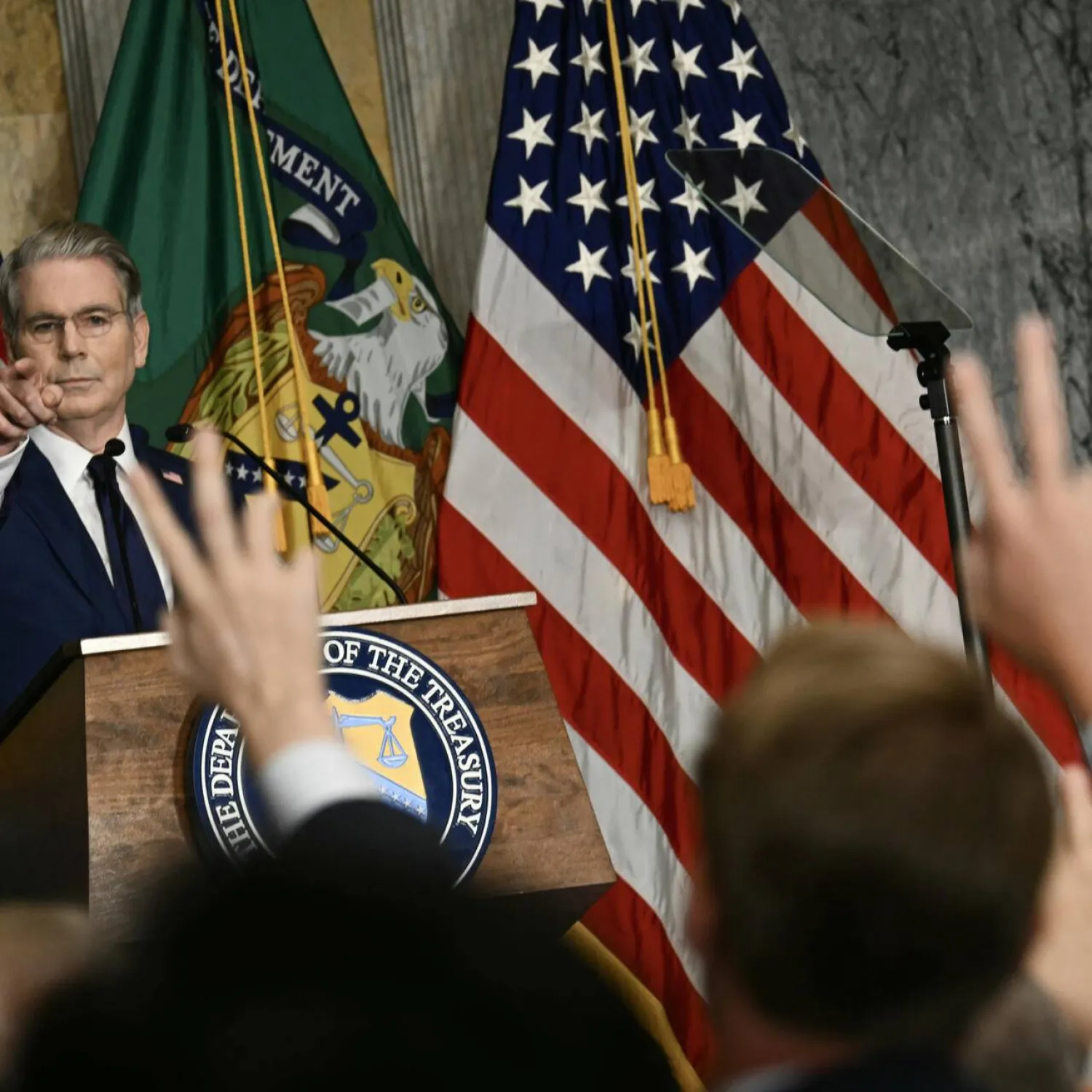
US Treasury Secretary Scott Bessent laid out plans this week to strangle Iran's economy. Kent NISHIMURA / AFP
TT

China's Help Critical, But Unlikely, for US to Choke off Iran

US Treasury Secretary Scott Bessent laid out plans this week to strangle Iran's economy. Kent NISHIMURA / AFP

The United States has threatened the "economic asphyxiation" of Iran, but analysts say that a successful chokehold would require unlikely cooperation from China.

Almost six months into the Middle East war, Washington this week laid out plans to expand sanctions against Iran, warning that any nation which continued to enable Tehran would become a "global pariah".

China is among countries whose entities have already been hit by the sweeping US plan, with Treasury Secretary Scott Bessent telling Beijing to "get with the program".

But Beijing instead has defended its cooperation with Tehran and vowed to safeguard its interests.

The apparent impasse is likely to further strain ties between Beijing and Washington, ahead of an expected visit by China's President Xi Jinping to the US capital in September.

- Oil 'central lever' -

Iran has weathered sanctions for decades, using complex international financial networks to evade restrictions.

Cutting off Iran "would certainly require China's help", said political scientist Dylan Loh of Singapore's Nanyang Technological University.

Beijing is a key customer for Iranian oil, while "a good amount of their trade also relies on (the Chinese currency) renminbi, which can be outside the reach of US sanctions", Loh told AFP.

Before the war, Tehran exported millions of barrels of oil a day, mostly to China.

"Oil is the central economic lever," said Nino Lezhava, a fellow at the Washington-based Center for European Policy Analysis.

Although most ship traffic in the vital Strait of Hormuz is still blocked, China is not totally cut off from Iran's crude thanks to the highways and railways of Central Asia, said Sun Degang, a professor of political science at Shanghai's Fudan University.

Despite Chinese purchases being lower than before, they remain an important source of revenue.

"Simply continuing to... maintain commercial channels and provide alternative payment mechanisms can substantially reduce the effectiveness of economic isolation," said Lezhava.

- 'Economic sovereignty' -

The United States is well aware of this.

Bessent said "no one is above the reach of US sanctions" when asked if Washington would target Chinese banks that do business with Iran.

However, while its sanctions announced on Monday targeted some Chinese entities accused of helping Tehran procure "critical technology", Washington has so far held back from punishing major Chinese financial institutions.

The United States "can't expect to obtain China's support if it continues to implement sanctions on Chinese companies", said Fudan University's Sun.

"Sino-Iranian trade relations are legitimate and China will safeguard its economic sovereignty."

China is already feeling some consequences from the Strait of Hormuz disruption, adding to economic strain from persistently sluggish domestic consumption.

Cutting off Iran would exacerbate that, as well as implicate Beijing in a messy conflict that has already weakened its strategic rival Washington.

Overall, China has "little reason" to cooperate with the United States on sanctions, said Chong Ja Ian, an associate professor of political science at the National University of Singapore.

- 'Push back' -

On Tuesday, China's foreign ministry said its cooperation with Iran has "always been conducted within the framework of international law and should not be interfered with or disrupted".

Chong said that "Beijing seems highly confident of its ability to push back successfully against the US", were it pressured.

China has expanded its capacities to deal "precisely with such scenarios", said Loh.

"China has its own tools to respond to protect its own interest as we have seen in the tit-for-tat export controls," he added.

China and the United States spent much of last year embroiled in an escalating trade war but reached a fragile truce when the two presidents met last October.

A successful global campaign against Iran may require Washington "to provide incentives" to Beijing to join it, said Lim Tai Wei, a professor and East Asia expert at Japan's Soka University.

China would only cooperate "if the costs of supporting Iran became significantly higher than the strategic and economic benefits", said Lezhava.


Abdul El-Sayed: 'As Michigan as You Get'

Michigan Democratic Senate candidate Abdul El-Sayed speaks at an election night event, early Wednesday, Nov. 4, 2026, in Detroit. (AP Photo/Julia Demaree Nikhinson)
TT

Abdul El-Sayed: 'As Michigan as You Get'

Michigan Democratic Senate candidate Abdul El-Sayed speaks at an election night event, early Wednesday, Nov. 4, 2026, in Detroit. (AP Photo/Julia Demaree Nikhinson)

Abdul El-Sayed, 42, made history as the first Muslim elected to the US Senate after winning a crucial seat in Michigan in Tuesday's congressional midterm elections.

Born in Michigan on October 31, 1984, El-Sayed previously served as a public health official in Wayne County, in the battleground state. He has never held elected office, but he is no stranger to politics. In 2018, he ran for governor of Michigan, finishing second to Gretchen Whitmer in the Democratic primary.

El-Sayed grew up in the Detroit area with his father, Mohamed, an Egyptian immigrant who came to the United States to study at Wayne State University, and his stepmother, Jackie. His biological mother, Fatten Elkomy, is a psychiatric nurse in Missouri.

El-Sayed describes himself as "as Michigan as you get." He attended local schools, graduating from high school in 2003. During his school years, he captained the lacrosse, wrestling and football teams.

He went on to the University of Michigan, where he majored in biology and political science and played on the university's lacrosse team. He graduated in 2007 with highest distinction and was selected to deliver the student commencement address.

"We have the audacity to believe that we can change this world, and that each of us will," he told his fellow graduates, describing what made Michigan exceptional.

El-Sayed received a full-tuition scholarship to the University of Michigan Medical School. After completing two years of medical school, he was awarded a Rhodes Scholarship for 2009 to study at Oriel College, Oxford University, where he completed a doctorate in public health in 2011.

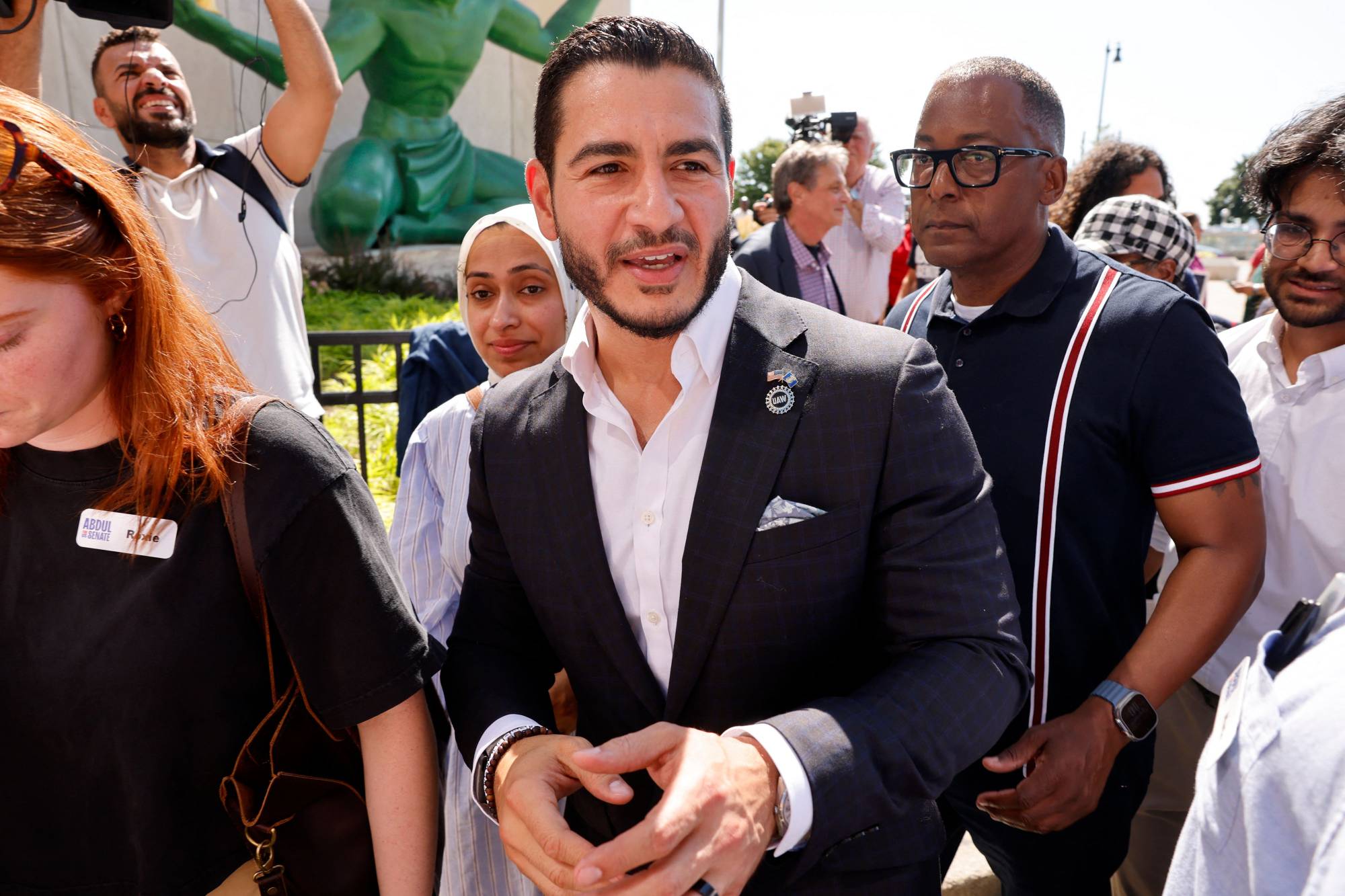
US Democratic Senate candidate from Michigan Abdul El-Sayed departs after a press conference declaring victory in the primary election in Detroit, Michigan, on August 5, 2026. (Photo by JEFF KOWALSKY / AFP)

He was the University of Michigan's first Rhodes Scholar since 2004. At Oxford, he continued playing lacrosse and earned a Full Blue, the university's highest sporting honor, as team captain.

By 2014, El-Sayed had completed his medical education, earning his medical degree from Columbia University's College of Physicians and Surgeons.

He subsequently joined Columbia's faculty as an assistant professor of epidemiology. Months later, then-Detroit Mayor Mike Duggan appointed him health officer and executive director of the city's Health Department.

El-Sayed rebuilt Detroit's Health Department following the city's bankruptcy. He later restructured Wayne County's Department of Health, Human and Veterans Services, which serves 1.8 million residents in Michigan's largest and most diverse county.

As a public servant, El-Sayed secured free eyeglasses for children in need, challenged some of Michigan's biggest polluters and expanded access to the lifesaving overdose-reversal medication naloxone, commonly known by the brand name Narcan.

He also spearheaded a program to eliminate up to $700 million in medical debt for 300,000 Michigan residents over two years.

His work earned him recognition as Public Official of the Year from the Michigan League of Conservation Voters and a place on Crain's Detroit Business's 40 Under 40 list.

Nationally recognized for his expertise in improving the American healthcare system, El-Sayed is the author of Medicare for All: A Citizen's Guide.

He later returned to public service as director of Wayne County's Department of Health, Human and Veterans Services, serving from December 2022 until April 2025, when he resigned to seek elected office once again, this time in the US Senate.

El-Sayed has also made a name for himself as a podcast host, including through America Dissected.

His medical credentials have attracted controversy, largely because he has described himself as a physician despite not holding a license to practice medicine in Michigan.

Although he studied medicine, El-Sayed came to believe that a broken political system was what was making people sick. That conviction ultimately led him to run for the Senate.

According to his campaign website, he entered the race because he believes life in America should not be so difficult and wants to build a government that serves ordinary Americans rather than Elon Musk, Donald Trump and their billionaire allies.

Responding to questions about his medical credentials in July, El-Sayed said: "I did graduate from a school that's literally called Columbia College of Physicians and Surgeons. So, you know, you can go have that argument with Columbia University if you'd like."

In his only previous bid for elected office, El-Sayed finished second to Gretchen Whitmer in Michigan's 2018 Democratic gubernatorial primary, ahead of Shri Thanedar, who subsequently won a seat in the state legislature and later in the US House of Representatives.

Throughout his Senate campaign, El-Sayed distilled his platform into a three-part message: "Money out of politics, money in your pocket, Medicare for All."

He repeatedly emphasized that he was the only candidate running for the US Senate in Michigan who had never accepted a dime of corporate campaign money and never would.

El-Sayed lives in Ann Arbor with his wife, Sarah, and their two young daughters, Emmalee and Serene.


Numbers That Tell the Story of the Democrats’ Midterm Blowout

This aerial view shows Union Station illuminated with the colors of the US flag after the midterm elections in Kansas City, Missouri, in the early hours of November 4, 2026. (AFP)
TT

Numbers That Tell the Story of the Democrats’ Midterm Blowout

This aerial view shows Union Station illuminated with the colors of the US flag after the midterm elections in Kansas City, Missouri, in the early hours of November 4, 2026. (AFP)

Democrats stormed back to power in Congress and governors' mansions across America in Tuesday's midterm elections, a stunning repudiation of Donald Trump's political agenda.

These are the numbers that tell the tale of a historic night.

- Record turnout -

Total turnout numbers were not in yet, but Americans cast more than 61.7 million votes even before election day, according to the University of Florida's Election Lab.

That figure, a runaway record for early voting in US midterms, undoubtedly boosted Democrats, who traditionally cast their ballots early more often than Republican voters.

The numbers showed large turnout among African Americans, young people and other groups that typically support Democratic candidates, National Public Radio reported.

The surge contributed to a wave election, with Democrats running the table on key races and seizing control of both chambers of Congress.

- Record fundraising -

Total spending for the 2026 midterms soared to a record $11.9 billion, substantially higher than the $8.9 billion racked up in 2022, according to OpenSecrets, a non-partisan authority on spending in US politics.

Campaign fundraising and ad buys jumped in the 2026 races, driven by the outside spending of so-called political action committees.

Such outside spending, led by Trump's mega-billionaire ally Elon Musk, favored Republicans by some $360 million.

But Democratic candidates proved adept at raising their own funds.

House and Senate candidates spent an unprecedented $3.7 billion from their campaign warchests, with Democrats outspending Republicans by $800 million, according to OpenSecrets.

In Texas, Democratic Senate candidate James Talarico broke records by bringing in a staggering $145 million, several times the $22 million raised by his Republican rival Ken Paxton who was forced to rely on outside groups to fund his campaign.

- First wins in decades -

Ninety-four years ago was the last time Kansas sent a Democrat to the US Senate. But on Tuesday night, Adam Hamilton unseated Republican incumbent Roger Marshall.

Hamilton, the pastor of a Methodist megachurch who was registered as a Republican until recently, became the first Democrat to win a Senate race in the largely rural, conservative state since 1932.

Texas also went blue for the first time in decades, with Talarico scoring a massive upset to flip a Senate seat in the Lone Star State for the first since 1988 -- the year before Talarico was born.

South Carolina also defied history, ousting Senator Darline Graham -- who had been appointed earlier this year to fill the seat of her late brother Lindsey Graham -- in favor of Democrat Annie Andrews. No South Carolina Democrat had been elected to the Senate since 1998.

- Young voters, Latinos turn away -

Young men and Latino voters -- two segments of the American electorate crucial to Trump -- turned sharply away from the president and his Republican Party, exit polls showed.

Hispanic voters had helped bring Trump to power in 2016, and were instrumental in his victory in 2024, when they only narrowly went to Democrat Kamala Harris in the presidential election, 51 percent to 48 percent, according to Pew Research.

But in recent weeks, several Latino voters have expressed anger at Trump, saying they felt betrayed.

It showed in NBC News exit polls on Tuesday, when Latino voters backed Democratic candidates by 62 percent to 35 percent over Republicans.

Young voters also soured on Trump. NBC News reported that its exit polls showed 18-29-year olds, men and women, voted for Democrats by a 72 percent to 25 percent margin. That is a sharp shift from 2024 when young voters were split between Trump and Harris.


Historic Leadership Firsts for Minorities Across US in Midterm Vote

Democratic Senate candidate Minnesota Lt. Gov. Peggy Flanagan, speaks at an election night event, Tuesday, Nov. 3, 2026, in St. Paul, Minn. (AP)
TT

Historic Leadership Firsts for Minorities Across US in Midterm Vote

Democratic Senate candidate Minnesota Lt. Gov. Peggy Flanagan, speaks at an election night event, Tuesday, Nov. 3, 2026, in St. Paul, Minn. (AP)

The US midterm vote ushered in a wave of historic leadership firsts across the country on Tuesday, electoral milestones on a night that saw voters issue a sharp rejection of President Donald Trump's second term.

The first Black female governor, the first openly gay male senator, the first Muslim senator and the first female Native American governor all won groundbreaking elections in the vote that racked up resounding gains for Democrats.

Bill Shiebler -- chief strategy officer at the non-profit State Voices, a network of advocates for civic engagement and equity -- told AFP the night was "a huge rebuke against hate and division."

"We're witnessing an electorate that increasingly sees itself in its leaders, and the leaders who come out of communities they now represent," Shiebler said.

In Michigan, leftist Abdul El-Sayed became the first Muslim elected to the US Senate.

The former medical administrator drew huge campaign crowds but faced a surge of anti-Muslim rhetoric from his detractors in the bruising race.

The Council on American-Islamic Relations advocacy group praised El-Sayed for persevering despite "endless Islamophobic attacks."

"Our communities worked hard to make sure our voices were heard and that we are properly represented in the Senate," the organization said.

"This is what is possible when we show up and vote together."

- 'Historic election' -

In the southern state of Georgia, Democrat Keisha Lance Bottoms won the race for governor, making her the first Black woman elected to the top office in any US state.

A former Atlanta mayor, Bottoms defeated billionaire health care executive Rick Jackson, a win that returns the governor's office to Democrats after more than two decades of Republican control.

In New Mexico, Democrat Deb Haaland became the first Native American woman elected governor, beating Republican Gregg Hull.

A member of the Laguna Pueblo tribe, she had served as the secretary of the interior under former president Joe Biden, the first Native American to serve as a US cabinet secretary.

Democrat Peggy Flanagan of Minnesota was elected as the first female Native American senator.

The sweeping midterm rebuke of Trump also saw a number of state-level electoral firsts, including the first Latina governor in Texas with Gina Hinojosa's victory.

Looking ahead, if the current House Minority Leader Hakeem Jeffries wins the speakership as expected in the new Congress, he would become the first Black speaker of the House in US history.

"This was a historic election where people decided to believe in themselves and really lean into the hope about the promise of this country, rebuking an effort to snuff out people's voices," Shiebler said.