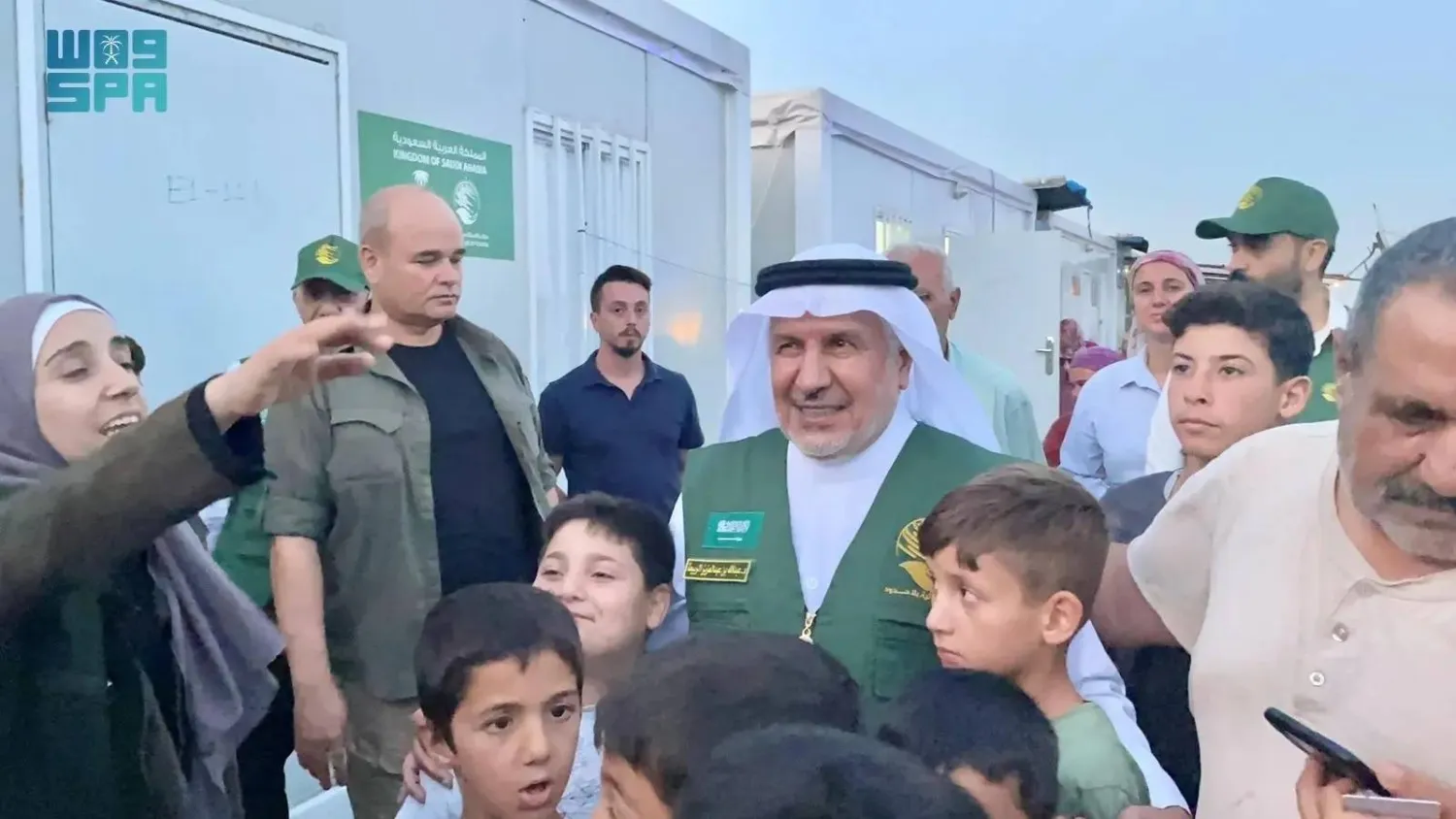
Al Rabeeah Inspects Housing Project for Earthquake Victims in Türkiye

Advisor at the Saudi Royal Court and KSrelief Supervisor General Dr. Abdullah bin Abdulaziz Al Rabeeah during his tour of Turkish regions affected by the earthquakes. (SPA)
TT

Al Rabeeah Inspects Housing Project for Earthquake Victims in Türkiye

Advisor at the Saudi Royal Court and KSrelief Supervisor General Dr. Abdullah bin Abdulaziz Al Rabeeah during his tour of Turkish regions affected by the earthquakes. (SPA)

Advisor at the Saudi Royal Court and King Salman Humanitarian Aid and Relief Center (KSrelief) Supervisor General Dr. Abdullah bin Abdulaziz Al Rabeeah conducted on Wednesday an inspection visit to the housing units delivered to earthquake victims in Türkiye.

The project includes 364 residential units located in the İslahiye area of Gaziantep province.

During the visit, beneficiaries of the project expressed profound gratitude to the Kingdom of Saudi Arabia for providing these residential units through humanitarian arm KSrelief.

They emphasized that these temporary housing units are of high quality, modern design, and meet essential living needs for families and individuals. They also noted that such gestures are not surprising from the government and generous people of the Kingdom.

KSrelief has supplied 3,000 housing units for earthquake victims in Syria and Türkiye, including 1,500 temporary housing units for those affected by the earthquake in the Afrin region of Syria’s Aleppo Governorate in 2023. Each temporary housing unit consists of two rooms and a bathroom equipped with basic furniture.

Other Saudi-provided facilities include a school accommodating 756 individuals, a mosque for 700 worshippers, 20 caravans for administrative and commercial activities, 15 playground areas for children, and a water well.

Solar-energy units and infrastructure works also were provided for all housing units.

About 1,500 temporary housing units were also provided for earthquake victims in the districts of İslahiye and Nurdağı in Gaziantep province, as well as in Adıyaman and Malatya provinces in Türkiye. These units also consist of two rooms and a bathroom with basic furniture, benefiting a total of 12,000 individuals.

Meanwhile, efforts are underway to provide 1,000 temporary housing units in three areas in Hatay province, expected to benefit 5,000 individuals.

These efforts come as an extension of relief projects provided by the Kingdom through its humanitarian arm, KSrelief, aimed at alleviating the suffering of those affected by the earthquakes.


Saudi Arabia, Egypt, Türkiye, Pakistan Move to Deepen Partnership, Cooperation

 Foreign ministers attend a four-way meeting in Riyadh on March 20. (Egyptian Foreign Ministry)
Foreign ministers attend a four-way meeting in Riyadh on March 20. (Egyptian Foreign Ministry)
TT

Saudi Arabia, Egypt, Türkiye, Pakistan Move to Deepen Partnership, Cooperation

 Foreign ministers attend a four-way meeting in Riyadh on March 20. (Egyptian Foreign Ministry)
Foreign ministers attend a four-way meeting in Riyadh on March 20. (Egyptian Foreign Ministry)

Egypt will host a four-way meeting with the foreign ministers of Saudi Arabia, Türkiye and Pakistan, days after Washington and Tehran finalized a memorandum of understanding to stop the war that began in late February.

Egyptian Foreign Minister Badr Abdelatty will meet his Saudi counterpart, Prince Faisal bin Farhan, Türkiye’s Hakan Fidan and Pakistan’s Mohammad Ishaq Dar in Cairo on Sunday for a four-way meeting, Egypt’s state news agency reported late on Thursday.

The talks will be followed by an expanded session and a press conference.

A former Egyptian diplomat told Asharq Al-Awsat the meeting would focus on “ways to consolidate cooperation, deepen partnership and coordinate on regional issues, complete efforts to cement de-escalation in the region, and narrow differences during the next 60 days of negotiations between Washington and Tehran.”

The quartet played a prominent role in reaching the US-Iran agreement days ago. Its efforts formally began with a meeting in March in the Saudi capital, Riyadh, followed by meetings in Islamabad and Antalya as part of efforts to end the Iran war.

The meeting comes two days after the Swiss government said negotiations between the United States and Iran, due to begin on Friday in Switzerland, had been postponed indefinitely.

The announcement came hours after a planned visit by US Vice President JD Vance was canceled.

Iranian Supreme Leader Mojtaba Khamenei said earlier on Thursday that he had approved the memorandum of understanding signed by Washington and Tehran, despite expressing reservations about it.

US forces said they had lifted a naval blockade on Iranian ports after the memorandum was signed by the US and Iranian presidents on Wednesday.

Ambassador Mohamed Hegazy, a member of the Egyptian Council for Foreign Affairs and a former assistant foreign minister, told Asharq Al-Awsat the call for the four-way meeting marked an important step in regional consultations at a time of deep strategic shifts in the Middle East.

He cited the ceasefire, the containment of the US-Iran military confrontation, and the risks of the continuing war in Gaza and its impact on regional security and stability.

He said the “consultative quartet” of influential regional states had “proved its presence as an effective regional and international framework capable of addressing problems and issues in coordination with regional states and major powers to calm regional conditions and deal with their problems.”

Hegazy said the meeting’s importance went beyond traditional political coordination. He expected the agenda to include support for consolidating the “Washington-Tehran agreement,” continuing negotiations, discussing Gaza and Lebanon, and backing efforts to secure a sustainable regional calm.

The meeting is also expected to “open the door to deepening partnership and coordination among the quartet, and to studying the possibility of holding a regional or international conference on security and cooperation in the Middle East, similar to successful experiences in other regions,” Hegazy said.

Such a conference, he said, would aim to draft a declaration of principles governing regional relations and establish institutional mechanisms for dialogue, dispute settlement, and stronger economic, security and humanitarian cooperation among the region’s countries.

Egypt’s Foreign Ministry said on Friday that Abdelatty held separate phone calls with Pakistan’s Mohammad Ishaq Dar and Iranian Foreign Minister Abbas Araghchi to discuss regional developments after the US-Iran memorandum of understanding.

An official statement said the Egyptian and Pakistani ministers stressed “the importance of continuing coordination and joint consultation in the coming phase to ensure the implementation of the memorandum of understanding and reach a final and sustainable agreement that takes into account the interests and concerns of all parties and strengthens diplomatic solutions, in a way that achieves security and stability in the region.”

In his call with Araghchi, Abdelatty expressed hope that the memorandum of understanding would become “an important turning point in support of security and stability in the region, and contribute to opening the way to addressing all issues through dialogue and diplomatic means.”

He also voiced hope for a final and sustainable agreement that addresses the concerns of all parties and supports efforts to achieve lasting security and stability in the region.

Hegazy said it was important to maintain “serious dialogue among the main regional powers over the shape of the regional order that should govern relations among the countries of the region in the next phase, ensuring a shift from the logic of managing successive and recurring crises to building a stable system of security, cooperation and development.”

The current phase requires “the formulation of mutual understandings with Iran on the security of the Arabian Gulf, in a way that reassures all parties and lays the foundation for normal relations based on good neighborliness, common interests, and the non-use or threat of force,” Hegazy said.

He also called for strengthening political and security dialogue mechanisms to prevent the region from returning to cycles of escalation and confrontation, and for building frameworks to manage cooperation and development among the region's countries across various fields.



Saudi Foreign Minister Receives Written Message from Chinese Counterpart

Saudi Vice Minister of Foreign Affairs Waleed Elkhereiji and Chinese Ambassador to Saudi Arabia Chang Hua.(SPA)
TT

Saudi Foreign Minister Receives Written Message from Chinese Counterpart

Saudi Vice Minister of Foreign Affairs Waleed Elkhereiji and Chinese Ambassador to Saudi Arabia Chang Hua.(SPA)

Saudi Minister of Foreign Affairs Prince Faisal bin Farhan bin Abdullah received a written message from Foreign Minister of the People's Republic of China Wang Yi concerning relations between the two countries, the Saudi Press Agency reported Thursday.

The message was received by Vice Minister of Foreign Affairs Waleed Elkhereiji during a meeting at the ministry's headquarters in Riyadh with Chinese Ambassador to Saudi Arabia Chang Hua.

During the meeting, the two sides reviewed bilateral relations and discussed regional and international developments.


MWL Condemns Escalating Israeli Settler Violence against Palestinians in West Bank

The Muslim World League (MWL) logo
TT

MWL Condemns Escalating Israeli Settler Violence against Palestinians in West Bank

The Muslim World League (MWL) logo

The Muslim World League (MWL) strongly condemned the continued attacks by Israeli settlers against Palestinians in the occupied West Bank, the Saudi Press Agency reported on Friday.

The latest Israeli aggression in the West Bank targeted the Grand Mosque in the village of Jiljilya and Al-Farouq Mosque north of Ramallah.

In a statement issued by the MWL General Secretariat, Secretary-General and Chairman of the Organization of Muslim Scholars Sheikh Dr. Mohammed Al-Issa denounced the escalating waves of violence carried out by settlers against Palestinians and their property and sacred sites in the occupied West Bank.

He said the attacks constitute a grave violation of the sanctity of places of worship and of all international and humanitarian laws and norms, undermine peace efforts, and threaten security and stability in the region.