

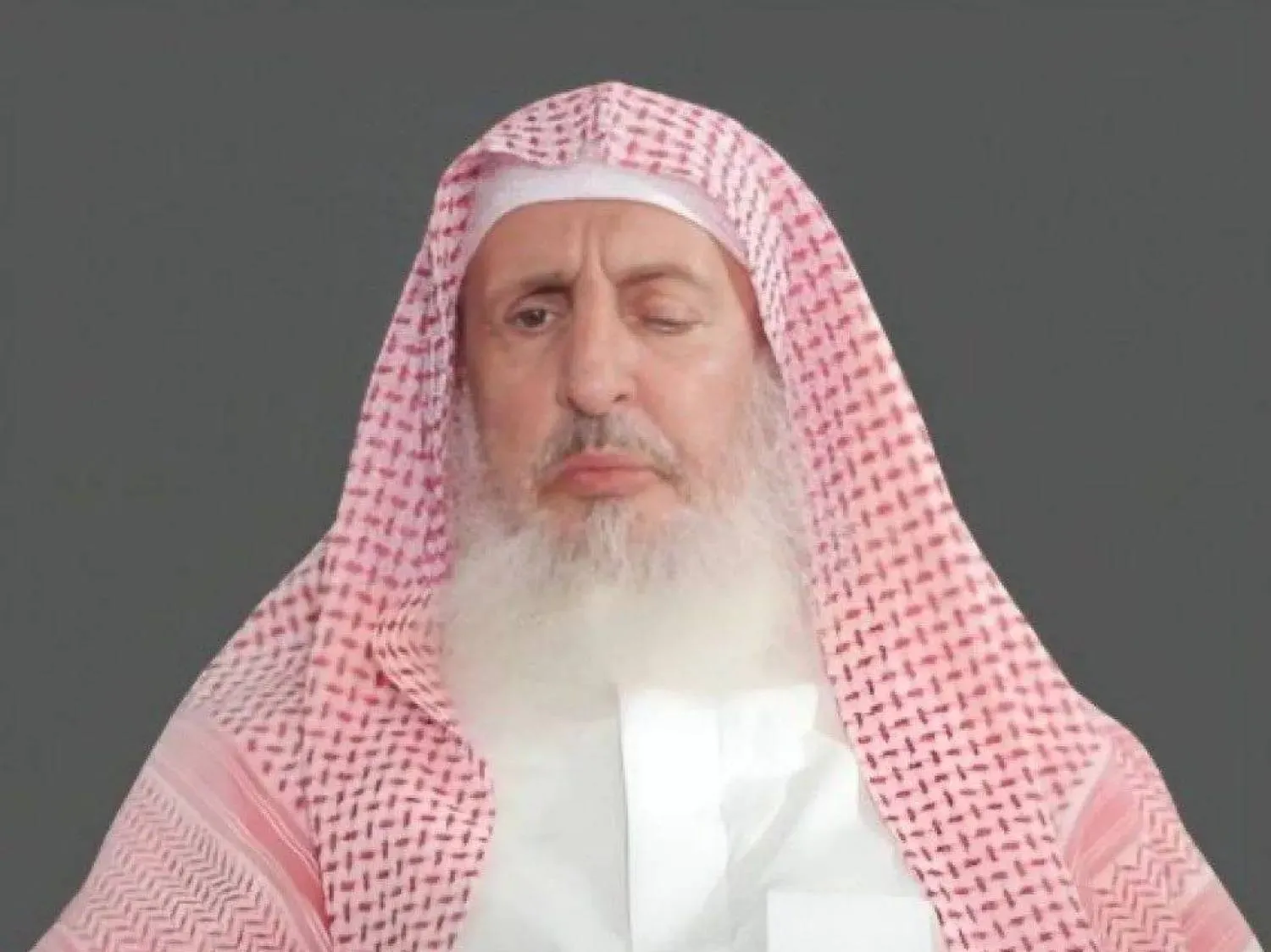

Saudi Grand Mufti Abdulaziz Al Al-Sheikh, Third in Kingdom’s History, Passes Away

Grand Mufti of Saudi Arabia Sheikh Abdulaziz bin Abdullah bin Mohammed Al Al-Sheikh. (Asharq Al-Awsat)
TT

Saudi Grand Mufti Abdulaziz Al Al-Sheikh, Third in Kingdom’s History, Passes Away

Grand Mufti of Saudi Arabia Sheikh Abdulaziz bin Abdullah bin Mohammed Al Al-Sheikh. (Asharq Al-Awsat)

Grand Mufti of Saudi Arabia Sheikh Abdulaziz bin Abdullah bin Mohammed Al Al-Sheikh passed away at 82, announced the Royal Court on Tuesday.

Born in Makkah in November 1943, Sheikh Abdulaziz grew up in a family of scholars.

He lost his father at the age of eight but memorized the Quran as a boy and pursued religious studies under leading clerics, including former grand muftis Sheikh Mohammed bin Ibrahim Al Al-Sheikh and Sheikh Abdulaziz bin Baz.

Despite losing his eyesight in his twenties, he went on to complete his education, graduating from Imam al-Dawa Scholarly Institute in Riyadh in 1964 with a degree in Arabic and Islamic law.

Sheikh Abdulaziz began teaching at the Institute in 1964 and later became professor at the College of Sharia in Riyadh.

Alongside his academic work, he served as imam and preacher at several mosques in Riyadh, before being appointed in 1982 as preacher at the Nimra Mosque in Arafat, where he delivered the annual Hajj sermon for 35 years, a role watched by millions of Muslims worldwide.

His career in religious leadership advanced steadily. He joined the Council of Senior Scholars in 1986, became a member of the General Presidency of Scholarly Research and Ifta in 1991, and was appointed deputy grand mufti in 1995.

In 1999, following the death of Sheikh Abdulaziz bin Baz, he became the Kingdom’s third grand mufti, a position he held until his death. He also chaired the Council of Senior Scholars, led the General Presidency of Scholarly Research and Ifta, and presided over the Supreme Council of the Muslim World League.

Known for his moderate approach and emphasis on balance in religious guidance, Sheikh Abdulaziz was described by fellow scholars as a figure who combined firm knowledge with compassion, raising generations of students and leaving behind a deep scholarly legacy.

“He spent his life in the pursuit of knowledge and fatwa, planting wisdom and spreading reassurance,” Mohammed al-Omari, a researcher in Islamic sciences, told Asharq Al-Awsat.

“He was a voice of moderation and tolerance, a scholar who combined firm knowledge with compassion and understanding, raising generations of students and leaving behind a profound legacy,” he added.
OIC Condemns Israeli Move to Seize Homes and Displace Palestinian Families in Jerusalem

OIC Condemns Israeli Move to Seize Homes and Displace Palestinian Families in Jerusalem
TT

OIC Condemns Israeli Move to Seize Homes and Displace Palestinian Families in Jerusalem

OIC Condemns Israeli Move to Seize Homes and Displace Palestinian Families in Jerusalem

The General Secretariat of the Organization of Islamic Cooperation (OIC) condemned the Israeli authorities’ decision to seize 15 homes in Jerusalem’s Silwan neighborhood and forcibly displace Palestinian families from their homes, the Saudi Press Agency reported Sunday.

The OIC warned that these measures constitute an escalation in forced displacement policies aimed at reshaping the city’s Arab identity, undermining Palestinian presence, and altering the city’s demographic composition.

It affirmed that all measures taken by Israeli authorities, including annexation and settlement plans and attempts to impose sovereignty over the West Bank, are null and void and lack legitimacy under international law and relevant United Nations resolutions.

The general secretariat reiterated its call on the international community, particularly the United Nations Security Council, to assume its responsibilities and act to halt violations and crimes in the occupied Palestinian territories.


Mohammed bin Salman, Modi Discuss Impact of Escalation in Regional Security

Prince Mohammed bin Salman bin Abdulaziz Al Saud, Saudi Crown Prince and Prime Minister. (SPA)
TT

Mohammed bin Salman, Modi Discuss Impact of Escalation in Regional Security

Prince Mohammed bin Salman bin Abdulaziz Al Saud, Saudi Crown Prince and Prime Minister. (SPA)

Prince Mohammed bin Salman bin Abdulaziz Al Saud, Saudi Crown Prince and Prime Minister, held telephone talks on Saturday with India’s Prime Minister Narendra Modi on the escalation in the region.

Modi reiterated his country's condemnation of the repeated Iranian attacks that threaten the Kingdom's security and sovereignty.

The leaders discussed the latest regional developments and the repercussions of the ongoing military escalation on the security and stability of the region and the world, as well as its risks to international maritime security and the global economy.


UAE Intercepts 20 Ballistic Missiles and 37 Drones

UAE air defenses intercepted 398 ballistic missiles and 15 cruise missiles, along with 1,872 drones (AFP)
TT

UAE Intercepts 20 Ballistic Missiles and 37 Drones

UAE air defenses intercepted 398 ballistic missiles and 15 cruise missiles, along with 1,872 drones (AFP)

The UAE Ministry of Defense announced that its air defenses on Saturday intercepted 20 ballistic missiles and 37 drones launched toward the country from Iran, in the latest wave of attacks targeting its security and stability.

In a statement, the ministry said its forces successfully intercepted and neutralized the threats with high efficiency, as part of an integrated defense system reflecting a high level of readiness to address various threats.

It added that since the start of the “Iranian attacks,” air defenses have intercepted 398 ballistic missiles, 15 cruise missiles, and 1,872 drones in ongoing operations aimed at protecting the country’s airspace.

The ministry said the attacks resulted in the deaths of two members of the armed forces while performing their national duty, as well as a Moroccan civilian contractor with the military. Eight other civilians were also killed, of Pakistani, Nepali, Bangladeshi, Palestinian, and Indian nationalities.

It added that 178 people were injured, with injuries ranging from minor to severe, including nationals from the UAE, Egypt, Sudan, Ethiopia, the Philippines, Pakistan, Iran, India, Bangladesh, Sri Lanka, Azerbaijan, Yemen, Uganda, Eritrea, Lebanon, Afghanistan, Bahrain, the Comoros, Türkiye, Iraq, Nepal, Nigeria, Oman, Jordan, Palestine, Ghana, Indonesia, Sweden, and Tunisia.

The Ministry of Defense affirmed that it remains fully prepared to respond to any threats, stressing it will act “decisively” against anything that could undermine the country’s security, ensuring the protection of its sovereignty and national interests.
