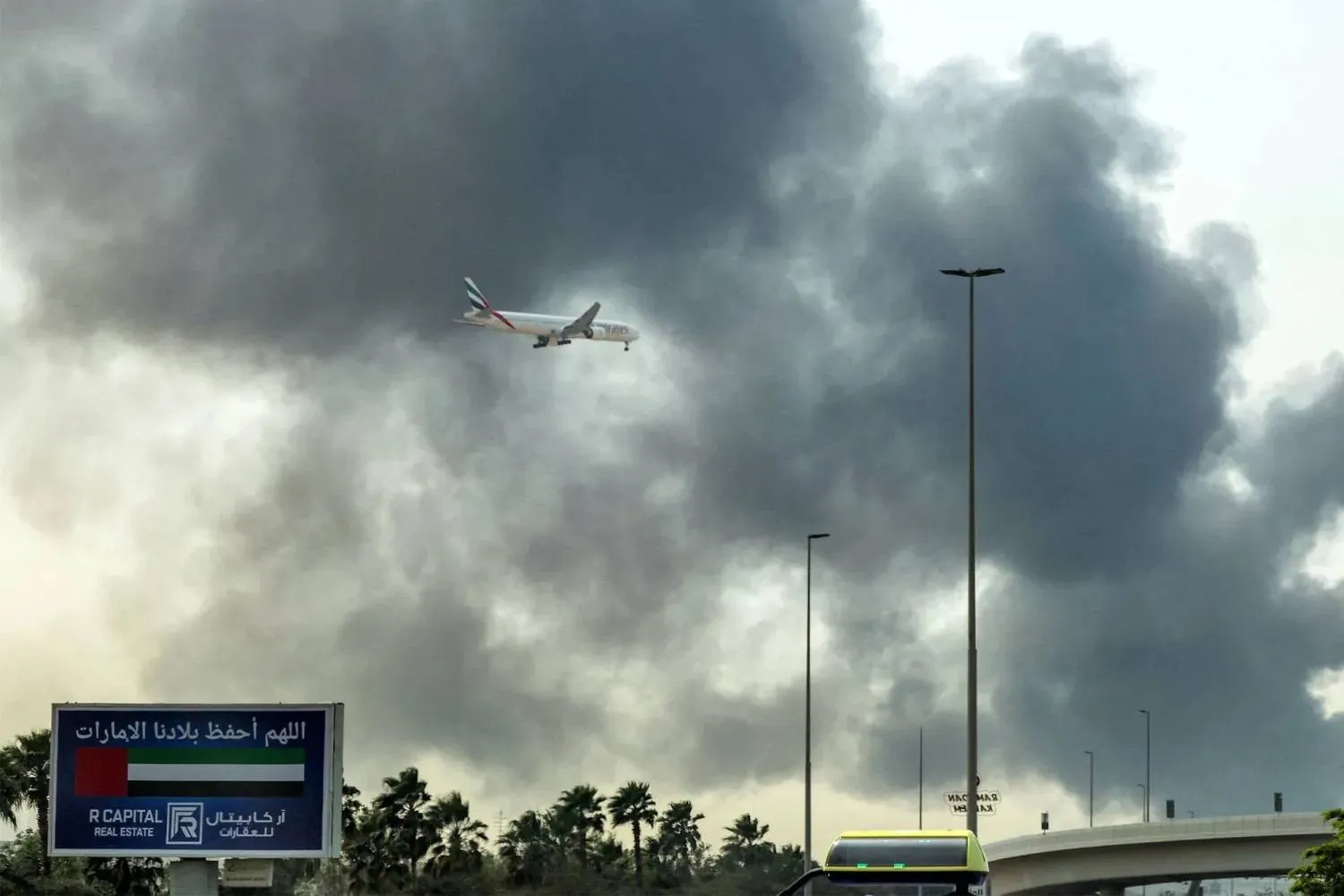

Despite a two-week ceasefire between Iran on one side and the United States and Israel on the other, Tehran has continued to target Gulf cities, underscoring the fragility of the truce.
Official figures show Iran launched 94 drones and 30 missiles toward Gulf states after the ceasefire announcement. Kuwait dealt with 28 drones, Bahrain intercepted six missiles and 31 drones, the United Arab Emirates downed 17 ballistic missiles and 35 drones, and Qatar intercepted seven missiles.
Saudi political analyst Khaled Al-Habbas said the continued attacks carry multiple signals.
He told Asharq Al-Awsat they “may indicate the fragility of the truce” and reflect Iran’s attempt to entrench an approach centered on opening the Strait of Hormuz as a key US demand, separating it from other tracks tied to the 15 points Washington presented to Tehran.
He added the attacks also reflect “Iran’s aggressive behavior toward Gulf states,” noting that Tehran targeted countries not party to the conflict under what appears to be a pre-prepared plan anticipating confrontation with the US and Israel.
Al-Habbas pointed to decision-making in Iran during the war, saying political leadership had been sidelined in favor of hardline military figures within the Revolutionary Guards.
Continued attacks, he said, would require Gulf states to reassess ongoing diplomacy, particularly mediation led by Pakistan, and to press Iran regionally and internationally to fully comply with the ceasefire.
Kuwaiti strategic military analyst Dhafer Al-Ajmi said Tehran was “writing messages to Washington in the ashes of our civilian assets and infrastructure.” He added that Iran harbors hostility toward Gulf states as part of a broader societal culture.
Saudi Arabia
Saudi air defenses intercepted and destroyed five ballistic missiles launched toward the Eastern Province early Wednesday, along with nine drones, according to Brig. Gen. Turki Al-Maliki, spokesperson for the Ministry of Defense.
The Saudi Foreign Ministry welcomed the announcement by US President Donald Trump and Pakistani Prime Minister Shehbaz Sharif that Washington and Tehran had reached a ceasefire.
It also praised the efforts of Pakistan’s prime minister and Field Marshal Asim Munir, Chief of Army Staff, in securing the agreement.
In a statement, the ministry reaffirmed support for Pakistan’s mediation toward a lasting deal that ensures security and stability and addresses long-standing causes of regional instability.
It stressed the need to keep the Strait of Hormuz open to navigation in line with the 1982 United Nations Convention on the Law of the Sea.
The kingdom said it hopes the ceasefire will lead to a comprehensive, sustainable de-escalation that strengthens regional security and halts violations of sovereignty and stability.
Kuwait
Kuwait came under missile and drone attacks from Iran despite the ceasefire announced by Trump and Sharif.
The Kuwaiti army said its air defenses had been responding since 8 a.m. Wednesday to a heavy wave of attacks, with 28 drones targeting the country.
Kuwaiti forces intercepted many of the drones, some of which targeted vital oil facilities and power stations in the south, causing significant material damage to oil infrastructure, electricity plants, and water desalination facilities.
Facilities operated by Kuwait Petroleum Corporation were hit by sustained strikes for several hours.
Col. Saud Al-Otaibi, spokesperson for the Ministry of Defense, said three desalination plants for electricity and water were hit by drones, causing major damage.
He said Iranian attacks continued despite the two-week ceasefire, with air defenses responding to a wave of 28 drones targeting key facilities across the country.
Bahrain
Bahrain said it intercepted six missiles and 31 drones from Iran in recent hours.
The Bahrain Defense Force said its air defenses have intercepted and destroyed 194 missiles and 508 drones targeting the country since the start of the attacks.
United Arab Emirates
The UAE said its air defenses intercepted 17 ballistic missiles and 35 drones launched from Iran despite the ceasefire.
Since the start of what it described as Iranian attacks, its air defenses have intercepted 537 ballistic missiles, 26 cruise missiles, and 2,256 drones.
The attacks left three people with minor injuries, bringing the total injuries to 224, while 10 civilians of various nationalities have been killed.
Qatar
Qatar’s Ministry of Defense said the country was targeted on Wednesday by seven ballistic missiles and drones from Iran, adding its armed forces intercepted all of them.
Qatar called on Iran to compensate for all damages resulting from the attacks.
According to the Qatar News Agency, Doha sent two identical letters (the 12th and 13th) to the Secretary-General of the United Nations, Antonio Guterres, and the Permanent Representative of the Kingdom of Bahrain to the United Nations and President of the Security Council for the month of April, Jamal Fares Alrowaiei, regarding the latest developments of the Iranian attack on its territories.
The letters stressed that the Iranian attack constitutes a blatant violation of its national sovereignty, a direct threat to its security and territorial integrity, and an unacceptable escalation that threatens the security and stability of the region.