

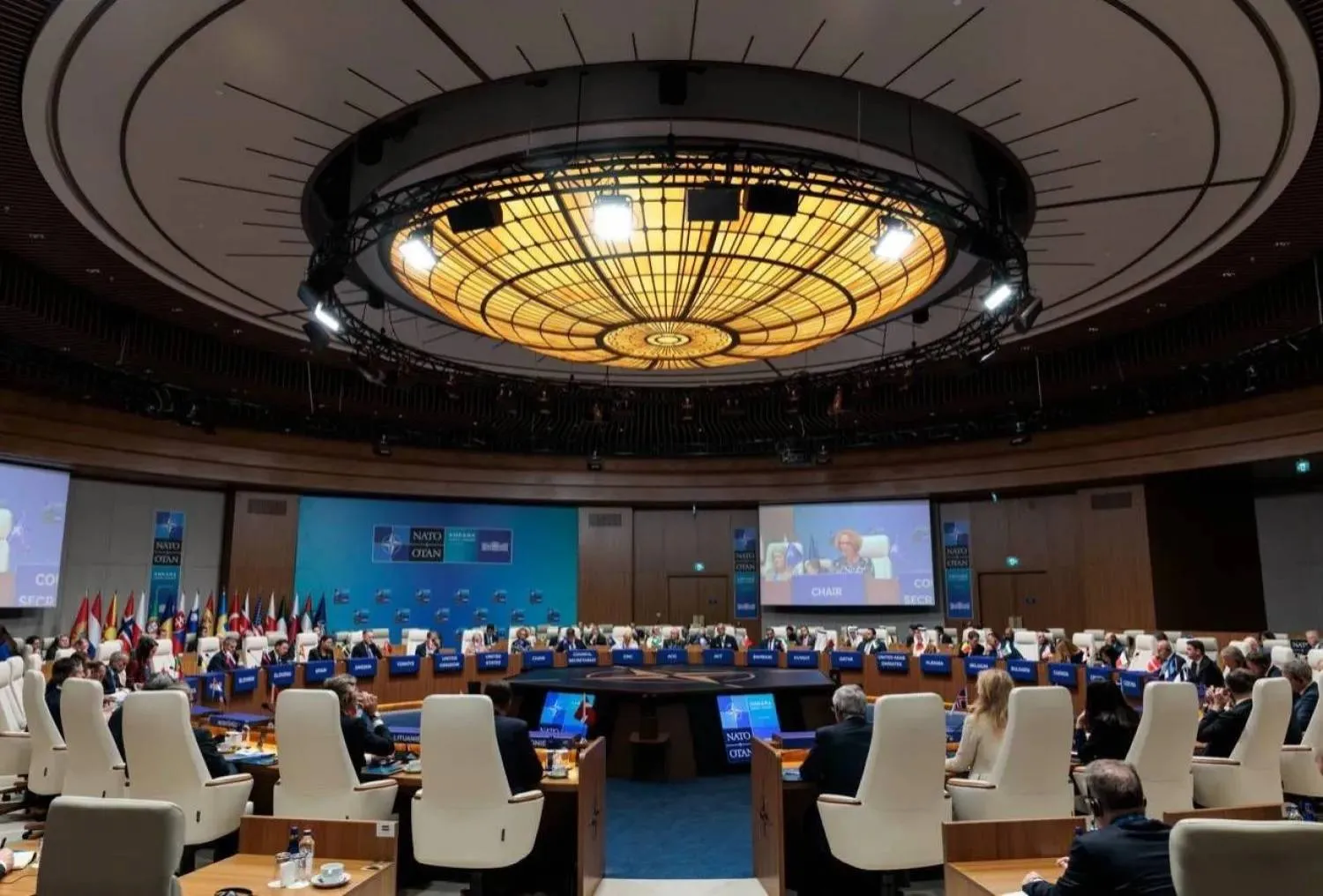

NATO, Gulf States Discuss Regional Security, Encourage Closer Cooperation

NATO foreign ministers and their Gulf counterparts participating in the Istanbul Cooperation Initiative meet on the sidelines of the alliance’s summit in Ankara. (Turkish Foreign Ministry)
TT

NATO, Gulf States Discuss Regional Security, Encourage Closer Cooperation

NATO foreign ministers and their Gulf counterparts participating in the Istanbul Cooperation Initiative meet on the sidelines of the alliance’s summit in Ankara. (Turkish Foreign Ministry)

Foreign ministers from NATO member states and their counterparts from Gulf countries participating in the Istanbul Cooperation Initiative agreed to strengthen cooperation in response to the challenges highlighted by the Iran war.

The meeting, held late Tuesday into early Wednesday on the sidelines of NATO's 36th summit in Ankara, focused on regional security developments, the security of maritime routes, and strengthening the partnership between NATO and the initiative's participating countries.

The meeting took place as part of Türkiye's efforts, as host of NATO's 36th summit, to discuss the Iran war and its repercussions for the region and the wider world.

It came after weeks of tensions in the Strait of Hormuz, despite the United States and Iran reaching a temporary peace agreement.

Strengthening cooperation

Ahead of the meeting, Belgian Foreign Minister Maxime Prevot said the stability of Gulf states, which came under Iranian attacks during the war with the United States and Israel, was closely linked to Europe’s stability.

He said the issue went beyond the Strait of Hormuz, despite its vital importance to European energy security.

Gulf representatives at the meeting stressed the importance of strengthening cooperation with NATO.

Kuwait, which hosts the headquarters of the Istanbul Cooperation Initiative, was represented at the meeting by Foreign Minister Sheikh Jarrah bin Jaber Al-Ahmad.

He held talks with Turkish Foreign Minister Hakan Fidan at the Turkish Foreign Ministry on Monday, on the eve of the NATO summit, focusing on bilateral relations and regional issues.

Bahrain’s delegation was headed by Sheikh Abdullah bin Ali Al Khalifa, director general of bilateral relations at the Foreign Ministry.

Qatar’s delegation chief, Minister of State at the Foreign Ministry Dr. Mohammed Al-Khulaifi, announced during the meeting that Qatar and NATO had reached an agreement on a partnership program, though the details were not disclosed.

He said the program would establish a comprehensive strategic framework to organize and guide civilian and military cooperation between the two sides.

He said Qatar attached great importance to strengthening its cooperation with the alliance under the Istanbul Cooperation Initiative. He also said the two sides were nearing the final stage of establishing a regional center for peace support operations in Qatar under NATO sponsorship.

Al-Khulaifi said the Ankara meeting came at a pivotal stage, when security and political challenges had become more interconnected and complex, and international interests more intertwined.

He said this made it necessary to unify efforts and strengthen coordination to confront challenges that affect the security of Middle Eastern states and threaten the foundations of regional and international stability.

The Istanbul Initiative and the ‘Iran war’

The Istanbul Initiative, which had remained a suspended framework during successive crises in the region, regained importance amid recent developments and the war involving the United States, Israel and Iran.

Türkiye sees value in turning it into an effective tool in cooperation with countries bearing the brunt of regional instability.

NATO leaders launched the Istanbul Cooperation Initiative at their summit in Istanbul on June 28, 2004, as a partnership framework aimed at strengthening practical cooperation in counterterrorism, energy security, air defense and joint military exercises.

The initiative came after the Sept. 11, 2001, attacks on the United States, when NATO activated Article 5 of its founding treaty for the first time in its history.

That increased the importance of regional partnerships and cooperation mechanisms, after threats such as terrorism, which cross borders and require a collective response, showed the need for NATO to engage in closer political and practical cooperation with regional partners.

The initiative followed an earlier move to deepen NATO’s partnership with North African countries through the 1994 Mediterranean Dialogue.

Kuwait, Qatar, Bahrain and the United Arab Emirates joined the Istanbul Cooperation Initiative, which was launched as a broad framework for cooperation in the Middle East and North Africa after the Mediterranean Dialogue, beginning with the Gulf region in 2005.

Saudi Arabia and Oman did not join but continue to participate only in selected activities under the initiative.

Objectives of the initiative

The initiative aims to strengthen regional and international security and stability by building practical bilateral partnerships with Middle Eastern countries, with a main focus on interested countries, especially in the Gulf region.

The Istanbul Cooperation Initiative Group, composed of political advisers from NATO member states, was created to manage relations between the alliance and its partner countries. It was later replaced by the Political Partnerships Committee, which is responsible for managing all NATO partnership relations.

The initiative’s regional center was established in Kuwait in January 2017 as a key hub for training, education and strengthening operational partnership between NATO and ICI member states in the Gulf region.

Former NATO Secretary-General Jens Stoltenberg took part in meetings held in Kuwait in 2024 to mark 20 years since the launch of the Istanbul Cooperation Initiative.

NATO has also appointed a special representative for the southern neighbourhood to lead the alliance’s engagement and cooperation with partners in the Middle East, North Africa and the Sahel, including partners in the Istanbul Cooperation Initiative.

The role is aimed at strengthening partnership and cooperation on issues such as defense planning, defense budgeting and development, and civil-military relations, while taking into account the specific circumstances of each country.

It also aims to establish cooperation enabling coordinated operations between NATO armed forces and partner countries, allowing them to participate in NATO exercises.

The role also includes coordinating specific exercise programs and cooperation on counterterrorism through intelligence sharing, preventing the proliferation of weapons of mass destruction and their delivery systems, and border security.

It focuses mainly on terrorism, the uncontrolled spread of small arms, smuggling and the development of a civil emergency action plan to respond to natural disasters.




Qatari Prime Minister Arrives in Riyadh

Qatar’s Prime Minister and Minister of Foreign Affairs Sheikh Mohammed bin Abdulrahman bin Jassim Al Thani is welcomed upon his arrival in Riyadh. (SPA)
TT

Qatari Prime Minister Arrives in Riyadh

Qatar’s Prime Minister and Minister of Foreign Affairs Sheikh Mohammed bin Abdulrahman bin Jassim Al Thani is welcomed upon his arrival in Riyadh. (SPA)

Qatar’s Prime Minister and Minister of Foreign Affairs Sheikh Mohammed bin Abdulrahman bin Jassim Al Thani arrived in Riyadh on Wednesday.

He was received by Vice Minister of Foreign Affairs Waleed Elkhereiji at King Khalid International Airport.


UAE Halts All Trade, Financial Dealings with Iran after Attack

Tuesday's announcement is the latest measure against Iran by the UAE after it recalled its ambassador early in the conflict. (Asharq Al-Awsat)
TT

UAE Halts All Trade, Financial Dealings with Iran after Attack

Tuesday's announcement is the latest measure against Iran by the UAE after it recalled its ambassador early in the conflict. (Asharq Al-Awsat)

The United Arab Emirates has said it is suspending all trade and financial dealings with Iran after reporting an Iranian missile attack directed at its ships.

The announcement comes after a period of relative calm in the UAE, with no Iranian missiles aimed at the country since May after it bore the brunt of attacks in the early weeks of the Middle East war.

Abu Dhabi has however accused Tehran of repeatedly targeting its tankers at sea in recent weeks.

"In light of regional escalations... all trade, commercial exchanges, and financial transactions with Iran have been halted until further notice," said UAE foreign ministry communications director Afra Al Hameli.

The UAE is home to a sizeable Iranian community and has been a major trading partner for US-sanctioned Iran, at least before the war.

Tuesday's announcement is the latest measure against Iran by the UAE after it recalled its ambassador early in the conflict.

- Navigation -

Abu Dhabi on Tuesday accused Iran of firing two ballistic missiles towards the country, the first such attack since May.

It later said the salvo was directed at shipping, but Tehran denied firing missiles at the UAE.

"UAE air defenses detected two ballistic missiles launched from Iran towards the country, with the first falling outside the country's territorial waters, while the second fell within the territorial waters," the UAE ministry said in a statement posted to social media.

A second statement released later said the missiles "were targeting maritime navigation and fell into the sea".

Iranian foreign ministry spokesman Esmaeil Baqaei "categorically rejected the United Arab Emirates' claim that Iran had launched a missile towards that country", calling it harmful to regional trust and security efforts.

The first UAE statement came nearly two hours after a phone alert that warned residents of a "potential missile threat".

It was the first such alert since a false alarm in June and an alert in July for an attack that ultimately did not enter UAE territory.

Before that, the last missile warning came in early May.

However, tankers belonging to the UAE's state-owned oil company ADNOC have been repeatedly targeted in the past few weeks.

When the Middle East war began on February 28, the UAE bore the brunt of Iran's attacks, with nearly 3,000 missiles and drones directed at the country -- more than anywhere else in the region.

After a memorandum of understanding between Iran and the United States came into effect in June, which has since collapsed, the UAE reported no attacks, unlike other Gulf states.


MWL, GCC Condemn Israeli Airstrikes on Syria’s Abu al-Duhur Military Airbase

A man rides a motorbike in the town of Abu al-Duhur, Syria, August 18, 2026. (Reuters)
TT

MWL, GCC Condemn Israeli Airstrikes on Syria’s Abu al-Duhur Military Airbase

A man rides a motorbike in the town of Abu al-Duhur, Syria, August 18, 2026. (Reuters)

The Muslim World League (MWL) strongly condemned on Tuesday the Israeli airstrikes targeting Syria’s Abu al-Duhur Military Airbase, saying they are a violation of all international laws and norms.

In a statement, MWL Secretary-General and Chairman of the Organization of Muslim Scholars Sheikh Dr. Mohammed bin Abdulkarim Al-Issa slammed “the aggression against the sovereignty and resources of Syria”, reiterating the league's “full solidarity” with the country in confronting threats to its security, sovereignty and people.

Secretary-General of the Gulf Cooperation Council (GCC) Jasem Albudaiwi also strongly condemned the attack.

“The brutal Israeli targeting of Syrian territory is an unacceptable violation of its sovereignty and territorial sanctity, contradicting international rules and norms that prohibit infringing upon state sovereignty,” he said.

Such continued practices raise tension and escalation and undermine regional and international efforts aimed at achieving security and stability in the region, he warned.

Albudaiwi called on the international community to assume its responsibilities, take a firm stance against these violations, and work to halt Israeli attacks on Syrian territory to safeguard its security and stability.

He reiterated the GCC states' solidarity with Syria, and support for its sovereignty and territorial integrity.