


Iraqi Forces Breach Tal Afar, Advance on ISIS

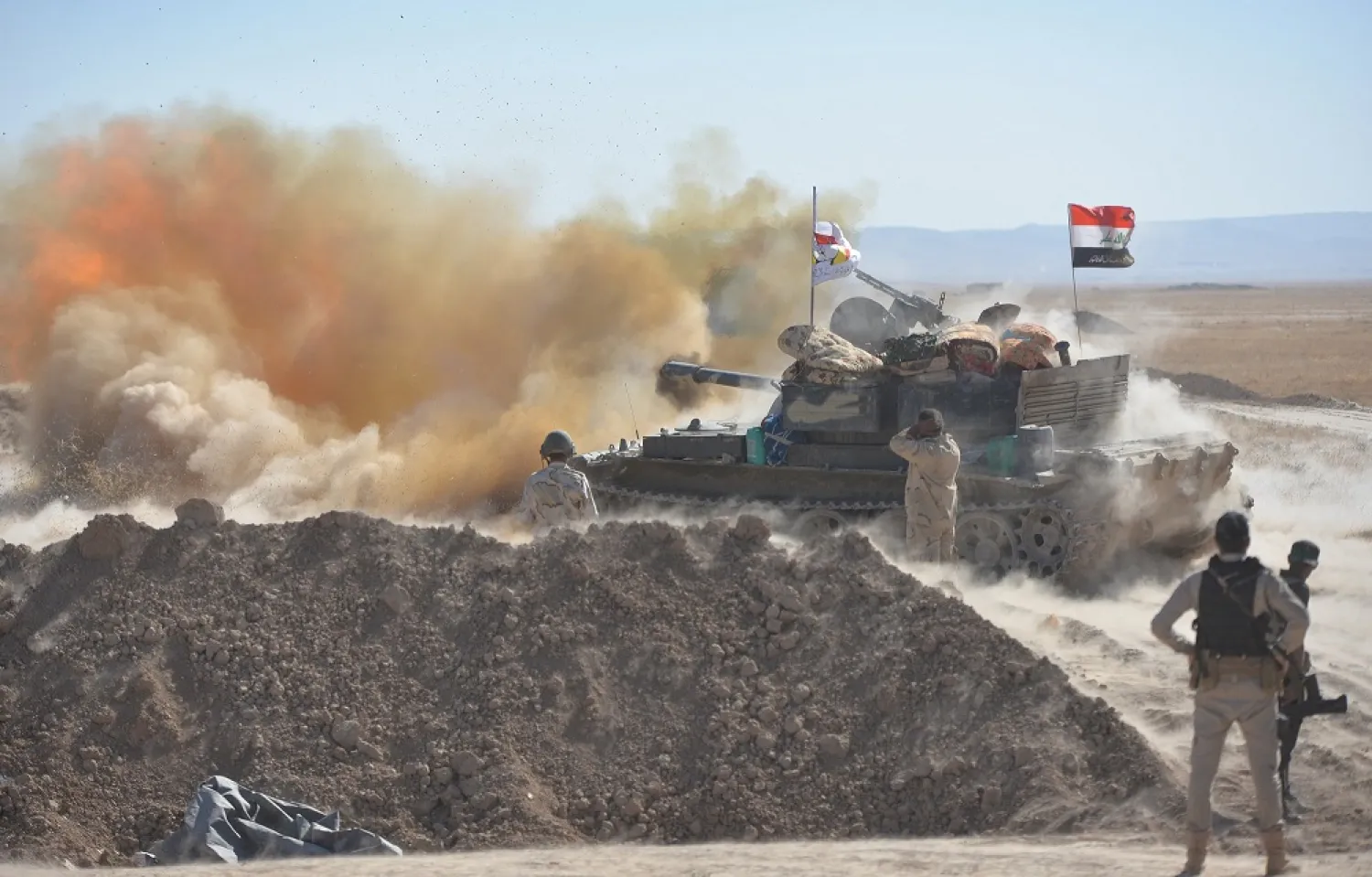
Iraqi army fire against ISIS militants on the outskirts of Tal Afar, Iraq, August 20, 2017. (Reuters)
TT

Iraqi Forces Breach Tal Afar, Advance on ISIS

Iraqi army fire against ISIS militants on the outskirts of Tal Afar, Iraq, August 20, 2017. (Reuters)

Iraqi forces cracking down on ISIS terrorists in the country breached Tal Afar on Tuesday as part of their offensive to liberate the city.

Army and counter terrorism units broke into the city from the eastern and western sides and entered the neighborhoods Southern Kefah and al-Saray.

Dozens of ISIS militants were killed in the first three days of the offensive that was launched over the weekend and the terrorist organization tried to slow down the advancement through suicide bombers and explosives.

About three quarters of Tal Afar remains under militant control, including the Ottoman-era citadel in its center.

An Iraqi Colonel told Asharq Al-Awsat that troops had indeed breached the city from two fronts. The colonel, who spoke on condition of anonymity, said that the US-led and Iraqi air forces are backing the military troops on land and raided an ISIS gathering inside Tal Afar, killing about 46 mostly foreign militants.

He explained that the army is facing fierce clashes with ISIS inside the city.

Lt.- Gen. Abdul-Amir Rasheed Yarallah commanding the liberation operation said the Counter Terrorism Service (CTS) had entered al-Kifah neighborhood on the southwestern edge of the city. He said that the 15th infantry division of the Iraqi army liberated al-Khan and al-Tayneyyeh villages south of Tal Afar, as well as other villages in the northwest.

Around 40,000 Iraqi soldiers are advancing on all sides of Tal Afar. Military leaders estimate the ISIS militants at about one thousand, most of whom are foreign militants, however other estimations claim the number is higher than that.

Iraqi Federal Police announced on Tuesday that the troops are advancing from the western axis and succeeded in destroying ISIS positions and a mine field.

Media official of the 14th district of the Kurdish Democratic Party in Mosul Said Momzini stated that over the past two days more than 60 ISIS militant were killed on the outskirts of Tal Afar.

Momzini told Asharq Al-Awsat that the terrorists are trying to escape the city with the displaced civilians, but the security forces are apprehending them. He also said that the militants had set fire to oil wells outside of Tal Afar to slow down the troop advance.

The Popular Mobilization Forces (PMF) meanwhile seized "full control" of Tal Afar's al-Kifah and al-Nour districts, PMF spokesman Ahmed al-Assadi was quoted by the Agence France Presse as saying.

Assadi said Iraqi forces had encircled the city despite "intense" fighting, adding that the offensive would likely last for weeks.

In New York, the United Nations High Commissioner for Refugees (UNHCR) stated that thousands of civilians have fled Tal Afar since the start of the offensive, but thousands more remain stuck in the city.

Additionally, the International Organization for Migration (IOM) said its teams were responding to thousands of fleeing civilians.

UNHCR spokesperson Andrej Mahecic stated that the UN fears civilians are likely to be held as human shields, in similar tactics adopted by ISIS in Mosul, and that attempts to flee could result in executions and shootings.

He called on all parties in the conflict to allow civilians to leave the area to safety.

“Humanitarian agencies have been without access to Tal Afar since 2014, but it’s estimated that thousands of people could still be in the city. Conditions are said to be very difficult, with food and water running out, a lack of electricity and diminishing health facilities. People are said to have been surviving on unclean water and bread for the past three to four months,” the spokesman stated.

He stated that the families who fled the area faced huge risks, with many reporting seeing dead bodies along the way, some believed to have been killed by extremist groups and others likely dying from dehydration or illnesses.

UNHCR explained that many are forced to walk long distances to reach safety without food or water, at times for up to 20 hours and in scorching heat.

IOM spokeswoman Olivia Headon stated that since August 18, around 1,500 individuals have been received at IOM’s Hajj Ali emergency site, and more than 1,700 individuals have also been received at Qayara emergency site, adding that thousands more are expected to flee in the coming days.

In a recent report, UN Assistance Mission to Iraq (UNAMI) and the UN rights office warned that the children born as a result of the sexual violence risked facing a lifetime of discrimination and abuse, reported AFP.

The agency urged the Iraqi government to ensure that thousands of women and girls who survived sexual violence by ISIS terrorists receive care, protection and justice, and that children born because of such violence do not face a life of discrimination and abuse.

The report explained that victims have been subjected to rape and sexual assault, forced displacement, abduction, deprivation of liberty, slavery, forced religious conversion, and cruel, inhumane and degrading treatment. In addition, women from the Yazidi and other minority communities have been especially vulnerable to abuses of human rights and violation of international humanitarian law.

“The physical, mental, and emotional injuries inflicted by ISIS are almost beyond comprehension. If victims are to rebuild their lives, and indeed those of their children, they need justice and they need redress,” said UN High Commissioner for Human Rights Zeid Ra'ad al-Hussein in a press release.

The report noted that the Iraqi government and the Kurdistan Regional Government have taken some positive steps to promote women and children's rights and to address the needs of those who have suffered abuses at the hands of ISIS.



Saudi Crown Prince Receives Message on Bilateral Ties from President of Kazakhstan

Prince Mohammed bin Salman bin Abdulaziz Al Saud, Saudi Crown Prince and Prime Minister. (SPA file)
TT

Saudi Crown Prince Receives Message on Bilateral Ties from President of Kazakhstan

Prince Mohammed bin Salman bin Abdulaziz Al Saud, Saudi Crown Prince and Prime Minister. (SPA file)

Prince Mohammed bin Salman bin Abdulaziz Al Saud, Saudi Crown Prince and Prime Minister, received on Tuesday a written message from President of Kazakhstan Kassym-Jomart Tokayev on bilateral relations between their two countries.

The message was received by Minister of Foreign Affairs Prince Faisal bin Farhan bin Abdullah during a meeting with his Kazakh counterpart Yermek Kosherbayev in Riyadh.


Princes and Officials Take Oath Before Custodian of the Two Holy Mosques

Custodian of the Two Holy Mosques King Salman bin Abdulaziz Al Saud and other officials are seen during the ceremony in Riyadh on Tuesday. (SPA)
TT

Princes and Officials Take Oath Before Custodian of the Two Holy Mosques

Custodian of the Two Holy Mosques King Salman bin Abdulaziz Al Saud and other officials are seen during the ceremony in Riyadh on Tuesday. (SPA)

Princes and officials appointed by royal orders to their new positions took the oath of office before Custodian of the Two Holy Mosques King Salman bin Abdulaziz Al Saud in Riyadh on Tuesday.

They included Deputy Governor of Al-Baha Region Prince Fahd bin Saad bin Abdullah bin Abdulaziz bin Turki; Member of the Shura Council Prince Dr. Saad bin Saud bin Mohammed bin Abdulaziz; Deputy Governor of Madinah Region Prince Saud bin Nahar bin Saud; Deputy Governor of Northern Borders Region Prince Mohammed bin Abdullah bin Abdulaziz; and Minister of Investment Fahd Al-Saif.

They swore to be faithful to their religion, then their King and country, not to reveal any of the state’s secrets, to preserve its interests and regulations, and to perform their duties with honesty, trustworthiness, and sincerity.


Saudi Arabia Reiterates Its Categorical Rejection of Israel’s ‘State Land’ Decision in West Bank

Custodian of the Two Holy Mosques King Salman bin Abdulaziz Al Saud chairs the Cabinet meeting in Riyadh. (SPA)
TT

Saudi Arabia Reiterates Its Categorical Rejection of Israel’s ‘State Land’ Decision in West Bank

Custodian of the Two Holy Mosques King Salman bin Abdulaziz Al Saud chairs the Cabinet meeting in Riyadh. (SPA)

The Saudi government condemned on Tuesday Israel’s decision to West Bank lands as "state lands."

Reiterating its absolute rejection of these illegal measures, the Cabinet warned that they undermine peace efforts and violate the Palestinian people's inherent right to establish an independent, sovereign state within the 1967 borders, with East Jerusalem as its capital.

Custodian of the Two Holy Mosques King Salman bin Abdulaziz Al Saud chaired the Cabinet session that was held in Riyadh.

The Cabinet congratulated citizens and Muslims on the advent of the holy month of Ramadan, expressing gratitude for the Kingdom's honor in caring for the two holy mosques and their visitors.

The Cabinet highlighted the success of the Hajj and Umrah seasons, noting that the Kingdom welcomed 19.5 million international pilgrims and Umrah performers in 2025, setting new records that reflect rapid progress toward the goals of Vision 2030 and the Pilgrim Experience Program.

The Cabinet described the Kingdom's Founding Day celebration on February 22 as an expression of pride in the Saudi state's nearly three-century history, underscoring the foundations of justice, unity, and development established by leaders and citizens throughout history to ensure the nation remains a global leader in all fields.

The Cabinet was briefed on recent talks between Saudi Arabia and various nations, which focused on strengthening bilateral and multilateral cooperation and boosting coordination to foster regional and international security, stability, and prosperity.

The session further reviewed the Kingdom's economic, cultural, and social activities, stressing the state's commitment to social solidarity and giving. This includes continued support for the sixth National Campaign for Charitable Work, set to begin on Friday.

The Cabinet commended the success of the third World Defense Show held in Riyadh under the Custodian of the Two Holy Mosques' patronage, during which strategic partnerships, agreements, and memoranda of understanding were signed to localize military technologies and strengthen local supply chains in alignment with Vision 2030 objectives.