

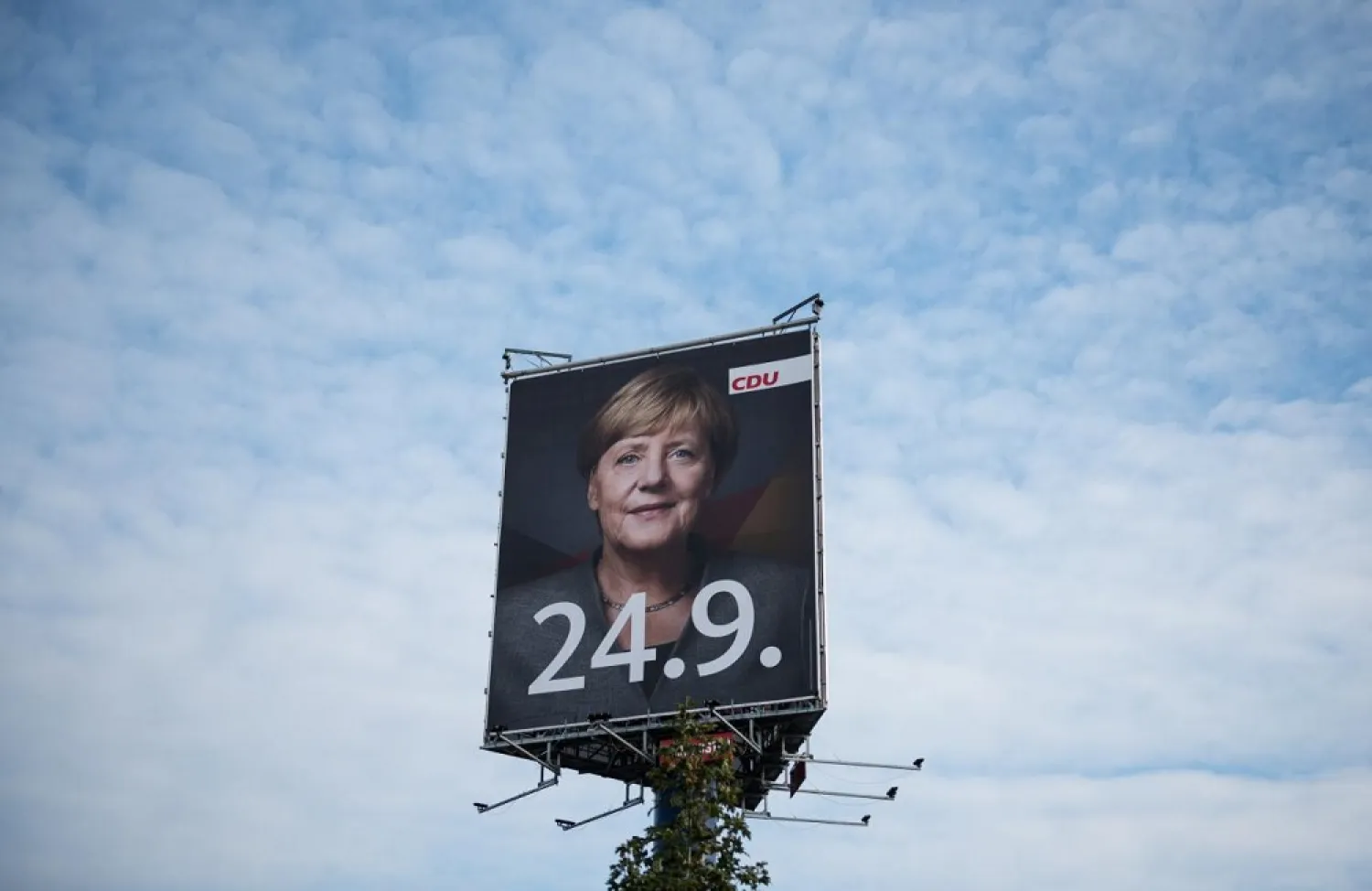

Merkel, Schulz in Final Appeal to German Voters ahead of Sunday Polls

An election campaign poster for the general elections of the Christian Democratic Union party (CDU) with a headshot of German Chancellor Angela Merkel is displayed near Berlin, Germany. (Reuters)
TT

Merkel, Schulz in Final Appeal to German Voters ahead of Sunday Polls

An election campaign poster for the general elections of the Christian Democratic Union party (CDU) with a headshot of German Chancellor Angela Merkel is displayed near Berlin, Germany. (Reuters)

German Chancellor Angela Merkel and her main challenger Martin Schulz embarked on Saturday on the final round of their electoral campaign ahead of Sunday’s elections.

Both are united in their appeal to Germans to shun anti-migrant populists.

Merkel, of the Christian Democratic Union, is visiting districts in the town of Greifswald and the island of Ruegen where the Islamophobic Alternative for Germany (AfD) topped her party's score in state elections last year.

Social Democrat chief Schulz meanwhile will take his rally to Aachen, a western city next to his hometown of Wuerselen.

Although Merkel's party enjoys a double-digit lead over the second place SPD, alarm is growing among mainstream parties as the latest polls show support for the hard-right AfD rising in the final campaigning stretch to between 11 and 13 percent.

That means that around 60 lawmakers of the openly anti-immigration party could sit in the German parliament for the first time since World War II, a prospect prompting established parties to urge voters to shun the upstarts.

At Merkel’s final major stump speech on Friday evening at the southern city of Munich, dissenters blew whistles and vuvuzelas and chanted "get lost", seeking to drown her out.

But the 63-year-old refused to be derailed from her stability-and-prosperity stump speech, telling the crowd that "the future of Germany will definitely not be built up through whistles and hollers."

Merkel, whose rallies across Germany had been plagued by organized AfD supporters, also called people to go out and "vote for the parties that are 100 percent loyal to our constitution".

In an appeal for voters to close ranks and keep the AfD out, Schulz told a rally in central Berlin that "this Alternative for Germany is no alternative. They are a shame for our nation."

Foreign Minister Sigmar Gabriel, also a Social Democrat, said the party is led by "people who incite hate, who spread Nazi propaganda".

"For the first time since the end of the Second World War, real Nazis will sit in the German parliament," said Gabriel.

Two months of campaigning have been largely low-key, with few hot-button issues dividing the main contenders.

While Merkel has been pushing her stability and prosperity agenda and Schulz seeking to sway voters with his pledges for greater social equality, the AfD has diverted attention.

Sueddeutsche Zeitung columnist Heribert Prantl praised the chancellor for not only pressing on with her rallies despite protests from AfD supporters, but also giving a clear rebuttal to the populists.

But the columnist regretted that it only came late in the campaign when it became "clear how the political climate in Germany will change with the AfD in the Bundestag."

"Not only nationalist politicians, but racists and bigots too will enter parliament," he wrote, adding that "the seriousness of the situation was only recognized too late."

Thorsten Benner, director of the Global Public Policy Institute in Berlin, said the AfD "will challenge key themes" in parliament, warning that taboos since 1945 that could be breached include how Germany views its World War II past and the question of what makes a German.

One of two AfD leading candidates, Alexander Gauland, had called for Germans to stop atoning for the war past.

He had also sparked outrage when he said integration commissioner Aydan Ozoguz should be "disposed of in Anatolia", suggesting that she will never be German because of her Turkish origin.

Merkel, already chancellor for 12 years, has run a low-key campaign emphasizing the country's sinking unemployment, strong economic growth, balanced budget and overall stability in a volatile world.

Pre-election polls give her conservative Union bloc a lead of 13 to 17 points over Schulz. The two are traditional rivals but have governed together in a "grand coalition" of the biggest parties for the past four years.

Schulz returned to German politics in January after years as the European Parliament's president. He has struggled to gain traction with a campaign that centered on righting perceived economic injustices for Germany's have-nots. It's also been difficult for him to carve out clear differences with the conservatives.

Merkel offered Germans "a combination of the experience of recent years, in which we have achieved plenty, and curiosity for the new" during the pair's only head-to-head debate of the campaign.

Merkel is pledging to get from Germany's current 5.7 percent unemployment rate — down from 11 percent when she took office in 2005 — to "full employment" by 2025. She pledges limited tax cuts and to keep Germany's borrowing at zero.

And she offers a steady hand internationally, with long experience of European Union negotiating marathons, tough talks with Russian President Vladimir Putin, and now of engaging cautiously with President Donald Trump.



Somalia’s Al-Shabaab Vows to Fight Any Israeli Use of Somaliland

Residents wave Somaliland flags as they gather to celebrate Israel's announcement recognizing Somaliland's statehood in downtown Hargeisa, on December 26, 2025. (AFP)
TT

Somalia’s Al-Shabaab Vows to Fight Any Israeli Use of Somaliland

Residents wave Somaliland flags as they gather to celebrate Israel's announcement recognizing Somaliland's statehood in downtown Hargeisa, on December 26, 2025. (AFP)

Somalia's Al-Qaeda-linked militant group Al-Shabaab vowed Saturday to fight any attempt by Israel "to claim or use parts of Somaliland" following its recognition of the breakaway territory.

"We will not accept it, and we will fight against it," Al-Shabaab said in a statement.

Its spokesman Ali Dheere said in the statement that Israel's recognition of Somaliland as a sovereign state showed it "has decided to expand into parts of the Somali territories" to support "the apostate administration in the northwest regions".

Israel said Friday it was officially recognizing Somaliland, a first for the self-proclaimed republic that in 1991 declared it had unilaterally seceded from Somalia.

Mogadishu immediately denounced a "deliberate attack" on its sovereignty, while Egypt, Türkiye, the six-nation Gulf Cooperation Council and the Saudi-based Organization of Islamic Cooperation all condemned Israel's move.

Regional analysts believe that a rapprochement with Somaliland could allow Israel to secure better access to the Red Sea.

In addition, press reports a few months ago said Somaliland was among a handful of African territories willing to host Palestinians expelled by Israel, but neither the Somaliland authorities nor the Israeli government has ever commented on those reports.

"It is humiliation of the highest level today, to see some Somali people celebrating a recognition by the Israeli Prime Minister (Benjamin) Netanyahu" when "Israel is the biggest enemy of the Islamic society".

The territory of Somaliland is roughly a third the size of France and corresponds more or less to the former British Somaliland protectorate.

It has its own money, army and police and enjoys relative stability compared to its neighbors.

But, until now, Somaliland had not been publicly recognized by any country, which has kept it politically and economically isolated despite its location on one of the world's busiest trade routes connecting the Indian Ocean to the Suez Canal.

Somalia has been battling Al-Shabaab for nearly 20 years and while security has significantly improved in Mogadishu, the war still rages 60 kilometers from the capital.


China Welcomes Cambodia-Thailand Ceasefire, Plans Talks

A handout photo made available by the Defense Ministry of Thailand shows Cambodian Defense Minister Tea Seiha (L) and Thai Defense Minister Natthaphon Narkphanit exchanging ceasefire agreement documents during a General Border Committee Meeting in Ban Pak Kard, Chanthaburi Province, Thailand, 27 December 2025. (EPA/Defense Ministry of Thailand/Handout)
TT

China Welcomes Cambodia-Thailand Ceasefire, Plans Talks

A handout photo made available by the Defense Ministry of Thailand shows Cambodian Defense Minister Tea Seiha (L) and Thai Defense Minister Natthaphon Narkphanit exchanging ceasefire agreement documents during a General Border Committee Meeting in Ban Pak Kard, Chanthaburi Province, Thailand, 27 December 2025. (EPA/Defense Ministry of Thailand/Handout)

China on Saturday welcomed a joint ceasefire statement signed by Cambodia and Thailand and said its foreign minister would meet his counterparts from both countries in China, according to a notice posted on the foreign ministry's website late in the day.

Cambodia and Thailand agreed ‌on Saturday to ‌a second ceasefire ‌in ⁠recent months, ‌ending weeks of intense border clashes described as the worst fighting in years between the two Southeast Asian neighbors.

China's foreign ministry said the agreement showed that dialogue and consultation ⁠were practical and effective ways to resolve ‌complex disputes.

Foreign Minister Wang ‍Yi will meet ‍Cambodian counterpart Prak Sokhonn and ‍Thailand's Sihasak Phuangketkeow in southwestern Yunnan province on December 28–29, the ministry said, adding that military representatives from all three countries would also attend.

China said it was willing to continue ⁠providing a platform and facilitating more substantive and detailed communication between Cambodia and Thailand.

"China will play a constructive role in its own way to help Cambodia and Thailand consolidate the ceasefire, resume exchanges, rebuild political mutual trust, achieve a turnaround in relations and maintain regional ‌peace," the ministry said.


Netanyahu to Meet Trump in US on Monday for Talks on Iran, Gaza, Hezbollah, Syria

 Israeli Prime Minister Benjamin Netanyahu speaks during a joint press conference with Greek Prime Minister Kyriakos Mitsotakis and Cypriot President Nikos Christodoulides (not pictured) after a trilateral meeting in Jerusalem on December 22, 2025. (AFP)
Israeli Prime Minister Benjamin Netanyahu speaks during a joint press conference with Greek Prime Minister Kyriakos Mitsotakis and Cypriot President Nikos Christodoulides (not pictured) after a trilateral meeting in Jerusalem on December 22, 2025. (AFP)
TT

Netanyahu to Meet Trump in US on Monday for Talks on Iran, Gaza, Hezbollah, Syria

 Israeli Prime Minister Benjamin Netanyahu speaks during a joint press conference with Greek Prime Minister Kyriakos Mitsotakis and Cypriot President Nikos Christodoulides (not pictured) after a trilateral meeting in Jerusalem on December 22, 2025. (AFP)
Israeli Prime Minister Benjamin Netanyahu speaks during a joint press conference with Greek Prime Minister Kyriakos Mitsotakis and Cypriot President Nikos Christodoulides (not pictured) after a trilateral meeting in Jerusalem on December 22, 2025. (AFP)

Israeli Prime Minister Benjamin Netanyahu is due to meet US President Donald Trump in Florida on Monday, an Israeli official told AFP, in what is seen as a crucial visit for the next steps of the fragile Gaza truce plan.

It will be Netanyahu's fifth visit to see key ally Trump in the United States this year.

His trip comes as the Trump administration and regional mediators push to proceed to the second stage of the ceasefire between Israel and Hamas in the Gaza Strip.

An Israeli official on Saturday said Netanyahu would leave for the US on December 28 and meet with Trump a day later in Florida, without providing a specific location.

Trump told reporters in mid-December that Netanyahu would probably visit him in Florida during the Christmas holidays.

"He would like to see me. We haven't set it up formally, but he'd like to see me," Trump said before leaving for his Mar-a-Lago resort.

Israel's Yedioth Ahronoth newspaper reported on Wednesday that a wide range of regional issues was expected to be discussed, including Iran, talks on an Israel-Syria security agreement, the ceasefire with Hezbollah in Lebanon and the next stages of the Gaza deal.

- 'Going nowhere' -

Concerning Gaza, the timing of the meeting is "very significant", said Gershon Baskin, the co-head of peacebuilding commission the Alliance for Two States, who has taken part in back-channel negotiations with Hamas.

"Phase one is basically over, there's one remaining Israeli deceased hostage which they (Hamas) are having difficulty finding," he told AFP.

"Phase two has to begin, it's even late and I think the Americans realize that it's late because Hamas has had too much time to re-establish its presence and this is certainly not a situation that the Americans want to leave in place," he added.

Progress in moving to the second phase of October's Gaza ceasefire agreement, which was brokered by Washington and its regional allies, has so far been slow.

Both sides allege frequent ceasefire violations and mediators fear that Israel and Hamas alike are stalling.

Under the next stages, Israel is supposed to withdraw from its positions in Gaza, an interim authority is to govern the Palestinian territory instead of Hamas, and an international stabilization force (ISF) is to be deployed.

It also includes a provision for Palestinian movement Hamas to lay down its weapons -- a major sticking point.

On Friday, US news outlet Axios reported that the meeting between Trump and Netanyahu was key to advancing to the next steps of the deal.

Citing White House officials, Axios said that the Trump administration wanted to announce the Palestinian technocratic government for Gaza and the ISF as soon as possible.

It reported that senior Trump officials were growing exasperated "as Netanyahu has taken steps to undermine the fragile ceasefire and stall the peace process".

"There are more and more signs that the American administration is getting frustrated with Netanyahu," said Yossi Mekelberg, a Middle East expert at London-based think-tank Chatham House.

"The question is what it's going to do about it," he added, "because phase two is right now going nowhere."

- Iran tops agenda -

While the Trump administration is keen for progress on Gaza, analysts said the prospect of Iran rebuilding its nuclear program and ballistic missile capabilities was likely to top the agenda for Netanyahu.

"All the news that we've heard in the Israeli media over the last two weeks about Iran building up its missiles and being a threat to Israel is all part of a planned strategy of deflecting attention from Gaza to the issue that Netanyahu loves to talk about which is Iran," said Baskin.

In June, Israel launched strikes on Iranian military and nuclear sites as well as residential areas.

Iran responded with drone and missile strikes on Israel, and later on in the 12-day war, the United States joined Israel in targeting Iranian nuclear facilities.

Mekelberg shared the view that Netanyahu could be attempting to shift attention from Gaza onto Iran.

With Israel entering an election year, Mekelberg said with regards to the Trump meeting, Netanyahu would be "taking a defensive approach, to minimize what can be difficult for him coming back home".

"Everything is connected to staying in power," he said of the long-time Israeli premier.