


Low Turnout in Kenya’s Violence-Marred Elections

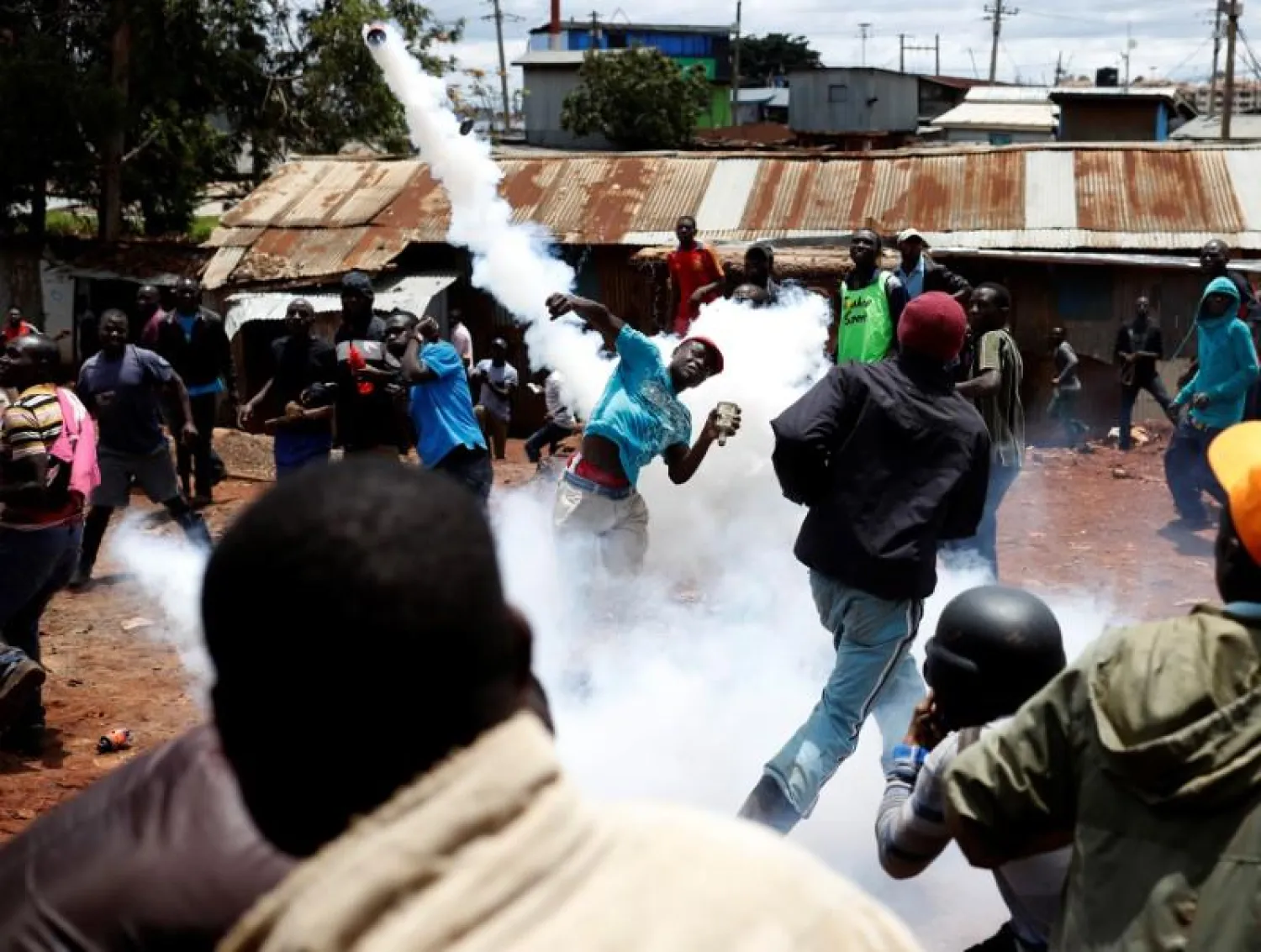
An opposition supporter returns a teargas canister fired by police during clashes in Kibera slum in Nairobi, Kenya October 26, 2017. REUTERS/Goran Tomasevic
TT

Low Turnout in Kenya’s Violence-Marred Elections

An opposition supporter returns a teargas canister fired by police during clashes in Kibera slum in Nairobi, Kenya October 26, 2017. REUTERS/Goran Tomasevic

As polling officials tallied votes, Kenyans reflected on the cost of a do-over, deeply-divisive election marred by protests, clashes, tear gas and an opposition boycott that left at least four dead and scores wounded.

The country's second presidential election in three months descended into chaos on Thursday as supporters of opposition leader Raila Odinga attempted to block voting, clashing with police who fired tear gas, water cannon and live bullets.

The vote came after a two-month political drama that began when the Supreme Court overturned the victory of President Uhuru Kenyatta in August 8 elections due to "irregularities".

Although the ruling was initially hailed as a chance to deepen democracy in one of east Africa's most stable nations, its impact quickly soured, unleashing weeks of angry protests, acrimonious political rhetoric and intimidation of election officials.

And Odinga's boycott of the re-run, on grounds the election commission had failed to make the necessary changes to ensure a free and fair vote, has assured Kenyatta a landslide victory.

But as votes continued to be tallied on Friday difficult questions remained over the credibility of an election boycotted by a large part of the 19 million registered voters.

Estimated figures compiled by the election board after polling shut pointed to a turnout of 48 percent, said election chief Wafula Chebukati.

Kenya's leading Daily Nation newspaper said the low turnout would mean "a serious question of legitimacy for the winner."

According to Kenya's election commission, the turnout in Thursday's election was much lower than the nearly 80 percent of registered voters who participated in an Aug. 8 election that was. That first disputed election was won by Kenyatta but was later nullified by the Supreme Court, sparking weeks of protest and acrimonious debate.

About 6.5 million people, or one-third of registered voters, went to the polls, said the commission.

Wafula Chebukati, the election commission chairman, said late Thursday the count was based on results from 267 out of Kenya's 290 constituencies.

While the August election saw long queues of voters and ballots being cast long after closing time in some places, Thursday's vote was a different story with many polling stations empty or welcoming only a trickle of people.

On Friday morning Chebukati said the central tally center in Nairobi had received results sheets from 90 percent of polling stations nationwide.

However, he had been forced to postpone the election until Saturday in four protest-hit counties in the country's west where Odinga enjoys overwhelming support.

The move, he said, was due to "security-related" challenges.

But the governor of Kisumu, an opposition stronghold in western Kenya where violence raged on Thursday, rejected the move, saying people would not vote while they were "mourning".

He said he had invited Odinga and top leaders of his National Super Alliance coalition (NASA) to visit the city on Friday.

At least four people were shot dead and around 50 others wounded, most of them by live bullets, during Thursday vote, according to an AFP tally of figures from officials and medics.

One of the dead was a 19 year-old who died from blood loss after being shot in the thigh during clashes in Kisumu, police and hospital sources said.

A second person died from a gunshot wound to the leg in Kisumu, police said, after a polling center was "stormed" by a mob.

Police said another man was shot dead in Homa Bay, also in the west, "where a large mob attacked a small police facility" prompting officers to open fire "to protect themselves".

And a fourth man was shot dead in Nairobi's Mathare slum, another hotspot in the capital where police fired water cannon and teargas to disperse demonstrators.

The confirmed casualties raised to 44 the tally of people killed in election-related violence since the August poll.

The crisis is the worst since a 2007 election sparked politically-driven ethnic violence that left 1,100 dead.

In its post-election editorial the Daily Nation warned Kenya is now "more fractured and unstable than ever before" but added, "Ours is a political problem that requires a political solution."

"There is a need to forge inclusivity."


Israel’s Supreme Court Suspends Govt Move to Shut Army Radio

Israeli troops during a military operation in the Palestinian village of Qabatiya, near the West Bank city of Jenin, 27 December 2025. (EPA)
TT

Israel’s Supreme Court Suspends Govt Move to Shut Army Radio

Israeli troops during a military operation in the Palestinian village of Qabatiya, near the West Bank city of Jenin, 27 December 2025. (EPA)

Israel's Supreme Court has issued an interim order suspending a government decision to shut down Galei Tsahal, the country's decades-old and widely listened-to military radio station.

In a ruling issued late Sunday, Supreme Court President Isaac Amit said the suspension was partly because the government "did not provide a clear commitment not to take irreversible steps before the court reaches a final decision".

He added that Attorney General Gali Baharav-Miara supported the suspension.

The cabinet last week approved the closure of Galei Tsahal, with the shutdown scheduled to take effect before March 1, 2026.

Founded in 1950, Galei Tsahal is widely known for its flagship news programs and has long been followed by both domestic and foreign correspondents.

A government audience survey ranks it as Israel's third most listened-to radio station, with a market share of 17.7 percent.

Prime Minister Benjamin Netanyahu had urged ministers to back the closure, saying there had been repeated proposals over the years to remove the station from the military, abolish it or privatize it.

But Baharav-Miara, who also serves as the government's legal adviser and is facing dismissal proceedings initiated by the premier, has warned that closing the station raised "concerns about possible political interference in public broadcasting".

She added that it "poses questions regarding an infringement on freedom of expression and of the press".

Defense Minister Israel Katz said last week that Galei Tsahal broadcasts "political and divisive content" that does not align with military values.

He said soldiers, civilians and bereaved families had complained that the station did not represent them and undermined morale and the war effort.

Katz also argued that a military-run radio station serving the general public is an anomaly in democratic countries.

Opposition leader Yair Lapid had condemned the closure decision, calling it part of the government's effort to suppress freedom of expression ahead of elections.

Israel is due to hold parliamentary elections in 2026, and Netanyahu has said he will seek another term as prime minister.


Thai Army Accuses Cambodia of Violating Truce with over 250 Drones

Displaced residents rest in a bunker in Thailand's Surin province on December 11, 2025, amid clashes along the Thai-Cambodia border. (AFP)
TT

Thai Army Accuses Cambodia of Violating Truce with over 250 Drones

Displaced residents rest in a bunker in Thailand's Surin province on December 11, 2025, amid clashes along the Thai-Cambodia border. (AFP)

Thailand's army on Monday accused Cambodia of violating a newly signed ceasefire agreement, reached after weeks of deadly border clashes, by flying more than 250 drones over its territory.

The Thai army said "more than 250 unmanned aerial vehicles (UAVs) were detected flying from the Cambodian side, intruding into Thailand's sovereign territory" on Sunday night, according to a statement.

"Such actions constitute provocation and a violation of measures aimed at reducing tensions, which are inconsistent with the Joint Statement agreed" during a bilateral border committee meeting on Saturday, it added.

Cambodian Foreign Minister Prak Sokhonn said in remarks aired on state television on Monday that the two sides had discussed the incident and agreed to investigate and "resolve it immediately".

Prak Sokhonn described it as "a small issue related to flying drones seen by both sides along the border line".

Thailand and Cambodia agreed to the "immediate" ceasefire on Saturday, pledging to end renewed border clashes that killed dozens of people and displaced more than a million this month.

The reignited fighting spread to nearly every border province on both sides, shattering an earlier truce for which US President Donald Trump took credit.

Under the agreement signed on Saturday, the Southeast Asian neighbors agreed to cease fire, freeze troop movements and cooperate on demining efforts and combatting cybercrime.


Mexican Train Derailment Kills at Least 13 People, 98 Injured

Authorities work at the site of train derailment on the Interoceanic Corridor of the Isthmus of Tehuantepec, a railway line connecting Mexico's Pacific and Gulf coasts, where several passengers were killed and injured near Nizanda, Oaxaca state, Mexico, December, 28, 2025. (Reuters)
TT

Mexican Train Derailment Kills at Least 13 People, 98 Injured

Authorities work at the site of train derailment on the Interoceanic Corridor of the Isthmus of Tehuantepec, a railway line connecting Mexico's Pacific and Gulf coasts, where several passengers were killed and injured near Nizanda, Oaxaca state, Mexico, December, 28, 2025. (Reuters)

Mexican authorities said on Sunday that at least 13 people ​were killed after an Interoceanic Train carrying 250 people derailed in the southern state of Oaxaca.

The Mexican Navy said the train, which derailed near the town of Nizanda, was carrying nine crew members and 241 passengers.

Of those on board, 139 were reported to be out of ‌danger, while 98 ‌were injured, including 36 ‌who ⁠were ​receiving medical assistance.

President ‌Claudia Sheinbaum said on X that five of the injured were in critical condition, adding that senior officials had been dispatched to the site to assist the families of those killed.

The governor of Oaxaca, Salomon Jara Cruz, expressed condolences to the families ⁠of those killed in the accident and said state authorities ‌were coordinating with federal agencies to ‍assist those affected.

Mexico's Attorney ‍General's Office has already opened an investigation into ‍the incident, Attorney General Ernestina Godoy Ramos said in a social media post.

The Interoceanic Train, inaugurated in 2023 under former President Andres Manuel Lopez Obrador, forms ​part of the broader Interoceanic Corridor project.

The initiative was designed to modernize the rail link across ⁠the Isthmus of Tehuantepec, connecting Mexico's Pacific port of Salina Cruz with Coatzacoalcos on the Gulf Coast.

The Mexican government has sought to develop the isthmus into a strategic trade corridor, expanding ports, railways and industrial infrastructure with the goal of creating a route that could compete with the Panama Canal.

The train service is also part of a broader push to expand passenger and freight rail ‌in southern Mexico and stimulate economic development in the region.
