


Europe Soldiers Guard Europe’s Streets from Terrorism

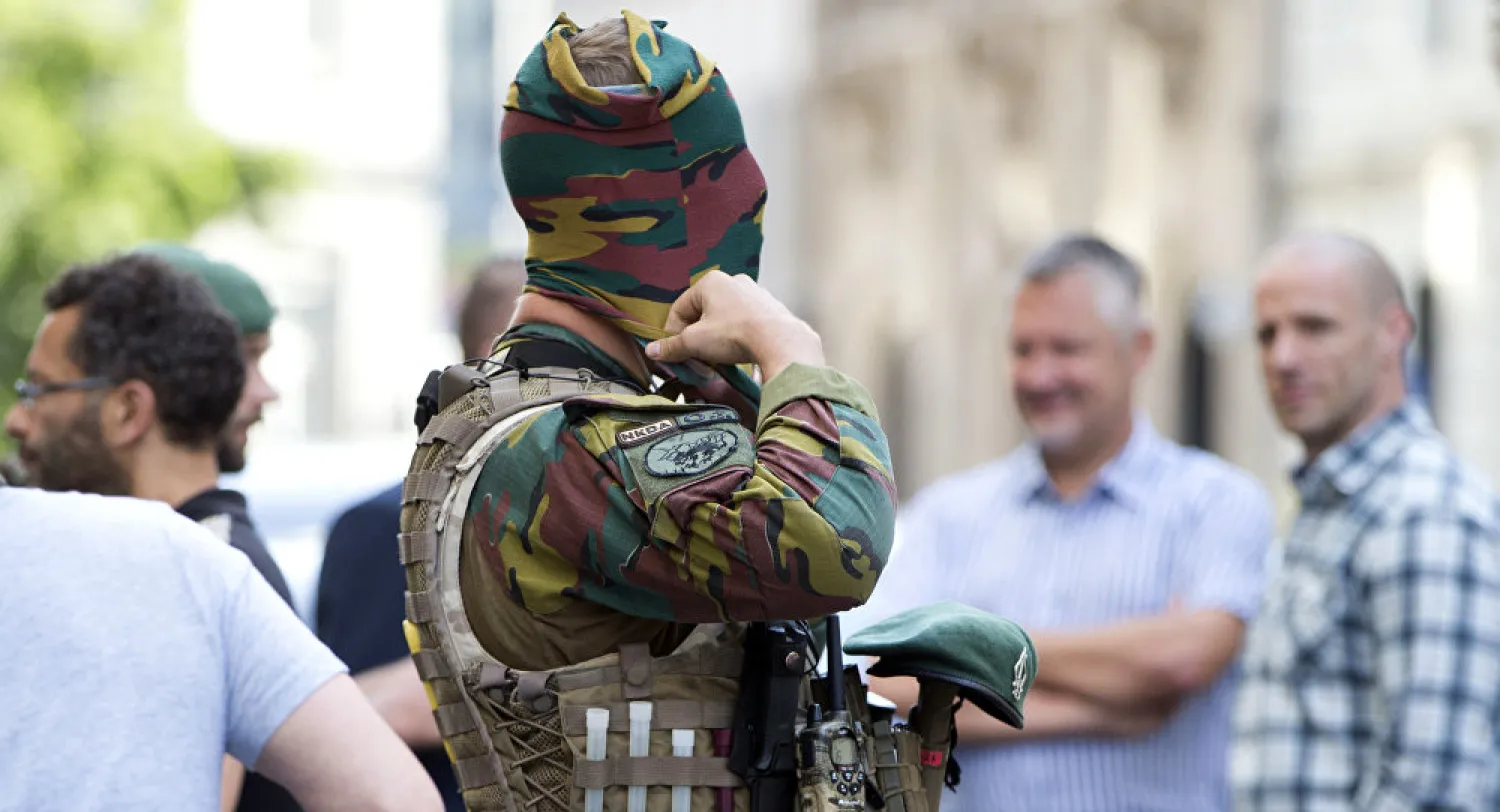
A Belgian soldier adjusts his face mask as he patrols outside the prime minister’s office in Brussels in June. (Virginia Mayo/AP)
TT

Europe Soldiers Guard Europe’s Streets from Terrorism

A Belgian soldier adjusts his face mask as he patrols outside the prime minister’s office in Brussels in June. (Virginia Mayo/AP)

Green army trucks are rumbling across the cobbled streets of Brussels. Stiff-spined soldiers are patrolling the Champs-Elysees in Paris. Italian troops are guarding the Colosseum. And critics say the years-long deployments at home are sapping the ability of these militaries to fight wars.

Taken together, the domestic deployments — to guard against terrorism — are among the largest in Western Europe since World War II. They come as European militaries are tapped to address an unusually wide range of challenges at once: a resurgent Russia, grinding conflicts in the Middle East, migration across the Mediterranean and smaller wartime deployments far from their borders.

Confronted by terrorism, European leaders rushed their armies onto their streets in the aftermath of attacks starting in 2015. Although advocates say the deployments help bolster security, the peacetime duty has stretched forces thin.

Until recently, 40 percent of Belgium’s combat-ready soldiers were devoted to domestic guard duty. Some officers worry that the lack of time to practice warfare means basic skills are getting rusty. In France, the former leader of the military said last month that he quit in July in part to protest that his forces were “overheating.”

President Trump has pressed NATO allies to commit more toward their own defense and to international missions, but the domestic deployments have made that a challenge. The latest sign came last month at a meeting of defense chiefs in Brussels, when the alliance fell short on pledges toward the NATO training operation in Afghanistan.

In Belgium, a country of 11 million people, military leaders say their troops are feeling the strain.

“I had machine gunners with the rifle section who didn’t fire a machine gun in 16 months because they had become riflemen,” said Maj. Gen. Marc Thys, commander of Belgium’s land forces. “It’s like asking our national team that hasn’t played a game of soccer all year to go to the world championships. It doesn’t work.”

Until October, 1,250 Belgian soldiers were deployed across the country, guarding grand boulevards, train stations and other crowded public places that make tempting targets. The intention was to increase public safety and to give police officers more freedom to do investigative work rather than tie them up on guard duty.

The domestic deployments came as European nations struggled to find a way to protect themselves against attacks in a new era of terrorism strategies. Some recent ISIS-inspired strikes used explosives and required large networks that could be disrupted through aggressive counterterrorism work, but other attacks were as simple as renting a truck and plowing it into a crowd.

Proponents of the military approach say that such attacks can be prevented by quick-thinking soldiers. They point to June’s attempted attack in the Brussels Central railway station, where soldiers patrolling the platforms shot dead a suspected bomber after he set off a small explosive that failed to hurt anyone.

“We weren’t ready for the threats that we were facing,” Belgian Defense Minister Steven Vandeput said about the aftermath of the 2015 terrorist attacks in Paris. Both the January Charlie Hebdo newspaper attack and the November Bataclan nightclub attack that year had Brussels connections, and authorities were searching for a quick solution.

“After November, the threat was high and at the same time police need to do police work,” Vandeput said. “If we’re not able to contribute to our defense, how can we contribute to others’ defense?”

France also deployed soldiers to its streets following the terrorist attacks and has faced similar challenges. Italian troops have been deployed since 2008. Britain made such deployments an option this year, but it has done so sparingly. In the United States, federal law generally forbids military deployments for law enforcement purposes, although state National Guards have more flexibility when commanded at a state level.

Germany has also been struck repeatedly by small-scale terrorist attacks, and its Parliament recently considered a measure to allow the army to be used domestically. That would have been a significant step because the country’s World War II history has made lawmakers wary of using their military at home. In the end, the legislature took no action.

In Belgium, the soldiers do not have the power to make arrests or investigate crimes. Advocates say their powerful rifles serve as a deterrent as they walk through crowded weekend markets or stand watch at train stations during rush hour.

The Washington Post


Trump Hints at Land Strike as Venezuela Pressure Mounts

A US Air Force C-130J Super Hercules aircraft approaches for landing at Rafael Hernandez Airport, amid tensions between US President Donald Trump's administration and the government of Venezuelan President Nicolas Maduro, in Aguadilla, Puerto Rico, December 28, 2025. (Reuters)
TT

Trump Hints at Land Strike as Venezuela Pressure Mounts

A US Air Force C-130J Super Hercules aircraft approaches for landing at Rafael Hernandez Airport, amid tensions between US President Donald Trump's administration and the government of Venezuelan President Nicolas Maduro, in Aguadilla, Puerto Rico, December 28, 2025. (Reuters)

A throwaway remark last week by President Donald Trump has raised questions about whether US forces may have carried their first land strike against drug cartels in Venezuela.

Trump said the US knocked out a "big facility" for producing trafficking boats, as he was discussing his pressure campaign against Venezuelan President Nicolas Maduro in an interview broadcast Friday.

"They have a big plant or a big facility where they send, you know, where the ships come from," Trump said in an interview with billionaire supporter John Catsimatidis on the WABC radio station in New York.

"Two nights ago we knocked that out. So we hit them very hard."

Trump did not say where the facility was located or give any other details. US forces have carried out numerous strikes in both the Caribbean Sea and eastern Pacific Ocean since September, killing more than 100 people.

The Pentagon referred questions about Trump's remarks to the White House. The White House did not respond to requests for comment from AFP.

There has been no official comment from the Venezuelan government.

Trump has been saying for weeks that the United States will "soon" start carrying out land strikes targeting drug cartels in Latin America, but there have been no confirmed attacks to date.

The Trump administration has been ramping up pressure on Maduro, accusing the Venezuelan leader of running a drug cartel himself and imposing an oil tanker blockade.

Maduro has accused Washington of attempting regime change.


UN Chief Says ‘Get Serious’ in Grim New Year Message

 UN Secretary-General Antonio Guterres. (AFP)
UN Secretary-General Antonio Guterres. (AFP)
TT

UN Chief Says ‘Get Serious’ in Grim New Year Message

 UN Secretary-General Antonio Guterres. (AFP)
UN Secretary-General Antonio Guterres. (AFP)

The United Nations urged global leaders Monday to focus on people and the planet in a New Year's message depicting the world in chaos.

"As we enter the new year, the world stands at a crossroads. Chaos and uncertainty surround us. Division. Violence. Climate breakdown. And systemic violations of international law," UN Secretary-General Antonio Guterres said in a video message.

In 2026, as war rages in Ukraine and elsewhere, world leaders must work to ease human suffering and fight climate change, he added.

"I call on leaders everywhere: Get serious. Choose people and planet over pain," said Guterres, criticizing the global imbalance between military spending and financing for the poorest countries.

Military spending is up nearly 10 percent this year to $2.7 trillion, which is 13 times total world spending on development aid and equivalent to the entire gross domestic product of Africa, he said.

Wars are raging at levels unseen since World War II, he added.

"In this New Year, let's resolve to get our priorities straight. A safer world begins by investing more in fighting poverty and less in fighting wars. Peace must prevail," said Guterres, who will be serving his last year as secretary general.


Türkiye and Armenia Agree to Simplify Visa Procedures to Normalize Ties

Türkiye’s President Recep Tayyip Erdogan, right, and Armenia's Prime Minister Nikol Pashinyan shake hands before a meeting at Prague Castle in Prague, Czech Republic, Thursday, Oct. 6, 2022. (Turkish Presidency via AP, File)
TT

Türkiye and Armenia Agree to Simplify Visa Procedures to Normalize Ties

Türkiye’s President Recep Tayyip Erdogan, right, and Armenia's Prime Minister Nikol Pashinyan shake hands before a meeting at Prague Castle in Prague, Czech Republic, Thursday, Oct. 6, 2022. (Turkish Presidency via AP, File)

Türkiye and Armenia have agreed to simplify visa procedures as part of efforts to normalize ties, Türkiye’s Foreign Ministry announced Monday, making it easier for their citizens to travel between the two countries.

Relations between Türkiye and Armenia have long been strained by historic grievances and Türkiye’s alliance with Azerbaijan. The two neighboring countries have no formal diplomatic ties and their joint border has remained closed since the 1990s.

The two countries, however, agreed to work toward normalization in 2021, appointing special envoys to explore steps toward reconciliation and reopening the frontier. Those talks have progressed in parallel with efforts to ease tensions between Armenia and Azerbaijan.

Türkiye supported Azerbaijan during its 2020 conflict with Armenia for control of the Karabakh region, known internationally as Nagorno-Karabakh, a territorial dispute that had lasted nearly four decades.

The Turkish Foreign Ministry said in a statement posted on social platform X that Ankara and Yerevan agreed that holders of diplomatic, special and service passports from both countries would be able to obtain electronic visas free of charge as of Jan. 1.

“On this occasion, Türkiye and Armenia reaffirm once again their commitment to continue the normalization process between the two countries with the goal of achieving full normalization without any preconditions,” the ministry said.

Türkiye and Armenia also have a more than century-old dispute over the deaths of an estimated 1.5 million Armenians in massacres, deportations and forced marches that began in 1915 in Ottoman Türkiye. Historians widely view the event as genocide.

Türkiye denies the deaths constituted genocide, saying the toll has been inflated and those killed were victims of civil war and unrest. It has lobbied to prevent countries from officially recognizing the massacres as genocide.
