


North Korea Preparing Satellite Launch as China Sanctions Weigh Heavily

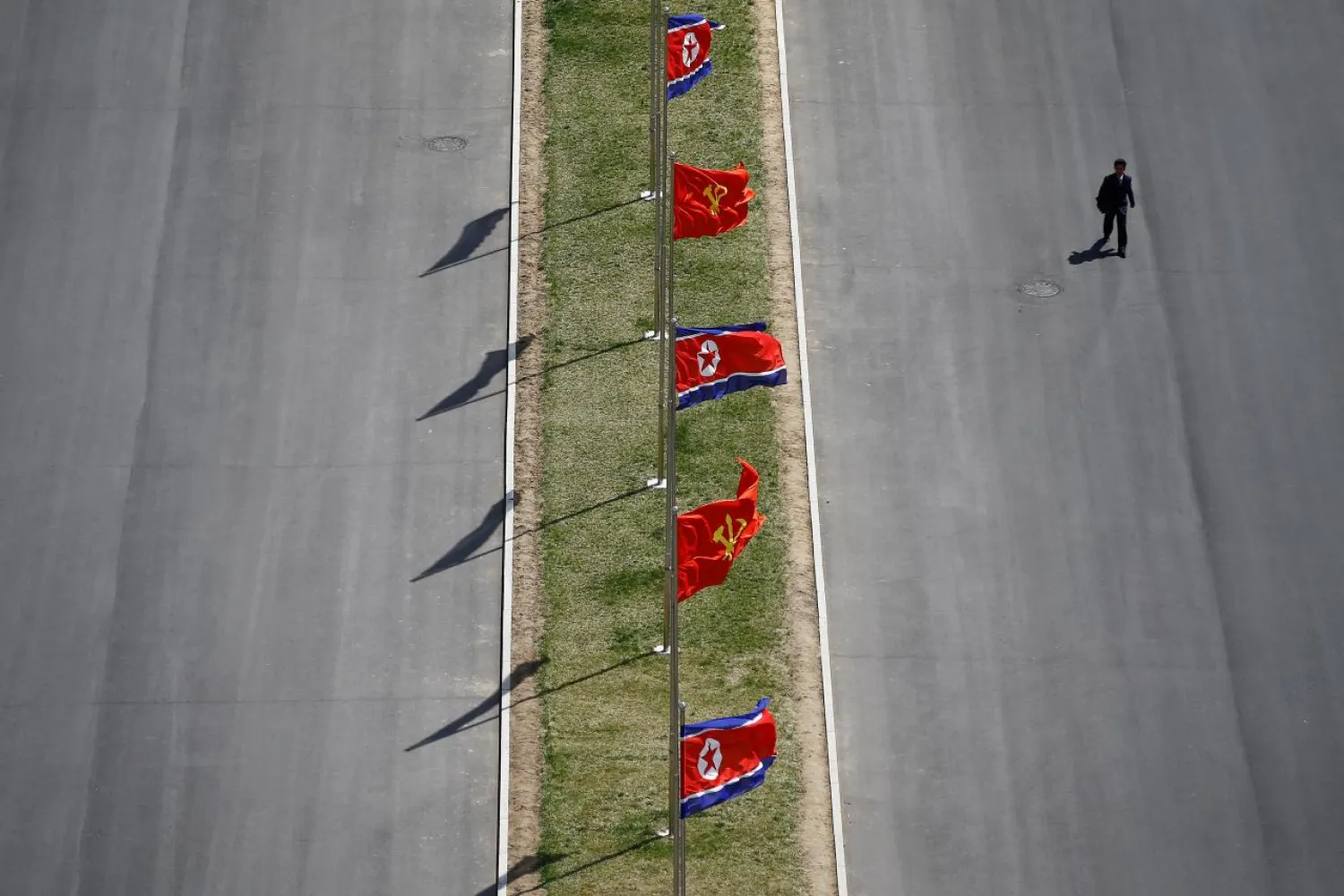
A man walks a street decorated with flags as North Korea prepared to mark the 105th anniversary of the birth of Kim Il-sung in April 2017. (Reuters)
TT

North Korea Preparing Satellite Launch as China Sanctions Weigh Heavily

A man walks a street decorated with flags as North Korea prepared to mark the 105th anniversary of the birth of Kim Il-sung in April 2017. (Reuters)

A satellite launch prepared by North Korea is in fact a cover for weapons tests, observers said on Tuesday.

"Through various channels, we've recently learned that the North has completed a new satellite and named it Kwangmyongsong-5", the Joongang Ilbo Seoul daily reported, quoting a South Korean government source.

"Their plan is to put a satellite equipped with cameras and telecommunication devices into orbit", he said.

Pyongyang launched their Kwangmyongsong-4 satellite in February 2016, which most in the international community viewed as a disguised ballistic missile test.

A spokesman for the South Korean military joint chiefs of staff said there was "nothing out of ordinary at this moment" but added that Seoul was watching out for any provocative acts "including the test of a long-range missile disguised as a satellite launch".

The report came as the North's ruling party newspaper Rodong Sinmun reasserted the regime's right to launch satellites and develop its space technology.

In a commentary published on Monday and titled "peaceful space programs are sovereign countries' legitimate rights", the daily said Pyongyang's satellite launches "absolutely correspond" with international laws concerning space development.

At a UN General Assembly committee meeting in October, North Korea's deputy UN ambassador Kim In-Ryong said his country has a 2016-2020 plan to develop "practical satellites that can contribute to the economic development and improvement of the people’s living".

He stressed North Korea's right to produce and launch satellites "will not be changed just because the US denies it".

North Korea is believed to have successfully put a satellite into orbit in December 2012 after years of failures dating back to 1998 when it launched a pilot satellite and named it Kwangmyongsong-1.

Earlier this month, the Russian newspaper Rossiyskaia Gazeta quoted a Russian military expert, Vladimir Khrustalev, as saying that North Korea was expected to launch two satellites -- an Earth exploration satellite and a communications satellite -- in the near future.

Pyongyang is under multiple UN sanctions over its nuclear and missile tests and is prohibited from carrying out any launch using ballistic missile technology including satellites.

Chinese sanctions against North Korea meanwhile have started to have an impact. Beijing exported no oil products to the North in November, Chinese customs data showed, apparently going above and beyond sanctions imposed earlier this year by the UN in a bid to limit petroleum shipments to the isolated country.

Last week, the UN Security Council imposed new caps on trade with North Korea, including limiting oil product shipments to just 500,000 barrels a year.

Beijing also imported no iron ore, coal or lead from North Korea in November, the second full month of the latest trade sanctions imposed by UN.

China, the main source of North Korea’s fuel, did not export any gasoline, jet fuel, diesel or fuel oil to its isolated neighbor last month, data from the General Administration of Customs showed on Tuesday.

November was the second straight month China exported no diesel or gasoline to North Korea. The last time China’s jet fuel shipments to Pyongyang were at zero was in February 2015.

Since June, state-run China National Petroleum Corp (CNPC) has suspended sales of gasoline and diesel to North Korea, concerned that it would not get paid for its goods, Reuters previously reported.

Beijing’s move to turn off the taps completely is rare.

In March 2003, China suspended oil supplies to North Korea for three days after Pyongyang fired a missile into waters between the Korean Peninsula and Japan.

It is unknown if China still sells crude oil to Pyongyang. Beijing has not disclosed its crude exports to North Korea for several years.

Industry sources say China still supplies about 520,000 tons, or 3.8 million barrels, of crude a year to North Korea via an aging pipeline. That is a little more than 10,000 barrels a day, and worth about $200 million a year at current prices.

North Korea also sources some of its oil from Russia.

Chinese exports of corn to North Korean in November also slumped, down 82 percent from a year earlier to 100 tonnes, the lowest since January. Exports of rice plunged 64 percent to 672 tonnes, the lowest since March.

Trade between North Korea and China has slowed through the year, particularly after China banned coal purchases in February. In November, China’s trade with North Korea totaled $388 million, one of the lowest monthly volumes this year.

Chinese exports of liquefied petroleum gas to North Korea, used for cooking, rose 58 percent in November from a year earlier to 99 tons. Exports of ethanol, which can be turned into a biofuel, gained 82 percent to 3,428 cubic meters.



Thailand and Cambodia Sign New Ceasefire Agreement to End Border Fighting

A handout photo made available by the Defense Ministry of Thailand shows Cambodian Defense Minister Tea Seiha (L) and Thai Defense Minister Natthaphon Narkphanit attending a General Border Committee Meeting in Ban Pak Kard, Chanthaburi Province, Thailand, 27 December 2025. (EPA/Defense Ministry of Thailand/Handout)
TT

Thailand and Cambodia Sign New Ceasefire Agreement to End Border Fighting

A handout photo made available by the Defense Ministry of Thailand shows Cambodian Defense Minister Tea Seiha (L) and Thai Defense Minister Natthaphon Narkphanit attending a General Border Committee Meeting in Ban Pak Kard, Chanthaburi Province, Thailand, 27 December 2025. (EPA/Defense Ministry of Thailand/Handout)

Thailand and Cambodia on Saturday signed a ceasefire agreement to end weeks of armed combat along their border over competing claims to territory. It took effect at noon local time.

In addition to ending fighting, the agreement calls for no further military movements by either side and no violations of either side’s airspace for military purposes.

Only Thailand employed airstrikes in the fighting, hitting sites in Cambodia as recently as Saturday morning, according to the Cambodian defense ministry.

The deal also calls for Thailand, after the ceasefire has held for 72 hours, to repatriate 18 Cambodian soldiers it has held as prisoners since earlier fighting in July. Their release has been a major demand of the Cambodian side.

The agreement was signed by the two countries’ defense ministers, Cambodia’s Tea Seiha and Thailand’s Nattaphon Narkphanit, at a checkpoint on their border after lower-level talks by military officials met for three days as part of the already-established General Border Committee.

The agreement declares that the two sides are committed to an earlier ceasefire that ended five days of fighting in July and follow-up agreements and includes commitments to 16 de-escalation measures.

The original July ceasefire was brokered by Malaysia and pushed through by pressure from US President Donald Trump, who threatened to withhold trade privileges unless Thailand and Cambodia agreed. It was formalized in more detail in October at a regional meeting in Malaysia that Trump attended.

Despite those deals, the two countries carried on a bitter propaganda war and minor cross-border violence continued, escalating in early December to widespread heavy fighting.

Thailand has lost 26 soldiers and one civilian as a direct result of the combat since Dec. 7, according to officials. Thailand has also reported 44 civilian deaths from collateral effects of the situation.

Cambodia hasn’t issued an official figure on military casualties, but says that 30 civilians have been killed and 90 injured. Hundreds of thousands of people have been evacuated from affected areas on both sides of the border.

Each side blamed the other for initiating the fighting and claimed to be acting in self-defense.

The agreement also calls on both sides to adhere to international agreements against deploying land mines, a major concern of Thailand. Thai soldiers along the border have been wounded in at least nine incidents this year by what they said were newly planted Cambodian mines. Cambodia says the mines were left over from decades of civil war that ended in the late 1990s.

Another clause says the two sides “agree to refrain from disseminating false information or fake news.”

The agreement also says previously established measures to demarcate the border will be resumed and the two sides also agree to cooperate on an effort to suppress transnational crimes.

That is primarily a reference to online scams perpetrated by organized crime that have bilked victims around the world of billions of dollars each year. Cambodia is a center for such criminal enterprises.


Russia Attacks Kyiv with Missiles and Drones, Wounding 11 ahead of Ukraine-US Meeting

Firefighters work at the site of a private home that went up in flames after it was hit by a Russian drone during a night of attacks on Kyiv, amid Russia's attack on Ukraine, November 29, 2025. REUTERS/Thomas Peter
TT

Russia Attacks Kyiv with Missiles and Drones, Wounding 11 ahead of Ukraine-US Meeting

Firefighters work at the site of a private home that went up in flames after it was hit by a Russian drone during a night of attacks on Kyiv, amid Russia's attack on Ukraine, November 29, 2025. REUTERS/Thomas Peter

Russia attacked Ukraine's capital with missiles and drones early Saturday morning, wounding at least 11 people a day before talks between Ukraine and the US, local authorities said.

Explosions boomed across the capital for hours as ballistic missiles and drones hit the city. The attack began in the early morning hours Saturday and was continuing as day broke.

The attack came as Ukrainian President Volodymyr Zelenskyy prepares to meet with US President Donald Trump on Sunday for further talks in an effort to end the nearly four-year-old war. Zelenskyy said they plan to discuss issues including security guarantees and territorial issues in the Donetsk and Zaporizhzhia regions.

Two children were among those injured in the attack, which affected seven locations across the city of Kyiv said the head of Kyiv's City Military Administration Tymur Tkachenko in a statement on Telegram, The Associated Press said.

A fire broke out in an 18-story residential building in the Dnipro district of the city, and emergency crews rushed to the scene to contain the flames.

A 24-story residential building in the Darnytsia district was also hit, Tkachenko said, and more fires broke out in the Obolonskyi and Holosiivsky districts.

In the wider Kyiv region, the strikes hit industrial and residential buildings, according to Ukraine's Emergency Service. In the Vyshhorod area, emergency crews rescued one person found under the rubble of a destroyed house.


Russia Lashes Out at Zelensky ahead of New Trump Talks on Ukraine Plan

Trump is trying to broker an agreement between the warring sides to end Europe's worst conflict since World War II. Jim WATSON, Tetiana DZHAFAROVA / AFP/File
TT

Russia Lashes Out at Zelensky ahead of New Trump Talks on Ukraine Plan

Trump is trying to broker an agreement between the warring sides to end Europe's worst conflict since World War II. Jim WATSON, Tetiana DZHAFAROVA / AFP/File

Volodymyr Zelensky is due to meet President Donald Trump in Florida this weekend, but Russia accused the Ukrainian president and his EU backers Friday of seeking to "torpedo" a US-brokered plan to stop the fighting.

Sunday's meeting to discuss new peace proposals comes as Trump intensifies efforts to end Europe's worst conflict since World War II, one that has killed tens of thousands since February 2022, AFP said.

The 20-point plan would freeze the war on its current front line but open the door for Ukraine to pull back troops from the east, where demilitarized buffer zones could be created, according to details revealed by Zelensky this week.

Ahead of the talks, AFP journalists reported several powerful explosions in Kyiv on Saturday, and authorities warned of a possible missile attack.

“Explosions in the capital. Air defense forces are operating. Stay in shelters!" Kyiv's mayor Vitali Klitschko said on Telegram.

Ukraine's air force announced a countrywide air alert and said drones and missiles were moving over several regions including Kyiv.

Zelensky's office said earlier that a meeting with Trump is planned for Sunday in Florida, where the US leader has a home.

Trump, speaking to news outlet Politico, said about Zelensky's plan that "he doesn't have anything until I approve it", adding: "So we'll see what he's got."

Zelensky meanwhile said he held telephone talks on Friday with NATO Secretary General Mark Rutte, Germany's Chancellor Friedrich Merz and a host of other European leaders.

A spokesperson for Britain's Prime Minister Keir Starmer said the leaders "reiterated their unshakeable commitment for a just and lasting peace for Ukraine and the importance that talks continue to progress towards this in the coming days".

Security guarantees

The new plan formulated with Ukraine's input is Kyiv's most explicit acknowledgement yet of possible territorial concessions and is very different from an initial 28-point proposal tabled by Washington last month that adhered to many of Russia's core demands.

Part of the plan includes separate US-Ukraine bilateral agreements on security guarantees, reconstruction and the economy. Zelensky said those were changing on a daily basis.

"We will discuss these documents, security guarantees," he said of Sunday's meeting.

"As for sensitive issues, we will discuss (the eastern region of) Donbas and the Zaporizhzhia nuclear power plant, and we will certainly discuss other issues," he added.

Russia signaled its opposition to the plan ahead of the Florida talks.

The Kremlin said Friday that foreign policy aide Yuri Ushakov had held telephone talks with US officials, and deputy foreign minister Sergei Ryabkov criticized Zelensky's stance.

Russia accuses EU

"Our ability to make the final push and reach an agreement will depend on our own work and the political will of the other party," Ryabkov said on Russian television.

"Especially in a context where Kyiv and its sponsors -- notably within the European Union, who are not in favor of an agreement -- have stepped up efforts to torpedo it."

He said the proposal drawn up with Zelensky input "differs radically" from points initially drawn up by US and Russian officials in contacts this month.

He said any deal had to "remain within the limits" fixed by Trump and Russia's President Vladimir Putin when they met in Alaska in August, or else "no accord can be reached".

Zelensky said this week there were still disagreements between Kyiv and Washington over the two core issues of territory and the status of the Zaporizhzhia plant.

Washington has pushed Ukraine to withdraw from the 20 percent of the eastern Donetsk region that it still controls -- Russia's main territorial demand.

It has also proposed joint US-Ukrainian-Russian control of Zaporizhzhia, Europe's largest nuclear plant, which Russia seized during the invasion.

Zelensky said he could only give up more land if the Ukrainian people agree to it in a referendum, and he does not want Russian participation in the nuclear plant.

But Moscow has shown little inclination to abandon its hardline territorial demands that Ukraine fully withdraw from Donbas and end efforts to join NATO.

Zelensky said Ukrainian negotiators were not directly in touch with Moscow, but that the United States acted as intermediary and was awaiting Russia's response to the latest proposal.

"I think we will know their official response in the coming days," Zelensky said.

"Russia is always looking for reasons not to agree," he added.