


Palestinian President: We are always Ready for Negotiations

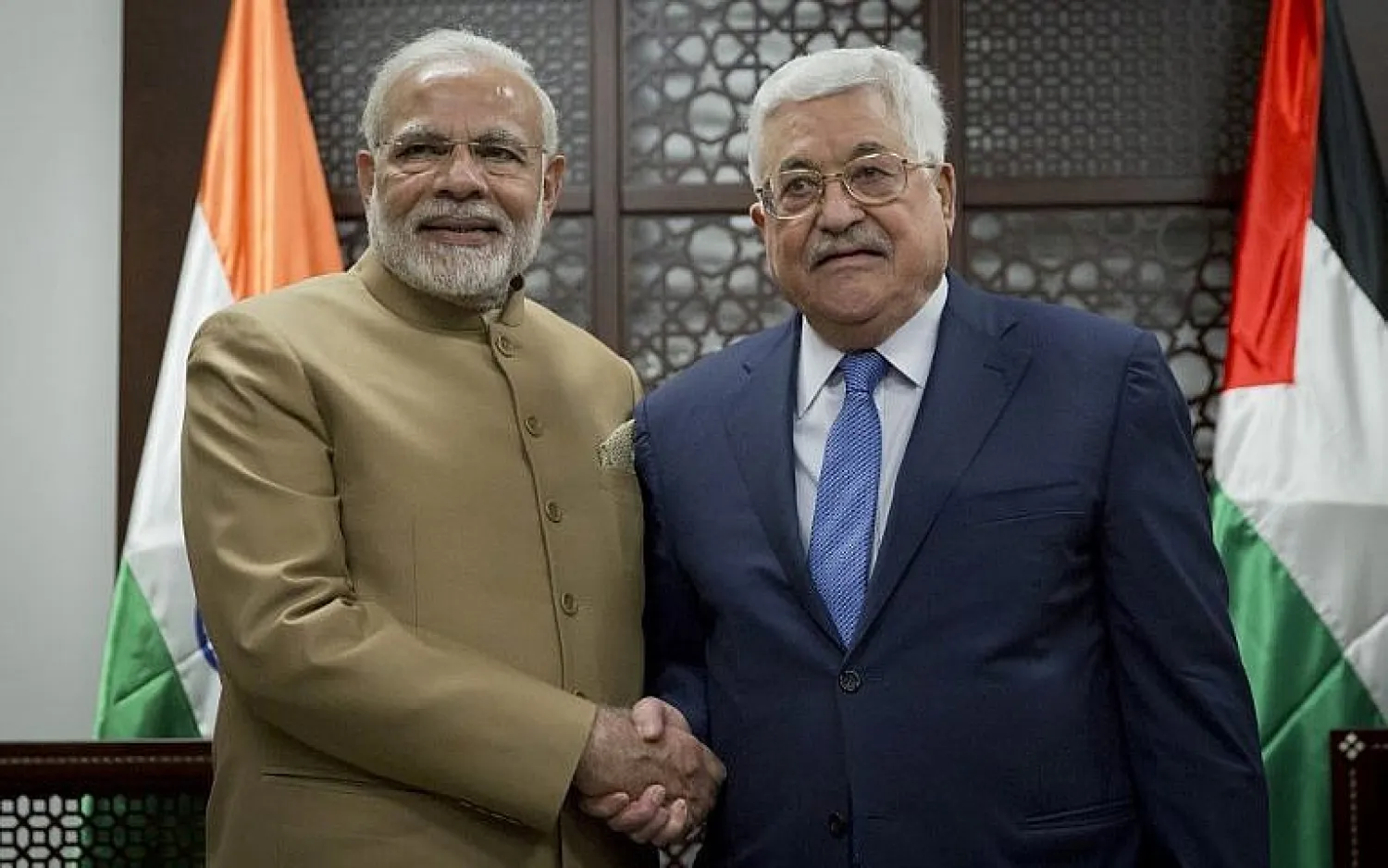
Palestinian Authority President Mahmud Abbas (R) and India's Prime Minister Narendra Modi pose for a picture, during the latter's visit to the West Bank city of Ramallah on February 10, 2018. (AFP Photo/AP/Nasser Nasser)
TT

Palestinian President: We are always Ready for Negotiations

Palestinian Authority President Mahmud Abbas (R) and India's Prime Minister Narendra Modi pose for a picture, during the latter's visit to the West Bank city of Ramallah on February 10, 2018. (AFP Photo/AP/Nasser Nasser)

Palestinians seek a two-state solution “based on the 1967 borders and international resolution" with Jerusalem as a capital for the Palestinian state, Palestinian President Mahmoud Abbas announced during a joint press conference with visiting Indian Prime Minister Narendra Modi.

It was the first visit of an Indian prime minister to Ramallah in 30 years who arrived to Ramallah on a Jordanian army helicopter from Amman, where he was received by his Palestinian counterpart Rami Hamdallah.

Abbas acknowledged India's role in the peace process saying he was counting on India's support for multi-country sponsorship of future Israeli-Palestinian negotiations.

The President said Palestine is always ready to engage in negotiations to achieve its goal of an independent state. He asked India to facilitate the peace process with Israel.

“We rely on India’s role as an international voice of great standing and weigh through its historical role in the Non-Aligned Movement and in all international forum and its increasingly growing power on the strategic and economic levels, in a way that is conducive to just and desired peace in our region,” said President Abbas.

Speaking about the talks between the two leaders, Abbas told the press they discussed "bringing the political process out of the deadlock due to the continued Israeli occupation of our land and the political impasse following Trump's decision on Jerusalem and the refugees."

Modi visited the mausoleum of Yasser Arafat, Modi hailed the late president as “one of the greatest leaders in history.”

He then headed to Arafat Museum and wrote in the guest book saying that Arafat was a “special friend of India and his contribution to Palestine is historical. It was an unforgettable moment for me to visit a museum dedicated to him. I once again pay tribute to Abu Ammar.”

President Abbas conferred the "Grand Collar of the State of Palestine" on Prime Minister Modi, recognizing his key contribution to promote ties between India and Palestine.

Abbas said he had "fruitful and constructive" talks with Prime Minister Modi and he updated the Indian leader on the overall developing situation in Palestine and in the region.

PM Modi assured President Abbas that India is committed to the Palestinian people's interests.

"The support for Palestinian interests in our foreign policy has always been a priority - continuous and steadfast," Modi said.

"Friendship between India and Palestine has stood the test of time. The people of Palestine have shown remarkable courage in the face of several challenges. India will always support Palestine’s development journey," Modi said, adding that India is hopeful of peace and stability in the region.

Both governments of Palestine and India signed, in the presence of Abbas and Modi, six memorandums of understanding (MoUs) worth around $50 million that include setting up of a $30 million super specialty hospital in Beit Sahur.

An MoU was signed for construction of the India-Palestine centre for empowering women called "Turathi" at a cost of $5 million. Another MoU was signed for setting up of a new National Printing Press at Ramallah at a cost of $5 million. Two MoUs were also signed for the construction of two schools at Tamoon village in Tubas governorate and Muthalth al-Shuhada village respectively. A sixth MoU was signed for the construction of an additional floor at Jawahar Lal Nehru School for Boys at Abu Dees.

Modi said that India was proud to help the Palestinians build state institutions and support the government's budget and projects. He also expressed hope that peace in the region would be achieved quickly through dialogue and understanding.

"We hope for peace and stability in Palestine. We believe a permanent solution is possible with dialogue. Only diplomacy and farsightedness can set free from violence and baggage of the past. We know it is not easy but we need to keep trying as a lot is at stake," Modi concluded.



Israeli Settlers Forcibly Enter Palestinian Home and Kill Sheep in Latest West Bank Attack

 This picture shows sheep grazing on a field in Kafr al-Labad with the Israeli settlement of Avnei Hefetz seen in the background, near the city of Tulkarem in the occupied West Bank on December 18, 2025. (AFP)
This picture shows sheep grazing on a field in Kafr al-Labad with the Israeli settlement of Avnei Hefetz seen in the background, near the city of Tulkarem in the occupied West Bank on December 18, 2025. (AFP)
TT

Israeli Settlers Forcibly Enter Palestinian Home and Kill Sheep in Latest West Bank Attack

 This picture shows sheep grazing on a field in Kafr al-Labad with the Israeli settlement of Avnei Hefetz seen in the background, near the city of Tulkarem in the occupied West Bank on December 18, 2025. (AFP)
This picture shows sheep grazing on a field in Kafr al-Labad with the Israeli settlement of Avnei Hefetz seen in the background, near the city of Tulkarem in the occupied West Bank on December 18, 2025. (AFP)

Israeli settlers attacked a Palestinian home in the south of the Israeli-occupied West Bank overnight, breaking in and killing sheep, a Palestinian official said Tuesday. It was the latest in a surge of attacks by settlers against Palestinians in the territory in recent months.

Israeli police said they arrested five settlers.

The settlers killed three sheep and injured four more, smashed a door and a window of the home, and fired tear gas inside, sending three Palestinian children under the age of 4 to the hospital, said Amir Dawood, who directs an office documenting such attacks within a Palestinian governmental body called the Wall and Settlement Resistance Commission.

Police said they arrested the five settlers on suspicion of trespassing onto Palestinian land, damaging property and dispensing pepper spray, not tear gas. They said they are investigating.

CCTV video from the attack in the town of As Samu’, shared by the commission, showed five masked settlers in dark clothing, some with batons, approaching the home and appearing to enter. Sounds of smashing are heard, as well as animal noises. Another video from inside shows masked figures appearing to strike sheep in the stable.

Photos of the aftermath, also shared by the commission, show smashed car windows and a shattered front door. Bloodied sheep lie dead as others stand with blood staining their wool. Inside the home, photos show broken glass and the furniture ransacked.

Dawood said it was the second settler attack on the family in less than two months. He called it “part of a systematic and ongoing pattern of settler violence targeting Palestinian civilians, their property and their means of livelihood, carried out with impunity under the protection of the Israeli occupation.”

During October’s olive harvest, settlers across the territory launched an average of eight attacks daily, the most since the United Nations humanitarian office began collecting data in 2006. The attacks continued in November, with the UN recording at least 136 by Nov. 24.

Israel captured the West Bank, east Jerusalem and Gaza — areas claimed by the Palestinians for a future state — in the 1967 war. It has settled over 500,000 Jews in the West Bank, in addition to over 200,000 in contested east Jerusalem.

Israel’s government is dominated by far-right proponents of the settler movement, including Finance Minister Bezalel Smotrich and Cabinet Minister Itamar Ben-Gvir, who oversees the nation’s police force. Earlier this week, Smotrich said the Israeli cabinet had approved a proposal for 19 new Jewish settlements, another blow to the possibility of a Palestinian state.


Palestinian Authority Says Israel Tightening Control Over West Bank with New Settlements

Israeli bulldozers level land at the evacuated Israeli settlement of Sanur, near the West Bank city of Jenin, 23 December 2025. (EPA)
TT

Palestinian Authority Says Israel Tightening Control Over West Bank with New Settlements

Israeli bulldozers level land at the evacuated Israeli settlement of Sanur, near the West Bank city of Jenin, 23 December 2025. (EPA)

The Palestinian Authority condemned on Tuesday Israel's recent approval of 19 settlements in the occupied West Bank, accusing it of tightening its control over Palestinian land.

On Sunday, Israel's far-right Finance Minister Bezalel Smotrich announced the authorities had greenlit the settlements, saying the move was aimed at preventing the establishment of a Palestinian state.

The Ramallah-based Palestinian foreign ministry decried the approval as a "dangerous step aimed at tightening colonial control over the entirety of Palestinian land", calling it a continuation of "apartheid, settlement, and annexation policies that undermine the inalienable rights of the Palestinian people".

"The decision provides political cover for accelerating the plunder of Palestinian lands, expanding settlement infrastructure... alongside an escalating pace of settler terrorism against members of our people and their properties," it said in a statement.

The latest move brings the total number of settlements approved over the past three years to 69, Smotrich's office said.

Excluding east Jerusalem, which was occupied and annexed by Israel in 1967, more than 500,000 Israelis live in the West Bank, along with about three million Palestinian residents.

Smotrich's office said the 19 newly approved settlements were located in what it described as "highly strategic" areas, adding that two of them -- Ganim and Kadim in the northern West Bank -- would be re-established after being dismantled two decades ago.

Five of the 19 settlements already existed but had not previously been granted legal status under Israeli law, the statement said.

Israel's decision came days after the United Nations said the expansion of Israeli settlements in the West Bank -- all of which are illegal under international law -- had reached its highest level since at least 2017.

US President Donald Trump recently warned that Israel "would lose all of its support from the United States" if it annexed the West Bank.

Israel has occupied the territory since 1967, and violence there has surged following the outbreak of the Gaza war in October 2023 with Hamas's attack on Israel.

Israeli troops or settlers have killed at least 1,028 Palestinians in the West Bank -- both fighters and civilians -- since the start of the fighting in Gaza, according to an AFP tally based on Palestinian health ministry figures.

At least 44 Israelis have been killed in the West Bank in Palestinian attacks or Israeli military operations during the same period, according to Israeli data.


Germany Deports Man to Syria for First Time Since 2011

People attend a protest against reelection of Syria's president Bashar al-Assad, near Syria's embassy, Berlin, Germany May 26, 2021. (Reuters)
TT

Germany Deports Man to Syria for First Time Since 2011

People attend a protest against reelection of Syria's president Bashar al-Assad, near Syria's embassy, Berlin, Germany May 26, 2021. (Reuters)

Germany deported a man to Syria for the first time since the civil war began in that country in 2011, the interior ministry in Berlin announced on Tuesday.

A Syrian immigrant previously convicted of criminal offences in Germany was flown to Damascus and handed over to Syrian authorities on Tuesday morning, the ministry said.