
How this Retailer Started with Pickleball Paddles and Built a $33 Mln Business on Amazon

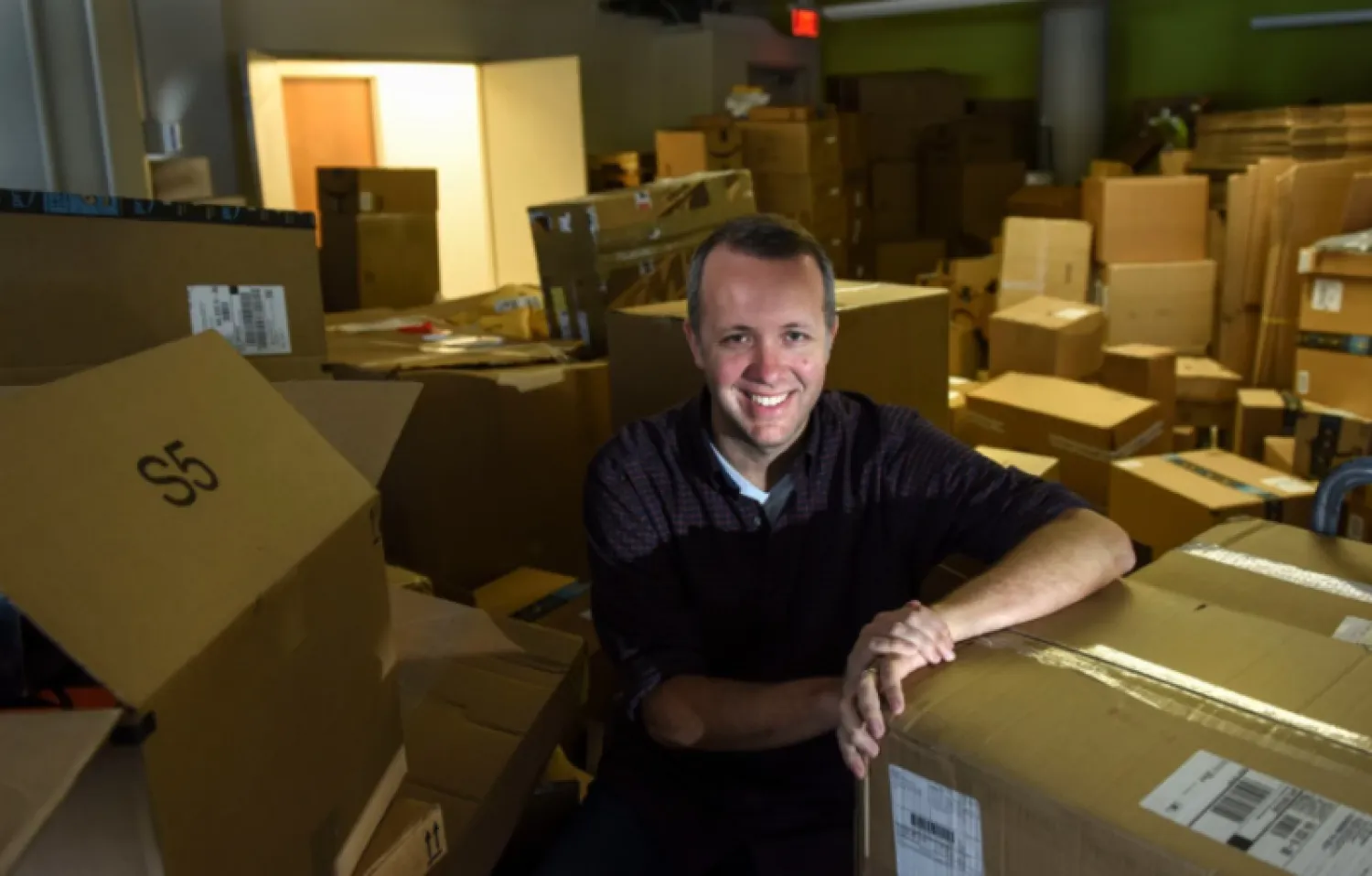
Ethan McAfee, founder and sole owner of Amify, at the company's offices in Alexandria. (Michael Robinson Chavez/The Washington Post)
TT

How this Retailer Started with Pickleball Paddles and Built a $33 Mln Business on Amazon

Ethan McAfee, founder and sole owner of Amify, at the company's offices in Alexandria. (Michael Robinson Chavez/The Washington Post)

Little Alexandria-based Amify is the 21st-century version of the thousands of enterprises that thrived around the railroads 150 years ago. Meatpackers, farmers and mail-order retailer Montgomery Ward are just a few examples of businesses that reached customers through the railroads.

Instead of railroads, Amify has latched on to retail supertanker Amazon.com, which has redefined how people today buy just about everything.

Amazon (founded and chaired by Washington Post owner Jeffrey P. Bezos) just a few days ago became the second-most-valuable company in the world, behind Apple.

Amify is one of about 3 million “third-party sellers” that use the Amazon platform to sell their products, paying a 15 percent commission to Amazon in return. Ethan McAfee, 41, Amify’s founder and sole owner, wants to capi­tal­ize on Amazon’s growing dominance and seize what he believes is a rare opportunity.

“We think there is a land rush going on,” McAfee said. “We have all these tail winds pushing us along. We are trying to grow this baby, hitting the accelerator and taking a long-term vision.”

Amify’s niche amounts to a tiny slice of the Amazon juggernaut. The Seattle-based giant sells an estimated $330 billion in merchandise each year — about two-thirds of which is sold by renters such as Amify.

McAfee expects to generate revenue of $33 million this year on 600,000 orders for Asics shoes, high-end Fender guitars (they expect to sell 8,000 this year), and binoculars and telescopes made by Vortex Optics, to name a few of his 350 sources.

About 90 percent of Amify’s revenue comes from being a third-party seller. The rest comes from Amify’s “value add.” That means coaching clients on how to sell more through better-looking Web pages, buying Amazon advertising and combating counterfeiters.

Amify’s secret sauce is knowing which products to make money on, McAfee said. “The higher price points usually have a higher margin than low price points. It’s harder selling a $15 item,” he said, “but with a $100 item, you can probably do it and make a profit. You can use technology to figure out which ones are the best bets.”

Amify’s biggest costs are the goods it buys and then resells on Amazon and its labor force. The usual profit for a retailer is 3 to 5 percent of gross sales, which would put Amify’s profits in the neighborhood of $1 million this year. McAfee said he is plowing every cent of profit back into the business, adding to its sales team, opening up a second warehouse in Las Vegas to lower shipping costs and hiring technology people to expand its consulting business.

“We tell brands to work with us, and we will help you sell more products, clean up your Amazon channel and maximize it,” McAfee said of the consulting business. “We help increase their selection and give good products at quality prices. They know they need an Amazon strategy.”

The company has been growing fast and is one of the largest in the third-party Amazon market. Most competitors are smaller mom-and-pops, so Amify uses its relative size to create its own technology, which it sells in its consulting practice.

Amify has a payroll of 42 people, 30 full-timers in the United States and 12 outsourced full-timers in the Philippines.

Amify has been profitable since McAfee started the business as Pickleball Direct in 2011 in a rented townhouse in the Court House area of Arlington. Pickleball is a game played with paddles, similar to tennis and badminton but requiring less running, which makes it popular among retired baby boomers.

McAfee graduated from Virginia Tech with a degree in accounting information systems. He was hired at Baltimore-based asset manager T. Rowe Price, where he helped pick stocks for the firm’s $5 billion science and technology fund starting in 1998, which was near the apex of the dot-com era.

“I was the low person on the totem pole,” he said. But he closely followed the start-ups that promoted themselves to T. Rowe as they were going to the public markets. He got a close look at many of the winners and losers from that era. He sat in on meetings with some of the biggest technology names, including former eBay founder Pierre Omidyar and its then-chief executive Meg Whitman and Mark Cuban, who was promoting his start-up Broadcast.com.

“Meg was polished,” he said. “A lot of Internet entrepreneurs, as they are today, were young people wearing hoodies. So a polished person really strikes you as impressive.”

His few years at T. Rowe Price in his early 20s helped him develop an eye for spotting the fake companies from the real thing.

“We were trying to pick what would be the real businesses that would survive the dot-com explosion that we knew was going to happen,” he said. “The good ones would probably go down 70 percent, but the bad ones would go down 100 percent.”

He left T. Rowe in 2001 and joined a hedge fund in Northern Virginia headed by Russ Ramsey, one of the founders of Friedman, Billings & Ramsey, an Arlington-based asset manager.

“It was my job to help figure out what we were going to invest in,” McAfee said. “This was 2001, after the Internet bubble had burst, and the idea was that there were going to be a whole bunch of Internet companies that you could buy for pennies on the dollar. We did pretty good.”

He stayed until 2009, earning enough money to take a year off. He got a master’s at the Paul H. Nitze School of Advanced International Studies at Johns Hopkins University and figured out his next move.

His eye for Internet survivors steered him toward Amazon, which had survived the blow-up, and at a far cheaper price for its stock.

“I saw something, it seems obvious now,” he said. “Amazon was getting bigger and bigger.”

The more he thought about it, the more he realized Amazon was dramatically altering the retail landscape.

“Retailers only would sell things that are really profitable and that would sell a lot,” he said. “Retailers didn’t want to stock your niche products. The Internet changed all that. You could now go to the Internet and buy any product you wanted.”

So, as crazy as it sounds, around 2010, he started selling pickleball paddles.

“My parents played this down in Florida, and they said ‘We can never find the equipment,’ ” McAfee said. “At the same time, I was looking to start selling stuff online.” It was love at first pickleball sight.

McAfee chose pickleball paddles for his test run on selling niche products on the Internet because he could buy them in small batches, instead of thousands at a time.

He ran Pickleball Direct out of a bedroom in his Arlington townhouse. For the next two years, Pickleball Direct expanded into tennis shoes, hockey skates, roller skates and sunglasses.

His homeowners association evicted him after seeing the pallets full of sporting goods dropped at the townhouse driveway. He moved to an Old Town Alexandria storefront in 2013 and began hiring people and turning his project into a real business. Revenue went from $300,000 to $1.2 million to $5 million, $10 million and, last year, $25 million. He made the Inc. 500 list twice.

Last year, McAfee changed the name to Amify, which is a combination of Amazon and amplify. He also moved Amify into larger offices. McAfee’s office is just a pickleball’s whack from the Potomac River.

The Washington Post


Deal to Export Oil from Kurdish Region to Continue with No Issues, Kurdish Rudaw Reports

A staff at an oilfield holds the flag of Kurdistan. (X)
TT

Deal to Export Oil from Kurdish Region to Continue with No Issues, Kurdish Rudaw Reports

A staff at an oilfield holds the flag of Kurdistan. (X)

Kurdistan broadcaster Rudaw quoted the ​vice president of Iraq's state oil company SOMO as saying ‌on Saturday that ‌the ‌oil ⁠export ​deal ‌between Baghdad and Erbil is set to be renewed with ⁠out issues, Reuters reported.

In September, ‌Iraq restarted ‍the ‍export of ‍oil from its Kurdish region to Türkiye after ​an interruption of more ⁠than two years following a deal between Baghdad and the Kurdish regional government.


Musk Wins Appeal that Restores 2018 Tesla Pay Deal Now Worth about $139 Billion

FILE PHOTO: Elon Musk attends the Breakthrough Prize awards in Los Angeles, California, U.S., April 13, 2024. REUTERS/Mario Anzuoni/File Photo
TT

Musk Wins Appeal that Restores 2018 Tesla Pay Deal Now Worth about $139 Billion

FILE PHOTO: Elon Musk attends the Breakthrough Prize awards in Los Angeles, California, U.S., April 13, 2024. REUTERS/Mario Anzuoni/File Photo

Elon Musk's 2018 pay package from Tesla, once worth $56 billion, was restored by the Delaware ​Supreme Court on Friday, nearly two years after a lower court struck down the compensation deal as "unfathomable." The ruling overturns a decision that had prompted a furious backlash from Musk and damaged Delaware's business-friendly reputation. It assures Musk greater control over the company, which he has said is his main concern, even after shareholders recently approved a new pay package that could be worth $878 billion if Tesla meets certain targets, Reuters reported.

The Supreme Court said a 2024 ruling that rescinded the pay package had been improper and inequitable to Musk. The remedy of total rescission "leaves Musk uncompensated for his time and efforts over a period of six years," the 49-page ruling issued on Friday stated.

The 2018 pay package is now worth about $139 billion based on the price of Tesla's stock at the close of trading on Friday. "For ‌Elon, this is ‌a win because he gets control faster," said Gene Munster, managing partner at Tesla ‌investor ⁠Deepwater ​Asset Management.

If Musk ‌exercises all the stock options from the 2018 package, his stake in Tesla would grow from about 12.4% to 18.1% of an expanded share base. The company is issuing shares tied to his new pay package, although he must earn them by hitting performance goals.

Tesla shares were up less than 1% in after-hours trading following the ruling.

Tesla did not immediately respond to a request for comment. Musk posted on X that he was "vindicated." Lawyers who challenged the pay package said in a statement that they were considering their next steps and were "proud to have participated in the historic verdict below, calling to account the Tesla board and its largest stockholder for their breaches of fiduciary duty." The pay package was by ⁠far the largest ever until Tesla shareholders approved the new pay plan in November. If Tesla’s appeal had failed, it could have triggered a $26 billion hit to profit over two ‌years to account for the replacement stock-compensation package it had promised Musk – at ‍today’s much higher stock price.

The 2018 pay deal provided Musk options ‍to acquire about 304 million Tesla shares at a deeply discounted price if the company hit various milestones, which it did. ‍The options represent around 9% of Tesla's outstanding stock. Musk never collected his stock options because soon after shareholders approved the 2018 compensation, the board was sued by Richard Tornetta, an investor with nine Tesla shares.

UNFRIENDLY TO BUSINESS?

In 2024, after a five-day trial, Delaware Judge Kathaleen McCormick concluded that Tesla's directors were conflicted and key facts were hidden from shareholders when they voted to approve the plan. She ordered that the 2018 plan be rescinded.

Musk ​accused Delaware judges of being activists who are hostile to tech founders and he urged businesses to follow Tesla and reincorporate elsewhere. Dropbox, Roblox, Trade Desk and Coinbase were among the handful of large companies that moved ⁠their legal homes to Nevada or Texas. However, Delaware remains by far the most popular legal home for U.S. public companies.

Tesla's board had warned that Musk, the world's richest person who also leads the SpaceX rocket venture and artificial intelligence startup xAI, could leave the electric car company if he did not get the pay he wanted and an increase in his voting power. The Delaware Supreme Court may have been reluctant to annul Musk's pay package because shareholders had overwhelmingly voted in favor of it, said Brian Dunn, director of the Institute for Compensation Studies at Cornell University’s School of Industrial and Labor Relations. "I think that there's some belief that maybe the courts shouldn't get between the shareholders and the decisions that they make," said Dunn. Shareholders approved the new pay package in November and Tesla has taken steps to reduce the risk that a shareholder could tie up the 2025 package in the courts.

The Austin-based company is now incorporated in Texas, which allows Tesla to require that any investor or group of investors must own 3% of the company stock before suing for an alleged corporate law violation. A ‌stake of that size would be worth around $30 billion and Musk is the only individual with that much stock.


Maersk Tests Red Sea Route as Gaza Ceasefire Offers Hope

Containers are seen on the Maersk Triple-E giant container ship Majestic Maersk, one of the world's largest container ships, next to cranes at the APM Terminals in the port of Algeciras, Spain, January 20, 2023. REUTERS/Jon Nazca/File Photo P
TT

Maersk Tests Red Sea Route as Gaza Ceasefire Offers Hope

Containers are seen on the Maersk Triple-E giant container ship Majestic Maersk, one of the world's largest container ships, next to cranes at the APM Terminals in the port of Algeciras, Spain, January 20, 2023. REUTERS/Jon Nazca/File Photo P

Danish shipping company Maersk said that one of its vessels had successfully navigated the Red Sea and Bab el-Mandeb Strait for the first time in nearly two years, as shipping companies weigh returning to the critical Asia-Europe trade corridor.

The company stated that while it had no firm plans to fully reopen the route, it would take a "stepwise approach towards gradually resuming navigation" via the Suez Canal and the Red Sea. Maersk declined to further elaborate on its plans, according to Reuters.

Maersk ‌and rivals, ‌including Germany's Hapag-Lloyd , rerouted vessels around Africa's Cape ‌of ⁠Good ​Hope from December ‌2023 after Houthis attacked ships in the Red Sea in what they said was a show of solidarity with Palestinians in Gaza.

The Suez Canal is the fastest route linking Europe and Asia and until the attacks had accounted for about 10% of global seaborne trade, according to Clarksons Research.

CMA HAS MADE LIMITED PASSAGES THROUGH THE SUEZ CANAL

French shipping firm CMA CGM has already made limited passages through the Suez Canal when ⁠security conditions allowed, with other operators similarly exploring resumption plans. "Most carriers appear to be adopting a wait-and-see approach, monitoring ‌developments, and any meaningful reopening would likely unfold gradually," said ‍Nikos Tagoulis, analyst at Intermodal Group.

The potential ‍return of Maersk to the Suez Canal could ripple through the shipping sector, ‍where freight rates have risen because the alternative route added weeks to transit times between Asia and Europe. A recent ceasefire in the Gaza conflict has renewed hope of normalizing Red Sea traffic, though analysts note the fragility of the truce. "By the end of 2026, we estimate ​things will start to look like they were before the Houthis attack started," said Simon Heaney, a container industry analyst at Drewry Shipping Consultants. "The ⁠risk level has reduced, so they're prepared to test the waters. But the Houthis aren't particularly reliable." Maersk confirmed that one of its smaller vessels, Maersk Sebarok, had completed the first test transit through the Red Sea on Thursday and Friday, while stressing that no additional sailings were currently planned.

"Whilst this is a significant step forward, it does not mean that we are at a point where we are considering a wider East-West network change back to the trans-Suez corridor," it said.

Niels Rasmussen, chief shipping analyst at ship-owner association BIMCO, projected that broader resumption of Suez Canal transits could result in a 10% drop in ship demand.

"The possibility of a return to Suez Canal routings looms large over ‌the market outlook," he said in a note published on Thursday.