


Trump’s Trade Dares Have Vaporized the Dow’s Gains for 2018

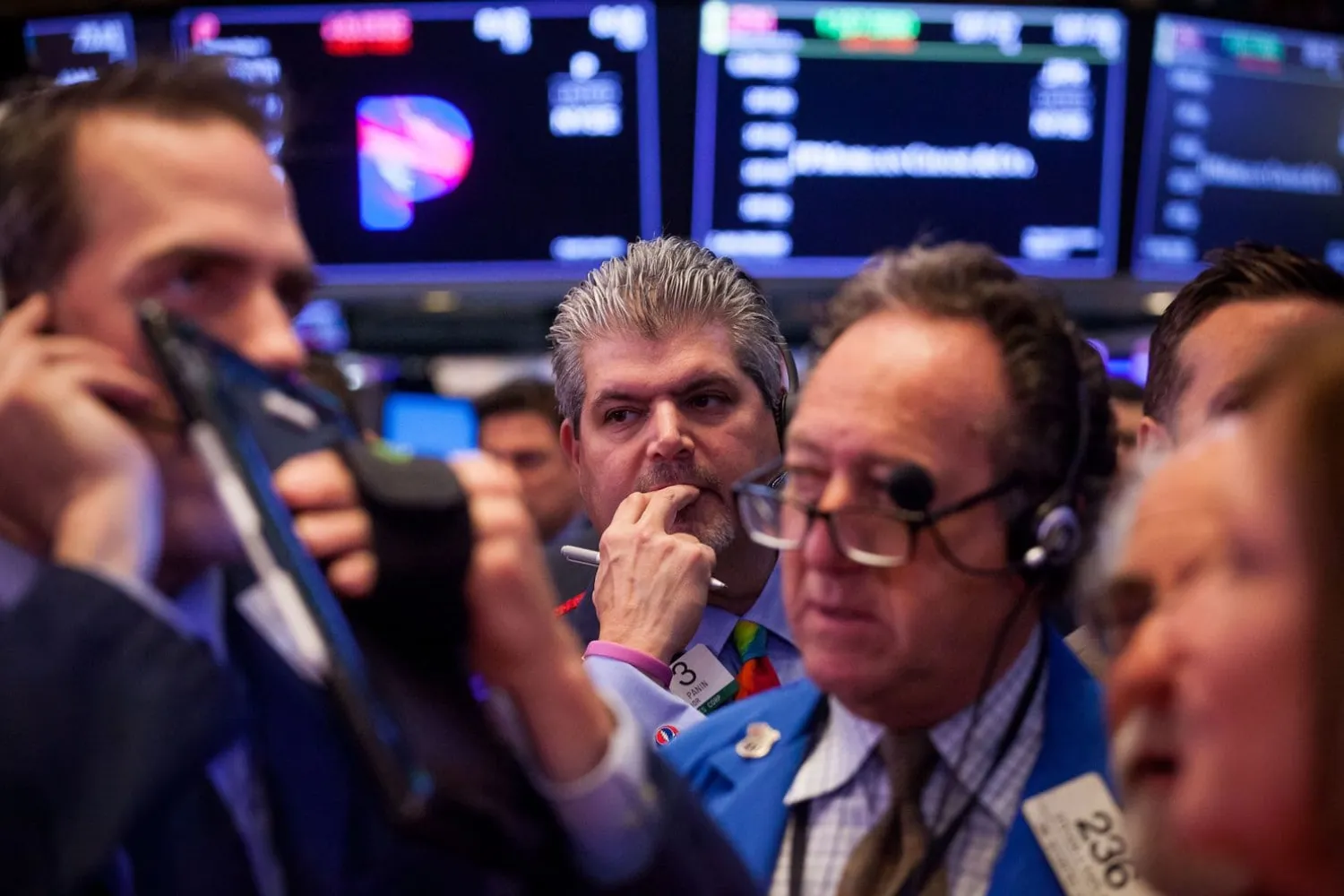
Traders work on the floor of the New York Stock Exchange on June 22. (Michael Nagle/Bloomberg)
TT

Trump’s Trade Dares Have Vaporized the Dow’s Gains for 2018

Traders work on the floor of the New York Stock Exchange on June 22. (Michael Nagle/Bloomberg)

The calm predictability that was the signature of the 2017 stock market has been replaced by the turbulence of the first half of 2018, with investors frazzled by the drum of trade threats between the United States and China.

The once-preening Dow Jones industrial average has erased all of its 2018 gains and is bobbing close to 10 percent correction territory, compared with its Jan. 26 high.

Some would see the pullback as a buying opportunity, especially given that the economy is otherwise robust. The gross domestic product is cresting at $20 trillion any day. What’s an investor to do? Stay the course. Stick to your plan. Look long term.

But the “headline risk” of presidential tweets, White House pronouncements and breathless policy leaks made for a pretty rocky second quarter. If not for the tariff talk, Steve Forbes said on Fox Business “Mornings with Maria” a few days ago, the Dow would probably leap thousands of points.

The major indexes rallied Friday and notched slight gains as the quarter closed. The blue-chip Dow rebounded toward the end of a turbulent week, up 55 points at Friday’s close.

The Standard & Poor’s 500-stock index and tech-heavy Nasdaq composite index were positive in Friday trading, with the Nasdaq finishing up more than 6 percent for the second quarter.

Most market watchers place blame for the bumpiness squarely on President Trump, who ups the ante on tariff threats almost daily.

“It’s all him,” said Ed Yardeni of Yardeni Research. “His tax cuts boosted earnings dramatically. But, on the other hand, his protectionism is a possible threat to the economy.”

Despite relatively blue skies, there’s plenty of other economic threats feeding into investors’ existing anxieties. Layered on top of the trade talk are the price of oil at multiyear highs, a strengthening U.S. dollar, the Federal Reserve foreshadowing interest rate increases, and Europe’s economies slowing.

Even the halo over technology shares was shaky the last week of June, with the Nasdaq working through one of its worst weeks of the quarter. Throw in a national donnybrook expected over an empty Supreme Court seat, as well as a looming midterm election, and you have a nervous “investorate.”

Wednesday’s markets are a case in point. The Dow swung 441 points on mixed messages bouncing out of the White House.

Trump’s trade adviser Peter Navarro told CNBC on Monday that “there’s no plans to impose investment restrictions on any countries that are interfering in any way with our country.” Treasury Secretary Steven Mnuchin followed with a statement that the administration would seek legislative redress through the Committee on Foreign Investment in the United States, instead of more direct methods to curtail theft of vital U.S. technology by rival countries (Pssst. We mean China.)

“If there are mixed messages, again, that’s something that’s unfortunate,” Mnuchin said on CNBC, responding to a question about inconsistencies from co-anchor Andrew Ross Sorkin. The Dow at first responded favorably to Mnuchin’s comments, running 285 points upward.

But by day’s end, the benchmark had given all that up and more, to close 165 points in the red.

“I don’t think anybody knows how serious the president is or isn’t about trade,” said Michael Farr, a Washington investment manager. “I heard someone say, ‘Most people pause when they shoot themselves in the foot. The president wants to reload.’ ”

The S&P 500 is staying above water at about 2 percent year to date as of Friday but was down about 5 percent off the Jan. 26 high. The hardest-hit sectors have been the industrials and materials sectors, which stand to lose the most in a tariff war. Industrials were down 3.6 percent in June and down more than 5.8 percent on the year as of Thursday’s close.

The Chinese are feeling the pain, too. The benchmark Shanghai composite index fell 0.9 percent to 2,786.90 on Thursday, its lowest finish in more than two years.

The president has money in the bank to play with if he wants to keep poking the Chinese on trade. The S&P 500 is up 26.96 percent since his election Nov. 8, 2016. That number grows to 31.18 percent if you include stock dividends.

Analysts say the president cares too much about the stock market to blow it, especially with the crucial midterm elections four months off.

“There is a limit to how far the president may take the trade battle if stocks fall enough,” John Lynch, chief investment strategist for LPL Financial, said in a recent report titled “Trade Tensions Playbook.”

“President Trump has a track record of starting a negotiation from an extreme position and then moving toward compromise. We expect resolution with China on trade, and only minimal economic damage to the U.S. and abroad,” Lynch said.

Howard Silverblatt, a senior index analyst with S&P Dow Jones Indices, suggests market wags stop trying to read the tea leaves and wait for whatever action Trump takes.

“The difference is rhetoric versus what I am actually doing,” Silverblatt said. “Pay no attention to the man behind the curtain,” he said in a nod to “The Wizard of Oz.”

Tariff talk has been brewing for months, but the threats elevated after Trump left the Group of Seven summit in Quebec in early June. He left Canada refusing to sign a joint communique and then followed up by referring to Canadian Prime Minister Justin Trudeau as “very dishonest & weak.”

On June 14, Trump broadened the trade dispute with an announcement that he would impose a 25 percent tariff on $50 billion of Chinese products. China responded in kind, and the market slid lower.

Trump then upped the ante with a $200 billion salvo lobbed toward China, which was followed by retaliatory tariffs from India, a profit warning from a European automaker blaming tariffs, and Trump’s call for a 20 percent tariff on automobile imports from the European Union.

Then came reports that Trump wants to ban Chinese investment in U.S. technology as a way to protect our advances. Yet another report surfaced Friday on Axios that Trump wants to pull out of the World Trade Organization, which could send global trade into a spin. Mnuchin called the report “an exaggeration.”

Investors reacted, even as Trump’s economic team scrambled to calm fears.

“As much as the government wants to tell you we are having a trade dispute, Wall Street is saying we are having a trade war,” Farr said.

The technology sector, whose FAANG — Facebook, Amazon.com, Apple, Netflix, Google-parent Alphabet — stalwarts have carried much of the bull market in recent months, showed its vulnerability, even though it is up more than 500 percent since the bear market low of March 9, 2009. (Amazon CEO Jeffrey P. Bezos owns The Washington Post.)

The chatter during the week was that the turbulence and selling are because of a confluence of factors, including investors taking quarterly profits and typical seasonal weakness as the summer kicks off.

“While President Trump’s continued dialogue on tariffs seem to be leading stocks down, investors shouldn’t be too surprised that markets are experiencing weakness, given seasonal considerations,” said Wayne Wicker, chief investment officer at ICMA Retirement. “This is an election year, which typically provides additional challenges for markets. Historically, the fourth quarter provides a bit of a relief rally, which investors might keep in mind.”

Jamie Cox of Harris Financial Group said markets have been selling off because some companies have been warning that tariffs are going to hurt quarterly earnings, due in July.

“If earnings are going to be less than what people expect them to be, stocks are going to have to re-price,” Cox said.

That means things might get worse before they get better. Whatever happens, expect more volatility.

“If he had just given us the tax cut and watched Fox News until the midterm elections,” Yardeni said, “the market would be a heck of a lot higher today.”

The Washington Post


Deal to Export Oil from Kurdish Region to Continue with No Issues, Kurdish Rudaw Reports

A staff at an oilfield holds the flag of Kurdistan. (X)
TT

Deal to Export Oil from Kurdish Region to Continue with No Issues, Kurdish Rudaw Reports

A staff at an oilfield holds the flag of Kurdistan. (X)

Kurdistan broadcaster Rudaw quoted the ​vice president of Iraq's state oil company SOMO as saying ‌on Saturday that ‌the ‌oil ⁠export ​deal ‌between Baghdad and Erbil is set to be renewed with ⁠out issues, Reuters reported.

In September, ‌Iraq restarted ‍the ‍export of ‍oil from its Kurdish region to Türkiye after ​an interruption of more ⁠than two years following a deal between Baghdad and the Kurdish regional government.


Musk Wins Appeal that Restores 2018 Tesla Pay Deal Now Worth about $139 Billion

FILE PHOTO: Elon Musk attends the Breakthrough Prize awards in Los Angeles, California, U.S., April 13, 2024. REUTERS/Mario Anzuoni/File Photo
TT

Musk Wins Appeal that Restores 2018 Tesla Pay Deal Now Worth about $139 Billion

FILE PHOTO: Elon Musk attends the Breakthrough Prize awards in Los Angeles, California, U.S., April 13, 2024. REUTERS/Mario Anzuoni/File Photo

Elon Musk's 2018 pay package from Tesla, once worth $56 billion, was restored by the Delaware ​Supreme Court on Friday, nearly two years after a lower court struck down the compensation deal as "unfathomable." The ruling overturns a decision that had prompted a furious backlash from Musk and damaged Delaware's business-friendly reputation. It assures Musk greater control over the company, which he has said is his main concern, even after shareholders recently approved a new pay package that could be worth $878 billion if Tesla meets certain targets, Reuters reported.

The Supreme Court said a 2024 ruling that rescinded the pay package had been improper and inequitable to Musk. The remedy of total rescission "leaves Musk uncompensated for his time and efforts over a period of six years," the 49-page ruling issued on Friday stated.

The 2018 pay package is now worth about $139 billion based on the price of Tesla's stock at the close of trading on Friday. "For ‌Elon, this is ‌a win because he gets control faster," said Gene Munster, managing partner at Tesla ‌investor ⁠Deepwater ​Asset Management.

If Musk ‌exercises all the stock options from the 2018 package, his stake in Tesla would grow from about 12.4% to 18.1% of an expanded share base. The company is issuing shares tied to his new pay package, although he must earn them by hitting performance goals.

Tesla shares were up less than 1% in after-hours trading following the ruling.

Tesla did not immediately respond to a request for comment. Musk posted on X that he was "vindicated." Lawyers who challenged the pay package said in a statement that they were considering their next steps and were "proud to have participated in the historic verdict below, calling to account the Tesla board and its largest stockholder for their breaches of fiduciary duty." The pay package was by ⁠far the largest ever until Tesla shareholders approved the new pay plan in November. If Tesla’s appeal had failed, it could have triggered a $26 billion hit to profit over two ‌years to account for the replacement stock-compensation package it had promised Musk – at ‍today’s much higher stock price.

The 2018 pay deal provided Musk options ‍to acquire about 304 million Tesla shares at a deeply discounted price if the company hit various milestones, which it did. ‍The options represent around 9% of Tesla's outstanding stock. Musk never collected his stock options because soon after shareholders approved the 2018 compensation, the board was sued by Richard Tornetta, an investor with nine Tesla shares.

UNFRIENDLY TO BUSINESS?

In 2024, after a five-day trial, Delaware Judge Kathaleen McCormick concluded that Tesla's directors were conflicted and key facts were hidden from shareholders when they voted to approve the plan. She ordered that the 2018 plan be rescinded.

Musk ​accused Delaware judges of being activists who are hostile to tech founders and he urged businesses to follow Tesla and reincorporate elsewhere. Dropbox, Roblox, Trade Desk and Coinbase were among the handful of large companies that moved ⁠their legal homes to Nevada or Texas. However, Delaware remains by far the most popular legal home for U.S. public companies.

Tesla's board had warned that Musk, the world's richest person who also leads the SpaceX rocket venture and artificial intelligence startup xAI, could leave the electric car company if he did not get the pay he wanted and an increase in his voting power. The Delaware Supreme Court may have been reluctant to annul Musk's pay package because shareholders had overwhelmingly voted in favor of it, said Brian Dunn, director of the Institute for Compensation Studies at Cornell University’s School of Industrial and Labor Relations. "I think that there's some belief that maybe the courts shouldn't get between the shareholders and the decisions that they make," said Dunn. Shareholders approved the new pay package in November and Tesla has taken steps to reduce the risk that a shareholder could tie up the 2025 package in the courts.

The Austin-based company is now incorporated in Texas, which allows Tesla to require that any investor or group of investors must own 3% of the company stock before suing for an alleged corporate law violation. A ‌stake of that size would be worth around $30 billion and Musk is the only individual with that much stock.


Maersk Tests Red Sea Route as Gaza Ceasefire Offers Hope

Containers are seen on the Maersk Triple-E giant container ship Majestic Maersk, one of the world's largest container ships, next to cranes at the APM Terminals in the port of Algeciras, Spain, January 20, 2023. REUTERS/Jon Nazca/File Photo P
TT

Maersk Tests Red Sea Route as Gaza Ceasefire Offers Hope

Containers are seen on the Maersk Triple-E giant container ship Majestic Maersk, one of the world's largest container ships, next to cranes at the APM Terminals in the port of Algeciras, Spain, January 20, 2023. REUTERS/Jon Nazca/File Photo P

Danish shipping company Maersk said that one of its vessels had successfully navigated the Red Sea and Bab el-Mandeb Strait for the first time in nearly two years, as shipping companies weigh returning to the critical Asia-Europe trade corridor.

The company stated that while it had no firm plans to fully reopen the route, it would take a "stepwise approach towards gradually resuming navigation" via the Suez Canal and the Red Sea. Maersk declined to further elaborate on its plans, according to Reuters.

Maersk ‌and rivals, ‌including Germany's Hapag-Lloyd , rerouted vessels around Africa's Cape ‌of ⁠Good ​Hope from December ‌2023 after Houthis attacked ships in the Red Sea in what they said was a show of solidarity with Palestinians in Gaza.

The Suez Canal is the fastest route linking Europe and Asia and until the attacks had accounted for about 10% of global seaborne trade, according to Clarksons Research.

CMA HAS MADE LIMITED PASSAGES THROUGH THE SUEZ CANAL

French shipping firm CMA CGM has already made limited passages through the Suez Canal when ⁠security conditions allowed, with other operators similarly exploring resumption plans. "Most carriers appear to be adopting a wait-and-see approach, monitoring ‌developments, and any meaningful reopening would likely unfold gradually," said ‍Nikos Tagoulis, analyst at Intermodal Group.

The potential ‍return of Maersk to the Suez Canal could ripple through the shipping sector, ‍where freight rates have risen because the alternative route added weeks to transit times between Asia and Europe. A recent ceasefire in the Gaza conflict has renewed hope of normalizing Red Sea traffic, though analysts note the fragility of the truce. "By the end of 2026, we estimate ​things will start to look like they were before the Houthis attack started," said Simon Heaney, a container industry analyst at Drewry Shipping Consultants. "The ⁠risk level has reduced, so they're prepared to test the waters. But the Houthis aren't particularly reliable." Maersk confirmed that one of its smaller vessels, Maersk Sebarok, had completed the first test transit through the Red Sea on Thursday and Friday, while stressing that no additional sailings were currently planned.

"Whilst this is a significant step forward, it does not mean that we are at a point where we are considering a wider East-West network change back to the trans-Suez corridor," it said.

Niels Rasmussen, chief shipping analyst at ship-owner association BIMCO, projected that broader resumption of Suez Canal transits could result in a 10% drop in ship demand.

"The possibility of a return to Suez Canal routings looms large over ‌the market outlook," he said in a note published on Thursday.
