

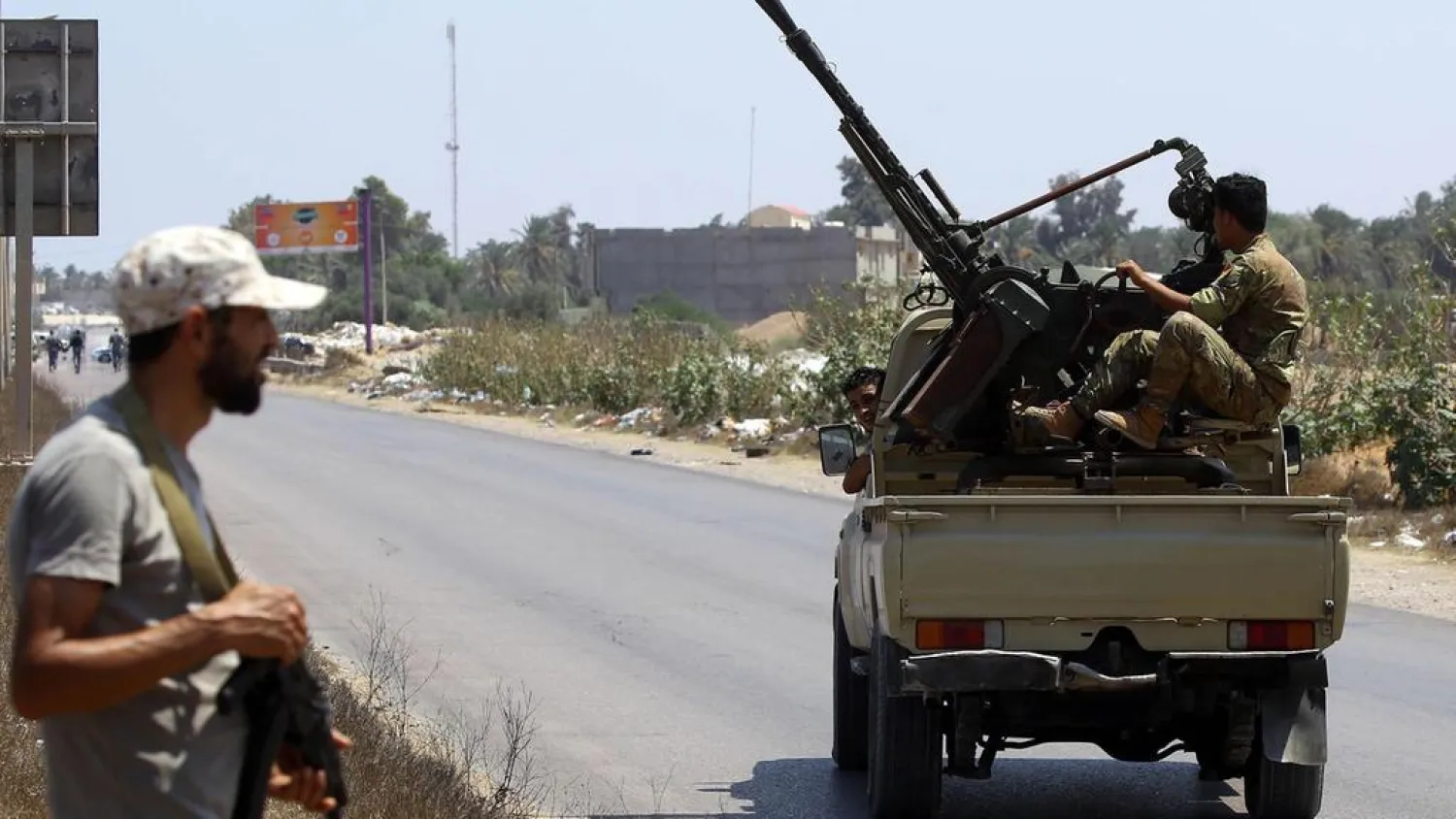

'7th Brigade' Declares ‘Military Coup’ against Militias in Libyan Capital

Security continues to deteriorate in the Libyan capital Tripoli. (AFP)
TT

'7th Brigade' Declares ‘Military Coup’ against Militias in Libyan Capital

Security continues to deteriorate in the Libyan capital Tripoli. (AFP)

Security continued to deteriorate in the Libyan capital Tripoli as clashes between rival militias persisted for a second week.

Spokesman for the Brigade, Abdul Salam Ashour urged in a statement the government and security forces to exercise their duties.

Ashour is interior minister of the Government of National Accord (GNA), which is headed by Fayez al-Sarraj.

The Brigade announced that its forces were advancing steadily on Tripoli.

In what could be interpreted as a military coup, the Brigade “reassured the residents of Tripoli, all sovereign institutions and diplomatic missions that its advance was aimed at protecting these institutions and ridding them of militias.”

The weeks-long fighting in Libya pits the 7th Brigade, which was marching from the city of Tarhuna, against the Tripoli Revolutionaries and “Special Deterrence – Abou Salim” force, both of which are linked to the GNA.

The GNA had labeled the 7th Brigade as an outlawed group.

Sarraj’s deputy, Ahmed Maiteeq had held talks with Ashour to discuss the situation in the capital.

A governments statement said that the minister had presented the measures and decisions taken by his ministry to restore calm in Tripoli.

Presidential Council of the GNA had declared on Sunday a state of emergency in Tripoli in wake of the clashes.

On Monday, authorities blocked Facebook as part of a clampdown on reports about the fighting.

Some reports claimed that the violence had reached the vicinity of the GNA headquarters, forcing Sarraj to flee to the naval base in the capital. A GNA official denied the claims.

Witnesses said that a number of gunmen had attacked the headquarters and clashed with the security guards.

On the political level, the Tubrok-based parliament said that the unrest in Tripoli led to the postponement of a legislative session, set for Monday, that was aimed at amending the Constitutional Declaration. The meeting was postponed to next week.

At least 41 people have been killed and 128 wounded in the Tripoli fighting.

Meanwhile, the Italian foreign ministry announced that it was reducing the number of its diplomatic staff in Libya. Diplomatic sources in Rome said that the embassy in Tripoli will remain functional.

Local diplomats and media reported that Italy had evacuated 18 embassy employees.

Russia, meanwhile, called on rival militias to cease their hostilities and prevent the country from slipping towards chaos.



Israel Army Says Intercepted Two Projectiles Fired from Lebanon

Smoke billows from southern Lebanon following an Israeli strike, as seen from Marjaoun, Lebanon, June 6, 2026. REUTERS/Stringer
TT

Israel Army Says Intercepted Two Projectiles Fired from Lebanon

Smoke billows from southern Lebanon following an Israeli strike, as seen from Marjaoun, Lebanon, June 6, 2026. REUTERS/Stringer

Israel's military said Sunday that it had intercepted two projectiles launched from Lebanon into Israeli territory, despite a new ceasefire agreement announced this week aimed at ending hostilities between Israel and Hezbollah.

"Following the sirens that sounded a short while ago in the areas of Yiftah and Ramot Naftali, two projectiles that crossed from Lebanon into Israeli territory were intercepted," the military reported.

Israel and Lebanon agreed to a new US-brokered ceasefire on Wednesday. However, Hezbollah has rejected the agreement.


Palestinians Suffer from Lack of Proper Toilets Across Gaza’s Vast Tent Cities

Palestinians walk along the street on a hot day at the Nuseirat refugee camp in the central Gaza Strip on June 5, 2026. (AFP)
TT

Palestinians Suffer from Lack of Proper Toilets Across Gaza’s Vast Tent Cities

Palestinians walk along the street on a hot day at the Nuseirat refugee camp in the central Gaza Strip on June 5, 2026. (AFP)

In their bare-bones tent in southern Gaza, Mostafa Shaaban built his family’s makeshift toilet behind a curtain in a corner. He dug a shallow pit in the sandy soil, poured a concrete slab around it, fixed a bottomless bucket over the hole, then topped it off with a battered, plastic toilet seat.

It reeks with a foul odor and buzzes with flies and mosquitoes only a few feet from where they sleep and prepare meals. Every week, Shaaban has to dig the sewage sludge out of the pit. But at least it’s more private than the fetid communal latrines used by hundreds of other people in their sprawling tent camp.

“I did not want the kids and my wife to use any public toilet. It is humiliating,” said the 38-year-old Shaaban, who was driven from his home city of Rafah by Israeli forces two years ago and eventually settled in a tent camp in Khan Younis.

“The situation is revolting,” he said of having the toilet inside the tent, “but at least it has more dignity.”

There is not a single proper toilet across the vast tent cities housing most of Gaza’s 1.7 million Palestinians left homeless by the war. Displaced families have largely been left on their own to dig their own latrines, some shared by extended families.

At communal camp toilets, men, women and children wait in long lines then do their business behind a thin cloth or sheet of metal separating them from the crowd of strangers outside. Women fear walking to the communal toilets at night.

The result is a hygienic nightmare as horrible smells drift among the tightly packed tents and pools of sewage collect from leaking cesspits or from people dumping the contents of their latrines. More than 80% of the sewage pumping stations in Gaza have collapsed under Israel’s bombardment and offensives over the past 2 ½ years, rights groups say.

Some aid groups have carried out projects to improve family toilets, but they have been small scale and supplies are limited. It remains far from certain when reconstruction of Gaza will begin.

The US-backed official overseeing the ceasefire in place since October has blamed Hamas for holding up the process by failing to reach an agreement on disarmament. The ceasefire deal calls for the entry of major construction and repair equipment into Gaza even before disarmament, and so far little has entered.

“It’s the most basic right. Making a toilet is more important than food and water, because you see the insects everywhere, the smell covers everyone,” said Shaaban’s wife, Iman Mansour, who is pregnant with their third child. “We want something clean.”

Building a latrine is not cheap. Shaaban said it took him a long time to set up his toilet because he had to buy the pipe for the latrine hole and the concrete to seal around it. The concrete often crumbles, so he has to buy more when he can afford it.

A porcelain toilet seat runs from 1,700 to 2,000 shekels ($500 to $680), out of reach for most families. In any case, a seat in a tent latrine would simply be set over the hole to provide a more comfortable seat, unable to flush. So people improvise, using chairs or buckets with the bottom knocked out. Or they just squat over the hole.

One vendor working out of a tent in Khan Younis makes metal sheets to fit around a latrine hole that at least are easier to clean, selling them for 100 shekels ($34).

In one of the camps around Khan Younis, Khaled Kollab laboriously cleared the sewage drain and pools of untreated wastewater next to his tent. His tent latrine is a simple squat toilet with no seat, which he said was made of ramshackle supplies because he couldn’t afford anything better. His 3-year-old daughter, Sila, stood nearby, her body covered in lesions.

“You go into this toilet and feel humiliation and shame,” Kollab said.


Iraqi Faction Warns against Dismantling of the PMF

Members of the Saraya al-Salam faction attend a ceremony marking the start of the process of handing over their weapons to Iraqi state forces in Samarra, north of Baghdad, Iraq, Thursday, June 4, 2026. (AP)
TT

Iraqi Faction Warns against Dismantling of the PMF

Members of the Saraya al-Salam faction attend a ceremony marking the start of the process of handing over their weapons to Iraqi state forces in Samarra, north of Baghdad, Iraq, Thursday, June 4, 2026. (AP)

The Iraqi government renewed its commitment to imposing state monopoly over weapons, while some factions continue to resist the move, saying it targets the “arms of the resistance.”

In televised remarks, government spokesman Haider al-Aboudi said: “Prime Minister Ali al-Zaidi's government has set as a priority Iraq’s sovereignty and security and imposing state monopoly over arms.”

“Iraq is a sovereign nation and its higher authority is not subject to foreign and internal dictates,” he stressed, in reference to the debate over armed factions, some of which are affiliated with the Popular Mobilization Forces (PMF) that is tied to the state, and others that operate under the banner of so-called “resistance”.

Deputy Commander of Joint Operations Qais al-Mohammedawi, who is also head of the committee tasked with limiting the possession of arms to the state, said the efforts cover factions connected to the PMF.

He denied claims that the efforts will target other groups, saying the authorities are focused on ending possession of weapons that are tied to religious or political affiliations.

The process will take time, he said in statements to the press.

He also revealed that authorities busted attacks against neighboring countries, declaring that Iraq will not act as a platform for assaults on others. He did not offer more details.

Meanwhile, President Nizar Amedi hailed the factions that chose to hand over their weapons and to cooperate with the authorities over this file.

Speaking at an economic forum in Sulaimaniyah city in the Kurdistan region, he added that efforts are ongoing to reach understandings over the disarmament of factions.

These moves bolster security and stability and will help in building and construction, he added.

“Stability is no longer a domestic target, but a main condition for local, regional and international development,” he stated.

He underlined the need for “practical and productive dialogue” to address challenges and limit mounting dangers.

“Iraq must not allow current challenges to hinder its ambitions for development and prosperity,” Amedi urged.

Resistance

The official stances over disarmament have been repeatedly met with defiance from the Kataib Hezbollah and al-Nujaba movement that are staunchly pro-Iran.

The movement said the efforts “target the weapons of the resistance and PMF.”

Head of its executive council Nazem al-Saeedi said from Najaf city that any serious discussions about the weapons “must be comprehensive and subject to unified standards that are applied to all parties without exception.”

He warned that the current demands about the weapons may later extend to the abilities of the security and military institutions, expressing concern over the “politicization of the PMF and involving it in the political power-sharing system,” which may impact its role and standing.

Head of the al-Nujaba movement Akram al-Kaabi had claimed on Wednesday that disarmament efforts are being “directly driven by Israel” and the US Charge d’Affaires in Iraq.

The Kataib Hezbollah, meanwhile, said it will not lay down its weapons and that tackling this issue will be possible after its goals are met.

Kataib security official Abu al-Mujahid al-Assaf warned of attempts to stoke strife over the disarmament efforts.

On the other side of the divide, Sunni clerics welcomed the government’s drive to impose state monopoly over weapons.

During Friday sermons, they hoped the move would achieve stability, security, peace and coexistence in Iraq.

There can be no security so long as several parties carry weapons, while others do not, they added.