


Can Ole Gunnar Solskjær Find a Solution to the Paul Pogba Puzzle?


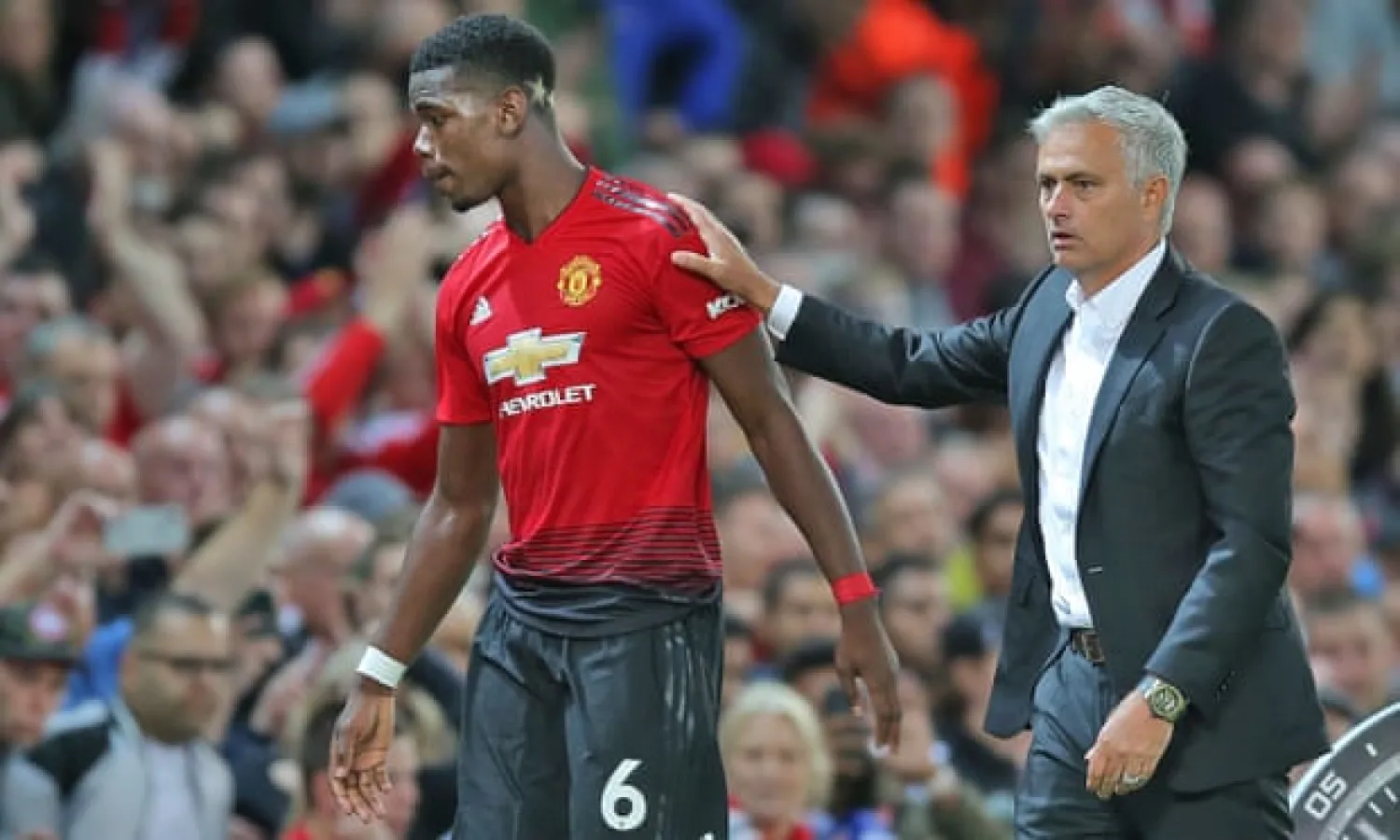
 Paul Pogba (left) sparkled at the World Cup but was sidelined during the latter stages of José Mourinho’s tenure. Photograph: Magi Haroun/Rex/Shutterstock
Paul Pogba (left) sparkled at the World Cup but was sidelined during the latter stages of José Mourinho’s tenure. Photograph: Magi Haroun/Rex/Shutterstock
TT

Can Ole Gunnar Solskjær Find a Solution to the Paul Pogba Puzzle?


 Paul Pogba (left) sparkled at the World Cup but was sidelined during the latter stages of José Mourinho’s tenure. Photograph: Magi Haroun/Rex/Shutterstock
Paul Pogba (left) sparkled at the World Cup but was sidelined during the latter stages of José Mourinho’s tenure. Photograph: Magi Haroun/Rex/Shutterstock

For any manager parachuted in to sort out someone else’s problems the nature of the job is to make the best meal out of the ingredients left in the cupboard. Paul Pogba, given his quality, should be one of the first things any new manager reaches for. The relationship between Manchester United’s marquee midfielder and Ole Gunnar Solskjær may not turn out to be a long one but it can certainly be important.

Wherever you stand on the Pogba-José Mourinho enmity – whether sympathising more with one, the other or neither during a deep frost that did neither of them any favours – there is no disputing that Pogba can be a major force for Manchester United. While Mourinho seemed to get a kick out of undermining him – a weird strategy to motivate an important player – outside this spiky chapter Pogba has been able to express his talent readily for Antonio Conte and Max Allegri at Juventus and for Didier Deschamps with France. Clearly getting more from him than has been on show this season is possible.

When Deschamps was in London recently to pick up an award he mounted a loyal defence of Pogba. “There are a few things people ought to know,” said the coach of the world champions. “First of all there is an image of Paul that doesn’t correspond to who he is. Maybe it is because he is a bit eccentric, a bit demonstrative. He has been with me since 2013 – that is five years now – and the way he functions is not about him for himself, it is him as part of the group. That is really important. His image in the media makes everything quite complicated.”

Pogba seems to crystallise so much about the modern footballer: a huge social media presence, a powerful athlete with his own team and marketing structure, and a personal fanbase that happily follows him from club to club. That is never going to be everybody’s cup of tea, least of all ex-players who did things differently – see Gary Neville this week, who told him to “do one” after an ill-timed message in the aftermath of Mourinho’s sacking.

Darren Fletcher, speaking to the BBC, suggested Pogba needed “a kick up the backside” and urged the midfielder not to interpret recent events as some kind of personal victory. “If Pogba starts thinking that he is bigger than Mourinho, there’s your next problem,” he suggested. “Somebody needs to get hold of him and say: ‘Listen, this hasn’t been a battle between Mourinho and Paul Pogba and you’ve won. You have got to go and prove yourself now.’ A new manager has to come in and demand more of him to lead this team forward.”

Solskjær, who coached Pogba as a young player during his three-year spell as reserve team manager, has been given the task of bringing the feelgood factor back to Old Trafford and the hierarchy will want to see greater evidence of a return on their vast investment in Pogba as part of that. Solskjær might appear to be in a weak position given his temporary status but, if things do not pick up, perhaps it will be perceived as Pogba’s problem rather than Solskjær’s.

The dispute with Mourinho, which left him oddly peripheral for a man of his sporting prowess, will leave after-effects and the best way for Pogba to obliterate them is on the pitch. That gives him something to chew on at the end of a year when he was an outstanding, influential leader during the World Cup but a misfiring cog for Manchester United. The contrast both technically and emotionally has been stark.

It is not uncommon for a player who has been part of a World Cup-winning squad to endure a hangover in the subsequent months. Antoine Griezmann is notably down on his normal scoring ratio in La Liga this season – a couple of goals last weekend bought his total to five in the first four months of the campaign. Hugo Lloris has had his difficulties on and off the pitch and was supported by his club manager during these challenges.

The possibility that Pogba might be undergoing a natural dip has not been part of the narrative but, when the conversation includes Mourinho and an arctic antipathy with a star player, any other theories tend to be sidelined. It was strange to see Pogba return from Russia and find himself under scrutiny, with Mourinho making a show of declaring him unsuitable to captain United again.

Then came the moment the hostility was laid bare in a filmed exchange one morning at Carrington one morning in September when the player jogged over to shake hands with the staff and looked disgusted by his manager’s choice of greeting. It has been obvious they could not reasonably coexist at the same club in the long term.

During the World Cup Pogba felt compelled to describe himself as “the most criticised player in the world” but he went on to explain how he tries to brush off such stuff as risible. “I treat the criticism like I did when I was playing on the block as a kid,” he said. “I never listen to it. I’m having fun and that’s the only answer I can give to all those people who criticise me or who think I am this or that. Everybody has opinions.”

They certainly do. For the moment Solskjær’s opinion of Pogba should be the one that matters.

The Guardian Sport


Shakhtar Boss Pays Ukrainian Racer $200,000 After Games Disqualification

Ukrainian President Volodymyr Zelenskiy holds helmet as he meets with a Ukrainian skeleton racer Vladyslav Heraskevych , who was disqualified from the Olympic skeleton competition over his "helmet of remembrance" depicting athletes killed since Russia's invasion and his father and coach, Mykhailo Heraskevych, amid Russia's attack on Ukraine, in Munich, Germany February 13, 2026. (Ukrainian Presidential Press Service/Handout via Reuters)
TT

Shakhtar Boss Pays Ukrainian Racer $200,000 After Games Disqualification

Ukrainian President Volodymyr Zelenskiy holds helmet as he meets with a Ukrainian skeleton racer Vladyslav Heraskevych , who was disqualified from the Olympic skeleton competition over his "helmet of remembrance" depicting athletes killed since Russia's invasion and his father and coach, Mykhailo Heraskevych, amid Russia's attack on Ukraine, in Munich, Germany February 13, 2026. (Ukrainian Presidential Press Service/Handout via Reuters)

The owner of ‌Ukrainian football club Shakhtar Donetsk has donated more than $200,000 to skeleton racer Vladyslav Heraskevych after the athlete was disqualified from the Milano Cortina Winter Games before competing over the use of a helmet depicting Ukrainian athletes killed in the war with Russia, the club said on Tuesday.

The 27-year-old Heraskevych was disqualified last week when the International Bobsleigh and Skeleton Federation jury ruled that imagery on the helmet — depicting athletes killed since Russia invaded Ukraine in 2022 — breached rules on athletes' expression at ‌the Games.

He ‌then lost an appeal at the Court ‌of ⁠Arbitration for Sport hours ⁠before the final two runs of his competition, having missed the first two runs due to his disqualification.

Heraskevych had been allowed to train with the helmet that displayed the faces of 24 dead Ukrainian athletes for several days in Cortina d'Ampezzo where the sliding center is, but the International Olympic Committee then ⁠warned him a day before his competition ‌started that he could not wear ‌it there.

“Vlad Heraskevych was denied the opportunity to compete for victory ‌at the Olympic Games, yet he returns to Ukraine a ‌true winner," Shakhtar President Rinat Akhmetov said in a club statement.

"The respect and pride he has earned among Ukrainians through his actions are the highest reward. At the same time, I want him to ‌have enough energy and resources to continue his sporting career, as well as to fight ⁠for truth, freedom ⁠and the remembrance of those who gave their lives for Ukraine," he said.

The amount is equal to the prize money Ukraine pays athletes who win a gold medal at the Games.

The case dominated headlines early on at the Olympics, with IOC President Kirsty Coventry meeting Heraskevych on Thursday morning at the sliding venue in a failed last-minute attempt to broker a compromise.

The IOC suggested he wear a black armband and display the helmet before and after the race, but said using it in competition breached rules on keeping politics off fields of play. Heraskevych also earned praise from Ukraine President Volodymyr Zelenskiy.


Speed Skating-Italy Clinch Shock Men’s Team Pursuit Gold, Canada Successfully Defend Women’s Title

 Team Italy with Davide Ghiotto, Andrea Giovannini, Michele Malfatti, celebrate winning the gold medal on the podium of the men's team pursuit speed skating race at the 2026 Winter Olympics, in Milan, Italy, Tuesday, Feb. 17, 2026. (AP)
Team Italy with Davide Ghiotto, Andrea Giovannini, Michele Malfatti, celebrate winning the gold medal on the podium of the men's team pursuit speed skating race at the 2026 Winter Olympics, in Milan, Italy, Tuesday, Feb. 17, 2026. (AP)
TT

Speed Skating-Italy Clinch Shock Men’s Team Pursuit Gold, Canada Successfully Defend Women’s Title

 Team Italy with Davide Ghiotto, Andrea Giovannini, Michele Malfatti, celebrate winning the gold medal on the podium of the men's team pursuit speed skating race at the 2026 Winter Olympics, in Milan, Italy, Tuesday, Feb. 17, 2026. (AP)
Team Italy with Davide Ghiotto, Andrea Giovannini, Michele Malfatti, celebrate winning the gold medal on the podium of the men's team pursuit speed skating race at the 2026 Winter Olympics, in Milan, Italy, Tuesday, Feb. 17, 2026. (AP)

An inspired Italy delighted the home crowd with a stunning victory in the Olympic men's team pursuit final as

Canada's Ivanie Blondin, Valerie Maltais and Isabelle Weidemann delivered another seamless performance to beat the Netherlands in the women's event and retain their title ‌on Tuesday.

Italy's ‌men upset the US who ‌arrived ⁠at the Games ⁠as world champions and gold medal favorites.

Spurred on by double Olympic champion Francesca Lollobrigida, the Italian team of Davide Ghiotto, Andrea Giovannini and Michele Malfatti electrified a frenzied arena as they stormed ⁠to a time of three ‌minutes 39.20 seconds - ‌a commanding 4.51 seconds clear of the ‌Americans with China taking bronze.

The roar inside ‌the venue as Italy powered home was thunderous as the crowd rose to their feet, cheering the host nation to one ‌of their most special golds of a highly successful Games.

Canada's women ⁠crossed ⁠the line 0.96 seconds ahead of the Netherlands, stopping the clock at two minutes 55.81 seconds, and

Japan rounded out the women's podium by beating the US in the Final B.

It was only Canada's third gold medal of the Games, following Mikael Kingsbury's win in men's dual moguls and Megan Oldham's victory in women's freeski big air.


Lindsey Vonn Back in US Following Crash in Olympic Downhill 

Milano Cortina 2026 Olympics - Alpine Skiing - Women's Downhill 3rd Official Training - Tofane Alpine Skiing Centre, Belluno, Italy - February 07, 2026. Lindsey Vonn of United States in action during training. (Reuters)
TT

Lindsey Vonn Back in US Following Crash in Olympic Downhill 

Milano Cortina 2026 Olympics - Alpine Skiing - Women's Downhill 3rd Official Training - Tofane Alpine Skiing Centre, Belluno, Italy - February 07, 2026. Lindsey Vonn of United States in action during training. (Reuters)

Lindsey Vonn is back home in the US following a week of treatment at a hospital in Italy after breaking her left leg in the Olympic downhill at the Milan Cortina Games.

“Haven’t stood on my feet in over a week... been in a hospital bed immobile since my race. And although I’m not yet able to stand, being back on home soil feels amazing,” Vonn posted on X with an American flag emoji. “Huge thank you to everyone in Italy for taking good care of me.”

The 41-year-old Vonn suffered a complex tibia fracture that has already been operated on multiple times following her Feb. 8 crash. She has said she'll need more surgery in the US.

Nine days before her fall in Cortina d'Ampezzo, Italy, Vonn ruptured the ACL in her left knee in another crash in Switzerland.

Even before then, all eyes had been on her as the feel-good story heading into the Olympics for her comeback after nearly six years of retirement.
