

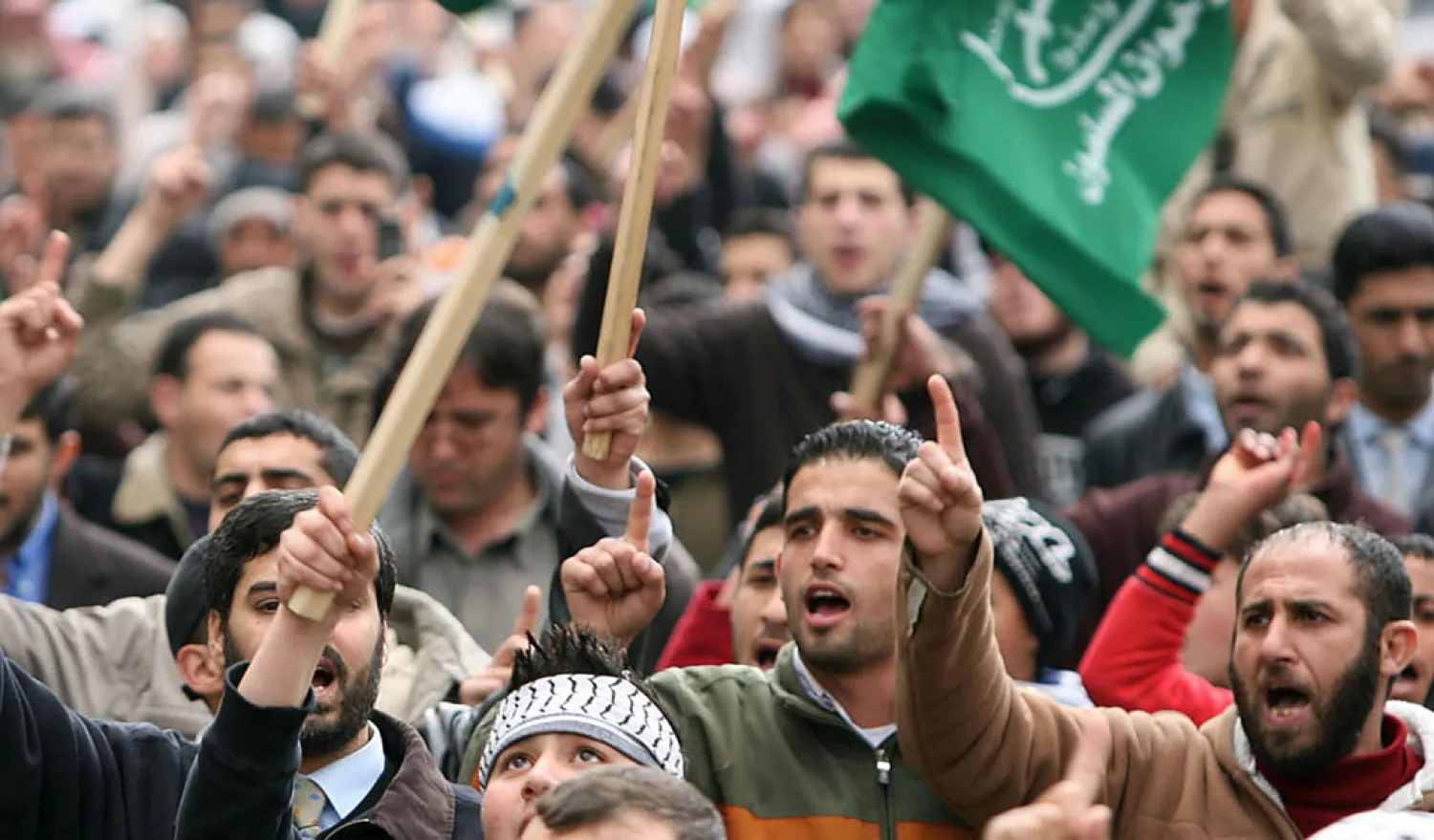

Muslim Brotherhood in Germany: Greater Danger than ISIS, Qaeda

Muslim Brotherhood supporters in Jordan. (AFP)
TT

Muslim Brotherhood in Germany: Greater Danger than ISIS, Qaeda

Muslim Brotherhood supporters in Jordan. (AFP)

Observers and analysts have expressed concern over the Muslim Brotherhood’s growing influence in Germany, which has started to knock on the doors of the country’s democratic system. The city of Cologne in the North Rhine-Westphalia region has for years acted as the group’s headquarters in Germany. The Brotherhood has, however, been expanding to other cities in recent years, pushing the Office for the Protection of the Constitution, or internal intelligence, to warn that the extremist group was now a greater danger to Germany than ISIS and al-Qaeda.

Terrorism affairs expert, journalist Axel Spilcker recently wrote of the Brotherhood’s threat in the Kölner Stadt-Anzeiger and FOCUS Online. He said that security agencies in North Rhine-Westphalia have noted how the Brotherhood’s mosques and organizations have grown in popularity.

Growing influence
According to German internal intelligence, the Cologne-based Islamic Community of Germany has transformed into the Brotherhood’s main headquarters in the country. Spilcker said that the intelligence services have voiced their concern that the group was “infiltrating the democratic system with its efforts to create a social and political order based on Islamic Sharia law.”

He quoted Burkhard Freier, head of the Office for the Protection of the Constitution in the German state of North Rhine-Westphalia, as saying that the Islamic Community of Germany, and organizations that are working with it, are ultimately seeking to establish a state based on Sharia law. This mission also includes Germany.

He, therefore, estimated that the Brotherhood’s threat to Germany on the medium-term was greater than other extremist groups, such as ISIS and al-Qaeda.

Intelligence agencies have noted how groups affiliated with the Brotherhood are increasingly attracting Arab refugees in Germany in order to exploit them for their interests, added Freier. He attributed this to the Brotherhood members’ high education and their funding from some Arab Gulf powers. The Brotherhood’s institutions offer comprehensive education and training for people of all ages.

Lectures and seminars
Spilcker explained that the Brotherhood education institutions and others it cooperates with focus on the youth in particular. They can reach tens of thousands of Muslims through lectures and seminars that present a radical interpretation of the Quran, he warned.

The Brotherhood boasts some 1,000 members in Germany and their numbers are growing. According to the Islamic Community of Germany, the group boasts 50 affiliated organizations. North Rhine-Westphalia intelligence estimates that 14 mosques in the region are linked to the group and 109 places of worship that promote extremist Brotherhood ideology are spread throughout the Rhine region. Spilcker noted some extremist mosques in Bonn and Cologne.

The Abu Bakr mosque in Cologne, he said, used to be frequented by a German extremist who had initially joined the extremist left. He was imprisoned for 13 years for carrying out terrorist operations. He converted to Islam while in jail and after his release, he became a frequent visitor of the Abu Bakr mosque. He often used his personal website to launch attacks against the German judiciary and police. He also showed pro-Qaeda sentiments and he is today active in advocating the causes of detainees held on charges related to extremism.

The Brotherhood in Germany denies that it supports violence, but German intelligence countered the argument, saying the group aimed to promote negative perceptions of western values. Most alarming, said Spilcker, is the group’s success in influencing the central Muslim council of Germany. He added that the Brotherhood is attempting to portray itself as moderate, but behind closed doors, its leaders speak of forming an Islamic state.

Network of relations
The Islamic Community of Germany denied its ties with the Brotherhood, but Spilcker said that head of the organization, Khaled Sweid has expressed on his Twitter account his sympathy with groups that call for boycotting Israel. He has also posted on his Facebook page the four fingers sign that has become associated to the Brotherhood.

Germany’s ARD television had reported former Brotherhood chief Mohammed Mahdi Akef as describing the former head of the Islamic Community of Germany, Ibrahim al-Zayat as the leader of the Brotherhood in Germany. Zayat denied the claim.

Zayat had headed the organization between 2002 and 2010. In 2008, he was sentenced in absentia by Egypt to ten years in jail. He was referred to military court by former President Hosni Mubarak in 2006 alongside a number of other Brotherhood leaderships. Ousted President Mohammed Morsi, of the Muslim Brotherhood, had issued a pardon for Zayat and others in 2012.

The Islamic Community of Germany was formed in 1958 and it is one of the oldest Islamic organizations in the country. It enjoys a vast network of ties with other organizations throughout Germany. It currently boasts the greatest number of Brotherhood followers in Germany. It is based in Cologne and funds itself through membership fees and donations collected at mosques.

The Brotherhood, say North Rhine-Westphalia intelligence, was formed in Egypt by Hassan al-Banna. The group seeks to replace governments in countries where it is active with systems based on Sharia law. It seeks to achieve its goals through “culturally” infiltrating countries, “sometimes through force if necessary.” The intelligence service also notes how the Brotherhood attempted a coup in Syria in 1982 and one in Algeria in the 1990s.

Platforms of incitement
FOCUS Online had published an interview Spilcker had conducted with Islamic affairs researcher Susanne Schröterin in which she warned of underestimating the Brotherhood in Germany. She said that the leaders of the group “often publicly shun violence, but they enjoy secret ties with figures that advocate it.”

In addition, German internal intelligence said that the Brotherhood is represented in various other organizations in Germany that in turn are integrated in an international network. These ties are aimed at ideologically influencing Muslims who live in Germany. Furthermore, it said that Brotherhood followers rarely appear openly and the group’s centers are used as platforms for political incitement.

In 2017, the internal intelligence service in the eastern Saxony state warned of the expansion of the Brotherhood. It warned that the group was trying to exploit new refugees in Germany to increase the number of its members in order to form a Sharia-based state. Moreover, it said that the group was buying property and buildings to expand its presence and construct mosques.

“This has nothing to do with jihad and terrorism, but the Brotherhood wants to impose Sharia law in Germany,” said head of Saxony intelligence ‎Gordian Meyer-Plath.


Trump Wants More Economic Pressure on Iran. What Are his Options?

US President Donald Trump arrives to deliver remarks at the Nassau County Police Academy Center for Training and Intelligence in Garden City, New York, on August 14, 2026. (Photo by Kent NISHIMURA / AFP)
TT

Trump Wants More Economic Pressure on Iran. What Are his Options?

US President Donald Trump arrives to deliver remarks at the Nassau County Police Academy Center for Training and Intelligence in Garden City, New York, on August 14, 2026. (Photo by Kent NISHIMURA / AFP)

US President Donald Trump on Friday vowed to hit Iran hard economically, a day after Treasury Secretary Scott Bessent said that Washington would impose measures on Tehran that have "never been seen" as soon as next week.

The United States, United Nations and European Union have applied sanctions, implemented trade embargoes and frozen assets since the late 1970s over Iran's nuclear program, human rights violations and support for militant groups.

Since the Iran war began in February, Washington has levied additional maritime, energy and financial sanctions and started a naval blockade.

Data from the US Treasury Department's Office of Foreign Assets Control (OFAC) shows the agency has imposed sanctions on more than 1,000 people, vessels and aircraft since Trump began his second term.

Recent measures have targeted Iran's shadow oil fleet; shipping insurers; entities and people enabling Iran's acquisition of weapons; and digital exchanges, freezing an estimated $500 billion in Iran-linked cryptocurrency.

According to Reuters, experts say the Trump administration also can try these options:

SANCTIONS ON CHINESE 'TEAPOT' REFINERS

Chinese independent refineries known as "teapots" account for a quarter of Chinese refinery capacity. They operate with narrow and sometimes negative profit margins.

China buys more than 80% of Iran's shipped oil, according to 2025 data from analytics firm Kpler. Independent refiners absorb much of this trade, exposing them to so-called secondary measures that penalize entities helping a primary sanctions target.

Past ⁠US sanctions have ⁠deterred larger independent refiners from buying Iranian oil. But the independent refineries are somewhat immune since they have little exposure to the US financial system, sanctions experts say.

SANCTIONS ON CHINESE BANKS

OFAC has imposed secondary sanctions on smaller China- and Hong Kong-based entities accused of processing billions of dollars in Iranian oil and helping to fund weapons procurement.

Treasury has warned two larger Chinese banks they could face secondary sanctions if Iranian funds were found moving through their systems, but has stopped short of designating them.

Hitting those two banks, which US officials have not publicly identified, or imposing other sanctions could have a chilling effect on bigger financial institutions, sanctions experts said, although they warned it could ⁠also trigger retaliatory actions by Beijing.

Trump administration officials have sought to play down tensions between Washington and Beijing ahead of an expected meeting between Trump and President Xi Jinping later this year.

They worry that China could curtail exports of critical minerals that are essential to advanced technology production at a time when the US and Western allies are still trying to develop their own supplies.

'WHACK-A-MOLE'

The United States could continue targeting Iranian individuals and entities, as well as others in China and the Gulf, that are helping Tehran evade sanctions to collect revenues for its war effort.

Treasury recently issued sanctions against firms that are springing up to facilitate Iran's trading of oil revenue for imports. But such measures amount to a "whack-a-mole" approach that has not altered Iran's behavior, said Brett Erickson, managing principal of Obsidian Risk Advisors, noting that Tehran simply creates new entities to replace them.

Miad Maleki, a sanctions expert with the Foundation for Defense of Democracies, said Bessent was likely signaling a sharpened enforcement push against oil shippers, purchasers and currency exchangers who help Iran pay for ⁠its imports.

Further aviation sanctions were ⁠also possible, aimed at degrading Iran's ability to move trade now that the US has blockaded shipping via the Strait of Hormuz, he added.

LAND BLOCKADE

Some US and Israeli officials have floated the prospect of a land blockade, which would require assistance from Iran's neighbors: Iraq, Türkiye, Pakistan, Afghanistan, Turkmenistan, Azerbaijan and Armenia.

The Trump administration has varying degrees of closeness with all those countries except Afghanistan, but that border is mountainous and extremely difficult to patrol anyway.

SECONDARY TARIFFS

Trump has repeatedly threatened tariffs on goods from countries that do business with Iran, although the Supreme Court struck down the legal basis for such taxes.

The Senate passed a sweeping Russia sanctions bill last week that included new Iran sanctions and would give Trump new tariff powers that he could potentially use against countries that aid Iran's commerce and weapons procurement. That legislation must still pass the US House of Representatives, which could prove challenging given widespread concerns among Democrats and some Republicans about the tariff measures.


The Ukrainian Social Media Channels Tracking Russian Missiles

Ukrainians use Telegram channels to track incoming Russian missiles and drones. Tetiana DZHAFAROVA / AFP
TT

The Ukrainian Social Media Channels Tracking Russian Missiles

Ukrainians use Telegram channels to track incoming Russian missiles and drones. Tetiana DZHAFAROVA / AFP

The chances of a missile attack on Kyiv that night were around 50 percent, according to the administrator of a social media channel monitoring Russian air raids.

His channel, Aeris Rimor -- roughly derived from the Latin for Searcher of the Skies -- is one of dozens sending real-time messages about incoming drones and missiles.

Ukrainians consult them to track potential Russian attacks, like people check weather applications for storms but with less certainty, shorter warning, and deadly stakes.

During one recent overnight attack, AFP journalists were granted rare access to shadow "Esko", the channel's administrator, on condition that his identity and some details of the operation remained undisclosed.

The 19-year-old, sporting a budding beard, usually operates from home, filling lulls by watching the TV show Criminal Minds or honing his drone-flying skills on a simulator.

Twenty-six minutes after midnight, the air raid alert rang, soon followed by a red dot glitching across the map on a screen in front of him.

"Oh, a missile on Kyiv," he said.

Switching to Telegram, he sent a message to 150,000 followers: "KYIV TARGET!"

"It's going to hit Kyiv in about a minute," he said.

He then sent out the names of the districts being targeted, quietly lamenting a few typos.

Seconds later, explosions echoed over the capital.

The red dot disappeared from the map, only for another to pop up shorty after.

"You have to literally stay on duty and stare at the screen the whole time, because you can easily miss it," said Esko, who did not appear to struggle, even late into the night.

Esko was looking at a live map used by Ukraine's air defense units.

Red icons -- depicting Russian drones -- were dotted across the map and disappeared as they were downed by Ukraine's air force.

- Bedtime dilemma -

The channels are tolerated by authorities but operate in a legal grey area as they use information from air force contacts.

Esko would not reveal publicly how he accessed the map.

In its nightly attacks, Moscow increasingly fires ballistic missiles, flying up to thousands of kilometers (miles) per hour and reaching Kyiv within three minutes of an air raid warning.

This poses a haunting dilemma for those in the capital.

Either go to a shelter -- the metro or a basement -- in advance, accepting a disrupted and uncomfortable night of half-sleep.

Or stay home and face the risk of a hit, particularly dangerous for those in high-rise buildings in heavily targeted districts.

Sometimes authorities warn hours before a likely attack.

Telegram channels -- sifting through intelligence data -- close the information gap, putting out daily forecasts on the probability of different types of attacks.

Esko said people often reach out asking for advice.

"You can only say: something might happen... but decide for yourselves."

On a recent night in Kyiv when there were mixed signals about a Russian strike, Kateryna Reshetnyk had gone down to the subway.

She based her decision on "a parallel analysis of several channels that have been posting truthful information for a long time."

She had set up folding chair next to the turnstiles with her mother and grandmother -- their beds for the next hours.

"But no one knows for sure what will happen or not. You just rely on your intuition and survival instinct," the 34-year-old said.

- 'Tension rising' -

Hundreds of others, armed with mats, tents and pillows, had done the same.

Dogs snored next to their owners, who were glued to their phones, screens lighting up weary faces.

"We track what's happening and where, because our relatives, friends and colleagues are all over Kyiv and the region, so at least we understand what is happening and where," Reshetnyk said.

The night passed without a major strike.

Ukraine's air force grudgingly tolerates the monitoring channels.

"We can't ban them. They exist, they inform the public, for some people that's convenient," spokesman Yuri Ignat told AFP.

But he warned those running them not to post "excess information ... that the enemy can use against us."

With people making potentially life-or-death decisions based on his posts, Esko said he felt the weight of responsibility.

Much of his life now is spent at the screen, tracking hundreds of drones on only a few hours sleep.

But he prefers busy nights, rather than uneasy periods of calm when Russia is stockpiling for future attacks.

"You keep waiting, waiting, waiting, and then you start posting warnings because the tension is rising. And still, nothing happens. You post again, and nothing happens..."

"And then they hit."


US Pulls Last Aircraft Carrier in Asia as Trump Focuses on Iran and the Western Hemisphere

This handout picture released by the US Navy on May 8, 2019 shows the Nimitz-class aircraft carrier USS Abraham Lincoln (CVN 72) while conducting a replenishment-at-sea with the fast combat support ship USNS Arctic (T-AOE 9), while MH-60S Sea Hawk helicopters assigned to the "Nightdippers" of Helicopter Maritime Strike Squadron (HSM) 5, transfer stores between the ships. (Jason WAITE / Navy Office of Information / AFP)
TT

US Pulls Last Aircraft Carrier in Asia as Trump Focuses on Iran and the Western Hemisphere

This handout picture released by the US Navy on May 8, 2019 shows the Nimitz-class aircraft carrier USS Abraham Lincoln (CVN 72) while conducting a replenishment-at-sea with the fast combat support ship USNS Arctic (T-AOE 9), while MH-60S Sea Hawk helicopters assigned to the "Nightdippers" of Helicopter Maritime Strike Squadron (HSM) 5, transfer stores between the ships. (Jason WAITE / Navy Office of Information / AFP)

President Donald Trump's war against Iran is stretching the limits of US aircraft carriers and leaving the western Pacific without one of the key American warships as China shows more signs of aggression.

The USS George Washington is departing the Pacific and expected to replace the USS Abraham Lincoln in the Middle East amid growing concerns about mental health and supply issues aboard the long-deployed carrier. The Lincoln has had its time at sea extended from its original May return date to support operations against Iran.

The lack of a US carrier in the Pacific may be short-lived if the Navy deploys another in the next couple of months. But it shows how the open-ended operations with Iran are running some American sailors ragged, analysts say, while the Trump administration further retreats from the Asia-Pacific region and focuses on the Western Hemisphere.

“The administration says that the Pacific is supposed to be the most important behind the Western Hemisphere,” said Greg Poling, director of the Southeast Asia Program at the Center for Strategic and International Studies. Instead, the US is "doing the exact opposite" of its previously expressed goal of pulling out of the Middle East.

American allies in the Pacific are unsettled over the unpredictability of the Republican administration, Poling said, while Beijing “is quite happy with US distraction, with the frustration of US allies and partners."

China may take advantage of US carrier's absence

Beijing sees the US military presence in the region as a threat to China’s rise and an obstacle to its ambition to seize Taiwan, the self-governing island it claims as its own. But the United States has argued that the Pacific region is too important economically to lose.

No one expects China to invade Taiwan because an American aircraft carrier has left the region. But the carrier's absence gives the Chinese another opportunity to show its strength, said Bryan Clark, a former Navy submariner who is a defense analyst at the Hudson Institute.

“They’re using this as part of the narrative to demonstrate to the Philippines, to Japan, to Indonesia and others that the US is not the big dog in the western Pacific anymore,” Clark said. “They would just prefer that countries in the region decide that China is the bigger power and the US is not able to guarantee their security anymore.”

China conducted naval exercises this week with Indonesia and recently has shown signs of aggression toward Japan and the Philippines, two key US allies that also have territorial disputes with Beijing.

China carried out military drills this month near the Scarborough Shoal in the South China Sea. Both China and the Philippines have claims over the shoal. Last month, a Chinese guided-missile destroyer conducted a live-fire exercise off Japan’s southernmost island of Okinotori.

Adm. Frank Bradley, head of the US Special Operations Command, has been trying to reassure regional allies of Washington’s commitment. He was in Manila on Thursday, telling his Filipino counterparts that US special operations forces are ready to step up joint exercises to strengthen the countries' alliance. He also is expected to travel to Japan.

“We have the ability to project force, the United States, anywhere on the globe,” Bradley told The Associated Press. “And when the threat in the region of the Middle East has been attended to, we will redeploy and reorient and be able to project that force wherever else it might be required.”

“I also feel very confident in the Armed Forces of the Philippines’ ability to protect their sovereignty here and for us to remain close with them,” he said.

Evan Sankey, a policy analyst at the Cato Institute who focuses on US policy toward China, said aircraft carriers provide psychological assurance to US allies. The absence of carriers in the region, he said, “adds to the general sense that the US is distracted by events in the Middle East.”

Trump has relied on aircraft carriers for military actions

Trump has relied heavily on aircraft carriers to support military operations during his second term. For example, the USS Gerald R. Ford returned home in mid-May after an 11-month deployment, the longest since the Vietnam War, during which it supported the US fight against Iran and the capture of Venezuela's then-leader, Nicolás Maduro.

The Ford had experienced a fire in a laundry space that forced the carrier to turn around and return to the Mediterranean Sea for repairs and left hundreds of sailors without places to sleep. Meanwhile, the Lincoln has spent a record uninterrupted time at sea of more than 240 days. Democratic lawmakers have been calling for investigations and greater visibility into conditions aboard the ship.

Warships and their crews can only handle so much, said Robert Farley, who teaches national security and diplomacy at the University of Kentucky and often writes about aircraft carriers.

“People don’t get enough rest. It's psychologically exhausting. And R&R is part of keeping the crew healthy,” Farley said. “Sometimes it’s framed as, ‘These people haven’t had a vacation.’ But we are dealing with well-known limits on the capacity of a crew to operate at top efficiency over time. And that just declines."

Clark, of the Hudson Institute, said the squeeze on the nation's aircraft carriers stems from the lack of preparation and planning for the Iran war.

“If we were going to mobilize to do this kind of conflict, and we anticipated it might go this long, we might have done some changes to the carrier schedule to make sure more would be available,” Clark said.

Clark said the Navy has 11 aircraft carriers and typically deploys two or three at a time. But it could soon deploy four if the USS Theodore Roosevelt leaves San Diego for the Middle East, allowing the Washington to return to Pacific.

But the massive warships will need maintenance, likely causing a bottleneck at the nation's only two carrier shipyards.

“We’ll end up with a maintenance debt that needs to be paid for the next few years,” Clark said. “We’ll probably have less carrier presence than we’ve had in the previous years because carriers will be lined up to get into the shipyard.”

There are questions about the use of aircraft carriers in modern warfare

Michael Swaine, a senior research fellow in the Quincy Institute’s East Asia Program, questions the future need for aircraft carriers as warfare rapidly changes.

Carriers can be more easily targeted with drones and missiles, particularly by an adversary such as China, Swaine said, while smaller ships and submarines can be as effective in striking targets as the fighter jets that launch off a carrier.

Top Navy officials have indicated a desire to move away from a heavy reliance on carriers. Adm. Daryl Caudle, chief of naval operations, told The Associated Press in February that he wants to convince commanders to use smaller, newer ships and other assets instead of consistently turning to huge aircraft carriers.
