

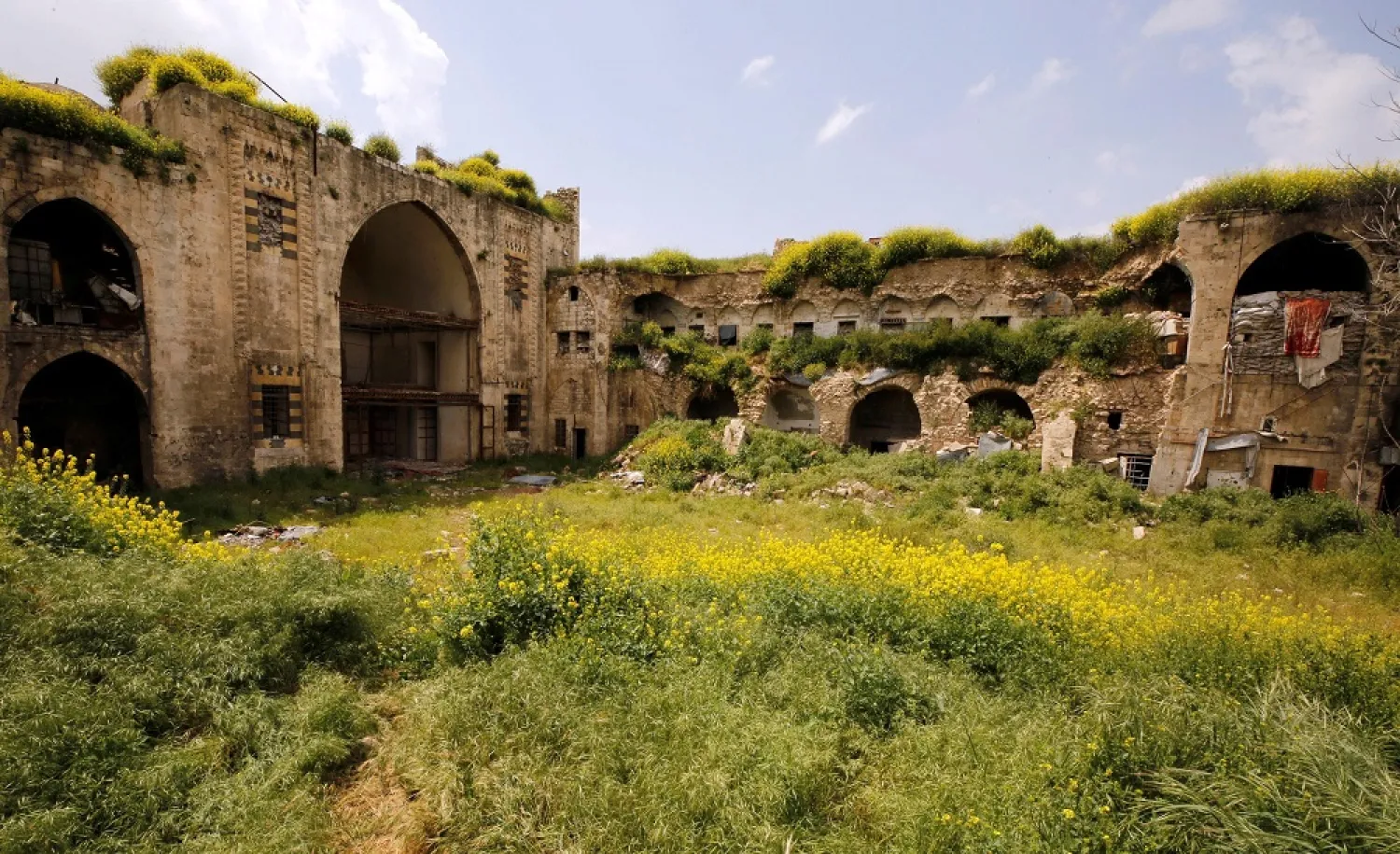

Flowers Bloom in War-Torn Syria's Battered Cities

A view of a damaged archaeological site in the old city of Aleppo. (Reuters)
TT

Flowers Bloom in War-Torn Syria's Battered Cities

A view of a damaged archaeological site in the old city of Aleppo. (Reuters)

A mantle of gold smothers Aleppo’s ruins, hiding the rubble and filling the craters with wild flowers that for a moment seem to transform a landscape scarred by war, destruction and death.

After an unusually wet winter, the warm days of spring have suddenly brought an abundance of color and life to a weary Syria, blooming in city and desert, said a Reuters report Tuesday.

But they blanket a scene of war. The hummocks and dells are piles of debris, barricades, craters and trenches. The flowers grow where people once lived, fought, died.

Eight years of conflict have killed perhaps half a million people, destroyed whole towns and city districts and made half of all Syrians homeless.

In most parts of the country, the fighting is now over - at least for now. Regime leader Bashar Assad holds most of Syria, including the city of Aleppo, taken after months of bitter fighting in 2016.

However, Kurdish-led groups hold northeast Syria, and, in the northwest near Aleppo is the frontline with the last big rebel stronghold, where there has been bombardment in recent weeks.

The war destroyed much of Aleppo’s beautiful Old City and many poor eastern districts, leaving neighborhoods of rubble and fallen stone.

In the remains of the Attariyeh section of the souk, where the stone roof collapsed, a young couple sat on a pile of stones courting in the warm evening air, the sun illuminating the yellow flowers and picking out the woman’s red headscarf.

The steep sides of the ancient citadel’s round hill in the center of the city are thick with blooms and families gather at sunset to stroll or sit.

“It’s God’s message to make everything beautiful after mankind destroyed everything,” said Majd Kanaa, 35, standing at the end of a souk alleyway where he was repairing his late father’s shop, ready to reopen.

Clouds of butterflies, russet, black and white, flutter from the undergrowth and bees hum round the flowers. Flocks of swallows flit from the sky to roost in the ruins.

At night, in the fields and olive groves just outside the city, a cacophonous croaking of frogs drowns out the noise of cars from a road lined with cypress and pine trees.

Along the road from the south, precariously held for years by the regime with opposition factions on one side and the ISIS terrorist group on the other, the fighting left a chain of fortifications.

The war has moved far from here and these are now mostly deserted. Grass and flowers grow thick between the oil drums, sandbags and stacked tires guarding the old gun emplacements and concrete boxes.

Yellow broom, purple thistles and fat red poppies spring from the desert floor and paint it a psychedelic swirl of color. In one place, a huge patch of ground seems to bleed with thousands of poppies springing from the softly undulating earth.

“In Syria we believe that poppies are the blood of the martyrs,” said Aleppo lawyer and historian Alaa al-Sayed, explaining that their Arabic name comes from a dead king. “There are so many martyrs,” he added, according to Reuters.

In the hills beyond the poppies are the pretty pointed mud domes of traditional “beehive” villages and young shepherds watching flocks of sheep and goats.

When the strong west wind ruffles the ground in the late afternoon, it makes the grass shimmer. Flocks of small birds suddenly rise from the ground and bob in the air. Migrating storks beat their wings in the distance.

Little electricity means little light, and at night the heavens are lit by a sharp crescent moon and brilliant constellations of stars. A fox slinks across the desert road in the light of car headlights.

But from time to time they also illuminate the burnt-out wrecks by the roadside, the remains of battles past, while two heavy trucks bear tanks onwards to today’s front line.



Meet the Baby Koala Hiding in Its Mom’s Pouch at a Florida Zoo’s New Outback Habitat

This photo provided by the Palm Beach Zoo Conservation Society Clearance shows a koala named Ellin and her newborn joey in a habitat at the Palm Beach Zoo Conservation Society in West Palm Beach, Fla., on Saturday, April 18, 2026. (John Towey/Palm Beach Zoo Conservation Society via AP)
TT

Meet the Baby Koala Hiding in Its Mom’s Pouch at a Florida Zoo’s New Outback Habitat

This photo provided by the Palm Beach Zoo Conservation Society Clearance shows a koala named Ellin and her newborn joey in a habitat at the Palm Beach Zoo Conservation Society in West Palm Beach, Fla., on Saturday, April 18, 2026. (John Towey/Palm Beach Zoo Conservation Society via AP)

A zoo in Florida has two reasons to celebrate — the first birth of a koala and a newly renovated habitat for the cuddly creatures is opening to the public on Saturday.

“For the zoo and for us here, it’s the very big deal,” said Amarylis Celestina, who oversees carnivores and koalas at the Palm Beach Zoo & Conservation Society in West Palm Beach, Florida. "We are trying the best that we can to help with a lot of the genetic diversity within the population that we have here in the United States. So that’s why it’s important that we do have a joey and that we were successful this year.”

The joey, born to Ellin and Sydney last fall, remains in its mother's pouch and has just recently started to become visible to zoo officials.

They continue to monitor Ellin's weight, and are providing extra food as she cares for the baby.

Meanwhile, the koala population is enjoying a renovated habitat, which includes more greenery, new perching for exercising, and solar tubes to bring in more natural light.

The changes bring a bit of the Australian outback to the zoo for koalas, which are an endangered species. They are able to move between their climate-controlled indoor exhibit and the expanded outdoor area.

“This new habitat is a milestone for our koalas,” Margo McKnight, the zoo's CEO and president said in a news release. “The deliberate design supports the voluntary, cooperative care our zoologists and koalas have developed together.”

Koalas in the US are on loan from the Australian federal government to help with conservation practices.

Koalas are generally peaceful, have a calm nature and enjoy a “slow” lifestyle. They like to climb and hop between the trees in the habitat.

The renovations are designed to help koalas express their natural behaviors, zoo officials said.


Melania Trump Is Growing the White House Honey Program with a New Beehive

 First lady Melania Trump smiles during the 113th Annual First Lady's Luncheon, Thursday, April 23, 2026, in Washington. (AP)
First lady Melania Trump smiles during the 113th Annual First Lady's Luncheon, Thursday, April 23, 2026, in Washington. (AP)
TT

Melania Trump Is Growing the White House Honey Program with a New Beehive

 First lady Melania Trump smiles during the 113th Annual First Lady's Luncheon, Thursday, April 23, 2026, in Washington. (AP)
First lady Melania Trump smiles during the 113th Annual First Lady's Luncheon, Thursday, April 23, 2026, in Washington. (AP)

What's all the buzz about?

Melania Trump on Friday announced that she is expanding the White House honey program by adding a beehive in the shape of the White House to two other beehives that have been on the south grounds since 2009.

The existing hives can swell to about 70,000 bees during peak summer months and produce 200 to 225 pounds of honey in a year, the White House said. The new hive could increase honey production by about 30 pounds, according to the White House.

The White House uses the clover honey to prepare meals, as official gifts from the president and first lady, and in donations to food kitchens.

The bees help pollinate a nearby produce garden that then-first lady Michelle Obama started in 2009 and a nearby flower cutting garden, along with vegetation on the National Mall.

The beekeeping program began in 2009 after a White House carpenter started beekeeping as a hobby on the complex.

The new hive was funded through the Trust for the National Mall, the White House said.

The hive and the base were designed by White House residence staff and hand-made by a Virginia artisan.


AlUla Manara Team Hosts Lyrid Meteor Shower Observation

The event utilized AlUla’s exceptionally clear skies and low light pollution - SPA
TT

AlUla Manara Team Hosts Lyrid Meteor Shower Observation

The event utilized AlUla’s exceptionally clear skies and low light pollution - SPA

AlUla Manara team hosted an educational astronomy evening yesterday near the iconic Arch Rock, aimed at promoting astrotourism and scientific awareness. The event utilized AlUla’s exceptionally clear skies and low light pollution to provide residents and visitors with an immersive celestial experience, SPA reported.

The evening featured the Lyrid meteor shower, an annual phenomenon caused by debris from Comet Thatcher entering Earth's atmosphere. Under expert guidance, attendees observed the shower and used advanced telescopes to explore the cosmos.

The program included interactive scientific discussions on the historical role of astronomy in navigation and timekeeping, as well as its contributions to modern science.

This initiative is part of AlUla’s strategic effort to become a premier global destination for astrotourism. By blending education with entertainment, AlUla Manara continues to showcase the governorate’s unique natural landscape and foster a deeper connection between the community and the universe.