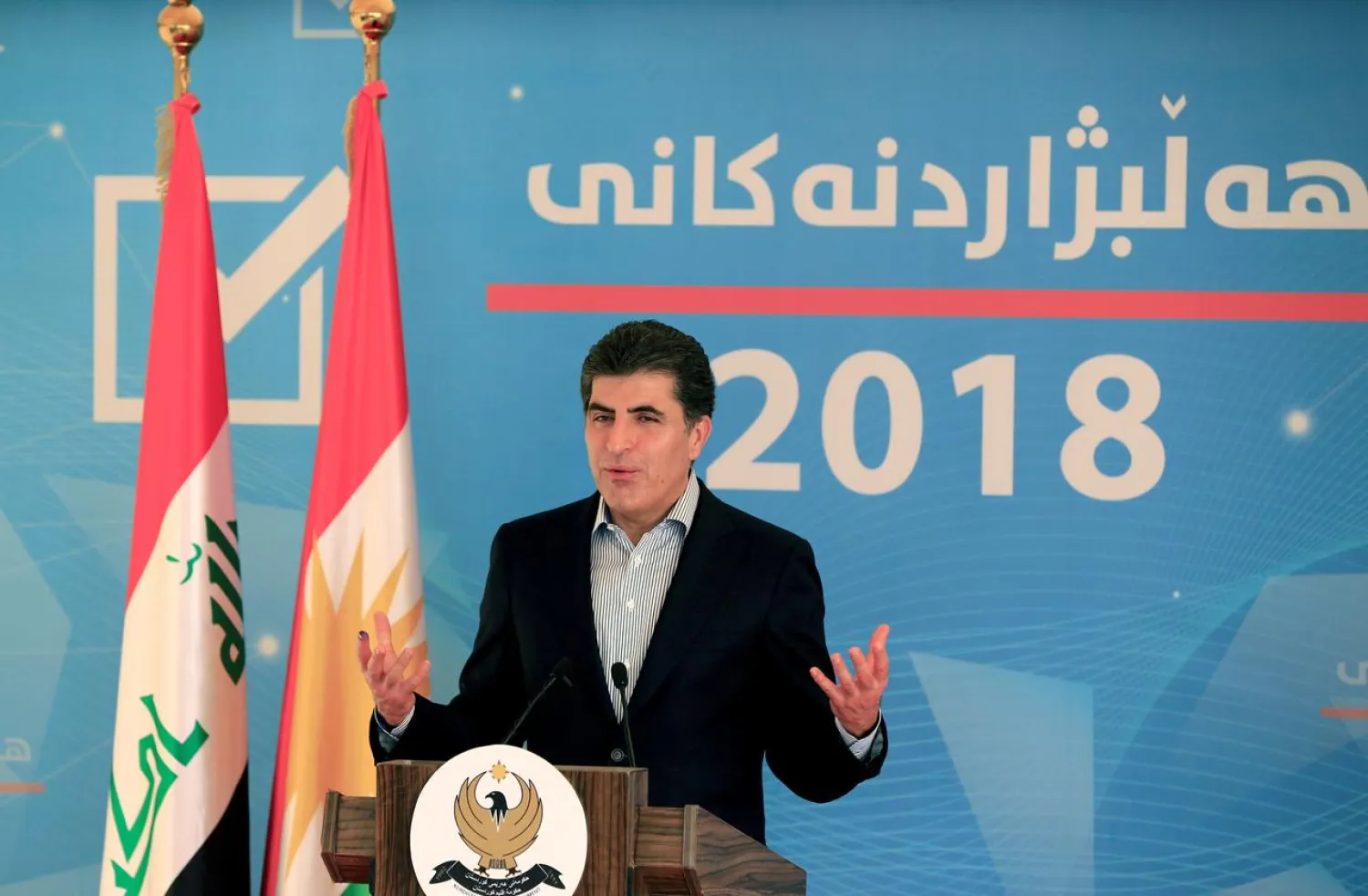
Nechirvan Barzani Elected Iraqi Kurdistan President

FILE PHOTO: Nechirvan Barzani speaks during a news conference after casting his vote in Erbil during parliamentary elections in the semi-autonomous region of Iraq, September 30, 2018. REUTERS/Thaier Al-Sudani/File Photo
TT

Nechirvan Barzani Elected Iraqi Kurdistan President

FILE PHOTO: Nechirvan Barzani speaks during a news conference after casting his vote in Erbil during parliamentary elections in the semi-autonomous region of Iraq, September 30, 2018. REUTERS/Thaier Al-Sudani/File Photo

Nechirvan Barzani was on Tuesday elected as president of the semi-autonomous Kurdistan Region of Iraq, a spokesman for the regional parliament said.

The deputy leader of the Kurdistan Democratic Party (KDP), who had been serving as regional prime minister, won 68 votes from the 84 lawmakers present.

He is the nephew of the previous and only other holder of the office, Masoud Barzani.

The regional legislature has 111 seats in total.

The parliamentary session was boycotted by the Patriotic Union of Kurdistan of late Iraqi president Jalal Talabani.

Masoud Barzani, still the head of the KDP, stepped down after 12 years as regional president in November 2017.


Israel Says South Lebanon’s Bint Jbeil Encircled, Full Control Within Days

Destroyed buildings in Bint Jbeil, southern Lebanon, near the Israel-Lebanon border, as seen from the Israeli side of the border in northern Israel, April 13, 2026. REUTERS/Florion Goga
TT

Israel Says South Lebanon’s Bint Jbeil Encircled, Full Control Within Days

Destroyed buildings in Bint Jbeil, southern Lebanon, near the Israel-Lebanon border, as seen from the Israeli side of the border in northern Israel, April 13, 2026. REUTERS/Florion Goga

The Israeli military said on Monday its troops had completely surrounded Bint Jbeil, a key town in southern Lebanon after killing more than 100 Hezbollah fighters there over the past week.

The announcement marks a significant advance in Israel's ongoing invasion of southern Lebanon.

"The forces of the 98th Division have completed the encirclement of the town of Bint Jbeil and have begun an assault on it," the military's Arabic-language spokesman Colonel Avichay Adraee said on X.

Over the past week, Israeli forces have killed more than 100 Hezbollah fighters in and around the town in "face-to-face" clashes and with air strikes, he said.

According to AFP, the Iran-backed Hezbollah said it has been engaged for days in clashes with Israeli forces in Bint Jbeil.

Full operational control of Bint Jbeil will be achieved within days, with Hezbollah fighters limited in their ⁠ability to attack ⁠northern Israel from the area, an Israeli military official said, according to Reuters.

"Only a small number of terrorists remains in the area of Bint Jbeil," the official said, adding that the military "eliminated terrorists ⁠as ⁠they were exiting the hospital in Bint Jbeil, as well as located numerous launchers and weapons."

Just five kilometers (three miles) from the Israeli border, Bint Jbeil has long been both a symbolic and strategic flashpoint in confrontations between Israeli forces and Hezbollah.

It was the scene of some of the fiercest fighting during the 2006 war, when Hezbollah's resistance there became central to the group's narrative of defiance.

It was from the stadium in Bint Jbeil in 2000 that the group's former chief Hassan Nasrallah delivered the "Liberation" speech following Israel's withdrawal from southern Lebanon after 22 years of occupation.

On Thursday, Hezbollah said it was engaged in "point-blank" clashes with Israeli forces in the town.

Since then, the group has repeatedly reported targeting Israeli forces and vehicles there, most recently on Sunday, when the state-run National News Agency (NNA) reported "intense clashes" in the town.

On Monday, the NNA reported Israeli artillery shelling at the town's entrance.

The escalation in Bint Jbeil comes as diplomatic efforts to contain the cross-border fighting have risen over the past few days.

Israeli and Lebanese officials are set to hold talks on Tuesday in Washington to end the war.

During a visit to troops in southern Lebanon on Sunday, Prime Minister Benjamin Netanyahu said Israeli forces had eliminated the threat of an invasion by Hezbollah militants.

But he added: "There is still more to do, and we are doing it."

Israeli officials have repeatedly said that Israel wants to establish a "security zone" in south Lebanon to help prevent Hezbollah attacks.


Israeli Fire Kills Three in Gaza Following New Ceasefire Talks

A Palestinian man kisses a shrouded body during the funeral of Palestinians who, according to a medic, were killed the night before in an Israeli strike at al-Aqsa Martyrs Hospital in Deir al Balah in the central Gaza Strip on April 13, 2026. (Photo by Eyad Baba / AFP)
TT

Israeli Fire Kills Three in Gaza Following New Ceasefire Talks

A Palestinian man kisses a shrouded body during the funeral of Palestinians who, according to a medic, were killed the night before in an Israeli strike at al-Aqsa Martyrs Hospital in Deir al Balah in the central Gaza Strip on April 13, 2026. (Photo by Eyad Baba / AFP)

An Israeli airstrike killed at least three Palestinians in the Gaza Strip on Monday, health officials said, as mediators met leaders from Hamas in an effort to shore up a US-brokered ceasefire deal.

Medics said the strike had hit a group of men outside a school in Deir al-Balah in the central Gaza Strip. There was no immediate comment by the Israeli military.

At Al-Aqsa Hospital in Deir al-Balah, the bodies of those killed lay on the ground in white shrouds outside the morgue as relatives and friends arrived to bid them farewell. Some kissed the victims' foreheads before holding special prayers, Reuters reported.

“This isn’t a truce; it’s a trap for our ⁠young men. Every day ⁠there are martyrs, every single day. How long can this continue?” said Umm Hussam Abu El-Rous, a female relative of one of the victims.

“Isn't it unjust that a three-year-old child is afraid of seeing his (dead) father? He says, 'My father went to bring me something from the shop,'" she added. The ceasefire that began last October halted two years of full-blown war but left Israeli troops in control of a depopulated zone demarcated by yellow-painted blocks that comprises ⁠well over half of Gaza, with Hamas in power in a narrow coastal strip and Israeli airstrikes continuing.

More than 750 Palestinians have been killed since the deal took effect, while militants have killed four Israeli soldiers. Israel and Hamas have traded blame for ceasefire violations.

Palestinians say Israeli forces have been moving some of the yellow concrete markers westward. Israel denies this.

The violence comes as leaders from Hamas and other Palestinian factions have been meeting since Saturday in Cairo with mediators from Egypt, Turkey, and Qatar to discuss implementing the second phase of the Gaza deal.

Under a plan put forward by US President Donald Trump's Board of Peace, Hamas would be required to lay ⁠down its arms ⁠in stages over eight months after a US-backed committee of Palestinian technocrats takes control in Gaza.

However, Hamas' disarmament has been a major obstacle to progress on Trump's ceasefire deal and plan for Gaza, which have also been put under strain by the war in Iran.

Two officials close to the latest talks said Hamas told mediators that discussions on disarmament could only move forward after Israel fully implements the first phase of Trump's October deal, which includes a complete ceasefire in Gaza.

Israeli military officials have said they are preparing for a swift return to full-scale war if Hamas does not lay down its weapons.


Jordan, Syria Sign 20 Agreements to Boost Ties

Jordan’s King Abdullah II receives the Syrian ministerial delegation participating in the Jordan-Syria Higher Coordination Council, in the presence of Crown Prince Hussein bin Abdullah II (Royal Court)
TT

Jordan, Syria Sign 20 Agreements to Boost Ties

Jordan’s King Abdullah II receives the Syrian ministerial delegation participating in the Jordan-Syria Higher Coordination Council, in the presence of Crown Prince Hussein bin Abdullah II (Royal Court)

Jordan and Syria signed more than 20 bilateral agreements and memorandums of understanding on Sunday, marking a significant step toward restoring strategic ties that had been frozen since the outbreak of the Syrian conflict in 2011.

Jordanian diplomacy has dealt pragmatically with restoring relations with Damascus after years of rupture caused by the war, which ended with the fall of the former Syrian regime and the departure of Bashar al-Assad to Moscow in late 2024.

Meetings of the second session of the Jordanian-Syrian Higher Coordination Council, held in Amman, reflected an advanced stage of renewed cooperation across a range of bilateral issues and a shared desire to achieve mutual economic gains.

A Jordanian government source told Asharq Al-Awsat that the talks, chaired by the two countries’ foreign ministers, resulted in the signing of more than 20 agreements and memorandums covering economic and key strategic projects. The source said the outcome demonstrated “the Syrian side’s seriousness in pursuing a genuine partnership with Jordan.”

The meetings take on added importance amid regional security, military and economic repercussions stemming from the ongoing conflict between Iran on one side and Israel and the United States on the other, as countries increasingly search for alternative trade routes to secure supply chains for goods and energy.

Jordan views its border with Syria as a gateway for exports to Türkiye and Europe, while Damascus sees Jordan as a safe corridor for its goods to Gulf countries.

Strategically, the cooperation is expected to support major projects such as electricity interconnection and a planned railway link that Jordan is preparing to launch in the near future. It also includes restoring Jordan’s water rights, which, according to sources, had been curtailed by the former Syrian authorities for around four decades.

Security remains a shared concern for both countries. During the Syrian conflict, Jordan bore the burden of securing its 375-kilometer border alone after southern Syria descended into instability due to the activity of militias and armed factions of various affiliations.

Officials say that progress on economic partnerships depends on maintaining stability in southern Syria. Jordan continues to support security efforts there, including closely monitoring smuggling activity and responding to threats along the border.

At a joint news conference on Sunday, Jordanian Foreign Minister Ayman Safadi and his Syrian counterpart Asaad al-Shaibani said defense and security coordination had made “significant progress” in addressing shared challenges, including drug and arms smuggling and attempts to undermine stability.

Safadi said the two sides had agreed on a joint roadmap aimed at reinforcing stability in Sweida and southern Syria.

Jordan’s King Abdullah II reaffirmed support for Syria’s efforts to preserve security, stability, sovereignty and territorial integrity during a meeting with the visiting Syrian ministerial delegation. Crown Prince Hussein bin Abdullah II was also present.

The king stressed the need to continue developing economic and trade relations and strengthening security cooperation in a way that serves mutual interests. He described the council’s second session as an important step toward advancing ties and called for effective implementation of the agreements reached.

The council covers 20 key sectors and aims to elevate Jordanian-Syrian relations to a comprehensive strategic partnership. Discussions addressed cooperation opportunities in water, transport and energy, with the king highlighting the importance of regional integration and joint Arab projects to enhance cooperation.

Safadi said the meetings reflected the political will of King Abdullah and Syrian President Ahmad al-Sharaa to strengthen bilateral relations and build an integrated strategic partnership.

He described the gathering as “the largest Jordanian-Syrian meeting in history,” noting that more than 30 ministers took part. He said agreements and memorandums had been signed and cooperation discussed across more than 21 sectors.

Safadi reiterated Jordan’s support for Syria’s reconstruction and its sovereignty over all its territory, describing the current moment as “historic” for Syria. He said Jordan would stand by Syria throughout the rebuilding process.

He also condemned what he described as Israeli actions undermining Syria’s security and called for continued joint efforts to confront shared challenges and threats.

For his part, Shaibani described Jordan as a “strategic partner” for his country. He said reconstruction in Syria would require between $250 billion and $400 billion, stressing the need for cooperation with Jordan and regional countries to address those needs.