


Jordan, Syria Sign 20 Agreements to Boost Ties

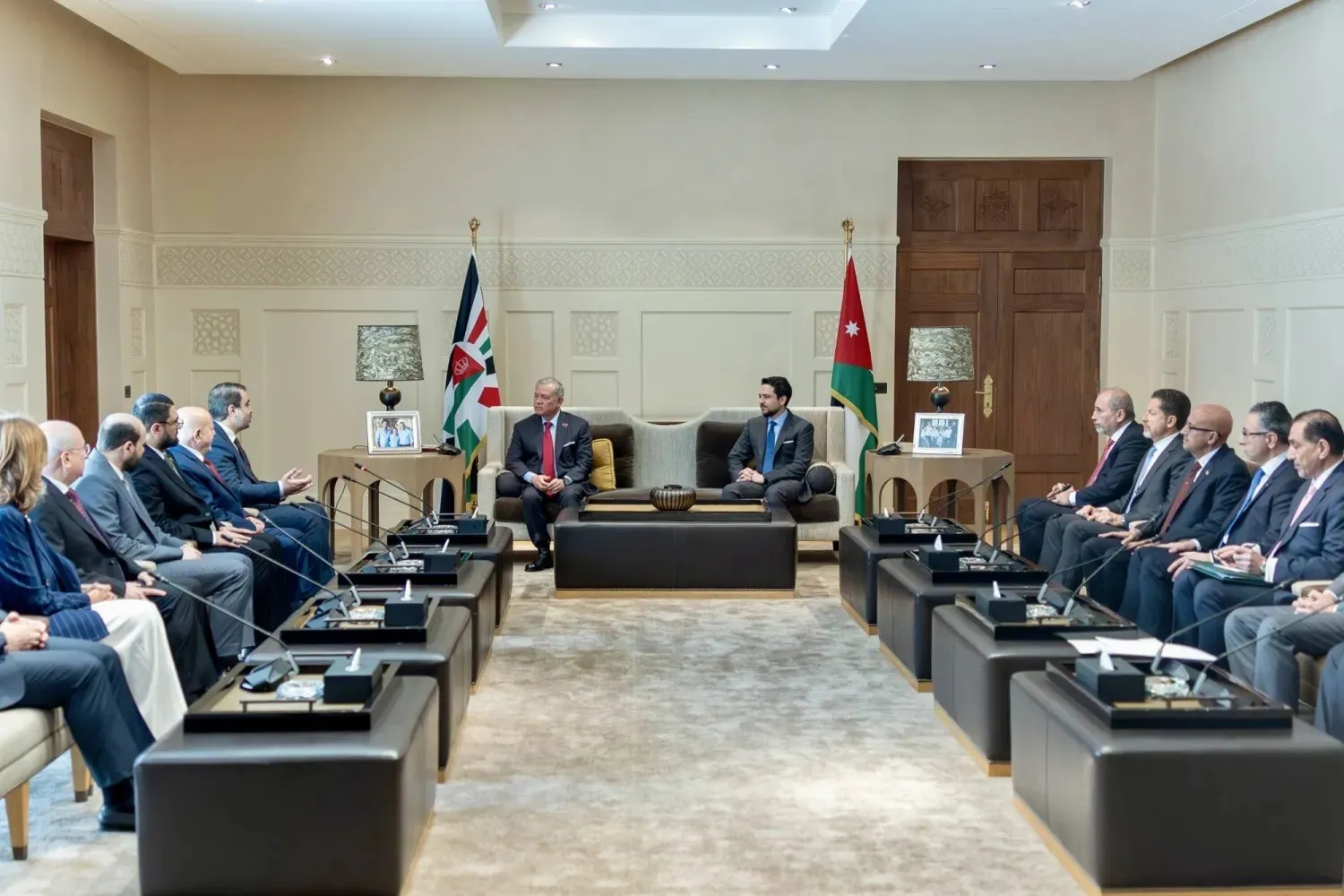
Jordan’s King Abdullah II receives the Syrian ministerial delegation participating in the Jordan-Syria Higher Coordination Council, in the presence of Crown Prince Hussein bin Abdullah II (Royal Court)
TT

Jordan, Syria Sign 20 Agreements to Boost Ties

Jordan’s King Abdullah II receives the Syrian ministerial delegation participating in the Jordan-Syria Higher Coordination Council, in the presence of Crown Prince Hussein bin Abdullah II (Royal Court)

Jordan and Syria signed more than 20 bilateral agreements and memorandums of understanding on Sunday, marking a significant step toward restoring strategic ties that had been frozen since the outbreak of the Syrian conflict in 2011.

Jordanian diplomacy has dealt pragmatically with restoring relations with Damascus after years of rupture caused by the war, which ended with the fall of the former Syrian regime and the departure of Bashar al-Assad to Moscow in late 2024.

Meetings of the second session of the Jordanian-Syrian Higher Coordination Council, held in Amman, reflected an advanced stage of renewed cooperation across a range of bilateral issues and a shared desire to achieve mutual economic gains.

A Jordanian government source told Asharq Al-Awsat that the talks, chaired by the two countries’ foreign ministers, resulted in the signing of more than 20 agreements and memorandums covering economic and key strategic projects. The source said the outcome demonstrated “the Syrian side’s seriousness in pursuing a genuine partnership with Jordan.”

The meetings take on added importance amid regional security, military and economic repercussions stemming from the ongoing conflict between Iran on one side and Israel and the United States on the other, as countries increasingly search for alternative trade routes to secure supply chains for goods and energy.

Jordan views its border with Syria as a gateway for exports to Türkiye and Europe, while Damascus sees Jordan as a safe corridor for its goods to Gulf countries.

Strategically, the cooperation is expected to support major projects such as electricity interconnection and a planned railway link that Jordan is preparing to launch in the near future. It also includes restoring Jordan’s water rights, which, according to sources, had been curtailed by the former Syrian authorities for around four decades.

Security remains a shared concern for both countries. During the Syrian conflict, Jordan bore the burden of securing its 375-kilometer border alone after southern Syria descended into instability due to the activity of militias and armed factions of various affiliations.

Officials say that progress on economic partnerships depends on maintaining stability in southern Syria. Jordan continues to support security efforts there, including closely monitoring smuggling activity and responding to threats along the border.

At a joint news conference on Sunday, Jordanian Foreign Minister Ayman Safadi and his Syrian counterpart Asaad al-Shaibani said defense and security coordination had made “significant progress” in addressing shared challenges, including drug and arms smuggling and attempts to undermine stability.

Safadi said the two sides had agreed on a joint roadmap aimed at reinforcing stability in Sweida and southern Syria.

Jordan’s King Abdullah II reaffirmed support for Syria’s efforts to preserve security, stability, sovereignty and territorial integrity during a meeting with the visiting Syrian ministerial delegation. Crown Prince Hussein bin Abdullah II was also present.

The king stressed the need to continue developing economic and trade relations and strengthening security cooperation in a way that serves mutual interests. He described the council’s second session as an important step toward advancing ties and called for effective implementation of the agreements reached.

The council covers 20 key sectors and aims to elevate Jordanian-Syrian relations to a comprehensive strategic partnership. Discussions addressed cooperation opportunities in water, transport and energy, with the king highlighting the importance of regional integration and joint Arab projects to enhance cooperation.

Safadi said the meetings reflected the political will of King Abdullah and Syrian President Ahmad al-Sharaa to strengthen bilateral relations and build an integrated strategic partnership.

He described the gathering as “the largest Jordanian-Syrian meeting in history,” noting that more than 30 ministers took part. He said agreements and memorandums had been signed and cooperation discussed across more than 21 sectors.

Safadi reiterated Jordan’s support for Syria’s reconstruction and its sovereignty over all its territory, describing the current moment as “historic” for Syria. He said Jordan would stand by Syria throughout the rebuilding process.

He also condemned what he described as Israeli actions undermining Syria’s security and called for continued joint efforts to confront shared challenges and threats.

For his part, Shaibani described Jordan as a “strategic partner” for his country. He said reconstruction in Syria would require between $250 billion and $400 billion, stressing the need for cooperation with Jordan and regional countries to address those needs.



Beirut Conference Sees Wide Consensus Over Weapons-free Capital

Beirut MPs met in the capital to support a government move declaring the city “safe and weapons-free." Asharq Al-Awsat
TT

Beirut Conference Sees Wide Consensus Over Weapons-free Capital

Beirut MPs met in the capital to support a government move declaring the city “safe and weapons-free." Asharq Al-Awsat

Beirut MPs representing most of Lebanon’s political parties met in the capital to support a government move declaring the city “safe and weapons-free,” following recent security incidents and Israeli strikes.

The conference brought together most factions, except MPs from Hezbollah, the Amal Movement and Al-Jamaa al-Islamiya.

Despite political divisions, participants struck a unified rhetoric, calling for all weapons to be placed exclusively under state control and for a stronger presence of official institutions, chiefly the Lebanese Army, across the capital to ensure stability and restore public confidence in security.

MP Fouad Makhzoumi said Beirut “deserves to be protected together” and would remain “a city that embraces everyone,” describing the “Black Wednesday” as a serious warning of the risks still facing the capital.

He called for the army to deploy across all neighborhoods, for checkpoints to be reinforced and for effective security oversight, stressing that state-building requires a monopoly on arms “without exception.”

He further stressed all necessary measures should be taken to restore order, “up to declaring general mobilization if needed.”

For his part, MP Ghassan Hasbani of the Lebanese Forces said the meeting reflected a national stance tied to the responsibility of representing Beirut’s residents. He voiced support for state efforts to assert full authority, confiscate illegal weapons and treat any armed activity outside state control as a direct threat to the capital’s security and stability.

Kataeb Party lawmaker Nadim Gemayel noted that Lebanon should no longer be used as a bargaining chip by external actors, calling for firm implementation of government decisions and for the army to deploy across the country, starting with Beirut, to protect citizens and reinforce sovereignty.

Similarly, MP Ibrahim Mneimneh said Hezbollah had dragged Lebanon into a conflict unrelated to it, exposing the country to heavy losses, while Beirut and other regions paid the price in security and stability. He stressed that the current phase required restoring state authority and ensuring its exclusive control over arms.

MP Waddah Sadeq said the Lebanese “have the right to loyalty to Lebanon alone,” urging support for what he described as “historic” government decisions. He called for unity under a state based on institutions and the rule of law, and for security forces to fully carry out their duties.

MP Nicolas Sehnaoui of the Free Patriotic Movement highlighted the need for an inclusive national approach to rebuild trust in the state, stressing that limiting arms to the army and legitimate forces remains essential, while avoiding exclusionary rhetoric.

Lawmaker Edgar Traboulsi said Beirut, despite wars and crises, “does not die,” but needs unity and solidarity free from division and incitement.

MP Faisal Sayegh of the Progressive Socialist Party stated that Beirut’s security is inseparable from Lebanon’s, calling for adherence to sovereignty and independence and implementation of the Taif Agreement and relevant government decisions.


A 10-day Ceasefire Agreed on By Israel and Lebanon Goes into Effect

A man stands on a damaged part of the Qasmiyeh Bridge that was targeted by an Israeli airstrike near Tyre, southern Lebanon, 16 April 2026. EPA/STRINGER
TT

A 10-day Ceasefire Agreed on By Israel and Lebanon Goes into Effect

A man stands on a damaged part of the Qasmiyeh Bridge that was targeted by an Israeli airstrike near Tyre, southern Lebanon, 16 April 2026. EPA/STRINGER

A 10-day truce began in Lebanon on Friday that could pause fighting between Israel and the Hezbollah militant group and boost attempts to extend the ceasefire between Iran, the United States and Israel after weeks of devastating war.

US President Donald Trump announced the agreement as a ceasefire between Israel and Lebanon. However, Israel has not been fighting with Lebanon itself, but rather with the Iranian-backed Hezbollah militants inside the country, who were not formally part of the agreement, The Associated Press said.

Barrages of gunshots rang out across Beirut as residents fired into the air just after midnight to celebrate the beginning of the truce.

Displaced families began moving toward southern Lebanon and Beirut’s southern suburbs, despite warnings by officials not to attempt to return to their homes until it became clear whether the ceasefire would hold.

Earlier, Israeli Prime Minister Benjamin Netanyahu said he agreed to the ceasefire “to advance” peace efforts with Lebanon, but said Israeli troops would not withdraw.

Israeli forces have engaged in fierce battles with Hezbollah in the border area as they pushed into southern Lebanon to create what officials have called a “security zone.” Netanyahu, in his video address, said it will extend 10 kilometers (6 miles) into Lebanon.

“That is where we are, and we are not leaving,” he said.

Hezbollah said that “Israeli occupation on our land grants Lebanon and its people the right to resist it, and this matter will be determined based on how developments unfold” — a stance that could complicate the ceasefire.

Israel reserves right to defend itself

The US State Department said that according to the agreement, Israel reserves the right to defend itself “at any time, against planned, imminent, or ongoing attacks.” But otherwise, Israel “will not carry out any offensive military operations against Lebanese targets, including civilian, military, and other state targets.”

The wording suggested Israel would maintain the freedom to strike at will, as it did in the months following the ceasefire that ended the previous war. This time, Hezbollah said it would respond to any strikes by Israel.

It's unclear when the 1 million people displaced by the war will be able to safely return.

Lebanon’s state-run National News agency reported that Israeli shelling continued in the villages of Khiam and Dibbine about a half hour after the truce went into effect. Israel’s military said it was looking into reports of shelling and artillery fire in southern Lebanon.

Hezbollah kept firing rockets at northern Israeli towns and communities right up to the start of the ceasefire. Air raid sirens went off in some often-targeted border towns less than 10 minutes before midnight.

Flurry of diplomacy

The agreement came after a meeting between Israel's and Lebanon’s ambassadors in Washington and a flurry of subsequent phone calls from Trump and Secretary of State Marco Rubio, according to a White House official.

They were the first direct diplomatic talks between the two countries in decades. Hezbollah had opposed direct talks between Lebanon and Israel.

Trump spoke Wednesday evening with Netanyahu, who agreed to a ceasefire with certain terms, according to the official, who was not authorized to comment publicly and spoke on condition of anonymity.

Rubio then called Lebanon’s president, Joseph Aoun, who got on board. Trump then spoke with Aoun, and again with Netanyahu.

The State Department worked with both governments to formulate a memorandum of understanding for the truce.

“May have been a historic day for Lebanon. Good things are happening!!!” Trump said in a social media post.

Trump extends White House invitation

Lebanon has insisted on a ceasefire to stop the fighting between Israel and Hezbollah before engaging in more talks, while vowing to commit to disarming the group.

Israel and Lebanon have technically been at war since Israel was established in 1948, and Lebanon remains deeply divided over diplomatic engagement with Israel.

Trump also invited the leaders of Israel and Lebanon to the White House for what he said would be “the first meaningful talks" between the countries since 1983.

“Both sides want to see PEACE, and I believe that will happen, quickly,” Trump wrote on social media.

Lebanon and Israel signed an agreement in 1983 saying Lebanon would formally recognize Israel, and Israel would withdraw from Lebanon. The deal fell apart during Lebanon’s civil war and was formally rescinded a year later.

A Hezbollah official said the ceasefire was a result of Iran’s negotiations with the US, in which Iran had insisted Lebanon be included in its own ceasefire, and came about through efforts by mediator Pakistan. The official spoke on condition of anonymity because he was not authorized to speak publicly.

Pakistan army chief meets with Iranian parliament speaker

Meanwhile, Pakistan’s army chief met Thursday with Iran’s parliament speaker as part of international efforts to press for an extension to a ceasefire that has paused almost seven weeks of war between Israel, the US and Iran.

It was unclear whether the frantic diplomacy could lead to a lasting deal before the ceasefire ends next week. The Iran war has killed thousands of people and upended global markets by disrupting the flow of oil.

Iranian state television did not provide details on the meeting between Pakistani Army Gen. Asim Munir and Iranian Parliament Speaker Mohammad Bagher Qalibaf, his country’s chief negotiator.

There was no immediate comment from Pakistan, a key mediator after hosting the talks between the US and Iran that authorities said helped narrow differences between the sides.

The White House said any further talks regarding Iran would likely take place in the Pakistani capital of Islamabad, though no decision had been made on whether to resume negotiations. The fragile ceasefire is holding despite a US naval blockade of Iranian ports and Iranian counter-threats to target regional ports across the Red Sea.

Trump suggested the ceasefire could be extended.

“If we’re close to a deal, would I extend?” Trump said in an exchange with reporters. “Yeah, I would do that.”

The war has jolted markets and rattled the global economy as shipping has been cut off and airstrikes have pounded military and civilian infrastructure. Oil prices have fallen amid hopes for an end to fighting, and US stocks on Wednesday surpassed records set in January.

Officials say US and Iran are making progress

Even as the US blockade on Iranian ports and renewed Iranian threats strained the ceasefire, regional officials reported progress, telling AP the United States and Iran had an “in-principle agreement” to extend it to allow for more diplomacy. They spoke on condition of anonymity to discuss sensitive negotiations.

But tensions simmered.

The commander of Iran’s joint military command, Ali Abdollahi, threatened to halt trade in the region if the US does not lift its naval blockade, and a newly appointed military adviser to Iranian Supreme Leader Mojtaba Khamenei said he does not support extending the ceasefire.

Mediators seek compromise on sticking points

The fighting has killed at least 3,000 people in Iran, more than 2,100 in Lebanon, 23 in Israel and more than a dozen in Gulf Arab states. Thirteen US service members have also been killed.

Mediators are pushing for a compromise on three main sticking points: Iran’s nuclear program, the Strait of Hormuz and compensation for wartime damages, according to a regional official involved in the mediation efforts.

Since the war began, Iran has curtailed maritime traffic through the strait, which a fifth of global oil transited through in peacetime. Tehran’s effective closure of the strait sent oil prices skyrocketing, raising the cost of fuel, food and other basic goods far beyond the Middle East.


Libya, US Hold Talks on Money Laundering, Terror Financing

Libya central bank governor (left) with US assistant secretary of state (central bank)
TT

Libya, US Hold Talks on Money Laundering, Terror Financing

Libya central bank governor (left) with US assistant secretary of state (central bank)

Anti-money laundering measures dominated talks in Washington between governor of the Central Bank of Libya Naji Issa and US officials, as prosecutors pursue corruption cases.

The central bank said Issa outlined efforts to strengthen anti-money laundering and counterterrorism financing systems, expand electronic payments, and introduce unconventional monetary tools in line with international standards, steps it said have boosted confidence among global financial institutions.

Late on Wednesday, the bank said Issa and his delegation met several officials, including Robert B. Thomson, Visa's vice chairman, in talks aimed at expanding electronic payment services and advancing financial inclusion in Libya, while tightening oversight of financial transactions in line with international standards.

Libya ranks among the world’s five most corrupt countries, according to recent estimates by Transparency International. The country fell to 177th out of 182 states in the 2025 Corruption Perceptions Index.

The central bank said Issa also attended a meeting of finance ministers and central bank governors from the Middle East, North Africa and Pakistan group, MENAP, with IMF Managing Director Kristalina Georgieva, on the sidelines of the 2026 Spring Meetings of the IMF and World Bank in Washington.

Discussions focused on slowing global growth, inflationary pressures, and challenges tied to commodity and energy prices.

The bank added that it received an official invitation from the US State Department and held a high-level meeting in Washington with Kyle Liston, a US State Department official. It quoted him as praising the governor and the bank’s board, calling their efforts “a model to be emulated in financial management despite compelling circumstances.”

Separately, Libya’s Anti-Financial Crimes, Money Laundering and Terrorism Financing Agency said it dismantled a local network and arrested five bank employees over embezzlement and manipulation of a customer account.

Investigators said the suspects abused their positions to load international cards with $12,000 and carry out transfers worth 63,000 dinars without the account holder’s knowledge, placing his name on suspicion lists. The official exchange rate is 6.33 dinars to the dollar.

The public prosecutor said electronic tracking and financial analysis linked the case to a wider network that used data from more than 200,000 people in an organized money-laundering scheme. The suspects were referred to the anti-corruption prosecution, and authorities said strict oversight would be enforced to protect the economy.

In a related ruling, the Tripoli Court of Appeal sentenced a former director of international marketing at the National Oil Corporation to 10 years in prison, fined him more than $1.825 billion, and permanently stripped him of his civil rights, after convicting him of serious violations in oil marketing and fuel supply.

The attorney general’s office said the case stems from charges that the official failed to collect payments for crude oil and petroleum products sold between 2010 and 2017, and approved contracts in 2013 to supply gasoline that did not meet Libyan standards.