

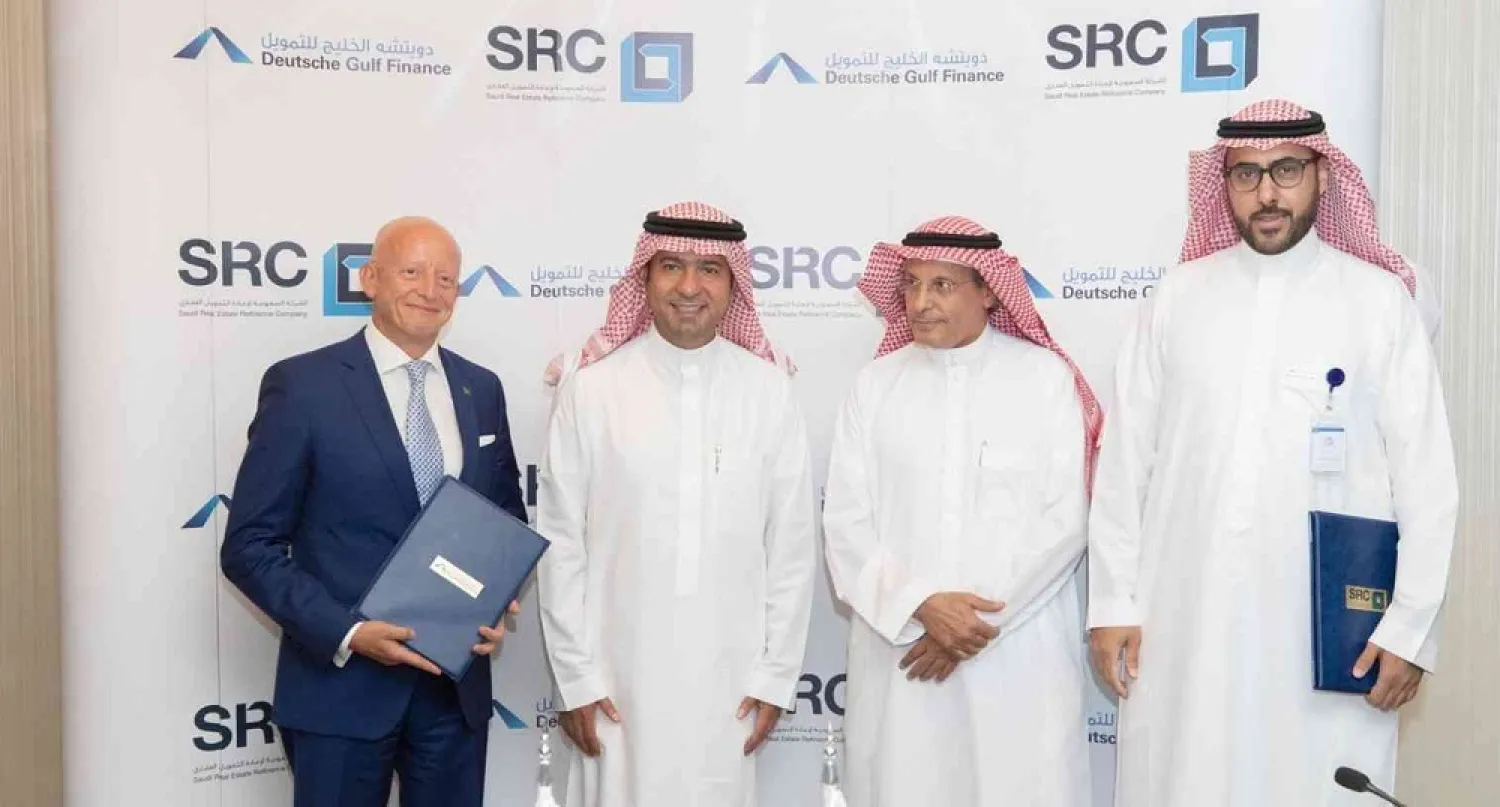

Saudi Real Estate Refinance, Deutsche Gulf Finance Ink Deal on Low Profits Mortgages

Saudi Real Estate Refinance Company (SRC) sign a partnership agreement with Deutsche Gulf Finance (DGF) to buy real estate portfolios.
TT

Saudi Real Estate Refinance, Deutsche Gulf Finance Ink Deal on Low Profits Mortgages

Saudi Real Estate Refinance Company (SRC) sign a partnership agreement with Deutsche Gulf Finance (DGF) to buy real estate portfolios.

The Saudi Real Estate Refinance Company (SRC), a subsidiary of the Saudi Public Investment fund (PIF), signed Sunday a partnership agreement with Deutsche Gulf Finance (DGF) to buy real estate portfolios.

The deal was signed in Riyadh under the patronage of Saudi Housing Minister Majed al-Hogail.

The agreement provides long-term mortgages with low profits and short-term financial facilities worth more than SAR2.25 billion ($600 million) in order to inject more liquidity into the housing sector and ensure the stability and growth of the mortgage market in the Kingdom.

It aims at reducing the annual rate of profit on the financing provided to citizens by DGF to 36 percent, which will increase the chances of Saudi families to own their houses.

Under the agreement, SRC will regularly acquire a portfolio of mortgages issued by DGF, thanks to a portfolio purchase program, as well as a short-term Murabaha financing (cost-plus financing) facility that allows warehousing the loans.

SRC CEO, Fabrice Susini told Asharq Al-Awsat that the company targets refinancing 20 percent of Saudi Arabia’s mortgage market, which is expected to grow to SAR500 billion ($133.3 billion) by 2020 and SAR800 billion ($213.3 billion) over the next 10 years.

He stressed that the SRC seeks to increase the rate of 20 percent of the refinancing in the mortgage market and redoubling its efforts in the next phase

Susini also explained in a press conference that the partnership agreement will contribute to pushing forward DGF’s plans to provide affordable home finance solutions to citizens and supporting SRC’s role to continue stimulating the development of the mortgage market.

He pointed out that this deal represents a strong and effective partnership that contributes to achieving the company’s objectives to increase home ownership rates and enable citizens wishing to own their homes to obtain mortgage finance more easily.

Acting CEO of DGF Mohammad al-Dowesh explained that the agreement reflects the continuous cooperation between the two companies to achieve the objectives of the Kingdom's Vision 2030 in raising the rate of citizens’ ownership of adequate housing.

Dowesh said it also represents an extension of the series of initiatives to develop the housing sector and provide the best financing solutions suitable for borrowers at a fixed rate for 25 years.



Egypt High-Speed Trains to Connect Red Sea, Mediterranean

Ships move through the Suez Canal, in Ismalia, Egypt, July 31, 2025. (Reuters)
TT

Egypt High-Speed Trains to Connect Red Sea, Mediterranean

Ships move through the Suez Canal, in Ismalia, Egypt, July 31, 2025. (Reuters)

Workers have started laying tracks in the desert east of Cairo for Egypt's first high-speed train, which will link the Red Sea and the Mediterranean in the latest attempt to modernize transport in the vast country.

Described by transport minister Kamel al-Wazir as a "new Suez Canal on rails", the project is slated to be completed in 2028, and will carry passengers and cargo the 660-kilometer (410-mile) distance in as little as three hours.

The Green Line, as it is known, is the latest of a long list of megaprojects undertaken by Egyptian President Abdel Fattah al-Sisi's government in the past decade -- the crowning jewel of which is the New Administrative Capital east of Cairo.

In 2021, Egypt signed a $4.5 billion contract with a consortium that includes German company Siemens to establish the Green Line, which will form the first of three high-speed tracks across the country.

Authorities hope the nearly 2,000 kilometer-network will carry 1.5 million passengers per day.

Egypt's existing train network -- used by a million people every day -- is plagued by infrastructure and maintenance problems that caused nearly 200 accidents last year, according to official figures.

The Green Line will run across the country's north, from Ain Sokhna on the Red Sea to Marsa Matrouh on the Mediterranean, crossing two Cairo satellite cities -- the New Administrative Capital to the east, and to the west 6th of October City, home to Egypt's only dry port.

- Urban planning bet -

According to Tarek Goueili, head of the National Authority for Tunnels, Egypt's revamped rail network will carry 15 million tons of cargo per year -- 3 percent of last year's Suez Canal transit volume.

For those behind it, the Green Line is also an urban planning bet.

"The high-speed line will ease pressure on Greater Cairo and encourage the emergence of new growth hubs," said Faical Chaabane of French company Systra, which is building the track.

In one desert station Systra showed reporters, workers on scaffolding have raised an imposing geometric ceiling over six open-air tracks.

Much of the New Administrative Capital that surrounds it is also still a construction site, home to government ministries where workers commute by bus every day.

With desert accounting for most of the country's million square kilometers, the vast majority of Egypt's 108 million people -- the Arab world's largest population -- are stacked vertically along the Nile River and its delta.

After its inauguration, the Green Line will be followed by the Blue Line, which will track the Nile linking Cairo to Aswan, and the Red Line, which will connect the Red Sea cities of Hurghada and Safaga inland to Luxor.


Saudi Air Navigation: Virtual Towers Boost Efficiency, Open Control and Maintenance Roles to Saudi Women

Virtual tower operations center – Air Navigation Services (Asharq Al-Awsat) 
TT

Saudi Air Navigation: Virtual Towers Boost Efficiency, Open Control and Maintenance Roles to Saudi Women

Virtual tower operations center – Air Navigation Services (Asharq Al-Awsat) 

Saudi Arabia is accelerating digital transformation in aviation as virtual air traffic control towers enter live operations, marking a first for the Middle East. Saudi Air Navigation Services Company said the technology is among its flagship digital initiatives to enhance air traffic efficiency and prepare Saudi airspace for rapid growth.

The company has also successfully enabled Saudi women to work in air traffic control and navigation systems maintenance after completing specialized training programs.

Eng. Ahmed Al-Zahrani, Chief Strategy and Sustainability Officer, told Asharq Al-Awsat that virtual towers are a cutting-edge global technology adopted as part of the company’s broader transformation drive.

Al-Zahrani explained that a virtual tower replaces the traditional structure with a digital system built on high-definition cameras and advanced target-tracking technologies at the airport. Controllers can perform their duties without direct line-of-sight, using zoom and data overlays unavailable in conventional towers, such as flight number, passenger count, origin, and destination.

The initiative has moved beyond theory: the company has already launched the region’s first virtual tower at AlUla International Airport, operated remotely from King Abdulaziz Airport in Jeddah. The project has also won the Ministry of Transport and Logistics Services’ Innovation Award.

Al-Zahrani said that virtual towers raise controller efficiency by enabling oversight of multiple airports from a single center, while improving safety and operational performance through clearer imagery and richer data.

Beyond technology, readiness depends on continuity. The company operates two primary air traffic control centers in Riyadh and Jeddah; if one is disrupted, the other can seamlessly manage Saudi airspace without service interruption.

Since its launch in June 2016, the company has aimed to rank among regional leaders in air traffic management. Today, it is one of the region’s foremost providers and is pursuing global leadership.

Air traffic continues to expand. By the end of November, flights totaled 921,095, up 5.7% year on year. A daily record was set on June 19, 2025, with 3,673 flights, averaging 153 per hour.

On workforce development, Al-Zahrani said women have begun work as controllers and maintenance specialists, demonstrating strong performance. The company employs about 2,000 staff, over 97% Saudi nationals, and 100% Saudis in air traffic control roles.

Sustainability underpins operations across environmental efficiency, social impact through national talent empowerment, and governance via integrity and compliance. On cybersecurity, the company adheres to top international standards and recently earned the global SOC-CMM certification, measuring operations readiness across people, processes, technology, services, and business integration.


US Economic Growth Surges in 3rd Quarter, Highest Rate in Two Years

Investment in artificial intelligence is expected to be a source of continued momentum for the US economy in 2026. ANDREW CABALLERO-REYNOLDS / AFP/File
TT

US Economic Growth Surges in 3rd Quarter, Highest Rate in Two Years

Investment in artificial intelligence is expected to be a source of continued momentum for the US economy in 2026. ANDREW CABALLERO-REYNOLDS / AFP/File

US economic growth in the third quarter came in at 4.3 percent on an annualized basis, easily topping expectations, according to Commerce Department data released Tuesday. 

The report, which also showed an acceleration in inflation, provides reassurance about the world's largest economy after other recent data showing a weakening labor market. It comes as worries have moderated over President Donald Trump's tariffs and as large tech companies advance massive investments to build new artificial intelligence infrastructure. 

The gross domestic product report -- delayed for nearly two months due to a government shutdown -- reflects increases in consumer spending, exports and government spending, partially offset by a decrease in investment, according to the department's Bureau of Economic Analysis. 

The reading, an initial estimate expected to be updated in early 2026, marks the highest GDP in two years. Analysts had expected 3.2 percent growth, according to consensus estimates from MarketWatch and Trading Economics. 

The report also showed the price index for domestic purchases rose 3.4 percent, a much higher inflation reading compared with 2.0 percent in the second quarter. 

The data suggest faster growth and higher inflation than markets had expected -- potentially changing the calculus for upcoming US monetary policy decisions. 

Trump pointed to the report as evidence that the "Trump Economic Golden Age is FULL steam ahead," the product of a "genius" policy on tariffs and "NO INFLATION," disregarding line-item aspects of the data showing otherwise. 

Other recent data has shown a weakening job market that has prompted the Federal Reserve to cut interest rates at the last three meetings, viewing the employment picture as its prime concern even as inflation has lingered above two percent. 

- 'Resiliency of US consumers' - 

Heather Long, chief economist at the Navy Federal Credit Union, wrote that the report shows the resiliency of US consumers, boding "well for 2026." 

"If the economy can avoid widespread layoffs, most American consumers can keep spending," she said. 

Joe Brusuelas, chief economist at RSM US, said the GDP data suggest that while growth has been robust, job creation remains "soft" and this dynamic "is likely to be the major economic narrative looking forward into 2025." 

The report also falls into the trend of what economists have described as "K-shaped," where consumption is driven by the wealthy, Brusuelas wrote. 

US stocks were little changed following the GDP data, as some saw lower odds that the Fed will again cut next month. 

"I think the implication is that with the GDP numbers being as strong as they are, that gives the Fed additional reason to be on hold at the January (Fed) meeting," said CFRA Research's Sam Stovall. 

While inflation remains well above the Fed's two percent target, Fed Chair Jerome Powell and other policymakers have described the weakening employment market as the greater concern at the moment. 

The Fed's median 2026 GDP forecast is 2.3 percent, up from 1.7 percent projected in 2025, according to a summary of the central bank's outlook. 

The data shows "an economy that is growing, but unevenly, one where inflation is still running well above the (Fed's) target," said Mike Fratantoni, chief economist of the Mortgage Bankers Association, who predicted just one rate cut in 2026. 

- Ebbing tariff angst - 

Tuesday's report reflects a much improved US macroeconomic outlook compared with earlier in 2025, when worries about Trump's aggressive trade policy changes weighed on sentiment. 

But by the latter stages of 2025, Trump's administration had negotiated agreements with China and other major economies that prevented enactment of the most onerous tariffs. 

Meanwhile, an AI investment boom by Chat GPT-maker OpenAI, Google and other tech giants continued to pick up momentum, keeping the US stock market near record levels. 

A December 18 outlook piece from S&P Global Ratings said AI investment would likely buoy the economy but could be offset by political uncertainty under Trump. 

"US trade policy uncertainty has settled down, but not US policy drama overall," S&P said. 

"Statutory US tariff rates may not move much in 2026, but uncertainty around laws, norms, investment rules, military actions and geopolitics more generally will remain elevated," S&P said. "This uncertainty will likely dampen investment and discretionary consumption."