


USA 94 – 25 Years On: Football’s Evolution Captivates the World

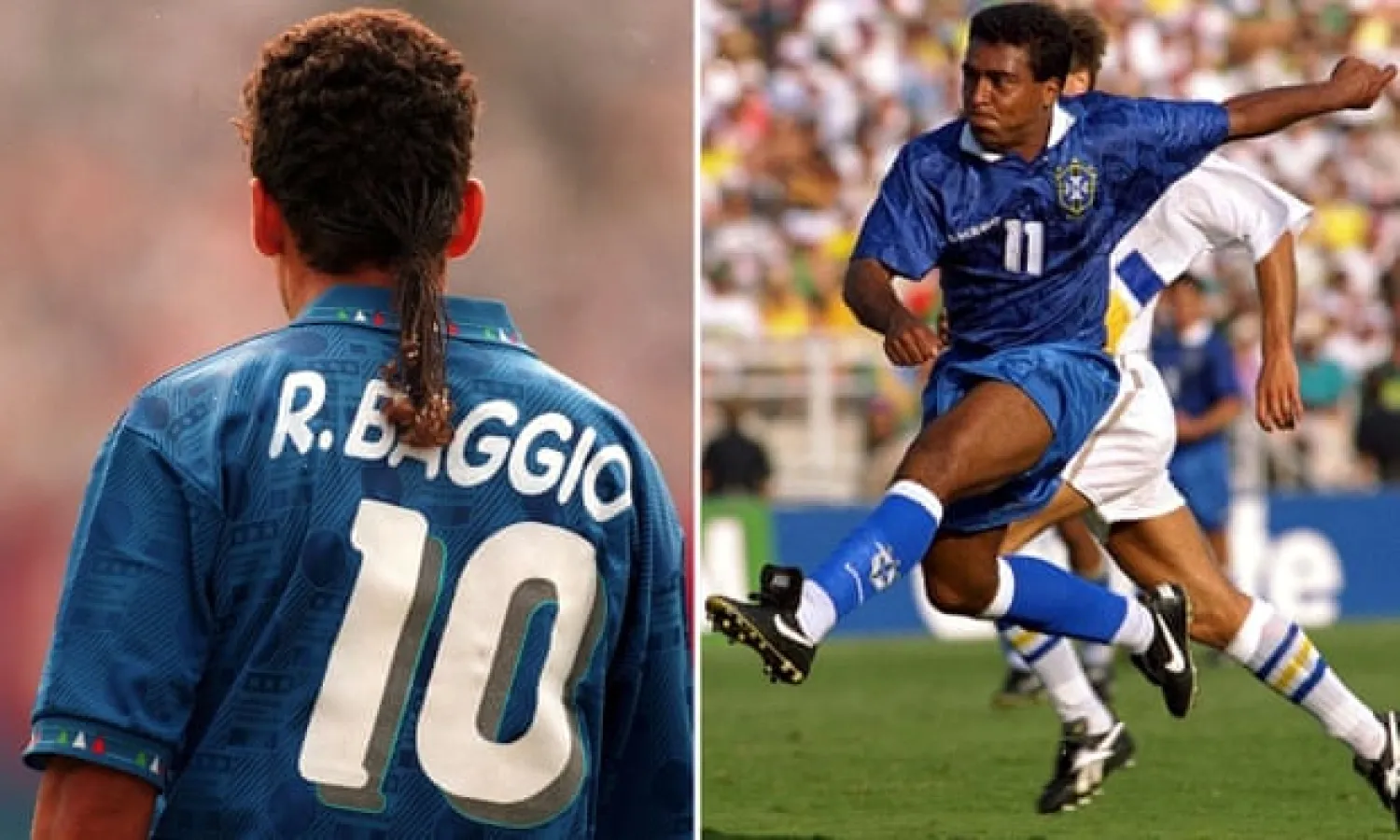
 Italy’s Roberto Baggio and the Brazil striker Romário were among the stars of the 1994 World Cup. Composite: Getty Images, Action Images
Italy’s Roberto Baggio and the Brazil striker Romário were among the stars of the 1994 World Cup. Composite: Getty Images, Action Images
TT

USA 94 – 25 Years On: Football’s Evolution Captivates the World

 Italy’s Roberto Baggio and the Brazil striker Romário were among the stars of the 1994 World Cup. Composite: Getty Images, Action Images
Italy’s Roberto Baggio and the Brazil striker Romário were among the stars of the 1994 World Cup. Composite: Getty Images, Action Images

A quarter of a century ago on Saturday millions of people all over the planet stopped what they might normally be doing to watch the World Cup semi-finals. Both games were played on the same day. First up Italy v Bulgaria at the Giants Stadium, New Jersey. Roberto Baggio was one of those players blessed with a style and personality that always felt singular. He arrived at USA 94 as the reigning World Player of the Year, was at the peak of his powers, and had elevated himself from an underwhelming group stage to inspire his nation through the knockouts with goal after important goal.

Bulgaria were a team full of cult heroes, one of whom was bald and brilliant; another looked like a werewolf, and then there was the maverick Hristo Stoichkov. But it was Baggio who stole the day. He played through the pain of a damaged hamstring and scored both Italy’s goals with typical balance, imagination and precision. “Incredible!” yelled John Motson. “Just look at this!” More of Baggio later.

The second semi-final was at the Rose Bowl in Pasadena and pitched one of the surprises of the tournament, an excellent Sweden team, against the mastery of Brazil led by a strike force of Romário and Bebeto (he of the rocking baby celebration), who pulled their team to the final.

Meanwhile, a germ of an idea that had formed in the mind of a couple of film directors from Germany and Argentina was coming to fruition. They wanted to portray this concept that people in diverse circumstances all around the world could be captivated by one moment through the medium of live television. They organised for 40 film crews to film fans in different countries watching the final. The Final Kick proved to be a brilliant documentary that was both of and ahead of its time. It flits not just between gatherings in an Italian bar or a Brazilian square but a harem in Cameroon where the chief is being fanned as he watches, a factory in Iran where the workers all clock off to watch a small screen, a monastery in the Czech Republic where an old telly is wheeled out of a cupboard for the monks to observe.

What the film captures so well is the tentacles of the appeal of the World Cup, and USA 94 was a significant milestone because it was in many ways the first modern tournament. It was the first time Fifa sought to take the prize of hosting outside the traditional football environments of Europe and Latin America. In 1994 there was no professional league in America. Since then, the World Cup has moved on other emerging markets, to Asia, Africa and now heads to the Middle East. It was a major turning point in terms of football’s mad dash towards globalisation, attracting mass interest and evolving as a cultural phenomenon.

Another example of the change in how events are consumed was witnessed during the tournament as the chase for OJ Simpson’s white bronco showed the power of a live-televised international rolling news story.

The 1994 World Cup was supposed to be a game changer for growing the game in the USA. A year previously MLS was founded as part of the bid to host the tournament. It was not actually up and running, though, until 1996. Did America fall in love with football enough during USA 94 to kick start a revolution? It was more of a slow burn. But today MLS is increasingly popular.

Colombia’s Andrés Escobar scores an own goal at USA 94. He was murdered in Medellín not long after. Photograph: Romeo Gacad/AFP/Getty Images
As giant European clubs full of multinational squads owned by foreign investors head off for pre-season tours to meet their global fanbase, roots can be traced back to the summer of 94. There were some memorable football moments that have lasted the test of time, from the Republic of Ireland beating Italy in front of a massive, raucous crowd at Giants Stadium to Saeed al-Owairan’s virtuoso run for Saudi Arabia against Belgium, from Diego Maradona’s crazed goal celebration and subsequent expulsion from the World Cup to the tragedy of Andrés Escobar, the Colombian defender murdered back in Medellín shortly after scoring an own goal.

And so, come 17 July, the watching world switched and zoomed in on Brazil v Italy. A heavyweight final. Perhaps the difference could be distilled by the fact Brazil expected of Brazil whereas Italy expected of Baggio.

They slugged it out until penalties. On this supersized stage Brazil kept their nerves while Italy wilted. That paragon of defensive excellence Franco Baresi missed, followed by European Cup final goalscorer Daniele Massaro. But it was the sight of Baggio lifting the ball over the bar that broke Italian hearts most. For he had been so heroic and had created the impression to make people believe he would win his country the World Cup – not quite on his own but mostly by virtue of his own will and wonders. To this day, everywhere where football is played, where a kid playing grassroots ends up bawling that he or she has missed the defining penalty in a shootout, adults try to console by reeling off the story of how the greatest player of his time did that at a World Cup final.

After Diana Ross’s showbiz missed penalty opened the tournament, the human drama of Baggio’s brought it to an emotional close. Over and out. Still, after these years, and for more to come, the memories endure.

The Guardian Sport


Real Madrid Replaces Coach Xabi Alonso with B Team Manager Alvaro Arbeloa

Real Madrid's defender Alvaro Arbeloa celebrates after scoring a goal during the Spanish league football match Real Madrid CF vs UD Almeria at the Santiago Bernabeu stadium in Madrid on April 29, 2015. (AFP)
TT

Real Madrid Replaces Coach Xabi Alonso with B Team Manager Alvaro Arbeloa

Real Madrid's defender Alvaro Arbeloa celebrates after scoring a goal during the Spanish league football match Real Madrid CF vs UD Almeria at the Santiago Bernabeu stadium in Madrid on April 29, 2015. (AFP)

Real Madrid replaced coach Xabi Alonso with B team manager Alvaro Arbeloa on Monday.

Madrid said in a statement that Alonso left by mutual agreement.

The announcement came a day after Madrid lost to Barcelona 3-2 in the final of the Spanish Super Cup in Saudi Arabia. It ended a tumultuous stint that lasted less than eight months for the former Madrid and Spain midfielder.

“Real Madrid wishes to announce that, by mutual agreement between the club and Xabi Alonso, it has been decided to bring his time as first team coach to an end,” Madrid said. “Xabi Alonso will always carry the affection and admiration of all Madridistas because he is a Real Madrid legend and has always represented the values of our club. Real Madrid will always be his home.”

The club thanked Alonso and his coaching staff for “their hard work and dedication throughout this time and wish them the best of luck in this new stage of their lives.”

Alonso was under pressure as the team struggled to play well under his command. He had spats with players such as Vinícius Júnior and widespread media reports said he'd lost the locker room.

Madrid trails Barcelona by four points at the halfway point of La Liga.

Like Alonso, Arbeloa is a former player of the Spanish powerhouse, helping it win eight titles from 2009-16, including two European Cups and one Spanish league. Arbeloa also helped Spain win the 2010 World Cup and the 2008 and 2012 European Championships.

He had been coaching the B team since June. He had also coached youth teams at the club.

Alonso arrived in May with high expectations and a contract to June 2028. He led Bayer Leverkusen to an unprecedented German league and cup double in his first full season after taking over the team when it was in the Bundesliga relegation zone the season before.

As a midfielder, Alonso won six titles with Madrid from 2009-14 and a World Cup and Euros champion teammate of Arbeloa's.


Teenage Super Sub Mbaye Could Prove Decisive for Senegal

Senegal's Ibrahim Mbaye celebrates after scoring during the Africa Cup of Nations best of 16 soccer match between Senegal and Sudan in Tangier, Morocco, Saturday, Jan. 3, 2026. (AP)
TT

Teenage Super Sub Mbaye Could Prove Decisive for Senegal

Senegal's Ibrahim Mbaye celebrates after scoring during the Africa Cup of Nations best of 16 soccer match between Senegal and Sudan in Tangier, Morocco, Saturday, Jan. 3, 2026. (AP)

Senegal’s 17-year-old Ibrahim Mbaye has emerged as a potential future star for African football, and his role as a super substitute at ​the Africa Cup of Nations could yet prove decisive for his team.

One of a number of exciting new players on display over the last three weeks at the tournament in Morocco, Mbaye has made the biggest impact, featuring in each of Senegal’s matches off the bench.

As they prepare to face Egypt in Wednesday’s semi-final in Tangiers, his impact will be part of the planning as Senegal look to advance to Sunday’s final.

His powerful and pacy running, dribbling skills, and a sharp nose for goal have given Senegal a ‌serious addition ‌to their already much-vaunted attack.

“He’s a gem, and we need ‌to ⁠nurture ​him,” said ‌coach Pape Bouna Thiaw.

“We know what he can bring to this team, and we will do everything we can to ensure he thrives and is at his best.”

Mbaye netted in Senegal’s 3-1 win over Sudan in the round of 16, officially becoming, at 17 years, 11 months, and 11 days, the second youngest scorer in tournament history. The youngest is Chiva Nzigou of Gabon, who was allegedly 16 when he scored in the 2000 finals, but has since ⁠admitted being an age cheat, although the record is not expunged.

Mbaye, who turns 18 this month, was close to a ‌goal in Senegal’s second group game against the Democratic ‍Republic of Congo when he was brought ‍on a minute after the Congolese took the lead in Tangiers.

IMPACT EIGHT MINUTES AFTER ‍COMING OFF THE BENCH

Eight minutes later, a surging run down the right led to him firing off a shot that the goalkeeper could not hold, allowing Sadio Mane to equalize.

"He has this spark within him. He's young, but you don't notice that on the pitch. Every time he comes on, ​he brings something extra," said Senegal teammate Krepin Diatta.

Mbaye won his first cap in November, in a friendly against Brazil, having one month previously played ⁠for France’s under-19 team, with Thiaw visiting him at Paris St Germain to persuade him to switch allegiance.

"It was easy to convince the player. Ibrahim wanted to play for Senegal," said the coach.

They had been tracking him from last season when PSG used him as a starter for their opening match of the Ligue 1 campaign. He was an unused substitute in the Champions League final against Inter Milan in May and this season has started eight times for the French giants, including October’s Champions League win at Barcelona.

Thiaw says the experience of rubbing shoulders with Senegal’s top players will be beneficial for Mbaye.

“He is in a squad where he has the chance to work with players like Sadio Mane, who has won everything ‌and can guide him, like Kalidou Koulibaly and Gana Gueye, who are familiar with the highest level. Now, we need to protect him properly,” added the coach.


Barcelona Beats Real Madrid Again to Win Spanish Super Cup in Saudi Arabia Clasico

Players of Barcelona celebrate with the trophy after winning the Spanish Super Cup final soccer match between Barcelona and Real Madrid in Jeddah, Saudi Arabia, 11 January 2026. (EPA)
TT

Barcelona Beats Real Madrid Again to Win Spanish Super Cup in Saudi Arabia Clasico

Players of Barcelona celebrate with the trophy after winning the Spanish Super Cup final soccer match between Barcelona and Real Madrid in Jeddah, Saudi Arabia, 11 January 2026. (EPA)

Raphinha scored twice as Barcelona beat Real Madrid 3-2 on Sunday in the final of the Spanish Super Cup played in Saudi Arabia.

Raphinha's 73rd-minute winner came in a fortuitous manner after he slipped while shooting and the shot deflected off Madrid defender Raúl Asencio to fool goalkeeper Thibaut Courtois.

The clasico final featured a hectic end to the first half when three stoppage-time goals were scored before the break, two by Real Madrid and one by Barcelona. Barcelona beat Madrid 5-2 in last year's final, when Raphinha also scored twice.

“We gave all we had,” Raphinha said. “I was emotional at the end of the match, we needed a win like this."

It was the 16th Super Cup title for Barcelona, more than any other club. Madrid is second with 13 titles.

Kylian Mbappé, who had missed the semifinals of the mini-Super Cup tournament because of a knee issue, entered the match in the 76th but couldn't do enough to help Madrid equalize. The France forward missed Madrid’s win over Atletico Madrid in the semifinals on Thursday but then traveled from Spain to Saudi Arabia to be available for the final of the mini-tournament.

Robert Lewandowski also scored for Barcelona. Madrid’s goals were scored by Vinícius Júnior and Gonzalo García.

The trophy was lifted by Barcelona defender Ronald Araujo, who had been out since November because of private reasons. Spanish media reports said he was on a mental health break.

The Catalan club opened the scoring in Jeddah on Sunday with Raphinha in a breakaway in the 36th. Madrid equalized with a superb goal from Vinícius two minutes into first-half added time, with the Brazil forward capping a nice run by splitting a couple of defenders before scoring from inside the area.

Vinícius hadn’t scored in 16 matches with Madrid, since October.

Lewandowski put Barcelona back ahead two minutes after Vinícius’ goal, and García evened the game again three minutes later at the end of the first half.

Madrid had two golden chances to equalize again in added time but couldn't capitalize on them.

“We have to turn the page as soon as possible,” Madrid coach Xabi Alonso said. "It’s just one game, one competition, and it’s the least important one we have. We have to look ahead, try to get everyone back together, recover our morale, and move on.”

Barcelona midfielder Frenkie de Jong was sent off in second-half stoppage time.

Barcelona reached the Super Cup final by routing Athletic Bilbao 5-0, while Madrid defeated Atletico Madrid 2-1.

Barcelona is the first league champion in eight seasons to win the Super Cup, and the first team to retain the trophy since Pep Guardiola’s team won three in a row in 2010, 2011 and 2012.
