

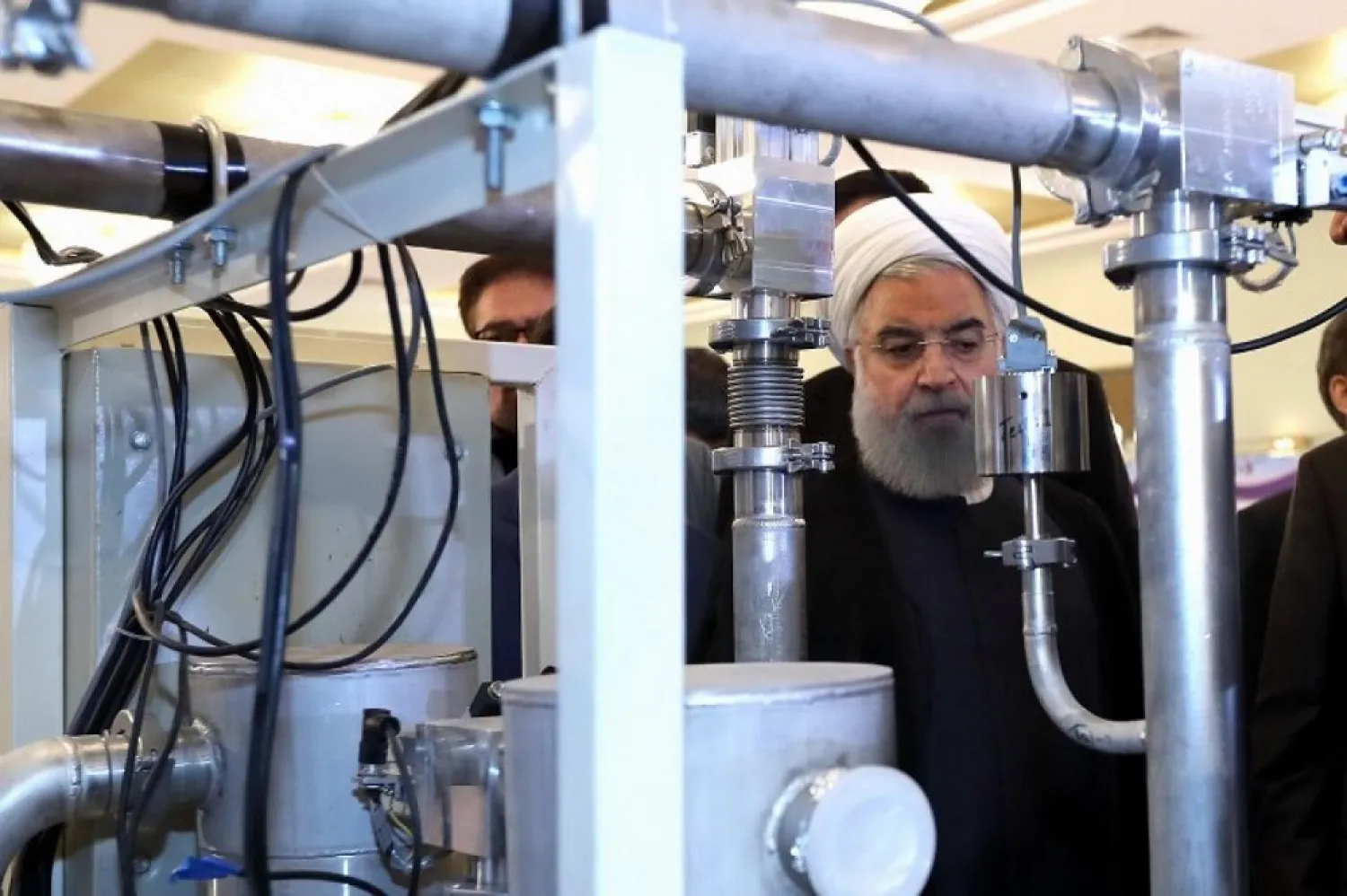

IAEA: Iran Installing More Advanced Centrifuges for Uranium Enrichment

Iran is moving towards enriching uranium by installing more advanced centrifuges in breach of the 2015 nuclear deal. (AFP)
TT

IAEA: Iran Installing More Advanced Centrifuges for Uranium Enrichment

Iran is moving towards enriching uranium by installing more advanced centrifuges in breach of the 2015 nuclear deal. (AFP)

Iran is moving towards enriching uranium by installing more advanced centrifuges in breach of the 2015 nuclear deal with world powers, the International Atomic Energy Agency said on Monday.

The deal only lets Iran produce enriched uranium with just over 5,000 of its first-generation IR-1 centrifuge machines. It can use far fewer advanced centrifuges for research but without accumulating enriched uranium.

But in response to US sanctions imposed since Washington withdrew from the deal in May last year, Iran has been breaching the limits it imposed on its atomic activities step by step.

Last week Tehran said it would breach the deal’s limits on research and development, the term applied to Iran’s use of advanced centrifuges.

An IAEA spokesman said Iran had informed it that it was making modifications to accommodate cascades - or interconnected clusters - of 164 of the IR-2m and IR-4 centrifuge. Cascades of the same size and type were scrapped under the deal.

Inspectors from the UN nuclear watchdog have verified that smaller numbers of various advanced centrifuges had been or were being installed, the spokesman added.

“All of the installed centrifuges had been prepared for testing with UF6,” though none of them were being tested with UF6 on Sept. 7 and 8, he said, referring to the uranium hexafluoride feedstock for centrifuges.

He added that Iran had told the agency it would modify lines of research centrifuges so that enriched uranium was produced, which is not allowed under the deal.

In a confidential report to member states, the IAEA also said Iran had made those modifications on some lines.

Iran defended Sunday its decision to use advanced centrifuges as IAEA acting chief Cornel Feruta urged Tehran to offer "time and active cooperation" with his inspectors.

Feruta met with Iranian Foreign Minister Mohammad Javad Zarif and Ali Akbar Salehi, the head of Iran's nuclear program, while in Tehran.

He is serving as the IAEA's acting director after the death of late director-general Yukiya Amano in July.

While Iran continues to pull away from the deal, Tehran has made clear it wants IAEA inspectors to continue their work. But officials blamed European leaders for being unable so far to offer a way for Iran to sell its crude oil around US sanctions.

A proposal by France to offer a $15 billion line of credit failed to materialize. China, Britain, France, Germany and Russia all were parties to the accord.



Germany Warns against Jeopardizing Peace after Trump's Venezuela Tanker Blockade

A man pauses on a pedestrian bridge as a German flag flies over the Reichstag building in Berlin on October 23, 2024. (AFP)
TT

Germany Warns against Jeopardizing Peace after Trump's Venezuela Tanker Blockade

A man pauses on a pedestrian bridge as a German flag flies over the Reichstag building in Berlin on October 23, 2024. (AFP)

Germany has taken note of US President Donald Trump's order to blockade sanctioned oil tankers entering and leaving Venezuela and warned against any steps that would jeopardize peace and security in the region, said a foreign ministry spokesperson, Reuters reported.

"The German government has an interest in preventing the situation in the region from deteriorating further," he noted.

"We are therefore viewing the overall situation with concern," said the spokesperson at a government press conference on Wednesday.


Spanish Police Evict Hundreds of Migrants from Squat Deemed Safety Hazard

Migrants confront police as they begin carrying out eviction orders at an abandoned school building where hundreds of mostly undocumented migrants had been living, in Badalona, near Barcelona, Spain, Wednesday, Dec. 17, 2025. (AP Photo/Emilio Morenatti)
TT

Spanish Police Evict Hundreds of Migrants from Squat Deemed Safety Hazard

Migrants confront police as they begin carrying out eviction orders at an abandoned school building where hundreds of mostly undocumented migrants had been living, in Badalona, near Barcelona, Spain, Wednesday, Dec. 17, 2025. (AP Photo/Emilio Morenatti)

Police in northeastern Spain carried out eviction orders Wednesday to clear an abandoned school building where hundreds of mostly undocumented migrants were living in a squat north of Barcelona.

Knowing that the eviction in the middle of winter was coming, most of the occupants had left to try to find other shelter before police in riot gear from Catalonia's regional police entered the school’s premises early in the morning under court orders. Those who had waited left peacefully.

The squat was located in Badalona, a working class city that borders Barcelona. Many sub-Saharan migrants, mostly from Senegal and Gambia, had moved into the empty school building since it was left abandoned in 2023.

The mayor of Badalona, Xavier García Albiol, announced the evictions in a post on X. “As I had promised, the eviction of the squat of 400 illegal squatters in the B9 school in Badalona begins," he wrote.

The judicial order obliged the Badalona town hall to provide the evicted people with access to social services, but it did not oblige local authorities to find housing for all the squatters.

Lawyer Marta Llonch, who represents the squatters, said that many people would surely end up without shelter in the cold.

“Many people are going to sleep on the street tonight,” Llonch told The Associated Press. “Just because you evict these people it doesn’t mean they disappear. If you don’t give them an alternative place to live they will now be on the street, which will be a problem for them and the city.”

Many of the squatters lived from selling scrap metal collected from the streets. Others had residency and work permits but were forced to live there because they couldn't afford housing during a cost-of-living crunch that is making it difficult even for working Spaniards to buy or rent homes. That housing crisis has led to widespread social angst and public protests.

On leaving the school, people loaded their belongings onto carts, some used as trailers led by bicycles, to haul them away.

García Albiol, of the conservative Popular Party, has built his political career as Badalona's long-standing mayor with an anti-immigration stance.

The Badalona town hall had argued that the squat was a public safety hazard. In 2020, an old factory occupied by around a hundred migrants in Badalona caught fire and four people were killed in the blaze.

Like other southern European countries, Spain has for more than a decade seen a steady influx of migrants who risked their lives crossing the Mediterranean or Atlantic in small boats.


EU's Von der Leyen: Europe Must be Responsible for its Own Security

European Commission President Ursula von der Leyen speaks during a debate on the preparation of a European Council meeting, at the European Parliament in Strasbourg, eastern France, on December 17, 2025. (Photo by FREDERICK FLORIN / AFP)
TT

EU's Von der Leyen: Europe Must be Responsible for its Own Security

European Commission President Ursula von der Leyen speaks during a debate on the preparation of a European Council meeting, at the European Parliament in Strasbourg, eastern France, on December 17, 2025. (Photo by FREDERICK FLORIN / AFP)

Europe must be responsible for its own security, European Union Commission President Ursula von der Leyen said on Wednesday.

"This is no longer an option. It is a must," she told the European Parliament in Strasbourg.

She added that Europe "cannot afford to let others define its worldview," adding that while the US national security strategy is right to say that Europe's share of global GDP is declining, the United States is on "the same path."

The European Council meets on December 18 and 19 to discuss in particular the need to support Ukraine, transatlantic relations and the EU's strategic autonomy.