


Desperate Pleas to Free Women, Children from ISIS Camps in Syria

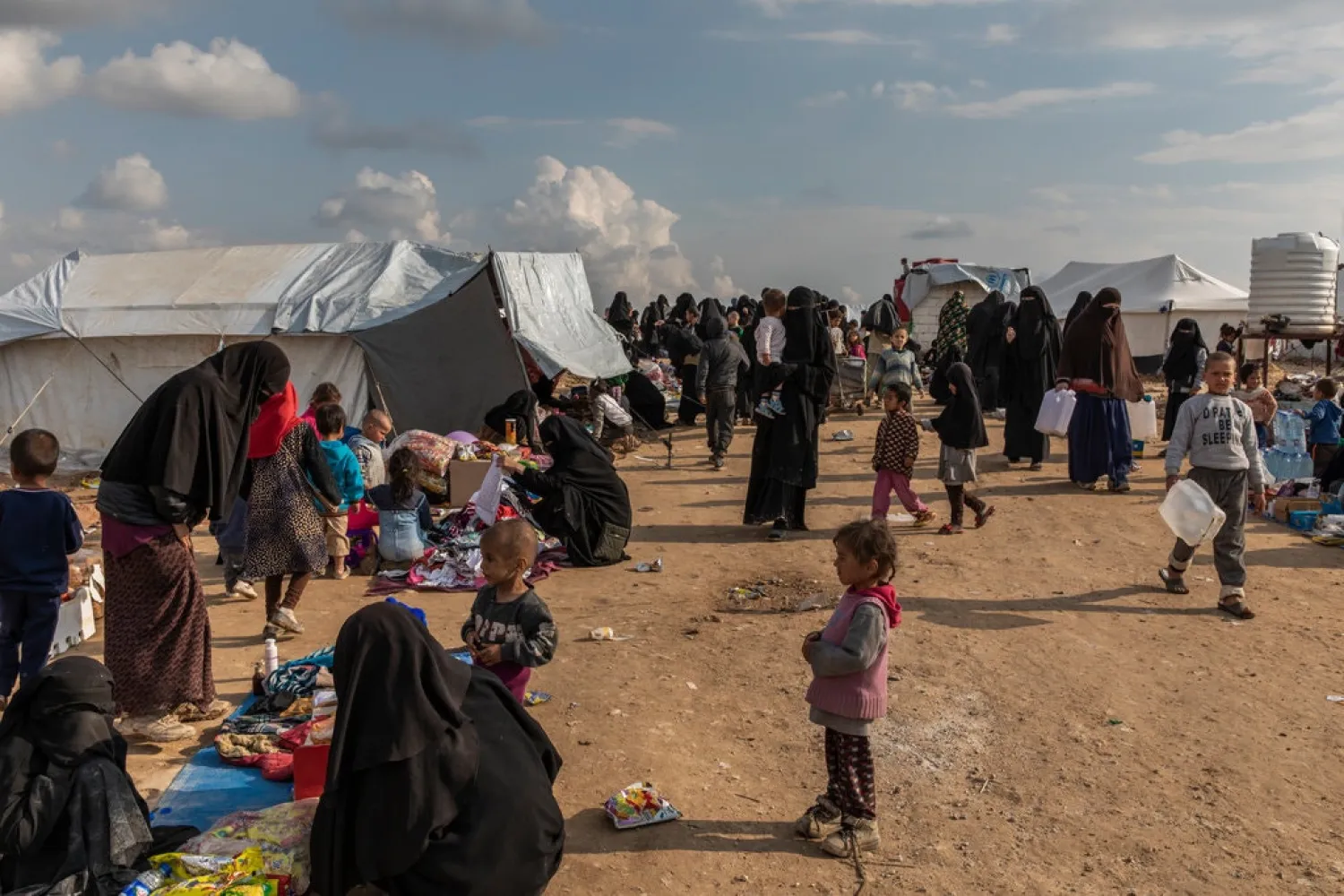
Women and children at al-Hol detention camp in Kurdish-controlled northern Syria in March. Credit: Ivor Prickett for The New York Times
TT

Desperate Pleas to Free Women, Children from ISIS Camps in Syria

Women and children at al-Hol detention camp in Kurdish-controlled northern Syria in March. Credit: Ivor Prickett for The New York Times

When Kamalle Dabboussy learned this month that President Donald Trump was removing troops from northeastern Syria, he pulled over in his car and wept.

For months, Dabboussy has been lobbying the Australian government to remove his daughter and three grandchildren from a detention camp for relatives of ISIS militants. Now, he believes, the window to save them is closing.

“It’s tough; it’s scary,” he told his daughter, Mariam, during a recent phone call. Dabboussy tried to comfort her. “We’re still pushing,” he said.

The fate of tens of thousands of women and children in Kurdish-run detainee camps in Syria has posed a challenge for governments around the world since ISIS lost its last territory there earlier this year. But the chaos and violence that have followed the American pullback have intensified questions about what duty nations have to citizens detained abroad, even those affiliated with a brutal terrorist group.

Dabboussy has been leading a contingent of about a dozen Australian families seeking the return of more than 65 relatives, most of them children. He has traveled to al-Hol, the camp where his daughter is being held in what he describes as unbearable conditions. He has spent months writing letters, calling politicians and uniting families who had kept the dark secret of their missing loved ones.

The women and children at al-Hol, from about 50 countries, have been largely shunned by their home governments. In Australia, top leaders have cited a long list of reasons they cannot be repatriated, including security concerns.

Even if a cease-fire announced late last week holds, the Australian government has said, it is still far too risky to consider extracting the detainees. Officials said they would not put other lives in danger to save the women and children.

“Parents, mothers and fathers, have made a decision to take children into a theater of war,” the home affairs minister, Peter Dutton, told reporters in Canberra, the capital, on Friday. “We’ve been very clear we’re not going to put Australian defense, foreign affairs or home affairs personnel or other agency staff at risk.” He added, “They’ve been fighting in the name of an evil organization, and there are consequences.”

The Australian government has maintained that at least some of the women joined ISIS willingly, and could pose a threat to national security. In some cases, it has even canceled the citizenship of fighters and family members it has deemed to be radicalized.

While many women from around the world joined the terrorist group of their own accord, the families of all the Australian women in al-Hol say they were coerced by husbands and other family members. Many say they are related by blood or marriage to Muhammad Zahab, a Sydney teacher turned ISIS militant, who they say delivered them to Syria.

Dabboussy says that his 28-year-old daughter, while on a vacation in Turkey, was tricked by her husband into going to the border with Syria. She was then forced to cross at gunpoint.

He and other family members of those inside al-Hol have become increasingly desperate to free them as fears have grown that Syrian government forces could displace the Kurds and take over the camp.

“That is a horrendous thought,” Dabboussy said. “Death might be the more merciful option.”

Conditions inside the camp were already miserable, with hundreds of children dying from disease and malnutrition, according to the United Nations Human Rights Council. Some women deemed apostates by more radicalized women have reported beatings and mutilation.

The Australian families argue that there are legal mechanisms to deal with the women, if necessary, after they return home. “We understand the rule of law,” Dabboussy said.

Lawyers representing the women argue that Australia has a constitutional duty to repatriate citizens and apply due process. These legal obligations include a duty to investigate crimes of an international nature, and to protect Australian citizens who are detained overseas, said Sarah Condon, one of the lawyers, who is based in Melbourne.

Policy experts also say that in some cases in which mothers are deemed to be radicalized, the state has a duty to take their children into its custody. Others argue that the government has a moral obligation to extract children who had no say in their parents’ journey to ISIS territory.

Some who study terrorism warn of the risks of leaving the women to potentially escape the camp amid the disarray. That, they argue, could help lead to a resurgence of ISIS.

“There are certainly threats and risks when you repatriate people, but there’s also risks to not addressing this issue,” said Lydia Khalil, a research fellow at the Lowy Institute in Sydney who specializes in the Middle East and international terrorism. She said the camp and other detention sites were “already hotbeds of further radicalization.”

United Nations Security Council resolutions mandate that countries take action to have their citizens who joined ISIS brought before the law.

But while “every government calls for other countries to repatriate their citizens,” said David Malet, a political scientist at American University in Washington, “most do what they can to avoid repatriating their own.”

Both President Trump and Secretary of State Mike Pompeo have urged other countries to take back their citizens. As of July, a handful had been repatriated to the United States, according to a report by the Rojava Information Center, a group that does research on the Kurdish areas of Syria.

Some countries with sizable Muslim populations have repatriated large numbers of detainees, and European countries have reportedly been looking at using the cease-fire to return women and children.

But Australia has brought home fewer than 10 children since the camp opened, mostly orphans.

The New York Times


2 US Service Members and One American Civilian Killed in Ambush in Syria, US Central Command Says

Residents ride a motorcycle along a war-damaged street in Palmyra, Syria. (AP)
TT

2 US Service Members and One American Civilian Killed in Ambush in Syria, US Central Command Says

Residents ride a motorcycle along a war-damaged street in Palmyra, Syria. (AP)

Two US service members and one American civilian were killed and three other people wounded in an ambush on Saturday by a lone member of the ISIS group in central Syria, the US military’s Central Command said. 

The attack on US troops in Syria is the first to inflict casualties since the fall of President Bashar al-Assad a year ago. 

Central Command said in a post on X that as a matter of respect for the families and in accordance with Department of Defense policy, the identities of the service members will be withheld until 24 hours after their next of kin have been notified. 

US Defense Secretary Pete Hegseth posted on X: “Let it be known, if you target Americans — anywhere in the world — you will spend the rest of your brief, anxious life knowing the United States will hunt you, find you, and ruthlessly kill you.” 

The shooting took place near historic Palmyra, according to the state-run SANA news agency, which earlier said two members of Syria’s security force and several US service members had been wounded. The casualties were taken by helicopter to the al-Tanf garrison near the border with Iraq and Jordan. 

SANA said the attacker was killed, without providing further details. 

The US has hundreds of troops deployed in eastern Syria as part of a coalition fighting the ISIS group. 

Last month, Syria joined the international coalition fighting against the ISIS as Damascus improves its relations with Western countries following the ouster of Assad when opposition factions overthrew his regime in Damascus. 

The US had no diplomatic relations with Syria under Assad, but ties have warmed since the fall of the five-decade Assad family rule. The interim president, Ahmed al-Sharaa, made a historic visit to Washington last month where he held talks with President Donald Trump. 

ISIS was defeated on the battlefield in Syria in 2019, but the group’s sleeper cells still carry out deadly attacks in the country. The United Nations says the group still has between 5,000 and 7,000 fighters in Syria and Iraq. 

US troops, which have maintained a presence in different parts of Syria, including al-Tanf garrison in the central province of Homs, to train other forces as part of a broad campaign against ISIS, have been targeted in the past.  

One of the deadliest attacks occurred in 2019 in the northern town of Manbij when a blast killed two US service members and two American civilians, as well as others from Syria while conducting a patrol. 


Israel Suspends Strike on Southern Lebanon Village After Lebanese Army Request

Smoke rises from the site of an Israeli strike that targeted the southern Lebanese, al-Mahmoudiyeh, Lebanon, Nov. 27, 2025. (AFP)
TT

Israel Suspends Strike on Southern Lebanon Village After Lebanese Army Request

Smoke rises from the site of an Israeli strike that targeted the southern Lebanese, al-Mahmoudiyeh, Lebanon, Nov. 27, 2025. (AFP)

Israel put a planned strike on a village in southern Lebanon on hold on Saturday after the Lebanese army requested access to the site to “address a breach” of a ceasefire agreement, an Israeli military spokesperson said.

Earlier in the day, Israel had issued an evacuation warning for the village of Yanouh ahead of what it said was a planned strike against infrastructure of the Hezbollah group.

“After the warning was issued, the Lebanese Army... requested permission to access the specified site again, which had been declared in violation, in order to address the breach of the agreement,” the Israeli military’s Arabic-language spokesperson, Avichay Adraee, said on X.

The Israel army “decided to allow this, and accordingly the airstrike was temporarily frozen.”

Israel and Lebanon agreed to a US-brokered ceasefire in 2024, ending more than a year of fighting between Israel and Hezbollah that had culminated in Israeli strikes that severely weakened the Iran-backed group. Since then, the sides have traded accusations over violations.

On Tuesday, Israel hit what it described as Hezbollah infrastructure in several areas of southern Lebanon.

Israel and Lebanon have both sent civilian envoys to a military committee monitoring their ceasefire, a step toward meeting a months-old US demand that they broaden talks in line with President Donald Trump’s Middle East peace agenda.


Israel Says Killed Top Hamas Weapons Figure in Gaza

Palestinians inspect the site of an Israeli strike on a car in Gaza City, December 13, 2025. (Reuters)
TT

Israel Says Killed Top Hamas Weapons Figure in Gaza

Palestinians inspect the site of an Israeli strike on a car in Gaza City, December 13, 2025. (Reuters)

Israel said it killed the head of weapons production in Hamas's military wing in a strike in the Gaza Strip on Saturday. 

The civil defense agency and medical sources in the Hamas-run Palestinian territory told AFP an Israeli strike killed five people in the Tel al-Hawa district, southwest of Gaza City. 

When contacted by AFP earlier on Saturday, the army did not say whether the strike reported in Tel al-Hawa was the same as the one mentioned in an army statement before the announcement that it had killed Hamas's Raed Saad. 

Israeli Prime Minister Benjamin Netanyahu and Defense Minister Israel Katz said in a joint statement that "in response to the detonation of a Hamas explosive device that wounded our forces today in the Yellow Area of the Gaza Strip... (they) instructed the elimination of the terrorist Raed Saad". 

Under the US-brokered ceasefire between Israel and Hamas in Gaza, Israeli troops have withdrawn to positions behind the so-called Yellow Line, though they are still in control of more than half the territory. 

Netanyahu and Katz described Saad as "one of the architects" of the October 7, 2023 attack on Israel that sparked the war in Gaza. 

The Israeli army said Saad was the head of the weapons production headquarters of Hamas's military wing who led the group's "force build-up". 

Family sources confirmed his death to AFP and said the funeral would be held on Sunday. 

Israel's military earlier on Saturday said two reserve soldiers were lightly injured "as a result of an explosive device that detonated during an operation to clear the area of terrorist infrastructure in southern Gaza". 

The ceasefire that came into effect on October 10 has halted the fighting between Israel and Hamas, but it remains fragile with each side accusing the other of violating its terms. 

- Burnt-out car - 

Mahmud Bassal, a spokesman for Gaza civil defense which operates as a rescue force under Hamas authority, said five people were killed after "a civilian jeep-type vehicle was targeted near the Nabulsi roundabout in Tel al-Hawa". 

Bassal said the "charred" bodies were taken to Al-Shifa hospital after "Israeli warplanes targeted the civilian vehicle with three missiles, causing it to burn and its destruction". 

The hospital's emergency department confirmed to AFP the arrival of the five bodies and said more than 25 people were injured in the strike. 

AFP footage showed a mangled car with vehicle parts scattered around next to other debris. 

"Warplanes fired several missiles at the vehicle, setting it ablaze. Residents rushed to extinguish the fire, and charred body parts were scattered on the ground," a witness, who did not wish to give his name for security reasons, said in the Tel al-Hawa area. 

Another witness, a 34-year-old man living in a tent in the Tel al-Hawa area, said he "saw several Hamas members arrive at the site of the attack", without providing further details. 

Civil defense agency spokesman Bassal also said a 17-year-old boy and an 18-year-old boy were killed by Israeli fire in two separate incidents in Gaza.
