Libya depends on oil for nearly 98% of its income. Yet a central question persists: How are those revenues collected and spent in a country divided between rival governments? And why do Libyans complain of poverty when their country holds Africa’s largest oil reserves and produces and exports about 1.4 million barrels a day?
The process starts with the National Oil Corporation, which collects proceeds from crude oil and gas sales in US dollars and deposits them in accounts at the Libyan Foreign Bank. The money is then transferred to the Central Bank of Libya's accounts in Tripoli, recorded as state budget sovereign revenue, and converted into Libyan dinars.
The dollar trades at 6.36 dinars at the official rate, compared with 9.12 on the parallel market.
The Finance Ministry in Tripoli then issues spending authorizations under approved financial arrangements, after which the central bank releases funds to ministries and other state bodies through the main budget chapters.
Libya’s oil export revenues have swung sharply in recent years, ranging between $18 billion and $22 billion. They rose to about $18 billion in the first half of this year, nearly double the level in the same period last year, according to the Economy Ministry in the interim Government of National Unity.
Libyan oil expert Mohamed al-Shahati attributed the increase during that period to the war involving Iran.
Where is the breakdown?
Economists say Libya’s dependence on oil as its near-exclusive source of income lies at the heart of the crisis.
Ayoub al-Farsi, an economics professor at the University of Benghazi, said Libya showed how excessive reliance on natural resources could turn into a complex financial crisis when combined with political fragmentation and a lack of economic diversification.
“The Libyan economy is a clear example of how excessive dependence on natural resources can become a complex financial crisis,” he said, adding that political fragmentation and the absence of diversification had created conditions that directly affected people’s lives.
Al-Farsi, a member of the Central Bank of Libya’s Monetary Policy Committee, said the economy was built around a rentier-state model that depended almost entirely on oil exports to fund the treasury and provide foreign currency.
That dependence, he told Asharq Al-Awsat, had created deep structural distortions.
Agriculture and industry had been marginalized, the state bureaucracy had expanded to absorb workers into unproductive public-sector jobs, and the country had grown heavily dependent on imports for most consumer goods, he said.
Industrial activity remains limited, largely confined to the private sector and small-scale production. Critics also point to a market dominated by a small number of traders and importers, helping imported goods crowd out local production.
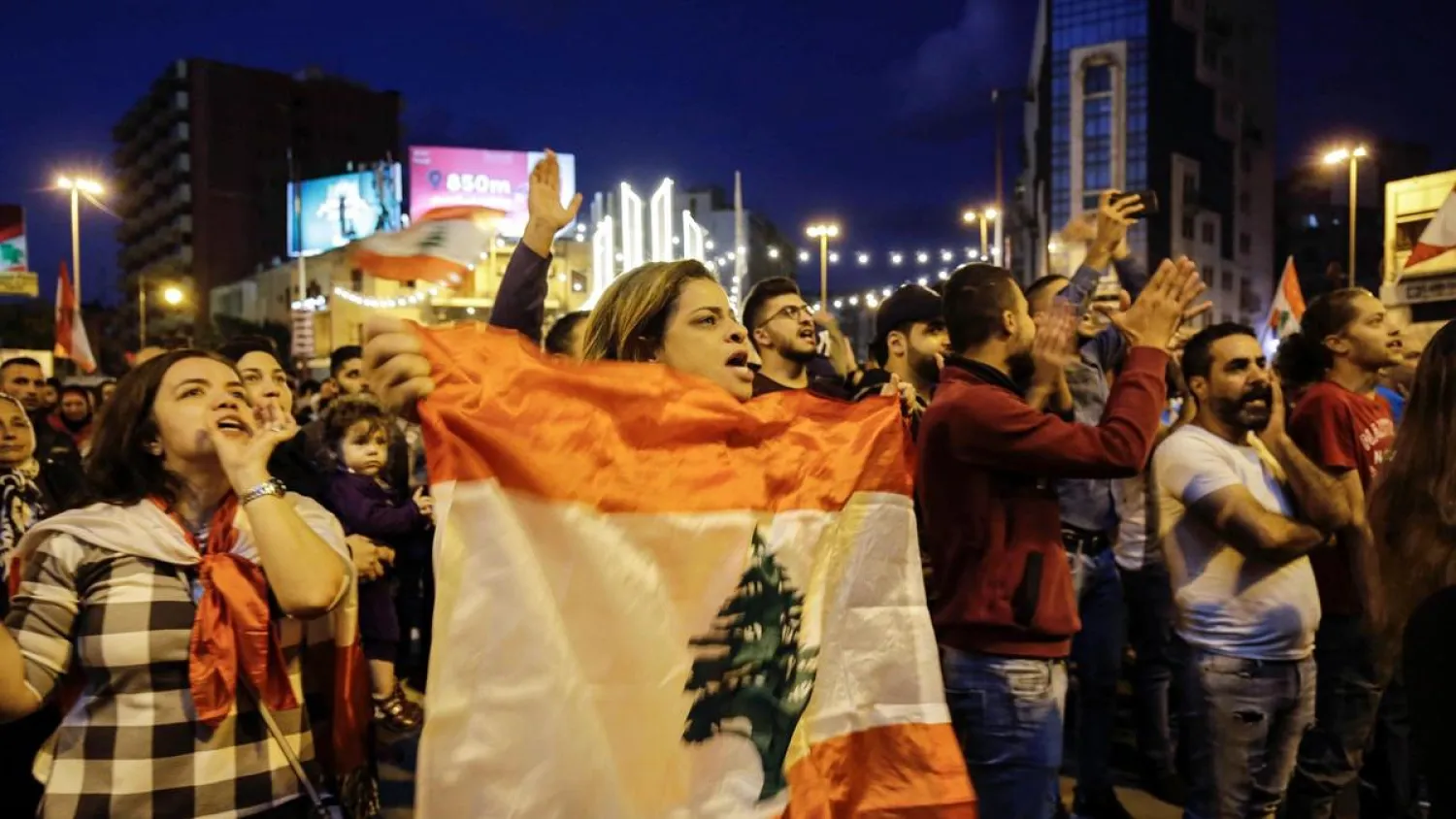
At protests across Libyan cities, the question is often the same: Where is the oil money going? Why are people struggling in an energy-producing country?
Al-Shahati said part of the answer lies in the difference between the value of the oil Libya produces and the amount that actually reaches the state treasury.
“Not every barrel produced in Libya is converted directly into a dollar entering the public treasury, because foreign partners have a share,” he told Asharq Al-Awsat.
Foreign companies have become production partners under various contractual arrangements, he said.
He also pointed to a stark contradiction: Libya produces oil, yet depends heavily on imports of gasoline, diesel, and other petroleum products to meet domestic demand.
That means a growing share of the country’s resources is converted into foreign currency to pay for fuel imports.
Al-Shahati said another problem was the lack of a regularly published, unified, and easy-to-read account that answers basic questions, such as: What was the total value of the oil produced? How much went to foreign partners? How much was exported for the state? How much went to the domestic market? And how much net revenue was actually available for public spending?
“The figures in circulation provide parts of the picture,” he said, “but they do not always show the full flow of revenues from the wellhead to the state’s public accounts.”
Libya’s oil fields are concentrated mainly in the eastern Sirte Basin, which holds about 82% of its oil reserves, as well as in the Murzuq Basin in the southwest and offshore areas along the coast.
Fuel and power crises
Those weaknesses in the oil revenue chain are unfolding as Libya grapples with a severe electricity crisis.
The country has suffered several “blackouts” in recent days, with some areas going without electricity for more than 17 hours a day.
Researcher Ezzedine Mokhtar sees the power cuts as one part of a wider pattern of recurring financial failures, including fuel shortages.
He blamed the hardship facing many Libyans on “corruption” and “unlimited spending” by two rival governments competing for power in the country’s east and west.
He also cited “oil smuggling through Arkenu, whose revenues go to specific individuals rather than the state treasury.”
Mokhtar said Libya’s subsidy system was another core problem, with more than 60% of the country’s budget going to fuel subsidies.
He called on the Tripoli government to phase out those subsidies gradually and to draw up a national plan to develop the workforce.
“We have no industrial skills in anything,” he said. “We import everything — yogurt, dairy products, fruit, vegetables, frozen fish, and even underwear. Everything comes from abroad.”
Libya ranks 10th globally in proven oil reserves, with about 48.3 billion barrels, according to Worldometer.
The UN Panel of Experts said in its latest report on Libya, covering October 2024 to February 2026, that Arkenu had moved at least $3 billion in oil revenues to bank accounts outside Libya between January 2024 and November 2025.
According to the report, Arkenu was established in 2023 as a private company and is indirectly controlled by Saddam Haftar, deputy commander-in-chief of the Libyan National Army. It faces accusations of “oil smuggling.”
Reuters previously investigated the company and concluded, based on shipping documents, London Stock Exchange Group data, and information from Kpler, that some oil revenues were being diverted away from the Central Bank of Libya.
How are revenues distributed?
Oil revenues are distributed across the four main chapters of the state budget, according to experts and economists.
Chapter One, salaries and wages, takes the largest share. It covers public-sector employees across eastern, western, and southern Libya through the unified national identification number system.
Chapter Two covers operating expenses for ministries and public institutions.
Chapter Three covers subsidies, including fuel, water, and electricity.
Chapter Four covers development and projects, including infrastructure, as well as allocations to the National Oil Corporation to sustain and increase production.
Al-Shahati said 26% of oil revenues went toward importing fuel products, equivalent to about $7 billion if crude traded at $70 a barrel.
This year, he said, the figure could rise to between $8 billion and $9 billion because oil prices had climbed above $85 a barrel and the gap between crude prices and diesel and gasoline prices had widened amid shortages.
He also pointed to higher domestic consumption driven by economic growth and a rise in smuggling.
A second problem, al-Shahati said, is the absence of an approved national budget, which would make it possible to determine how spending should be allocated among population groups and regions.
“What is clear is that the main cities control most spending,” he said.
He also pointed to “a large and obvious imbalance” in salaries across Libya’s three regions, job grades, and types of employment.
Those gaps, he said, risk widening financial divisions between social groups.
Even an agreement to unify development spending did not appear to be properly implemented because there were no clear standards and no comprehensive budget.
“There are no criteria for distributing oil revenues,” al-Shahati said. “The distribution process is random and unsustainable.”
Libya fell to 177th out of 182 countries in the 2025 Corruption Perceptions Index, from 173rd out of 180 countries in 2024, reflecting worsening corruption and no tangible improvement over the past two years.
Pressure on the local economy
A report by UN Secretary-General Antonio Guterres on Libya highlighted deep structural strains in the economy, driven by high public spending, near-total dependence on oil and gas revenues, and mounting pressure from food, fuel, and electricity prices.
The report, submitted to the UN Security Council on Aug. 17, covers the period from April 1 to July 28.
Citing the International Monetary Fund, it said Libya’s fiscal deficit reached 30% of gross domestic product last year, while public debt climbed to 146% of GDP.
Inflation also rose into double digits, eroding purchasing power.
The UN report noted unjustified increases in fuel consumption by military and security agencies and the energy sector, as well as repeated double purchasing.
The cost of institutional division
Libya’s political and institutional split and the presence of multiple authorities have made the economic crisis worse, al-Farsi said.
The distortions, he said, were no longer merely structural.
They had created parallel public finances and pushed consumer spending higher to meet the demands of rival authorities, sending salaries and subsidies to unprecedented levels.
Repeated shutdowns of oil fields in previous years, combined with lower actual revenues, pushed financial authorities toward deficit financing and higher public debt, al-Farsi said.
That flooded the market with money without a corresponding rise in domestic production.
Oil revenues reached $21.9 billion in 2025, according to the National Oil Corporation, up from $18.6 billion in 2024, an increase of 15%.
Al-Farsi said the deterioration in public finances had left monetary authorities in a difficult position and forced them into emergency measures to protect reserves and contain the deficit.
The result, he said, was a weaker national currency, liquidity shortages and a collapse in confidence.
Development tools had also been paralyzed.
“Monetary policy shifted from an instrument for stimulating growth and investment into a tool for managing daily crises,” he said.
Why has the crisis not been solved?
Economists point to several reasons.
Al-Shahati put “corruption spreading on an unprecedented scale” near the top of the list.
“Corruption is no longer confined to the margins,” he said. “It has come to dominate the core of public finances in key sectors, obstructing any attempt at reform.”
He also blamed the absence of an institutional vision following the breakdown of middle management, which had once linked fiscal and monetary policy to economic realities and provided unified political backing.
Policies, he said, had become detached from the economy and lost their ability to restore balance.
Conventional reforms that had worked elsewhere would not work in Libya, al-Shahati said, because the country lacked a central political authority capable of building an institutional vision and curbing corruption that had spread through both the state and private sector.
Al-Farsi said Libya could not escape its fiscal and monetary crisis without addressing the roots of the problem.
That meant unifying the management of public finances, curbing government spending, and launching genuine structural reforms that would gradually shift Libya from consuming oil rents to building a diversified economy.
Mokhtar also called on the Tripoli government to develop a strategic plan to make better use of human resources and support small and medium-sized industries.
For him, breaking Libya’s dependence on oil revenues is part of the way out.
Masoud Suleiman, chairman of Libya’s National Oil Corporation, said in media remarks last week that the country needed between $30 billion and $40 billion in investment to develop untapped oil and gas resources.
The corporation, he said, aims to raise production to 2 million barrels a day by 2030.