


Gareth Southgate Has Made England Likable Again but Slackness Remains

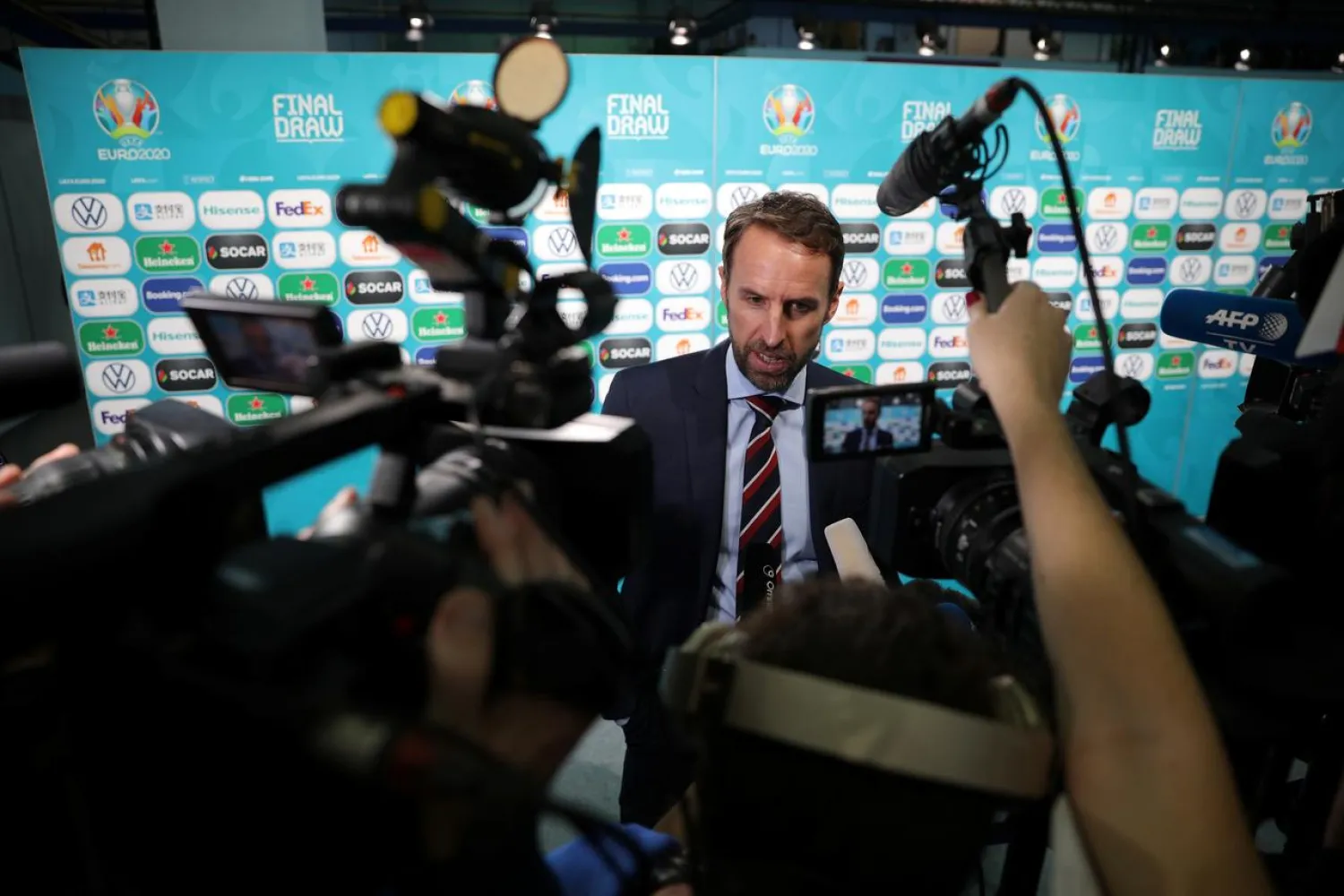
England manager Gareth Southgate is interviewed by the media after the Euro 2020 draw on November 30, 2019. (Reuters)
TT

Gareth Southgate Has Made England Likable Again but Slackness Remains

England manager Gareth Southgate is interviewed by the media after the Euro 2020 draw on November 30, 2019. (Reuters)

To these eyes, at least, it was not in a stadium that the saga of the England football team in the modern era reached its lowest point. It was not Kevin Keegan resigning in the Wembley washroom in 2000, or Steve McClaren watching helplessly from beneath an umbrella as Croatia denied his team a place in the Euro 2008 finals, or the stumbling capitulation to Iceland in Nice three years ago under Roy Hodgson. It came one afternoon in the middle of Fabio Capello’s four-year reign, in the very different surroundings of a Knightsbridge shopping street.

At the behest of the Football Association’s PR department, the notoriously aloof Capello had invited a large group of senior sports writers from national newspapers to lunch. This was a rare event, with the additional lure of the location: San Lorenzo, the famous Italian restaurant favored by Princess Diana, Jack Nicholson, Joan Collins and other celebs whose presence ensured the entrance was habitually patrolled by paparazzi.

The lunch was held under Chatham House rules, meaning nothing said would be repeated outside. The food was good and a couple of hours passed pleasantly enough. But no secrets were divulged. Capello said nothing about his tactics and gave no details of Wayne Rooney’s pre-match preparations. The Italian did a decent impersonation of geniality but seemed less than engaged. He left as soon as it was polite to do so, in the company of his assistant, Franco Baldini, one of the gaggle of compatriots hired to help him turn England from Sven-Göran Eriksson’s perennial quarter-finalists into champions.

A couple of minutes later, on leaving the restaurant and turning down Beauchamp Place, a street whose parking bays are generally filled with the Lamborghinis and Bentleys of high net worth individuals, and where the estate agents offer properties priced in the tens of millions, it was possible to observe Capello and Baldini standing side by side in animated conversation. They were examining, with great concentration, the window display of an upmarket jewelry shop, presumably thinking about how to spend some of the dosh lavished on them by the FA.

From the football perspective, it was a sight of pure decadence: a symbolic image of the way the game had changed and of the belief that money was the answer to everything. As we were to learn, paying a manager £6m a year and giving him carte blanche to hire his mates was a guarantee of nothing.

Capello made his abrupt exit in 2012, leaving behind a squad generally derided as overpaid and under-performing, just before the London Olympics persuaded us that we lived in a country where social tolerance and inclusivity, artistic creativity and sporting excellence continued to hold sway. Seven years later it is the England football team who appear to hold a beacon of enlightenment above the turmoil of a nation mired in public squalor, riven by seemingly insoluble arguments over the most basic of values and in danger of blowing apart under the strain of its own anger and self-importance.

Gareth Southgate’s achievement has been to apply not just his years of experience in football but also his natural qualities of decency, modesty, diligence and willingness to learn. In the process he has made the England team actually likable perhaps for the first time since Joe Mercer’s fondly remembered spell as caretaker between the sacking of Alf Ramsey and the arrival of Don Revie 45 years ago.

Not that you would have thought it as his players struggled for coherence and composure in the opening half-hour of their match against Kosovo last month. From front to back they were slack, sloppy and slovenly, passes misplaced or mistimed in a way that would have invited stronger opponents to take immediate advantage. This was an England familiar through the generations, seemingly entranced by an assumption of their own excellence and there for the taking.

In defense, in particular, it was an England reminding us the financial freedom of Premier League clubs to import a Virgil van Dijk or a N’Golo Kanté whenever necessary has suffocated the development of native-born specialists in the defensive arts. The cage football of south London may have helped produce a generation of delightfully expressive attackers but it has failed to provide Southgate with a rearguard of international quality.

He now has several months to observe events and wonder whether Joe Gomez or Fikayo Tomori will surpass John Stones and Tyrone Mings in the contest to provide Harry Maguire – himself fallible – with a reliable partner, whether the prodigious gifts of Trent Alexander-Arnold will outweigh his occasional moments of defensive negligence, and whether Declan Rice and Mason Mount can mature fast enough to justify their inclusion in his starting XI. At least Southgate can afford to be patient with Jadon Sancho and Callum Hudson-Odoi; neither is remotely the finished article but it was a wise decision to bring them into the squad and give them the feeling of belonging to the group.

Scoring seven against Montenegro and four against Kosovo is nothing to shout about but after the manager had guided them through the Sterling/Gomez altercation with his familiar blend of openness and realism, they continued to show an unselfish pleasure in each other’s achievements, relishing the sense of common purpose that is another of his achievements. They, too, are enjoying themselves.

When Southgate took the job three years ago, he was paid less than a third of Capello’s money. Since reaching the semi-finals of the 2018 World Cup, his salary has risen to £3m a year. Still a great deal of money, of course, but at least it no longer feels like filthy lucre.

The Guardian Sport


Shakhtar Boss Pays Ukrainian Racer $200,000 After Games Disqualification

Ukrainian President Volodymyr Zelenskiy holds helmet as he meets with a Ukrainian skeleton racer Vladyslav Heraskevych , who was disqualified from the Olympic skeleton competition over his "helmet of remembrance" depicting athletes killed since Russia's invasion and his father and coach, Mykhailo Heraskevych, amid Russia's attack on Ukraine, in Munich, Germany February 13, 2026. (Ukrainian Presidential Press Service/Handout via Reuters)
TT

Shakhtar Boss Pays Ukrainian Racer $200,000 After Games Disqualification

Ukrainian President Volodymyr Zelenskiy holds helmet as he meets with a Ukrainian skeleton racer Vladyslav Heraskevych , who was disqualified from the Olympic skeleton competition over his "helmet of remembrance" depicting athletes killed since Russia's invasion and his father and coach, Mykhailo Heraskevych, amid Russia's attack on Ukraine, in Munich, Germany February 13, 2026. (Ukrainian Presidential Press Service/Handout via Reuters)

The owner of ‌Ukrainian football club Shakhtar Donetsk has donated more than $200,000 to skeleton racer Vladyslav Heraskevych after the athlete was disqualified from the Milano Cortina Winter Games before competing over the use of a helmet depicting Ukrainian athletes killed in the war with Russia, the club said on Tuesday.

The 27-year-old Heraskevych was disqualified last week when the International Bobsleigh and Skeleton Federation jury ruled that imagery on the helmet — depicting athletes killed since Russia invaded Ukraine in 2022 — breached rules on athletes' expression at ‌the Games.

He ‌then lost an appeal at the Court ‌of ⁠Arbitration for Sport hours ⁠before the final two runs of his competition, having missed the first two runs due to his disqualification.

Heraskevych had been allowed to train with the helmet that displayed the faces of 24 dead Ukrainian athletes for several days in Cortina d'Ampezzo where the sliding center is, but the International Olympic Committee then ⁠warned him a day before his competition ‌started that he could not wear ‌it there.

“Vlad Heraskevych was denied the opportunity to compete for victory ‌at the Olympic Games, yet he returns to Ukraine a ‌true winner," Shakhtar President Rinat Akhmetov said in a club statement.

"The respect and pride he has earned among Ukrainians through his actions are the highest reward. At the same time, I want him to ‌have enough energy and resources to continue his sporting career, as well as to fight ⁠for truth, freedom ⁠and the remembrance of those who gave their lives for Ukraine," he said.

The amount is equal to the prize money Ukraine pays athletes who win a gold medal at the Games.

The case dominated headlines early on at the Olympics, with IOC President Kirsty Coventry meeting Heraskevych on Thursday morning at the sliding venue in a failed last-minute attempt to broker a compromise.

The IOC suggested he wear a black armband and display the helmet before and after the race, but said using it in competition breached rules on keeping politics off fields of play. Heraskevych also earned praise from Ukraine President Volodymyr Zelenskiy.


Speed Skating-Italy Clinch Shock Men’s Team Pursuit Gold, Canada Successfully Defend Women’s Title

 Team Italy with Davide Ghiotto, Andrea Giovannini, Michele Malfatti, celebrate winning the gold medal on the podium of the men's team pursuit speed skating race at the 2026 Winter Olympics, in Milan, Italy, Tuesday, Feb. 17, 2026. (AP)
Team Italy with Davide Ghiotto, Andrea Giovannini, Michele Malfatti, celebrate winning the gold medal on the podium of the men's team pursuit speed skating race at the 2026 Winter Olympics, in Milan, Italy, Tuesday, Feb. 17, 2026. (AP)
TT

Speed Skating-Italy Clinch Shock Men’s Team Pursuit Gold, Canada Successfully Defend Women’s Title

 Team Italy with Davide Ghiotto, Andrea Giovannini, Michele Malfatti, celebrate winning the gold medal on the podium of the men's team pursuit speed skating race at the 2026 Winter Olympics, in Milan, Italy, Tuesday, Feb. 17, 2026. (AP)
Team Italy with Davide Ghiotto, Andrea Giovannini, Michele Malfatti, celebrate winning the gold medal on the podium of the men's team pursuit speed skating race at the 2026 Winter Olympics, in Milan, Italy, Tuesday, Feb. 17, 2026. (AP)

An inspired Italy delighted the home crowd with a stunning victory in the Olympic men's team pursuit final as

Canada's Ivanie Blondin, Valerie Maltais and Isabelle Weidemann delivered another seamless performance to beat the Netherlands in the women's event and retain their title ‌on Tuesday.

Italy's ‌men upset the US who ‌arrived ⁠at the Games ⁠as world champions and gold medal favorites.

Spurred on by double Olympic champion Francesca Lollobrigida, the Italian team of Davide Ghiotto, Andrea Giovannini and Michele Malfatti electrified a frenzied arena as they stormed ⁠to a time of three ‌minutes 39.20 seconds - ‌a commanding 4.51 seconds clear of the ‌Americans with China taking bronze.

The roar inside ‌the venue as Italy powered home was thunderous as the crowd rose to their feet, cheering the host nation to one ‌of their most special golds of a highly successful Games.

Canada's women ⁠crossed ⁠the line 0.96 seconds ahead of the Netherlands, stopping the clock at two minutes 55.81 seconds, and

Japan rounded out the women's podium by beating the US in the Final B.

It was only Canada's third gold medal of the Games, following Mikael Kingsbury's win in men's dual moguls and Megan Oldham's victory in women's freeski big air.


Lindsey Vonn Back in US Following Crash in Olympic Downhill 

Milano Cortina 2026 Olympics - Alpine Skiing - Women's Downhill 3rd Official Training - Tofane Alpine Skiing Centre, Belluno, Italy - February 07, 2026. Lindsey Vonn of United States in action during training. (Reuters)
TT

Lindsey Vonn Back in US Following Crash in Olympic Downhill 

Milano Cortina 2026 Olympics - Alpine Skiing - Women's Downhill 3rd Official Training - Tofane Alpine Skiing Centre, Belluno, Italy - February 07, 2026. Lindsey Vonn of United States in action during training. (Reuters)

Lindsey Vonn is back home in the US following a week of treatment at a hospital in Italy after breaking her left leg in the Olympic downhill at the Milan Cortina Games.

“Haven’t stood on my feet in over a week... been in a hospital bed immobile since my race. And although I’m not yet able to stand, being back on home soil feels amazing,” Vonn posted on X with an American flag emoji. “Huge thank you to everyone in Italy for taking good care of me.”

The 41-year-old Vonn suffered a complex tibia fracture that has already been operated on multiple times following her Feb. 8 crash. She has said she'll need more surgery in the US.

Nine days before her fall in Cortina d'Ampezzo, Italy, Vonn ruptured the ACL in her left knee in another crash in Switzerland.

Even before then, all eyes had been on her as the feel-good story heading into the Olympics for her comeback after nearly six years of retirement.
