


Aoun, Diab Fail to Achieve Breakthrough in Lebanon’s Govt. Formation Efforts

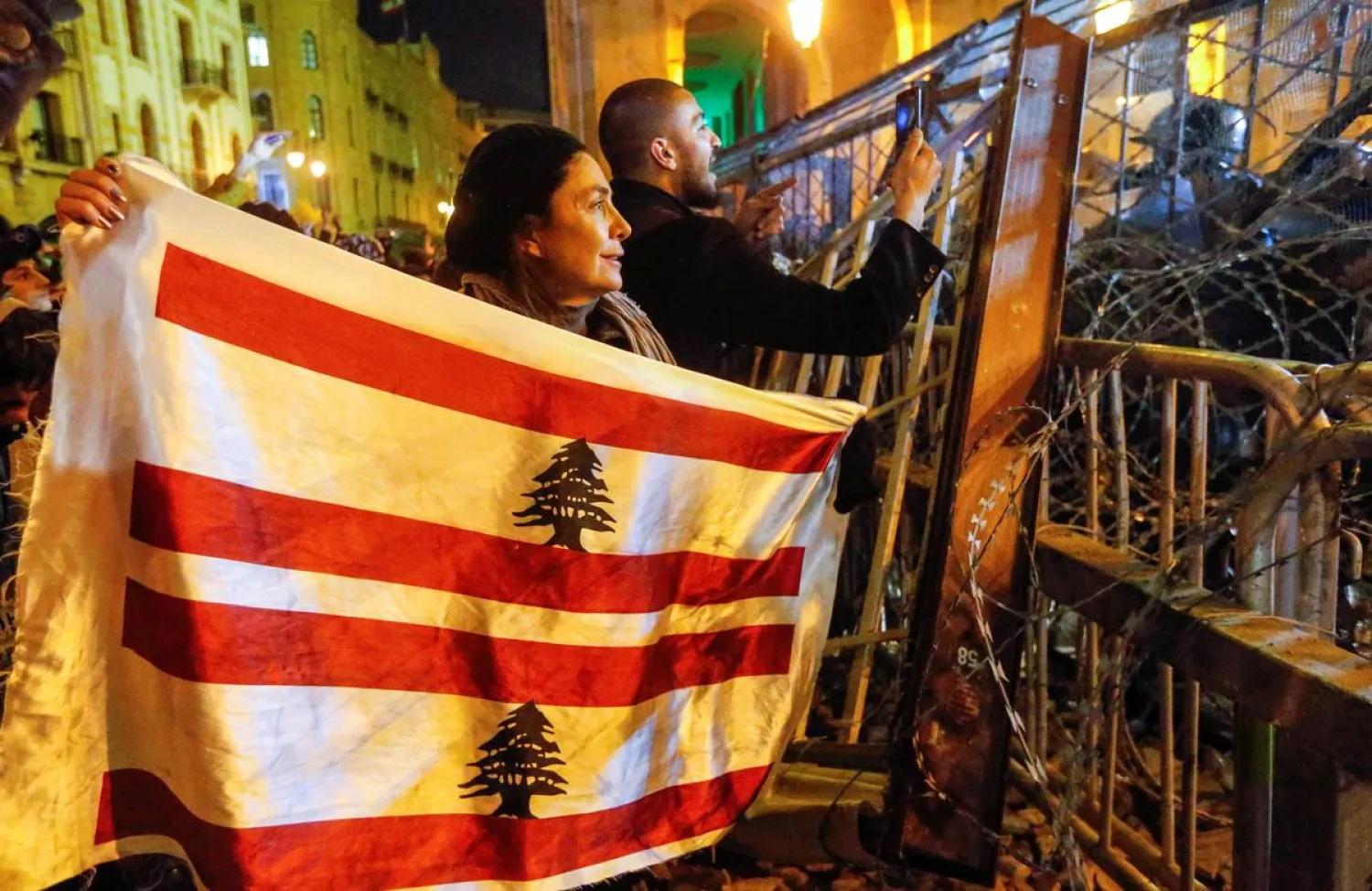
A demonstrator holds the Lebanese flag during a protest against a ruling elite accused of steering Lebanon towards economic crisis in Beirut, Lebanon January 19, 2020. (Reuters)
TT

Aoun, Diab Fail to Achieve Breakthrough in Lebanon’s Govt. Formation Efforts

A demonstrator holds the Lebanese flag during a protest against a ruling elite accused of steering Lebanon towards economic crisis in Beirut, Lebanon January 19, 2020. (Reuters)

Lebanese President Michel Aoun and Prime Minister-designate Hassan Diab failed on Sunday in achieving a breakthrough in the deadlock in forming a new government, as protests against the ruling elite continued to take on a violent turn with clashes erupting with security forces in central Beirut.

Aoun received Diab for talks to resolve pending disputes over the new government, but the PM-designate left the meeting without making a statement, signaling that the differences remain.

Aoun has been seeking the formation of a cabinet of 20 ministers, while Diab has stuck to his demand for an 18-member government. The president has been calling for a larger government to appease the Druze and Catholic powers and the Marada Movement.

Informed political sources said parliament Speaker Nabih Berri had exhausted his efforts to bridge the divide between Diab and caretaker Foreign Minister Gebran Bassil – Aoun’s son-in-law and head of the Free Patriotic Movement. Berri has been pressing for the formation of a new cabinet as soon as possible, his visitors quoted him as saying.

However, as he kept on encountering new obstacles, he decided to halt his efforts and observe how the developments unravel.

With Berri stepping back, efforts to overcome the hurdles will be left to Hezbollah. The party has been pressuring its allies Aoun and Bassil, rather than Diab, to reach a breakthrough.

Political sources told Asharq Al-Awsat that Bassil remains the main obstacle due to his shifting demands. At times he has called for the formation of a government of experts and at others, he has been nominating names that would grant him veto power in cabinet.

“If the new government will be one-sided in his camp’s favor, then why does he need this blocking power?” wondered the sources.

This insistence has prompted Marada Movement leader MP Suleiman Franjieh to sit out of the government because he opposes Bassil obtaining the veto power, several sources revealed.

Other complications have arisen with the Syrian Social Nationalist Party’s demand for Amal Haddad, who is not a member of the party, to be named a minister. Aoun and Diab have also differed over the economy portfolio. The PM-designate is demanding Petra Khoury be named to the position, while the president has proposed Ayman Haddad.

As politicians continued to bicker, protesters, who have been demanding the formation of a government of technocrats, clashed with security forces in downtown Beirut for a third consecutive day.

The protests say the political elite has ignored their calls for forming an independent government to tackle the deepening crisis.

“We don’t accept the government the way they are forming it. They are using the old method to form the government ... so it’s not acceptable," said protester Jil Samaha, according to The Associated Press. "We want a different way of forming a government.”

Sunday’s confrontation broke out near parliament a day after more than 370 people were wounded, the biggest casualty toll since the protests began in October.

Unrest in the capital this week has deepened the multi-faceted crisis sweeping Lebanon as it grapples with financial strains that have sunk the currency, pushed up prices and driven banks to impose capital controls.

Hundreds of people yelled “revolution” in the commercial district of the capital. Protesters pelted riot police with stones and fireworks.

Human Rights Watch on Saturday called for an end to a “culture of impunity for abuse” by police, which it said fired tear gas canisters at some people’s heads.

Demonstrators have been rallying against those who have held power since the end of the 1975-90 civil war. They blame politicians for widespread corruption and mismanagement in a country that has accumulated one of the largest debt ratios in the world.



German, Norwegian Ministers in Abortive Beirut Trip

Cars sit in traffic on a highway as residents flee following an Israeli threat to strike Dahieh, Beirut's southern suburbs, Lebanon, Monday, June 1, 2026. (AP)
TT

German, Norwegian Ministers in Abortive Beirut Trip

Cars sit in traffic on a highway as residents flee following an Israeli threat to strike Dahieh, Beirut's southern suburbs, Lebanon, Monday, June 1, 2026. (AP)

Ministers from Germany and Norway had to call off a trip to Beirut on Monday as Israel continued its assault on the city, the pair's press services said.

German minister for international development Reem Alabali Radovan and Norwegian counterpart Asmund Aukrust had to abort and head back to Berlin "for military reasons" as they approached Beirut airport owing to a "rapidly worsening situation," a spokesperson for Alabali Radovan told AFP.

The ministers had hoped to make the visit to show solidarity with the Lebanese people, but their German military aircraft finally had to land in Cyprus ahead of a return to Berlin, Norwegian daily VG reported.

A Norwegian government spokesman confirmed to AFP the trip had been scrapped.

Israeli Prime Minister Benjamin Netanyahu earlier had called on the Israeli army to hit southern Beirut, saying they were going after "terrorist" targets.

On Sunday he had ordered the scaling up of Israel's Lebanon offensive with Israeli forces hitting positions of Iran-allied Hezbollah fighters.

"More than 3,000 people have been killed since March" in Israel's deepest incursion into Lebanon in two decades, Aukrust told VG by telephone.

"What is happening now makes it all the more important to show our solidarity," Aukrust added.

He said the Lebanese people "must know that where Norway is concerned we shall continue to fight for them and for international humanitarian law," he went on.

Alabali Radovan called on "all sides" to de-escalate the fighting and urged ceasefire talks.

VG reported the ministers had been scheduled to meet with Lebanese President Joseph Aoun, as well as civil society groups and displaced persons.

Iran earlier stressed a ceasefire in Lebanon remained a condition for any Mideast peace deal with the United States.


Israel Orders Strikes on South Beirut ahead of UN Meeting

 Civil defense workers inspect the site of an Israeli strike in the southern Lebanese city of Tyre on May 31, 2026. (Photo by KAWANT HAJU / AFP)
Civil defense workers inspect the site of an Israeli strike in the southern Lebanese city of Tyre on May 31, 2026. (Photo by KAWANT HAJU / AFP)
TT

Israel Orders Strikes on South Beirut ahead of UN Meeting

 Civil defense workers inspect the site of an Israeli strike in the southern Lebanese city of Tyre on May 31, 2026. (Photo by KAWANT HAJU / AFP)
Civil defense workers inspect the site of an Israeli strike in the southern Lebanese city of Tyre on May 31, 2026. (Photo by KAWANT HAJU / AFP)

Israel said Monday it would once again target Beirut's southern suburbs, a Hezbollah stronghold mostly spared heavy attacks since April, as it stages its deepest incursion into Lebanon in two decades.

The UN Security Council is expected to hold an emergency meeting later Monday on Israel expanding its operations in Lebanon, and the European Union called on Israel to "stop its military escalation".

Iran, in stalled negotiations on an end to its wider war with the United States, said a Lebanon ceasefire remains a key condition for any deal.

Israel's Prime Minister Benjamin Netanyahu and Defense Minister Israel Katz said they had ordered strikes on Beirut's usually densely populated southern suburbs, AFP reported.

"In light of the repeated violations of the ceasefire in Lebanon by the terrorist organization Hezbollah and the attacks on our cities and citizens", Netanyahu and Katz "instructed the army to strike terror targets in the Dahiyeh district of Beirut", a joint statement said.

Katz said separately there would be "no calm in Beirut" if Hezbollah attacks continued, vowing to establish a military-controlled zone in the area of south Lebanon's Litani River.

The Israeli military's Arabic-language spokesman Colonel Avichay Adraee, posting on X, urged Dahiyeh residents to evacuate "to preserve their safety".

AFP journalists saw hundreds of families fleeing the southern suburbs, some on foot or on motorbikes, others in cars packed with belongings.

Hours later, a correspondent said shops were closed and the area's streets were largely deserted.

Lebanon was dragged into the Middle East war on March 2 when Hezbollah fired rockets towards Israel in retaliation for the US-Israeli killing of Iran's supreme leader.

A truce to halt the fighting in Lebanon began on April 17, but has never been observed. Both Israel and Hezbollah accuse each other daily of violating the ceasefire, justifying their attacks by the other's alleged breaches.

- 'Vicious aggression' -

South Beirut resident Hadi, 24, said he had hoped for some stability during the truce.

"That feeling did not last long... Our fears intensified this morning after I received a series of messages about orders to bomb the southern suburbs, which caused widespread panic, and we immediately left the area," he told AFP by phone.

Iranian foreign ministry spokesman Esmaeil Baqaei told a weekly press briefing that "a ceasefire in Lebanon is an essential condition for any deal aimed at ending the war" with the US.

Lebanese President Joseph Aoun said his country was facing "a vicious and reprehensible Israeli aggression", with the two nations set to hold a fourth round of US-hosted talks on Tuesday and Wednesday.

He called the talks "the only solution to stop the war with the least possible damage".

Beirut's southern suburbs and their surroundings have been struck twice since April 8, when huge Israeli attacks across Lebanon killed hundreds in minutes.

Israel's military on Monday also issued evacuation warnings for more than a dozen south Lebanon locations.

A day earlier, Israeli troops seized Beaufort castle, which commands sweeping views of south Lebanon, as the military expands its ground operations.

Israeli forces used the castle as a base during their previous two-decade occupation of southern Lebanon that ended in 2000.


Iran Foreign Ministry Says Ceasefire in Lebanon Remains Condition for US Deal

Civil defense workers inspect the site of an Israeli strike in the southern Lebanese city of Tyre on May 31, 2026. (Photo by KAWANT HAJU / AFP)
TT

Iran Foreign Ministry Says Ceasefire in Lebanon Remains Condition for US Deal

Civil defense workers inspect the site of an Israeli strike in the southern Lebanese city of Tyre on May 31, 2026. (Photo by KAWANT HAJU / AFP)

Iran's foreign ministry said on Monday that a ceasefire in Lebanon remains a key condition for any deal with the United States to end the Middle East war.

"We insist that a ceasefire in Lebanon is an essential condition for any deal aimed at ending the war," foreign ministry spokesman Esmaeil Baqaei said at a weekly press briefing, as Israel expands its offensive in Lebanon.

Israeli Prime Minister Benjamin Netanyahu has vowed to push deeper into Lebanon, while the UN Security Council is set to hold an emergency meeting on Monday after Israel's military took control of the medieval Beaufort castle.

Baqaei said Iran "will take all measures to support Lebanon and the resistance against the Zionist regime's illegal aggression".

His remarks come as Tehran and Washington continue exchanging messages in an effort to finalize a framework agreement aimed at ending the war, which erupted with US-Israeli strikes on Iran in late February and subsequently engulfed the region.

A fragile ceasefire between Iran, the United States and Israel has been in place since April 8, but military confrontations have continued in Lebanon despite Tehran's insistence that Lebanon should be covered by the truce.

On Monday, Baqaei accused the United States of "violating the ceasefire" following a brief overnight flare-up in which the US struck a telecommunications tower in a southern Iranian port city.

Iran's Revolutionary Guards said they targeted the US base from which the attack originated, without specifying its location.

Iran will "take whatever measures we deem necessary to defend Iran's national security", Baqaei said.

He said Iran was not seeking concessions in its exchanges with Washington but rather the fulfilment of its rights, including the release of assets frozen abroad under US sanctions.

He also said details related to Iran's nuclear program -- a key sticking point for Washington -- have not yet been part of the exchanges.

"No negotiations have taken place on the details of the nuclear file. At this stage, our priority is ending the war," said Baqaei.

He added that the exchange of messages with the United States was continuing, but that "we have not yet reached a final conclusion".

"We will decide on the arrangements for signing at the appropriate time," he added.