


Children in Scotland Could Be Banned From Heading Footballs Over Dementia Link

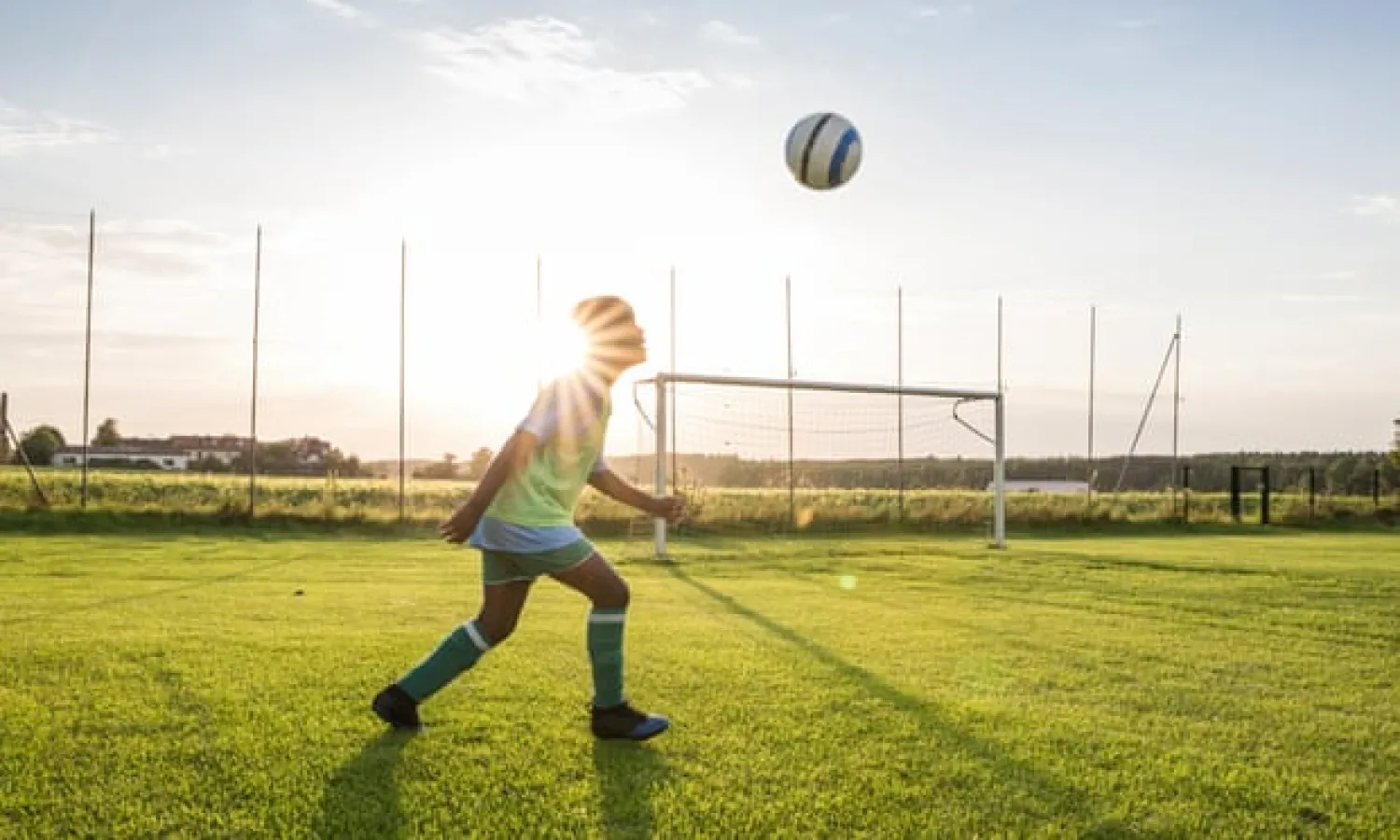
 Players under 12 could soon be banned from heading the ball in training in Scotland. Photograph: Westend61/Getty Images
Players under 12 could soon be banned from heading the ball in training in Scotland. Photograph: Westend61/Getty Images
TT

Children in Scotland Could Be Banned From Heading Footballs Over Dementia Link

 Players under 12 could soon be banned from heading the ball in training in Scotland. Photograph: Westend61/Getty Images
Players under 12 could soon be banned from heading the ball in training in Scotland. Photograph: Westend61/Getty Images

A move towards banning children from heading balls in training in Scotland because of the links between football and dementia has been welcomed as a “positive step” by the campaigner Dawn Astle, who has urged other governing bodies follow its lead.

The Scottish Football Association is finalising its plans but it is understood that it wants to “lead the way” on the issue. The BBC says that a ban on children under the age of 12 from heading could be introduced within weeks.

The United States has had similar restrictions in place since 2015 but Scotland would be the first European country to impose such a policy.

The SFA’s move follows a landmark study by the University of Glasgow, published in October, which found that former professional footballers are three and a half times more likely to suffer from dementia and other serious neurological diseases.

However it was unable to establish whether the cause of the higher levels of brain disease was due to repeated concussions, heading leather footballs, or some other factor.

Astle, the daughter of the former West Bromwich Albion striker Jeff Astle who died in 2002 of what a coroner said was an “industrial disease” partly caused by heading heavy footballs during his career, said she was very pleased at the SFA’s commitment.

“We applaud them for trying to put things in place to reduce the risk and not hanging on and hanging on and keep saying ‘more research, more research’,” she said. “I hope that children in other countries – English, Welsh, whatever – mean as much to our specific FAs as clearly Scottish children do to theirs.

“It’s a very positive step to reduce the risk and make sure their kids are OK. My dad’s dementia started at some point, didn’t it, and it’s always been my belief that it manifested in my dad – although no one was aware of it – when heading footballs as a kid.”

A spokesman for the SFA said it had worked closely with the authors of the University of Glasgow research to look at practical steps to take “a responsible but proportionate approach” to the findings.

“To that end, productive discussions have taken place … on proactive, preventative measures with particular focus on younger age groups,” it said in a statement. “It is our intention to finalise those proposals with the relevant stakeholders in early course and further details will be announced thereafter.”

However the English FA has no plans to change its position that heading is safe. In a statement it said there was no evidence to suggest that heading in youth football would be more of a risk than at other stages in a professional footballer’s career.

“Heading is actually significantly less common in children’s games,” the statement added. “Our analysis shows that on average there are only around 1.5 headers per game in youth football.

“The Medical & Football Advisory group currently don’t advise any changes to the rules of the game, but they have supported practical guidelines for heading practice which are common sense and in line with modern coaching practice.”

The FA’s stance was backed by Rangers manager Steven Gerrard who said he believed that heading practice still had a place in grassroots football.

“I used to love heading balls, probably from the age of four,” he said. “So I wouldn’t take it away from them completely because they will be watching their heroes every day on the TV, heading and scoring goals.

“But you can certainly do things; you can help them by making the balls smaller or lighter, or doing heading in a different way, without using the heavy-case balls.”

However the former Celtic striker John Hartson backed the SFA, saying: “There have been some serious situations where players have lost their lives and ex-legends suffering from dementia, so I’m glad the SFA are leading the rest of football and doing something about it.”

The brain injury association Headway has called for more research to fully understand what risks are linked to heading lightweight modern footballs.

“There are questions about the age limit and speculation suggests this will be 12 years,” it said. “This infers that a child of 13 years is safe to head the ball. How do we know this to be the case? The difficulty we face, in the absence of meaningful research relating to the modern game, is where we draw the line in terms of acceptable risk versus the rewards we know healthy exercise can bring.”

The leader of the University of Glasgow research, Professor Willie Stewart, favours a wider reduction of heading. “A move to reduce head impacts in youth sports is a good idea but I would caution that that’s probably not enough,” he said. “It’s not enough just to say: ‘Let’s take heading out of the game in under-12s.’

“I think we need to look across the entire game – amateurs, seniors, professionals – and say: ‘Where else can we make changes to be effective?’ And not just in football, look across all sports and think: ‘What could we do differently?’”

The Guardian Sport


What to Know About the 2026 Champions League Final

Fans of Arsenal cheer during the UEFA Champions League semi-finals 2nd leg match Arsenal FC against Atletico de Madrid, in London, Britain, 05 May 2026. EPA/NEIL HALL
TT

What to Know About the 2026 Champions League Final

Fans of Arsenal cheer during the UEFA Champions League semi-finals 2nd leg match Arsenal FC against Atletico de Madrid, in London, Britain, 05 May 2026. EPA/NEIL HALL

Arsenal became the first team to book its place in the 2026 Champions League final by beating Atletico Madrid on Tuesday.

Paris Saint-Germain or Bayern Munich will join the Premier League club in the showpiece at the Puskas Arena in Budapest, Hungary this month.

Defending champion PSG leads Bayern 5-4 after a thrilling first leg in Paris.

The second leg is on Wednesday in Munich.

Here's what to know about the Champions League final.

When is the Champions League final and what time is the kick off? This year's final will be staged in Budapest on May 30. Kick off time has been brought forward to 1800 CET, having traditionally been played 2100 CET. Governing body UEFA said the decision for an earlier kick off was to enhance the matchday experience for fans and to optimize logistics such as public transport.

Who is headlining the pre-match show? Rock band the Killers will be performing on the night. In recent years Linkin Park and Lenny Kravitz have headlined.

Arsenal is in the final for the first time since 2006. It is only its second time in the final and it has never won European club soccer's top competition, having lost to Barcelona in 2006.

Mikel Arteta's team was beaten in last year's semifinals by eventual champion PSG.

PSG is aiming to become only the second team to win back-to-back Champions League titles, having lifted the trophy for the first time last year.

Since the tournament was rebranded as the Champions League in the 1992-93 campaign only Real Madrid has retained the title, winning three times in succession from 2016-18.

Bayern has won the Champions League or European Cup on six occasions — most recently in 2020. Victory this year would see it equal AC Milan's total of seven titles to make the German giant the joint second most successful team in the competition's history behind Madrid, which is a 15-time winner.

About the Puskas Arena The 67,000-seater stadium was opened in 2019 and built on the same site as the previous Ferenc Puskas Stadion — named after the Hungarian and Real Madrid icon, who won three European Cups as a player.

Recent winners 2025 PSG
2024 Real Madrid
2023 Manchester City
2022 Real Madrid
2021 Chelsea
Most Champions League/European Cup wins 15 Real Madrid
7 AC Milan
6 Bayern Munich, Liverpool
5 Barcelona
4 Ajax
3 Manchester United, Inter Milan

Where is the 2026-27 Champions League final? The 2027 final will be staged at Atletico Madrid's stadium the Estadio Metropolitano. It is the second time it has held the final, having staged the 2019 showdown between Liverpool and Tottenham.

The city of Madrid has hosted the final on five previous occasions.


Kostyuk Withdraws from Italian Open with Physical Issues after Titles in Madrid, Rouen

Marta Kostyuk of Ukraine poses with the trophy after winning her women's singles finals match against Mirra Andreeva of Russia at the Madrid Open tennis tournament in Madrid, Spain, 02 May 2026.  EPA/CHEMA MOYA
Marta Kostyuk of Ukraine poses with the trophy after winning her women's singles finals match against Mirra Andreeva of Russia at the Madrid Open tennis tournament in Madrid, Spain, 02 May 2026. EPA/CHEMA MOYA
TT

Kostyuk Withdraws from Italian Open with Physical Issues after Titles in Madrid, Rouen

Marta Kostyuk of Ukraine poses with the trophy after winning her women's singles finals match against Mirra Andreeva of Russia at the Madrid Open tennis tournament in Madrid, Spain, 02 May 2026.  EPA/CHEMA MOYA
Marta Kostyuk of Ukraine poses with the trophy after winning her women's singles finals match against Mirra Andreeva of Russia at the Madrid Open tennis tournament in Madrid, Spain, 02 May 2026. EPA/CHEMA MOYA

Fresh off the biggest title of her career, Marta Kostyuk of Ukraine withdrew from the Italian Open due to hip and ankle issues, The Associated Press reported.

Kostyuk won the Madrid Open on Saturday and is up to a career-best No. 15 in the rankings this week. Having also won another clay-court title in Rouen, France, the week before Madrid, Kostyuk is on an 11-match winning streak.

“After the best stretch of my career, I was looking forward to Rome. But sometimes your body has other plans, and over the past few days I’ve been dealing with a hip issue. With my ankle still not fully at 100%, it’s just not smart to keep pushing right now, so I won’t be competing there this year,” Kostyuk posted on Instagram on Tuesday as the tournament in Rome began.

“Now it’s time to recover and get ready for Paris,” Kostyuk said, referring to the French Open, which starts May 24.


Infantino Defends World Cup Ticket Prices

FIFA President Gianni Infantino speaks during the 29th annual Milken Institute Global Conference at the Beverly Hilton in Beverly Hills, California on May 5, 2026. (Photo by Patrick T. Fallon / AFP)
TT

Infantino Defends World Cup Ticket Prices

FIFA President Gianni Infantino speaks during the 29th annual Milken Institute Global Conference at the Beverly Hilton in Beverly Hills, California on May 5, 2026. (Photo by Patrick T. Fallon / AFP)

FIFA president Gianni Infantino on Tuesday defended World Cup ticket prices, insisting that football's global governing body was obliged to take advantage of US laws that allow tickets to be resold for thousands of dollars above face value.

FIFA has faced searing criticism over the cost of World Cup tickets, with fan organization Football Supporters Europe (FSE) branding the pricing structure "extortionate" and a "monumental betrayal".

FSE filed a lawsuit with the European Commission in March targeting FIFA over "excessive ticket prices" for the tournament.

FIFA's own World Cup resale website, FIFA Marketplace, last week advertised four tickets to the July 19 final in New York at a cost of more than $2 million each.

Speaking at the Milken Institute Global Conference in Beverly Hills, Infantino said the eye-watering prices reflected demand to watch the World Cup.

"If some people put on the resale market, some tickets for the final at $2 million, number one it doesn't mean that the tickets cost $2 million," AFP quoted Infantino as saying.

"And number two it doesn't mean that somebody will buy these tickets," Infantino said. "And if somebody buys a ticket for the final for $2 million I will personally bring him a hot dog and a Coke to make sure that he has a great experience."

Fan groups have contrasted the difference in price of tickets for this summer with the Qatar World Cup in 2022.

The most expensive ticket for the final in 2022 was around $1,600 at face value, while in 2026 the most expensive ticket for the final is about $11,000 at its original price.

Infantino was adamant that the steep increase in face-value prices were justified.

"We have to look at the market -- we are in the market in which entertainment is the most developed in the world. So we have to apply market rates," Infantino said.

"In the US it is permitted to resell tickets as well. So if you were to sell tickets at the price which is too low, these tickets will be resold at a much higher price.

"And as a matter of fact, even though some people are saying that the ticket prices we have are high, they still end up on the resale market at an even higher price, more than double of our price."

Infantino said that FIFA received in excess of 500 million ticket requests for 2026, compared with fewer than 50 million combined for the 2018 and 2022 World Cups.

The FIFA leader added that 25 percent of tickets for the group phase were priced at under $300.

"You cannot go to watch in the US a college game, not even speaking about a top professional game of a certain level, for less than $300," Infantino said. "And this is the World Cup."
