

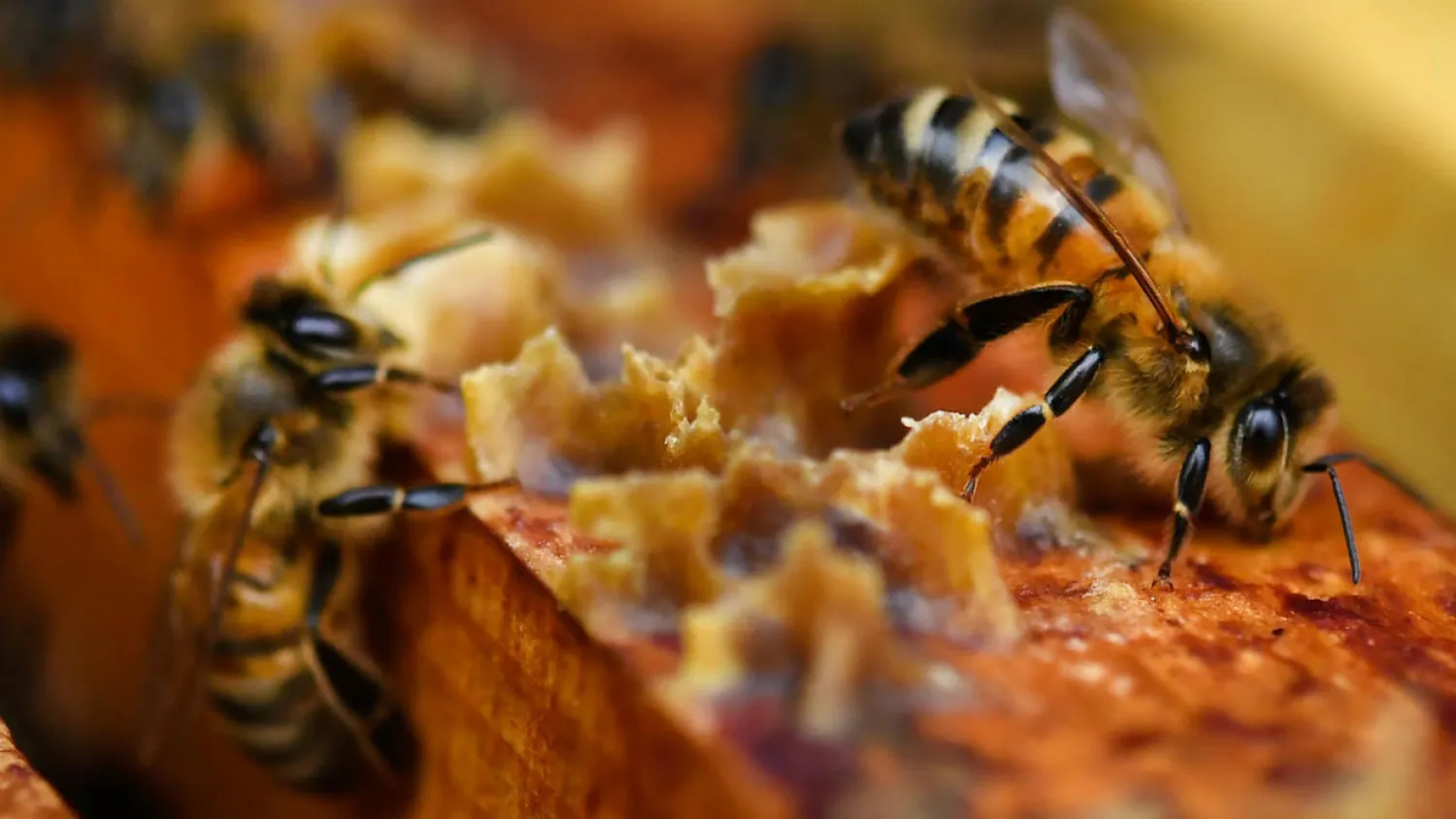

EU Member States Call For Labeling Origin of Imported Honey

Fred Tanneau, AFP | Bees on honey frames in Ploerdut, western France.
TT

EU Member States Call For Labeling Origin of Imported Honey

Fred Tanneau, AFP | Bees on honey frames in Ploerdut, western France.

To protects European beekeepers from cheap honey competition, 16 EU member states have suggested labeling the honey imported from outside Europe. German Minister for Food and Agriculture Julia Klöckner supported the initiative in Brussels, on Monday. The proposal comes amid a remarkable contrast between the prices of European honey and imported honey.

The proposal made by the 16 members of the European Commission stated that Honey products imported from outside Europe are much less expensive than European honey.

"Because of the high production costs of local honey, manufacturers are almost unable to compete with the imported products. In return, European producers are keen to respect the standards of quality and environment protection," the proposal read.

So far, honey importers have labeled the products made from a mix of European and imported honey (from China for example). Sellers of mixed honey also are also obliged to note that their honey "is a mix of both European and imported honey."

Theoretically, small amounts of European honey could be mixed with a large amount of imported honey, and the taste won't be affected.

The 16 countries are calling on the European Commission to prepare a proposal for clearer indications on honey sources.

Last year was the worst for many European beekeepers, particularly in France and Italy, where unpredictable weather produced the lowest honey harvests ever.

Italy's main agricultural union Coldiretti said 2019 has been a "black year", with the harvest almost halved compared with 2018.

In France, the harvest was "the worst on record", according to the National Union of French Beekeeping (UNAF), with "fewer than 9,000 tons" — almost a quarter of the crop harvested in the 1990s.

Romania was the European honey "champion" in 2018, with some 30,000 tons. But in 2019 the country's production dropped below its recent yearly average, the ROMAPIS association told AFP.

And in Spain, the leading country in terms of number of hives, the harvest has been poor since 2015, with a drop of 5.2 percent in 2017 and a 2018 season which was "not up to expectations", according to the country's agriculture ministry.

January to early September saw over 1,000 extreme weather events in Italy (up over 56 percent on 2018), including hail, storms and heat waves, Coldiretti said. In France, spring was curtailed by a sudden cold snap, followed by a heat wave at the end of June.

In some areas of southern France, the heat melted the wax in the hives, and trapped the bees, UNAF said.

In Romania, "the lack of rainfall last autumn and winter hit rapeseed crops hard", which resulted in a "very low honey production" according to beekeeper Marian Patrascu.



Syria President Discusses Security with Visiting Lebanon PM

Syrian President Ahmad al-Sharaa and Lebanese Prime Minister Nawaf Salam in Damascus in 2025 (File photo: AFP)
TT

Syria President Discusses Security with Visiting Lebanon PM

Syrian President Ahmad al-Sharaa and Lebanese Prime Minister Nawaf Salam in Damascus in 2025 (File photo: AFP)

Syrian President Ahmed al-Sharaa met Lebanon's Prime Minister Nawaf Salam in Damascus on Saturday on a visit tackling issues including security, transport and energy.

Beirut and Damascus have been rebuilding their ties after the December 2024 overthrow of longtime ruler Bashar al-Assad in Syria, whose family dynasty exercised control over Lebanese affairs for decades and is accused of assassinating numerous officials in Lebanon who expressed opposition to its rule.

A statement from the Syrian presidency said the officials discussed "developing economic and trade cooperation... and bolstering security coordination in order to support stability and confront challenges", as well as regional and international developments, AFP reported.

Syrian state news agency SANA said the visit aimed to "develop joint cooperation... particularly the economy, transportation and energy" sectors.

Salam was accompanied by Deputy Prime Minister Tarek Mitri as well as Lebanese ministers for energy, economy and transport.

Salam hailed "significant progress" on joint issues at the end of the visit, telling reporters that "we discussed continuing efforts to address the issue of detained Syrians (in Lebanon) and to uncover the fate of the missing and forcibly detained in both countries".

In March, Lebanon transferred more than 130 Syrian convicts to their home country to serve the remainder of their sentences there, as part of an agreement signed a month earlier.

Lebanon has also been seeking information on political assassinations in the country under the Assad dynasty.

The discussions also addressed "the need for stricter Syria-Lebanon border controls and preventing all types of smuggling", Salam added.

Lebanon and Syria share a porous, 330-kilometre (205-mile) border notorious for the smuggling of people and goods.

Last month, the main border crossing was closed for several days due to an Israeli threat to target it, with Israel accusing Hezbollah of using the crossing for military purposes and smuggling, though it ultimately did not carry out the strike.

Israel and Hezbollah have been fighting since the Iran-backed group drew Lebanon into the Middle East war with rocket fire at Israel on March 2, though a ceasefire was announced last month.

Hezbollah, which fought alongside Syrian government forces during the country's civil war, lost a major ally and cross-border supply route with Assad's ouster.

Syria's new authorities are hostile to the Lebanese group and its sponsor, and have announced the arrest of alleged Hezbollah-affiliated cells in recent months, while the group has denied having any presence in Syria.

Salam said that "we will not allow Lebanon to be used as a platform to harm any of its Arab brothers, including Syria".


Settlers Force Re-burial of Palestinian Man in West Bank, Family Says 

Israeli settlement structuers being installed in Sanur near Jenin, in the Israeli-occupied West Bank, May 9, 2026. REUTERS/Mohamad Torokman
TT

Settlers Force Re-burial of Palestinian Man in West Bank, Family Says 

Israeli settlement structuers being installed in Sanur near Jenin, in the Israeli-occupied West Bank, May 9, 2026. REUTERS/Mohamad Torokman

Israeli settlers in the occupied West Bank forced Palestinians to exhume the body of their father from his freshly dug village grave, his family said, near a settlement re-established by Prime Minister Benjamin Netanyahu's government.

Hussein Asasa, 80, died on Friday of natural causes and was buried that evening at the cemetery of Asasa village near Jenin, with all the necessary permits from Israel's military, whose forces were at the site, his son Mohammed said.

But shortly after the burial, the family was called back by some of the villagers, who said settlers were at the grave, ordering the grave be dug up.

"They said the land was for settlement and that burial was not allowed. We told them that this is the village's cemetery, not part of the settlement," said Asasa, Reuters reported.

The settlers then threatened to dig the grave up with a bulldozer, Asasa said, so the family decided to exhume their father's body themselves.

"We found that they already dug the grave and reached the body," Asasa said. "We continued digging and got the body and buried him in another cemetery," he said.

VIDEO SHOWS PEOPLE REMOVING A BODY

Video circulating on social media appeared to show settlers watching as people dig in the ground of a hill slope. They then carry away what looks like a body as Israeli troops walk behind them. Reuters verified the location as Asasa.

The Israeli military said that the funeral had been coordinated with it and that it had not instructed the family to rebury their father. Soldiers were sent to the scene following a report about a confrontation with settlers who were "digging in the area," the military said. "The soldiers confiscated digging tools from the Israeli civilians and remained at the location in order to prevent further friction," the military said. It added that it condemns actions that violate the "dignity of the living and the deceased".

The UN Human Rights Office condemned the incident.

"This is appalling and emblematic of the dehumanisation of Palestinians that we see unfolding across the OPT (Occupied Palestinian Territories). It spares no one, dead or alive," said Ajith Sunghay, head of the OHCHR Palestinian office.

Sa-Nur was one of 19 settlements evacuated under the 2005 Israeli disengagement plan, which also included Israel's withdrawal of settlers and troops from Gaza. Netanyahu's government approved Sa-Nur's re-establishment a year ago and construction has advanced rapidly, according to Peace Now, an Israeli settlement watchdog.

The West Bank is among the territories that Palestinians seek for an independent state. Israel cites historical and biblical ties to the land, as well as security needs.

Netanyahu's government, which staunchly opposes the establishment of a Palestinian state, has been accelerating settlement building, while a rise in attacks by settlers on Palestinians has drawn international alarm. The United Nations and most countries deem Israel's settlements on West Bank land captured in the 1967 war illegal, a view that Israel disputes.


WHO Chief Tells Tenerife People that Risk from Hantavirus-hit Ship 'Low'

Crew members of the hantavirus-stricken cruise ship, MV Hondius, wait their turns for a first interview with epidemiologists, during the voyage to Spain’s port of Tenerife, May 6, 2026. (AP Photo)
TT

WHO Chief Tells Tenerife People that Risk from Hantavirus-hit Ship 'Low'

Crew members of the hantavirus-stricken cruise ship, MV Hondius, wait their turns for a first interview with epidemiologists, during the voyage to Spain’s port of Tenerife, May 6, 2026. (AP Photo)

The WHO chief told the people of Tenerife Saturday that the risk to them from an arriving cruise ship hit with a deadly hantavirus outbreak was "low".

"I need you to hear me clearly: this is not another Covid," World Health Organization director-general Tedros Adhanom Ghebreyesus wrote in an open letter to the people of the Spanish island where the MV Hondius was expected to arrive Sunday.

"The current public health risk from hantavirus remains low."

The Dutch-flagged cruise ship was expected to reach waters off Tenerife at dawn, with Tedros also due on the archipelago to help coordinate the evacuation of around 150 people on board, The AP news reported.

Three passengers from the ship -- a Dutch husband and wife and a German woman -- have died, while others have fallen sick with the rare disease, which usually spreads among rodents.

The only hantavirus type that can transmit from person to person -- the Andes virus -- has been confirmed among those who have tested positive, fuelling international concern.

It has also sparked fears among people of the Canary Islands, with regional authorities having refused to allow the vessel to dock, deciding it will remain offshore while passengers are screened and evacuated.

- 'Serious' -

In his open letter, Tedros hailed the people of Tenerife for their solidarity and said he had thanked Spanish Prime Minister Pedro Sanchez personally for Spain agreeing to take on its "moral duty" and receive the ship.

"I know you are worried," Tedros wrote in his open letter.

"I know that when you hear the word 'outbreak' and watch a ship sail toward your shores, memories surface that none of us have fully put to rest. The pain of 2020 is still real, and I do not dismiss it for a single moment," he said.

Tedros acknowledged that the Andes strain of hantavirus "is serious".

"Three people have lost their lives, and our hearts go out to their families," he said, stressing though that "the risk to you, living your daily life in Tenerife, is low".

"This is the WHO's assessment, and we do not make it lightly."

An expert with the United Nations health agency was on board and had determined that currently "there are no symptomatic passengers", Tedros said.

He also highlighted that "medical supplies are in place" and stressed that Spanish authorities had prepared a "careful, step-by-step plan" for the evacuation.

According to that plan, he said, "passengers will be ferried ashore at the industrial port of Granadilla, far from residential areas, in sealed, guarded vehicles, through a completely cordoned-off corridor, and repatriated directly to their home countries".

"You will not encounter them. Your families will not encounter them."

- Deemed 'nearest port' -

The WHO chief insisted the request for Spain to receive the ship "was not made arbitrarily", pointing out that under International Health Regulations, "the nearest port with sufficient medical capacity must be identified to ensure the safety and dignity of those on board".

"Nearly 150 people from 23 countries have been at sea for weeks, some of them grieving, all of them frightened, all of them longing for home," he said.

Tedros said he was travelling to Tenerife to observe the evacuation operation personally, to "stand alongside" health workers and port staff, and to "pay my respects" to the island and its response.

"The WHO stands with you, and with every person on that ship, every step of the way," he said.