
‘The Only Choice Is to Wait for Death’

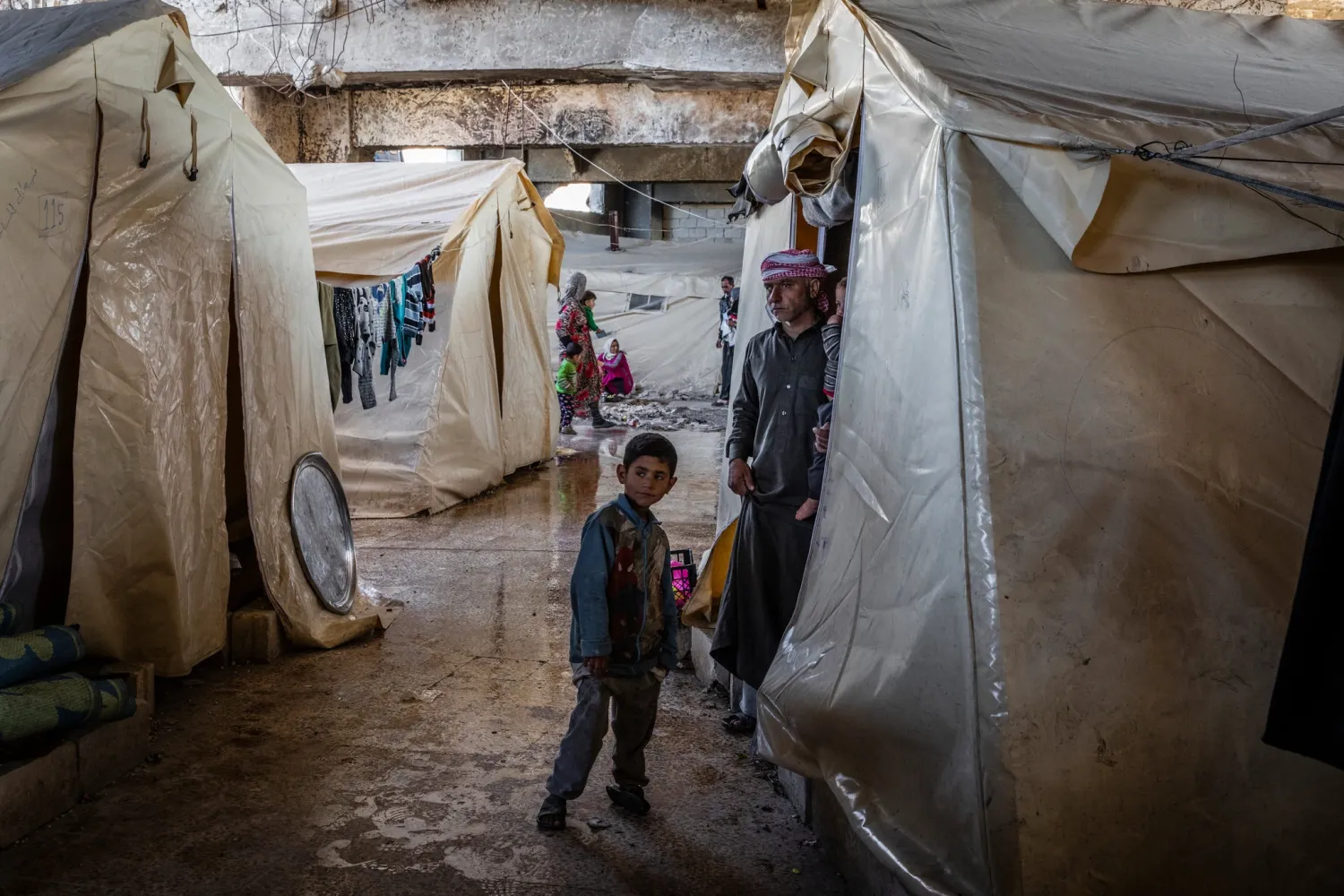
About 100 displaced families live in a temporary shelter in a soccer stadium in Idlib city. The city is likely to be the Syrian government’s next target.Credit...Ivor Prickett for The New York Times
TT

‘The Only Choice Is to Wait for Death’

About 100 displaced families live in a temporary shelter in a soccer stadium in Idlib city. The city is likely to be the Syrian government’s next target.Credit...Ivor Prickett for The New York Times

Before the war in Syria, Idlib city, with its tree-lined avenues and white-stone buildings, was known for its calm, provincial air.

Today it overflows with families who fled the war in other parts of Syria, swelling the population to nearly a million people.

Some shelter in bombed-out buildings. Those who can’t find shelter are camped in the soccer stadium, and more line up outside for food handouts.

Residents are so used to the shelling that no one even flinches at the sound of an explosion.

But for Syria’s last rebel-held city the worst is yet to come.

To the north, nearly a million people are living along roadsides and in olive groves in what is already one of the worst humanitarian disasters of Syria’s brutal nine-year war.

To the south and east, Syrian government forces backed by Russian warplanes are closing in, now just five miles away. When they reach Idlib city, its million residents are likely to flee, doubling the number of displaced people in the north.

Dr. Hikmat al-Khatib, an orthopedic surgeon, urged his parents to move to a town to the north. But when it was bombed his mother decided to stay put.

“Her words shocked me,” Dr. al-Khatib said. “The only choice is to wait for death.”

I made a rare visit into Idlib with a photographer and interpreter on Wednesday, crossing the border from Turkey. We were accompanied by relief workers of a Syrian charity and members of an extremist group, Hayat Tahrir al-Sham, which controls the province.

We found 100 families camped in the stadium, which has been converted into an emergency shelter.

Amina Sahloul was sitting on the floor around a stove in a large underground room for women and children. She had arrived hours earlier, after fleeing her village in the dead of night, clinging with her five grandchildren behind her son on a single motorcycle.

“We came away because of the airstrikes,” she said. “They started dropping cluster bombs. It was like fire raining in the sky.”

There has been no letup for the people of Idlib Province as the forces of President Bashar al-Assad of Syria, backed by Russian air power, have smashed their way forward, demolishing towns and villages in the south and east of the province with punishing airstrikes.

A cease-fire declared Thursday by Turkey, which backs Syrian opposition forces, and Russia, which backs the Syrian government, seemed to be holding on Friday but few believe it will last. Assad has insisted he will continue his offensive to retake Idlib Province, and rebel groups have vowed to resist.

At the soccer stadium, as word came across the radio that Russian planes were near, tension rose as people nervously scanned the skies.

Earlier that day, when an artillery shell slammed into a nearby neighborhood, few people even looked up. The Syrian government fires rockets all the time.

But when Russian planes begin a concerted assault, they use overwhelming force, laying down lines of repressive fire that force people to run for their lives with only minutes to get away.

“Whenever I hear planes I start running like crazy, I lose my mind,” Hassan Yousufi said as he paced angrily around the men’s shelter in the stadium.

“I lived beside the highway for 45 years. My brother was killed. The Russians bombed us.”

Outside of the stadium, life is on a war footing. The streets are busy with cars and motorcycles and women walk together in the main shopping street, but the city has only two hours of electricity a day and boys sell gasoline in plastic jerrycans on street corners.

Idlib Province has been free from government control for the length of the war and today is largely controlled by Hayat Tahrir al-Sham. But there were few armed fighters in sight in Idlib city, the provincial capital, on Wednesday.

Police officers loyal to the opposition stand guard outside the governor’s office and the police station, which still bear the scars of fighting from the first days of the revolution.

Billboards around the city bear glossy posters of uniformed rebel fighters, calling on people to join the fight.

“It is your turn to heed the call,” reads one. “There is no honor without jihad,” urges another, beside a military checkpoint.

“In the last one-and-a-half months we had a collapse,” said Abu Ahmed Muhammad, a Hayat Tahrir al-Sham spokesman. But he added that the Syrian government had lost many more soldiers than the opposition had, and had to bring in Iranian-backed fighters to retake the strategic town of Saraqib, which has changed hands several times in the last two weeks.

Hours before Russia and Turkey agreed to the cease-fire, he warned that nothing would come of it.

“Both sides will escalate,” he said. “We in the HTS factions will never accept to de-escalate because the Russians are on top and they may not agree to a peace settlement.”

But most of the province’s three million people are civilians, and they are desperate for an end to the violence. They cling to the hope that Turkey’s growing deployment of troops into the province will stop the onslaught.

“Anything that makes us feel secure or takes the regime away from us is a very good thing,” said Abdul Razzaq, the head of the emergency relief for the Syrian charity, Violet.

His teams were still helping people flee villages on the front line and preparing in case of a mass evacuation of the city.

“But Idlib city is huge and where to take them?” he said.

An hour’s drive north of the city, blue and white tents pockmark the rocky hillsides and olive groves of the border area. Hundreds of thousands more people have joined them in the last six weeks, pitching tents beside the roads and among the rocky limestone outcrops in a densely crowded strip along the Turkish border. Families are sheltering in mosques and schools, empty stores and factories.

Even those are not safe. A woman who gave her name as Umm Abdul fled her village three months ago and took refuge with her family in an old brick factory outside the town of Maaret Misrin. On Monday, she was out picking herbs with two of her children when she heard a sound like birds and looked up to see two missiles tumbling out of the sky toward her.

“I laid the kids on the ground and covered them with my body,” she said. “They say if you lie down you don’t get hit by shrapnel.”

She was knocked unconscious and her 18-month-old daughter was wounded but all three survived.

At an emergency shelter near the Turkish border, Alia Abras, 37, pushed forward to speak. “Do you know the meaning of displacement?” she asked. “You are like stray dogs.”

Rescuers took two-and-a-half hours to dig her and her three children out of the rubble of their home in the town of Ariha a month ago, she said. It was the middle of the night but they were left on the street beside their ruined home because there were others still to be rescued. The whole neighborhood around the main hospital had been hit.

“We spent two days sitting in the street,” she said until Violet’s rescue team found them and brought them to the shelter, which houses 45 families in a shopping center in the town of Sarmada.

“I wish I had died under the ruins and my children with me,” she said.

“We lost everything my husband and I spent our lives building up. We are at zero.”

In a camp called Al Nasr, new arrivals have pitched tents just yards from the concrete wall topped with rolls of barbed wire that marks the Turkish border. Some are already building breeze-block houses on a hill facing Turkey.

Four families were squeezed into one tent set up on top of the camp sewer. They had no other option, they said. Behind the tent, sewage drained down the hill into a fetid pool.

“No one else would take it,” said Hannah al-Mijan, a farmworker and mother of seven.

“We do not have money to build.”

The family had been displaced twice and without work they had fallen into debt.

“We are below zero,” she said. Her husband, Muhammad, shushed her, telling her not to shame them.

This time they chose to live within 100 yards of the border wall. Were they not scared that this place would also be bombed?

Mijan shook her head, and gestured at the hill opposite. “That’s Turkey,” she said.

The New York Times

The Guardian Sport


How the Assad Regime Covered Up Its Crimes

Piles of ransacked papers in a room in Maher al-Assad's private office in the hills above Damascus. (AFP)
TT

How the Assad Regime Covered Up Its Crimes

Piles of ransacked papers in a room in Maher al-Assad's private office in the hills above Damascus. (AFP)

Thousands of documents and interviews with Assad-era officials reveal how the Syrian regime worked to conceal evidence of its atrocities during the civil war, according to a report published by The New York Times.

The heads of the security agencies arrived in convoys of black SUVs to Bashar al-Assad’s presidential palace, a maze of marble and stone on a hillside overlooking Damascus.

Leaks about his regime’s mass graves and torture facilities were mounting and top Syrian leaders wanted them to stop.

So, in the fall of 2018, they summoned Assad’s feared security chiefs to discuss how to cover their tracks better, according to two people briefed on the meeting.

One of the security officials proposed scrubbing the identities of Syrians who died in secret prisons from their records, the two people said, recalling what participants in the meeting had told them.

That way there would be no paper trail. Assad’s top security chief, Ali Mamlouk, agreed to consider the suggestion.

Forging evidence

Months after that meeting, security agencies began interfering with evidence of the regime’s crimes, an investigation by The New York Times found.

Some security officials doctored paperwork so deaths of detainees could not be traced back to the security branch in which they were imprisoned and died.

Some omitted details like the number of the branch and the detainee’s identification number. And top government officials ordered security agencies to forge confessions of prisoners who had died in their custody.

Written confessions, they reasoned, would give the government some legal cover for the mass deaths of detainees.

Top secret memos

The Times reviewed thousands of pages of internal Syrian documents, including memos marked “Top Secret,” many of which we photographed inside Syria’s most notorious security branches.

The newspaper also interviewed more than 50 security and political officials, interrogators, prison guards, forensic doctors, mass-grave workers and others government employees, many of whom helped verify the documents.

Taken collectively, the documents and accounts provide the most comprehensive picture to date of the regime’s efforts to evade accountability for its industrial-scale system of repression. They also offer a rare look at how a secretive dictatorship responded in real time to growing international isolation and pressure.

Under Assad’s rule, more than 100,000 people disappeared, according to the United Nations, more than in any other regime since the Nazis.

The documents show that the government went to elaborate, sometimes tedious lengths to cover it up. Officials held meetings to discuss public-relations messaging. They strategized about how to handle families whose loved ones had been imprisoned. They worried about paperwork that might be used against them if they ever faced prosecution.

From documentation to threats

Early in the war, security agencies kept meticulous records of their activities, and the Syrians who vanished in their custody. Every interrogation was transcribed, every death noted, every corpse photographed.

Then the records became a liability. In January 2014, images of more than 6,000 bodies from secret prisons, some bearing signs of torture, were smuggled out of the country by a Syrian military photographer, code-named Caesar.

The photos were the first detailed evidence of torture and executions by the Assad government since the war began. Months later, France submitted the images to the United Nations Security Council, which lent them greater legitimacy and raised the prospect that the regime would be charged with war crimes.

The Syrian security apparatus decided to mount a defense.

In August 2014, senior military, political and intelligence officials met with Syrian legal scholars to discuss their strategy, according to a memo viewed by The Times that described a meeting of the National Security Bureau, the coordinating hub for Syria’s intelligence and security agencies.

The Times verified the deliberations laid out in the memo with two former officials who were briefed on the discussions.

Over two days, according to the memo, the senior officials plotted to discredit the images. Because there were no names connected to the photos, they could argue that only a handful were of political prisoners and that many were opposition fighters killed in battle or petty criminals, the memo said.

The officials also advised others in the government to “avoid going into detail and avoid attempts to prove or deny any facts,” the memo said. They urged them instead to “undermine the credibility” of the leaker, Caesar.

The mass grave

Some of the most damning evidence of the regime’s crimes were the mass graves where it dumped prisoners’ bodies during the civil war.

The mass-grave operation in the capital was overseen by Col. Mazen Ismandar, who organized teams to pick up bodies from military hospitals in Damascus and then bury them in sites around the city, according to three of his former colleagues.

Ismandar was ordered to move all of the bodies to a new site, two of his former colleagues said.

That operation, which Reuters first reported in October, was carried out over the next two years. The team used excavators to dig up bodies, piled them into dump trucks and drove them to a site in the Dhumair desert, northeast of Damascus.

“There were civilians, people in military clothes, old people with white beards, people who were naked,” said Ahmad Ghazal, a mechanic in Dhumair city who frequently repaired the trucks and eventually got to know the drivers.

He often tried to get a look at the bodies, he said, in the hope of finding the remains of two cousins who disappeared in 2015. He never found them.

The downfall

When the United States passed the Caesar Act in late 2019, many hailed the sanctions as a step toward justice for the victims of war crimes by the Assad government.

But the sanctions appeared to have little deterrent effect.

Interrogators in two agencies, Branch 248 and the Air Force Intelligence Directorate, said that they and their colleagues had become still more ruthless with prisoners, because they were angry about the plummeting value of their salaries as the economy weakened, in part from sanctions.

Despite the cover-up efforts, by 2023 the regime’s crimes were catching up with it.

In April 2023, French criminal investigative judges issued arrest warrants for three senior Assad officials, including Mamlouk, for the torture, enforced disappearance and death of two Syrian French nationals.

Then, in December 2024, the regime quickly came crashing down.

The opposition coalition led by Ahmed al-Sharaa, now the Syrian president, swept into Damascus in a lightning advance.

Assad, Mamlouk, Hassan and other top officials fled to Russia.

Ismandar, the official in charge of the mass-grave operations, also fled. The night the fighters arrived, he pulled a wooden box from the locked cabinet behind his desk in his office, according to one of his aides. Inside were the identification cards of Syrian civilians who had died in custody or been executed. He handed out the IDs to some of his staff, believing they might help them escape, the aide said.

Ismandar remains at large.


How Israel’s Multi-Ton Truck Bombs Ripped Through Gaza City

Destroyed buildings after Israeli military operations in Gaza City, November 12, 2025. (Reuters)
TT

How Israel’s Multi-Ton Truck Bombs Ripped Through Gaza City

Destroyed buildings after Israeli military operations in Gaza City, November 12, 2025. (Reuters)

In the weeks before the Gaza ceasefire on October 10, Israel widely deployed a new weapon: M113 Armored Personnel Carriers repurposed to carry between 1 and 3 tons of explosives, Reuters found.

As Israeli troops pushed toward the center of Gaza City, these powerful bombs, along with airstrikes and armor-plated bulldozers, leveled swathes of buildings, drone footage and satellite images show.

In most cases, but not all, the inhabitants fled ahead of demolitions after Israeli warnings, residents, Israeli security sources and Gaza authorities said.

Hesham Mohammad Badawi’s five-storey home on Dawla Street in the affluent Tel-al-Hawa suburb, damaged by an airstrike earlier in the war, was completely destroyed by an APC explosion on September 14, he and a relative said, leaving him and 41 family members homeless.

Badawi, who was a few hundred meters away, said he heard at least five APCs detonate in roughly five-minute intervals. He said he received no ​evacuation warning before the demolition and family members escaped “by a miracle” amid explosions and heavy gunfire.

Several buildings in the same block were demolished around that time, satellite images show.

The family is now staying with relatives in different parts of the city, Badawi said, while he lives in a tent by his former home. Israel’s military did not respond to Reuters questions about the incident. Reuters could not establish what Israel targeted in the attack or independently verify all the details of Badawi’s account of the events.

When Reuters visited in November, remains of at least one of the vehicles were strewn among large piles of rubble.

"We could not believe this was our neighborhood, this was our street," Badawi said.

To compile a detailed account of the role of APC-based bombs by the Israeli military in Tel-al-Hawa and the neighboring Sabra district in the six weeks before the ceasefire, Reuters spoke to three Israeli security sources, a retired Israeli military brigadier, an Israeli reservist, Gazan authorities and three military experts.

Seven Gaza City residents said their homes or those of neighbors were levelled or severely damaged by the explosions, which several likened to an earthquake. Analysis of Reuters footage by two of the military experts confirmed wreckage of at least two exploded APCs among the rubble at sites in Gaza City.

Israel packed 1 to 3 tons of ordnance in APCs, three military experts estimated, based on cabin space and wreckage of vehicle armor. Some of the ordnance was likely non–military ammonium nitrate or emulsion, though without chemical testing that conclusion is not certain, they said.

Such a multi-ton explosion could approach an equivalent power to Israel’s largest airborne bombs, the 2,000-pound US-made Mark 84, said two experts, who examined Reuters footage of the blast area and vehicle remains.

It could scatter vehicle fragments hundreds of meters and break close-by exterior walls and building columns. The blast wave would be strong enough to potentially collapse a multi-storey building, they said.

HIGHLY UNUSUAL

APCs generally transport troops and equipment on the battlefield. The three military experts ‌consulted by Reuters said use of ‌the vehicles as bombs was highly unusual and risked excessive damage to civilian dwellings.

In response to detailed Reuters questions for this story, Israel’s military said it was committed to the rules of war. Regarding ‌allegations of ⁠destruction of civilian ​infrastructure, it said it used ‌what it called engineering equipment only for “essential operational purposes,” without disclosing further details.

Decisions are guided by military necessity, distinction, and proportionality, it said.

In an interview with Reuters in Gaza for this story, Hamas spokesman Hazem Qassem said Israel’s demolitions with armored vehicles were aimed at the large-scale displacement of the city's residents, which Israel has denied.

The reporting provides new evidence of the power of these low-tech weapons and how they came to be widely used.

Retired reservist Brigadier-General Amir Avivi, founder of the Israel Defense and Security Forum (IDSF), a think tank, called the weapon an “innovation of the Gaza War.” One of the security sources said its increasing use partly responded to US restrictions on transfers of heavy Mark-84 airborne bombs and Caterpillar bulldozers.

Israel’s military and Prime Minister’s Office also did not respond to questions about the reasons for the shift in tactics. The US State Department, White House and Department of War did not respond to Reuters questions for this story.

Before the war, Tel-al-Hawa and Sabra, a historic area of modest houses in south-central Gaza City, bustled with bakeries, shopping malls, mosques, banks and universities.

Now, large parts lie in ruins.

Satellite imagery analysis by Reuters showed that about 650 buildings in Sabra, Tel-al-Hawa and surrounding areas were destroyed in the six weeks between September 1 and October 11.

MILITARY NECESSITY?

Two international law scholars, the UN human rights office and two of the military experts who reviewed Reuters findings said use of such large explosives in dense residential urban areas may have failed one or more principles of humanitarian law that prohibit attacking civilian infrastructure and using disproportionate force.

"The basis that some of it may be booby-trapped" or once used by Hamas snipers is not enough to justify mass destruction, Ajith Sunghay, head of the UN Human Rights Office in ⁠the Occupied Palestinian Territory, told Reuters, referring to Israel’s allegation that Hamas placed improvised explosive devices in houses, which Hamas denies.

In some circumstances, buildings could lose legal protection and become targets if Israel had evidence Hamas used them for military advantage, said Afonso Seixas Nunes, Associate Professor in the School of Law at Saint Louis University.

Israel’s military did not respond to Reuters requests to provide such evidence.

If not the result of military necessity, the ‌demolition of civilian infrastructure could amount to wanton destruction of property, which is a war crime, Sunghay said.

The level of ruin reflects a broader trend: 81% of Gaza’s buildings suffered damage or destruction ‍during the war, according to the UN Satellite Center. The area including Gaza City experienced most damage since July, with approximately 5,600 newly affected structures, it said ‍in October.

In August, Israeli Prime Minister Benjamin Netanyahu told reporters Israel was packing tons of explosives into APCs because Hamas had placed explosive devices in “just about every single building” in evacuated areas.

"We detonate them, and they set off all the booby traps. That's why you see the destruction," Netanyahu said.

In response ‍to questions for this story, Qassem, the Hamas spokesman, denied booby trapping buildings, and said Hamas did not have the capacity to set devices at the scale Israel claimed.

FORCES ENTER GAZA CITY

Later in August, Israeli forces entered Gaza City with the declared aim of eliminating Hamas and freeing hostages held by fighters since the October 7, 2023 attack on Israel that triggered the war.

Israel ordered a full evacuation of the city in September.

As troops advanced, backed by tanks and airstrikes, they extensively damaged eastern suburbs before approaching central areas of the city, where most displaced people were sheltering.

Hundreds of thousands fled south. The UN estimated 600,000-700,000 people remained in the city.

Israel’s defense minister has said soldiers demolished 25 towers that Israel said had Hamas tunnels underneath or were used as lookout points. The UN human rights office says Israel has provided no evidence the buildings were military targets.

Among the destruction visible in Sabra, Tel-al-Hawa and South Rimal between September 1 and October 11, Reuters identified al-Roya tower, which housed the Palestinian Center for Human Rights, a prominent human rights office that worked with charity Christian ​Aid, and al-Roya 2, a mixture of business and flats, brought down by airstrikes on September 7 and 8.

Two wings of the Islamic University of Gaza and a mosque on the campus were destroyed. In one six-block corner of Tel-al-Hawa almost every building was demolished - more than 60 in total.

Beyond the two cases of APC explosions analyzed in detail for this story, and airstrikes on towers caught on video, Reuters could not establish what weapons Israel deployed to demolish buildings, or the total number of APCs detonated ⁠from August until the ceasefire.

Gaza’s Civil Defense spokesperson Mahmoud Basal said the army detonated hundreds of APCs in that period, as many as 20 daily. Israel’s military did not reply to a question on numbers.

BADAWI’S HOUSE

Among the buildings destroyed was Badawi’s family home of four decades, along with more than 20 neighboring buildings in the same period.

"We didn’t recognize this as our house," he said.

Two military experts said Reuters footage of the area showed remains of at least one detonated APC.

The explosion had torn one APC caterpillar track from its running gear and “physically thrown it onto the roof” of a multi-storey building, a retired senior British military bomb disposal officer said, noting that M113 tracks each weigh hundreds of kilograms.

A thick, ripped piece of metal and a wheel torn in half, both scattered at the property, were consistent with a detonation from within the APC, said Gareth Collett, a retired British Brigadier General and leading authority on explosives and bomb disposal. He said the large size of the fragments was indicative of a commercial low energy explosive.

THE RETURN OF THE M113

Bought from the US after the Yom Kippur War in the 1970s, thousands of M113s were deemed to insufficiently protect soldiers and were mothballed, military historian Yagil Henkin said.

FMC Corp, originally the M113’s primary manufacturer, did not respond to Reuters’ requests for comment about its use as a weapon and potential associated human rights concerns.

BAE Systems, which currently provides maintenance for the vehicle globally, did not reply to Reuters questions about Israel's new use of the M113 other than to say it currently had no direct military sales to the country. It said equipment it sold to the US government could reach other countries indirectly.

In May, Israel posted a public tender seeking to sell an unspecified number of M113s internationally, public documents show.

The tender was later cancelled, according to an undated posting on the Ministry of Defense website. The cancellation allowed Israel to scale up repurposing M113s, one of the security sources told Reuters. The military did not respond to Reuters’ questions about the tender.

The first media reports of an APC detonating in Gaza date to mid-2024.

Use accelerated this year when Israel rationed stocks after the US paused deliveries of Mark-84 bombs over concerns about the bombs use in residential areas, the source said.

CATERPILLAR D9

The increased role of APC-based bombs also coincided with shortages in Israel of US company Caterpillar's giant D9 bulldozer, long used by Israel’s military for demolition, one of the security sources said.

Hamas heavily targeted D9s earlier in the war, killing or injuring soldiers and damaging the vehicles, the source said. Alarmed by their use to demolish homes, the US paused D9 sales to Israel in November 2024, adding to the shortage. Under President Donald Trump, D9 transfers resumed.

Caterpillar did not respond to questions from Reuters about the military ‌use of its machines in Gaza demolitions and has not publicly commented on the matter.

Amid the shortages, the military began using other methods of demolition, including APCs, another of the security sources said.

Danny Orbach, an Israeli military historian, told Reuters demolitions were normal in war, made necessary in Gaza due to tunnels and booby traps. He said Israel’s military was underprepared for the complex fighting, leading to the conclusion there was “no other way to fight such a war except destroying all buildings above ground.”

Israel's military told Reuters targets were reviewed prior to attack and the munition selected “to achieve the military objective while minimizing collateral damage” to civilians and civilian infrastructure.


What to Know about China's Drills around Taiwan

A rocket launches from Pingtan island in eastern China's Fujian province, the closest point to Taiwan. ADEK BERRY / AFP
TT

What to Know about China's Drills around Taiwan

A rocket launches from Pingtan island in eastern China's Fujian province, the closest point to Taiwan. ADEK BERRY / AFP

China's military drills around Taiwan entered their second day on Tuesday, the sixth major maneuvers Beijing has held near the self-ruled island in recent years.

AFP breaks down what we know about the drills:

What are the drills about?

The ultimate cause is China's claim that Taiwan is part of its territory, an assertion Taipei rejects.

The two have been governed separately since the end of a civil war in 1949 saw Communist fighters take over most of China and their Nationalist enemies flee to Taiwan.

Beijing has refused to rule out using force to achieve its goal of "reunification" with the island of 23 million people.

It opposes countries having official ties with Taiwan and denounces any calls for independence.

China vowed "forceful measures" after Taipei said this month that its main security backer, the United States, had approved an $11 billion arms sale to the island.

After the drills began on Monday, Beijing warned "external forces" against arming the island, but did not name Washington.

China also recently rebuked Japanese Prime Minister Sanae Takaichi after she said the use of force against Taiwan could warrant a military response from Tokyo.

What do the drills look like?

Chinese authorities have published a map showing several large zones encircling Taiwan where the operations are taking place.

Code-named "Justice Mission 2025", they use live ammunition and involve army, navy, air and rocket forces.

They simulate a blockade of key Taiwanese ports including Keelung in the north and Kaohsiung in the south, according to a Chinese military spokesperson and state media.

They also focus on combat readiness patrols on sea and in the air, seizing "comprehensive" control over adversaries, and deterring aggression beyond the Taiwanese island chain.

China says it has deployed destroyers, frigates, fighters and bombers to simulate strikes and assaults on maritime targets.

Taipei detected 130 Chinese military aircraft near the island in the 24 hours to 6:00 am on Tuesday (2200 GMT on Monday), close to the record 153 it logged in October 2024.

It also detected 14 Chinese navy ships and eight unspecified government vessels over the same period.

AFP journalists stationed at China's closest point to Taiwan saw at least 10 rockets blast into the air on Tuesday morning.

How has Taiwan responded?

Taipei has condemned China's "disregard for international norms and the use of military intimidation".

Its military said it has deployed "appropriate forces" and "carried out a rapid response exercise".

President Lai Ching-te said China's drills were "absolutely not the actions a responsible major power should take".

But he said Taipei would "act responsibly, without escalating the conflict or provoking disputes".

US President Donald Trump has said he is not concerned about the drills.

How common are the drills?

This is China's sixth major round of maneuvers since 2022 when a visit to Taiwan by then-US House Speaker Nancy Pelosi enraged Beijing.

Such activities were rare before that but China and Taiwan have come close to war over the years, notably in 1958.

China last held large-scale live-fire drills in April, surprise maneuvers that Taipei condemned.

This time, Beijing is emphasizing "keeping foreign forces that might intervene at a distance from Taiwan", said Chieh Chung, a military expert at the island's Tamkang University.

What are analysts saying?

"China's main message is a warning to the United States and Japan not to attempt to intervene if the CCP (Chinese Communist Party) uses force against Taiwan," Chieh told AFP.

But the time frame signaled by Beijing "suggests a limited range of activities", said Ja Ian Chong, an associate professor at the National University of Singapore.

Falling support for China-friendly parties in Taiwan and Beijing's own army purges and slowing economy may also have motivated the drills, he said.

But the goal was still "to cow Taiwan and any others who might support them by demonstrating that Beijing's efforts to control Taiwan are unstoppable".