



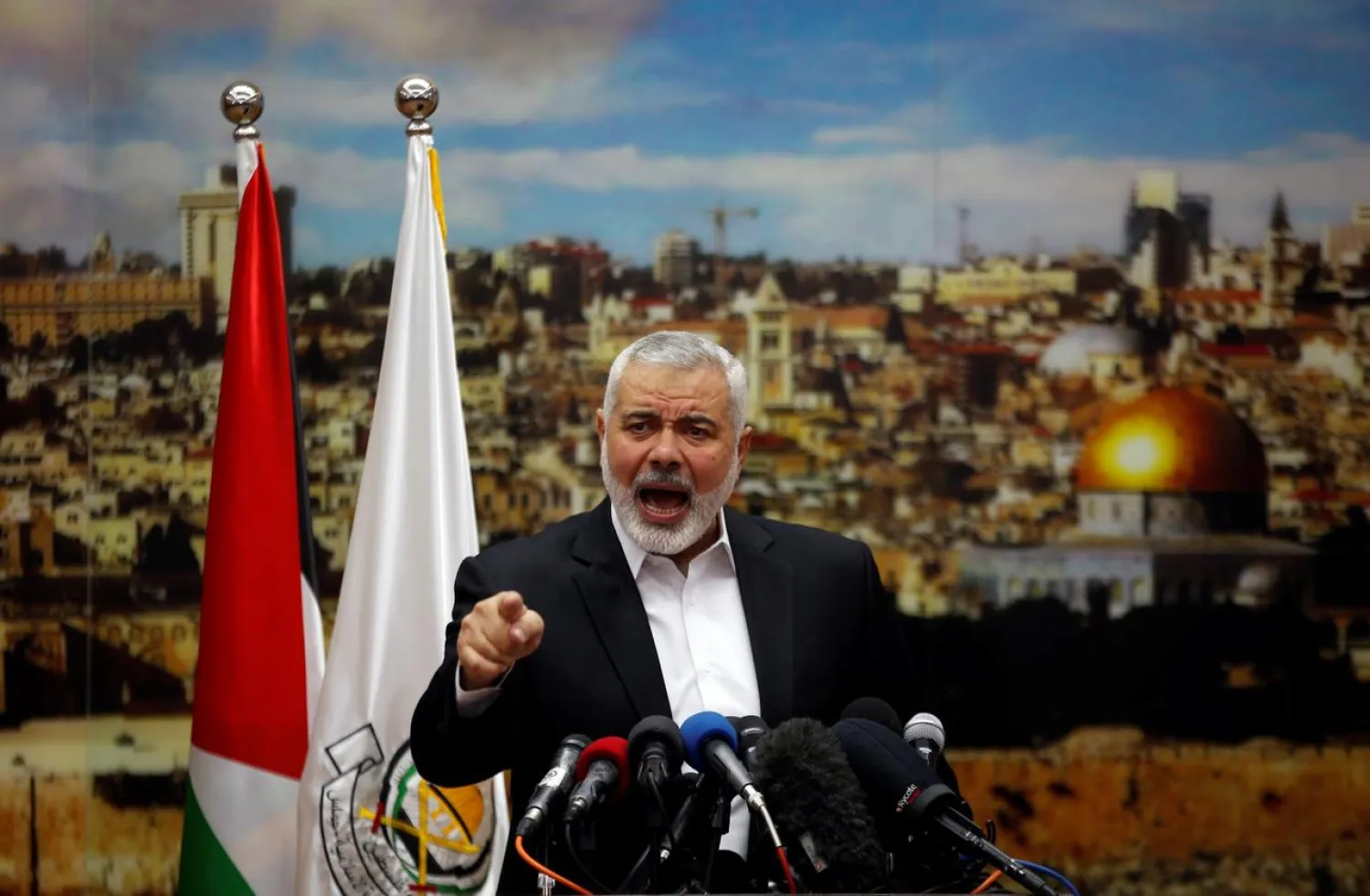

The Hamas leadership is currently based in Ankara and Doha, however, it has been frequently conducting its operations from Turkey, after Qatar and Lebanon asking the movement to reduce its public presence on their territories, sources from the movement told Asharq Al-Awsat.
The sources indicated that Hamas politburo chief Ismail Haniyeh and his deputy Saleh al-Arouri are settling in Turkey at this stage, while others are settling in Qatar and Lebanon.
They pointed out that Haniyeh moves between Turkey and Qatar, depending on the situation, and that others stay between the two countries.
Haniyeh chose Turkey despite the strong ties he has with the Emir of Qatar, Tamim bin Hamad.
In 2017, Qatar asked Hamas not to use its territories in any way that could be interpreted as an attack or aggression directed against Israel, due to political developments in the region.
The decision came shortly after US President Donald Trump's attacked Hamas, describing it as a terrorist organization, and criticizing everyone who provided cover to the movement.
About a year ago, Hamas received a similar request from Turkey, when Israel launched a media campaign against Arouri. He was accused of directing activities against Israel from the West Bank, which forced Ankara to ask him to leave the country.
Sources confirmed to Asharq Al-Awsat that, since then, Hamas has been facing difficulties in finding a permanent headquarters for its leadership.
Hamas had several options, including Malaysia, Lebanon, and Gaza, but it finally settled on Turkey, which once again opened its territory to leaders of the movement that were previously asked to leave.
In 2012, Hamas resorted to Qatar when it left Syria, and the leadership had limited options at the time, represented in Egypt, Tunisia, Turkey, Sudan, or Qatar.
In principle, chief of Hamas politburo should reside abroad so that he could move freely, collect financial aid, and obtain political support for the movement. The aim is also to maintain the security of the chief and keep him safe from Israeli attacks.
However, in 2017, the movement risked choosing Haniyeh from within the Strip. He remained in the Strip for two years, after which the movement discovered that the chief could not be imprisoned in the enclave, prompting Haniyeh to leave.
Most of his time, Haniyeh resides in Turkey, along with Arouri, Zahir Jabareen, Mousa Abu Marzouk, and Nizar Awadallah. His wife and two children are expected to join him soon.
Husam Badran, Izzat al-Rishq, Mohammed Nasr, Sami Khater, and Maher Obeid are staying in Qatar, sometimes visiting Turkey or Lebanon.
Hamas excluded Lebanon as an option because of Israeli threats, in addition to the unstable situation there.
Arouri moved to Lebanon in 2017, along with other senior Hamas officials, but then-Defense Minister Avigdor Lieberman accused him of plotting attacks against Israel, saying: “Lebanon is responsible for what happens inside it and for terror activity that will emerge from it.
“Lebanon is a sovereign state that maintains ties with the US – ties that include bilateral meetings at the highest levels both in Beirut and in Washington... That why it's important that the US work with the Lebanese government with the aim of expelling the three senior Hamas figures and preventing the establishment of another terrorist headquarters in its territory,” said Lieberman.
Ousama Hamdan is the only top official residing in Lebanon, while other well-known members, including Yahya Sinwar, Khalil al-Hayya, and Fathi Hamad, live in Gaza.
The current leadership, especially Haniyeh, want to rectify what they consider past mistakes, namely the relationship with Iran, according to the sources.


