


Lorenzo Sanz Led Real Madrid to the 1998 European Cup after 32-year Wait

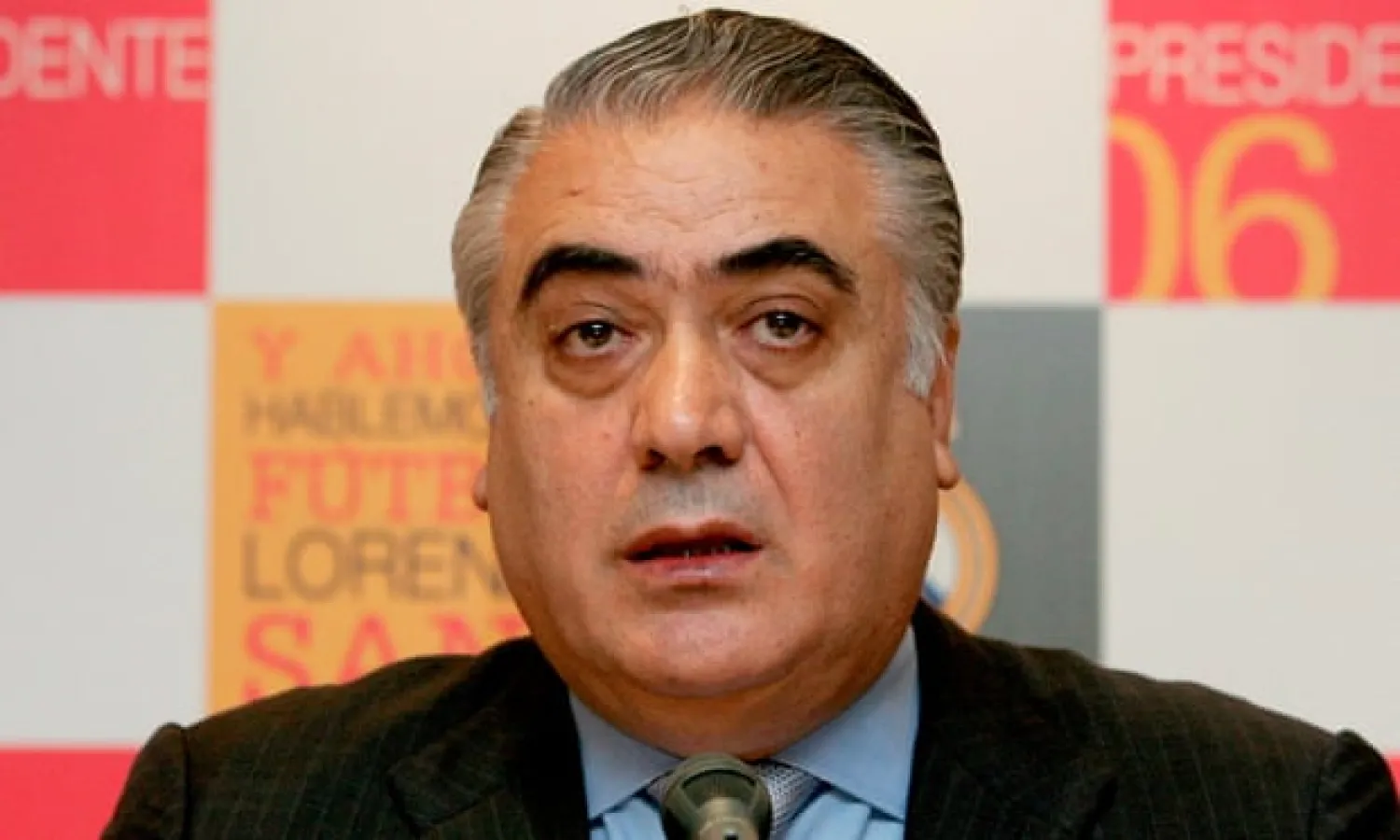
 Lorenzo Sanz in 2006, when he attempted to become Real Madrid president for a second time. Photograph: Bernardo Rodriguez/EPA
Lorenzo Sanz in 2006, when he attempted to become Real Madrid president for a second time. Photograph: Bernardo Rodriguez/EPA
TT

Lorenzo Sanz Led Real Madrid to the 1998 European Cup after 32-year Wait

 Lorenzo Sanz in 2006, when he attempted to become Real Madrid president for a second time. Photograph: Bernardo Rodriguez/EPA
Lorenzo Sanz in 2006, when he attempted to become Real Madrid president for a second time. Photograph: Bernardo Rodriguez/EPA

Lorenzo Sanz, the president who led Real Madrid to the 1998 European Cup after a 32-year wait, has died aged 76 due to coronavirus. Sanz, who had initially chosen to stay at home so as not to contribute to the saturation of Spain’s beleaguered health service, was admitted to hospital on Tuesday after eight days of fever. A test carried out there confirmed he had contracted Covid-19. As well as respiratory problems he suffered kidney failure because of an infection and died on Saturday night.

Sanz’s son Lorenzo Jr, who played basketball for Real Madrid, had informed people of his father’s worsening condition on Wednesday night. “We have to wait 24 hours but because of his age the situation is very complicated,” he wrote on social media. “The hardest thing is not being able to see him.”

On Saturday night Sanz’s other son, Fernando, who played football for the club, announced his death. Sanz becomes the first high-profilecoronavirus fatality in Spain, adding to the 1,326 that had been confirmed by the government at midday.

A former director, Sanz became president of Real Madrid in 1995 and served until 2000. He signed players such as Davor Suker, Pedrag Mijatovic, Roberto Carlos and Clarence Seedorf for the club, as well as Steve McManaman and Nicolas Anelka, making the Frenchman the most expensive player in the world at the time when he joined for £22.3m from Arsenal in 1999.

In 1998 Madrid finally won the European Cup for the first time since 1966, beating Juventus 1-0 in the final in Amsterdam thanks to a goal from Mijatovic. The séptima, or “seventh” – always referred without needing to mention the competition itself – sparked the biggest sporting celebrations the city had seen with an estimated half a million people on the streets. Two years later Madrid were European champions again but that same summer Sanz lost presidential elections to Florentino Pérez. Sanz also presided over one league title, a Spanish Super Cup and an Intercontinental Cup.

Sanz is survived by his wife, Mari Luz, his sons Lorenzo, Francisco and Fernando and his daughters Malula and Diana. In a statement, Real Madrid said they would pay homage as soon as the health crisis in Spain allowed.

The Guardian Sport



Diaz Shines as Colombia Outclass Uzbekistan

Football - FIFA World Cup 2026 - Group K - Uzbekistan v Colombia - Estadio Azteca, Mexico City, Mexico - June 17, 2026 Colombia players salute their fans after the match REUTERS/Henry Romero
TT

Diaz Shines as Colombia Outclass Uzbekistan

Football - FIFA World Cup 2026 - Group K - Uzbekistan v Colombia - Estadio Azteca, Mexico City, Mexico - June 17, 2026 Colombia players salute their fans after the match REUTERS/Henry Romero

Colombia opened their World Cup Group K campaign with a 3-1 victory over Uzbekistan at the Estadio Azteca on Wednesday, as Daniel Munoz, Luis Diaz and Jaminton Campaz struck to overcome a spirited second-half response from the tournament debutants.

Uzbekistan were disciplined for long periods under Fabio Cannavaro but Colombia's greater quality told in front of a crowd of over 80,000 on a cool, rain-tinged evening, reported Reuters.

Colombia, Copa America runners-up, had early sights of goal through Jhon Arias and James Rodriguez, but Uzbekistan sat deep, scrapped gamely and waited for mistakes. Bekhruz Karimov almost profited when ‌he burst forward, ‌only for Jhon Lucumi to intervene before he could ‌shoot.

Diaz ⁠had the clearest ⁠chance of the opening half when he struck the post, before Abdukodir Khusanov slid in after the winger had knocked the ball past him, taking out both the Colombian player and a pitchside cameraman who required medical treatment.

Uzbekistan's resistance finally cracked in the 40th minute. Diaz gathered the ball after an attack had broken down and clipped a fine pass into the path of Daniel Munoz, who guided home a neat finish for ⁠his third international goal.

The large Colombian contingent erupted, their yellow shirts ‌making the Azteca look and sound almost like ‌home. Chants of "Vamos Colombia", adapted from a Club America-style chorus, rolled around the ground, while Uzbekistan's ‌small band of supporters answered with drums of their own.

FIRST WORLD CUP GOAL

Uzbekistan ‌improved after the break and equalized on the hour with the country's first World Cup goal.

Dostonbek Khamdamov fed Eldor Shomurodov, whose shot from the right side of the box was saved low by Camilo Vargas. The goalkeeper could not hold it, however, and Abbosbek Fayzullaev nodded in ‌the rebound from close range. Their joy lasted only five minutes. Gustavo Puerta released Diaz in the 65th minute and ⁠the forward side-footed across ⁠goal to restore Colombia's lead. The crowd responded with chants of "Lucho, Lucho".

Uzbekistan kept pushing. Akmal Mozgovoy shot narrowly off target in stoppage time, Karimov hit the bar with an effort from distance and Azizbek Amonov had a shot blocked after Otabek Shukurov's pass.

But Colombia had the final word, Campaz scoring at the death to settle a contest in which Nestor Lorenzo's side had 15 attempts to Uzbekistan's nine and extended their strong recent group-stage record to seven wins in eight World Cup matches. Cannavaro, 20 years after lifting the World Cup as Italy captain, became only the fourth Ballon d'Or winner to appear at a World Cup as both player and coach, following Franz Beckenbauer, Oleg Blokhin and Marco van Basten. Ecuador face DR Congo on Tuesday in Guadalajara after Uzbekistan play Portugal in Houston.


Ballon d'Or Winner Dembele Still Searching for a Home in France Team

Football - FIFA World Cup 2026 - Group I - France v Senegal - New York/New Jersey Stadium, East Rutherford, New Jersey, US - June 16, 2026 France's Ousmane Dembele in action. (Reuters)
TT

Ballon d'Or Winner Dembele Still Searching for a Home in France Team

Football - FIFA World Cup 2026 - Group I - France v Senegal - New York/New Jersey Stadium, East Rutherford, New Jersey, US - June 16, 2026 France's Ousmane Dembele in action. (Reuters)

If Ousmane Dembele arrived at the World Cup hoping his last two club seasons would finally establish him as one of the cornerstones of Didier Deschamps' France side, the tournament's opening match has instead reinforced a familiar question - where exactly does he fit in this team?

For all his success with Paris St Germain, where he reinvented himself as a central creative force and one of Europe's most influential forwards, Dembele remains a player searching for his place in the national team. France's 3-1 victory over Senegal ‌offered another illustration ‌of the dilemma.

While Les Bleus produced enough attacking quality ‌to ⁠ease past the ⁠African side, Dembele again struggled to make himself indispensable in an attack that increasingly appears to revolve around Kylian Mbappe and Michael Olise.

The emergence of Olise has complicated Dembele's quest to become France's attacking leader. The Bayern Munich playmaker has quickly developed an understanding with Mbappe, combining between the lines and helping drive many of France's most dangerous moves.

That connection has left Dembele operating largely on the right ⁠flank, a role that contrasts sharply with the freedom he ‌enjoyed at PSG this season. In Paris, he ‌drifted inside, dictated attacks and became the focal point of the European champions' offensive ‌play. With France, he found himself wider on Tuesday, leaving room for the ‌explosive Mbappe-Olise duo.

At a time when Mbappe and Olise appear to be forming the attacking partnership around which France are building their title challenge, Dembele is still trying to define his own role.

"The key question is what to do with Ousmane Dembele," Bixente Lizarazu, ‌a 1998 World Cup winner, told French sports daily L'Equipe.

"How do you position him to get the best out ⁠of him and ⁠bring out the Dembele we've seen at PSG? So far, whether in the warm-up games or in this opening match, we haven't seen him play with his usual freedom. After a game like this, he'll be sitting there wondering what more he can do."

Dembele has never entered a major tournament in better form, yet rarely has his place in the team seemed less obvious.

Deschamps continues to trust his ability to unbalance opponents and create danger, but the challenge facing the France coach is becoming increasingly clear. It is no longer about finding room for Dembele in the starting lineup, but about finding a role that allows the Ballon d'Or winner to become as influential for France as he has been for PSG.

If he can't, the 29-year-old could end up sitting on the bench.


FIFA Hydration Breaks Spark Backlash, Blamed for Killing Momentum at the World Cup

Football - FIFA World Cup 2026 - Group J - Austria v Jordan - San Francisco Bay Area Stadium, Santa Clara, California, US - June 16, 2026 Austria coach Ralf Rangnick speaks to players during a hydration break. (Reuters)
TT

FIFA Hydration Breaks Spark Backlash, Blamed for Killing Momentum at the World Cup

Football - FIFA World Cup 2026 - Group J - Austria v Jordan - San Francisco Bay Area Stadium, Santa Clara, California, US - June 16, 2026 Austria coach Ralf Rangnick speaks to players during a hydration break. (Reuters)

Curaçao fans went wild. The Germans were in shock.

Livano Comenencia had scored a goal for the smallest nation by population to ever qualify for the World Cup against four-time champion Germany.

At 1-1 in Houston a famous upset looked possible.

Then came the hydration break.

Curaçao lost the initiative, conceding two goals before halftime in what eventually became a 7-1 defeat to the Germans.

“I actually felt sorry for them,” former England striker Alan Shearer told The Rest is Football podcast. “They scored and then it was maybe 30 seconds after that it stopped. So it’s killed their momentum.”

FIFA’s new hydration breaks midway through each half — a novelty for this World Cup — were introduced to help players deal with the summer heat in the United States, Canada and Mexico. But critics say they’re having unintended consequences, ruining the flow of the game and giving coaches a chance to tactically shift momentum in their team’s favor.

While player welfare is a real concern with temperatures expected to exceed 90 F (32 C) in the hottest World Cup venues, some say the hydration breaks are just an excuse for broadcasters to go to commercials in the middle of the game.

“We’re in America, right? So, it’s like it is it’s like it’s a timeout,” former Ireland international Roy Keane said on The Overlap, a podcast that he co-hosts with long-time Manchester United teammate Gary Neville. “We love football because of the pace of the game ... what it’s doing is stopping the flow of the game, the momentum.”

A chance for coaches to huddle with the players

Rather than players merely taking on fluids, coaches have been seizing the opportunity to pass on in-game tactical instructions that would normally not be possible. And early indications are that it is having an effect.

“You can use the break to tell the players what they need to improve or what is good or what they should do better,” Netherlands coach Ronald Koeman said. “So you can use it in different ways to your advantage, and this is what we will be doing.”

In eight of the first 16 games, there were goals scored within 10 minutes of the rehydration break.

Curaçao never recovered after the restart against Germany.

Morocco paid the price against Brazil in New Jersey, having dominated the game from the start and scored just before the first break. Less that 10 minutes after play resumed the game was level with Vinicius Junior equalizing.

Canada, the US, Australia, Scotland, Sweden and Iran have all benefited with goals soon after the break.

Momentum maps have shown how games have shifted after the new stoppages in play.

The hydration breaks also affect the experience of fans watching the games at stadiums. There were boos from the crowd on the first hydration break in the game Tuesday between Iraq and Norway in Foxborough, Massachusetts.

Breaks will be implemented regardless of the weather

Referees pause the games 22 minutes into each half, with players given three minutes to rehydrate.

FIFA stipulated that the breaks would occur regardless of the weather, venue or location, meaning the Spain vs. Cape Verde match in Atlanta on Monday was interrupted despite being under a roof and in an air-conditioned stadium.

The governing body said it was to “ensure equal conditions for all teams, in all matches.”

Spain coach Luis de la Fuente said the breaks make sense in “extreme” heat conditions but questioned whether they were necessary at every match.

“Pause, freshen up and continue. Tomorrow, when the temperature that we’ll have in this stadium is chill, maybe these breaks are not so needed, but we need to abide by the rules," he said.

Norway coach Staale Solbakken agreed.

“I can understand it when it’s like it’s been in Greensboro (North Carolina), when it’s been 35 degrees (95 Fahrenheit) and a really hot climate and there’s a bit of vibration in the air – then I think it’s fine. But I don’t like it otherwise. I think it’s unnecessary," he said.

Broadcasters cutting to commercials

Aside from the sporting impact on games, the stoppages have been criticized for damaging the spectacle for fans, with broadcasters using the opportunity to take commercial breaks.

In the United States, Fox immediately goes to commercials during the hydration breaks. Telemundo, a Spanish-language US broadcaster, does not.

Unlike in US professional sports like baseball, basketball and football, commercial breaks have not been a common feature in football except during the half-time break.

“Every time going to a commercial is a bit ... not really (something) that I like,” said Netherlands captain Virgil van Dijk, who watched World Cup games on TV before the Dutch began their campaign with a 2-2 draw against Japan. “I think for the neutral watchers on TV it’s also not great.”

France coach Didier Deschamps, however, said this is the changing face of football.

“It’s not two half times, it is four quarter times basically that we’ve got. This is what’s been decided and so the players and the coaches adapt to this new reality,” he said.

It is not known if FIFA will implement hydration breaks at all future World Cups, but the English Football Association said it was unlikely to be in place for the European Championship, hosted by the UK and Ireland in 2028.