

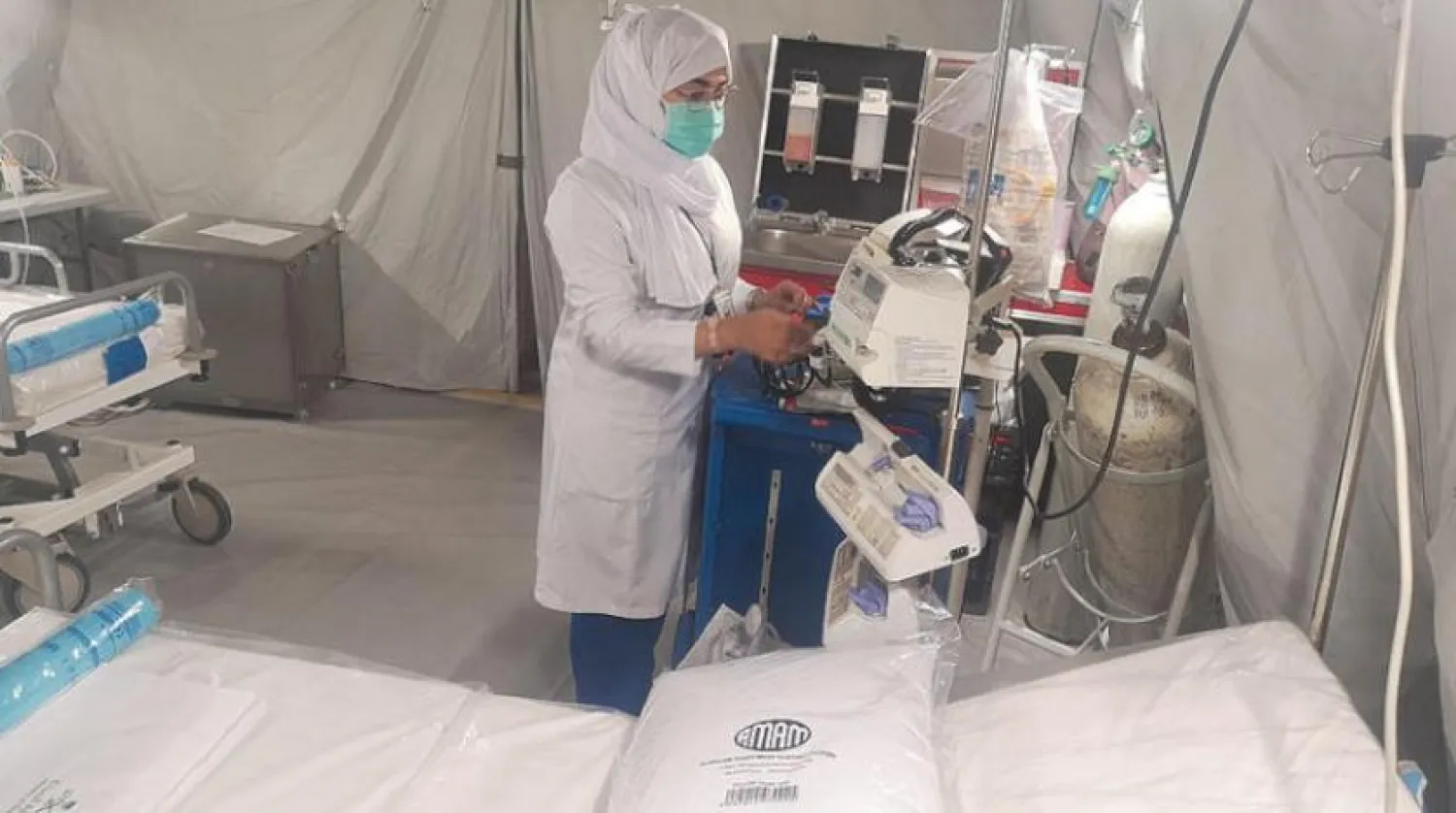

Asharq Al-Awsat Tours Makkah Field Hospital

The hospital is close to active examination sites. Asharq Al-Awsat
TT

Asharq Al-Awsat Tours Makkah Field Hospital

The hospital is close to active examination sites. Asharq Al-Awsat

Active testing has been one of the most important steps that the Saudi authorities have taken to limit the spread of the coronavirus, especially in crowded urban areas.

Different sectors are coordinating efforts to provide healthcare and protective services, including establishing a field hospital.

The Saudi Ministry of Defense established the first field hospital as part of a wider effort to provide services. The relevant bodies in Makkah completed the mobile field hospital that was prepared to treat and isolate cases.

The hospital aims to receive confirmed and suspected cases, as well as critical cases, especially from the isolated neighborhoods near the hospital.

Officials told Asharq Al-Awsat during its visit to the facility spanning more than 2,000 square meters, that the hospital consists of eight wings and 100 beds, including four ICU beds.

Dr. Al-Baraaa Kadhem, director of the mobile hospital, tells Asharq Al-Awsat that the hospital consists of six units, two wards each, and a division for digital imaging that is connected to all hospitals in order to rapidly interpret test results for those suspected to have the virus as well as those confirmed to have it.

According to the director, the hospital has a lab and pharmacy, in addition to a division that is heavily equipped to carry out surgeries.

The director of the wards in the mobile hospital, Dr. Ibrahim Jawahirji, tells Asharq Al-Awsat that their work in the hospital starts whenever a suspected case is confirmed to be positive through triage and clinical examination.

The wings are then prepared to receive the patient in compliance with the highest standards. Dr. Jawahirji adds, “despite being a field hospital, it operates within the standards that ensure patient safety, to an extent that it is indistinguishable from traditional hospitals”.

The critical care unit is of utmost readiness in case of any deterioration in the health condition of a patient, according to Dr. Abrar Mohammad, director of the nursing services in the hospital. Dr. Mohammad adds, “The cardiopulmonary resuscitation room is equipped to receive the most severe cases”.

According to Engineer Khaled al-Harthi, the field hospital was designed in compliance with the highest medical standards by the Saudi Armed Forces. Al-Harthi explained that the hospital was very meticulously prepared by the Armed Forces, in terms of equipment, medical supplies and ventilation.

It took around 60 hours to set up the hospital, weather-proof it and install a ventilation system.



Saudi Leadership Congratulates Syrian President on Liberation Day

Prince Mohammed bin Salman bin Abdulaziz Al Saud, Crown Prince and Prime Minister, meets with Syrian President Ahmed al-Sharaa in Doha on September 15, 2025. (SPA)
TT

Saudi Leadership Congratulates Syrian President on Liberation Day

Prince Mohammed bin Salman bin Abdulaziz Al Saud, Crown Prince and Prime Minister, meets with Syrian President Ahmed al-Sharaa in Doha on September 15, 2025. (SPA)

Custodian of the Two Holy Mosques King Salman bin Abdulaziz Al Saud sent on Monday a cable of congratulations to Syrian President Ahmed al-Sharaa on his country's Liberation Day.

King Salman wished the president continued good health and happiness, and the government and people of Syria steady progress and prosperity.

He praised the fraternal relations that unite the two countries and their peoples, noting that all parties are committed to strengthening and developing these ties across all fields.

Prince Mohammed bin Salman bin Abdulaziz Al Saud, Crown Prince and Prime Minister, sent Sharaa a similar cable on the occasion.


Saudi Arabia, Qatar Sign Strategic Deals, Deepen Cooperation Across Key Sectors

Saudi Crown Prince Mohammed bin Salman bin Abdulaziz Al Saud, holding talks with Emir of Qatar Sheikh Tamim bin Hamad Al Thani at Al-Yamamah Palace in Riyadh - SPA
TT

Saudi Arabia, Qatar Sign Strategic Deals, Deepen Cooperation Across Key Sectors

Saudi Crown Prince Mohammed bin Salman bin Abdulaziz Al Saud, holding talks with Emir of Qatar Sheikh Tamim bin Hamad Al Thani at Al-Yamamah Palace in Riyadh - SPA

Prince Mohammed bin Salman bin Abdulaziz Al Saud, Crown Prince and Prime Minister of Saudi Arabia met with Emir of Qatar Sheikh Tamim bin Hamad Al Thani at Al-Yamamah Palace in Riyadh on Monday, during which they held official talks and reviewed close bilateral relations, discussed prospects for cooperation, and explored ways to develop relations in various fields.

"Both sides commended the positive outcomes of their reciprocal fraternal visits, which have contributed to enhancing the level of cooperation between the two countries," read a joint statement issued at the conclusion of the Qatari Emir's visit.

"In an atmosphere of cordiality, fraternity, and mutual trust, the eighth meeting of the Saudi-Qatari Coordination Council was held during the visit, co-chaired by HRH the Crown Prince and the Amir of Qatar, with the council members in attendance. The two chairmen reviewed the distinguished bilateral relations, commended the achievements made within the framework of the council, and emphasized the importance of continuing to support and develop joint coordination in priority areas, including political, security, military, energy, industrial, economic, investment, trade, technology, infrastructure, culture, tourism, and education," the statement noted.

Both sides commended the strength of economic ties and the remarkable growth in bilateral trade, which reached $930.3 million in 2024 (excluding re-exported goods), marking a substantial 634% increase compared to 2021.

They also stressed the importance of strengthening joint efforts to diversify and increase trade, facilitate its flow, overcome any challenges, and capitalize on available opportunities in priority sectors within the framework of Saudi Vision 2030 and Qatar National Vision 2030, SPA reported.

According to the statement, the two sides stressed the need to transform these opportunities into tangible partnerships that support the concept of economic and trade integration. They also welcomed sustainable bilateral investment cooperation through partnerships between investment funds and companies, emphasizing the importance of intensifying reciprocal visits between officials and holding investment meetings and business forums.

"The leaders stressed the importance of enhancing the reliability and stability of global energy markets and ensuring the security of supplies for all energy sources globally, serving the interests of both producers and consumers and supporting global economic growth. They expressed their desire to explore ways to strengthen cooperation in the energy sector, including electricity, renewable energy, and energy efficiency, and to develop mutually beneficial projects," the statement said.

They emphasized the importance of enhancing cooperation in developing and sustaining energy supply chains and enabling collaboration between companies to maximize the utilization of local resources in both countries. Furthermore, they agreed on the need to strengthen cooperation on climate policies within international agreements and regional and international bodies, working to ensure that these policies focus on emissions rather than sources, according to SPA.

The two sides also agreed on the importance of enhancing cooperation in the digital economy and innovation; industry and mining; accelerating joint efforts on industrial integration; youth, sports, and cultural programs and activities; education, including establishing joint high-quality academic programs; media, including raising the level of credibility of media content, joint media production, and media coverage of events; cybersecurity; and health.

On the defense and security front, both sides affirmed their commitment to strengthening and developing the defense partnership, coordinating positions in confronting regional challenges, and enhancing security and stability at the regional and international levels.

They commended the existing level of security cooperation and coordination in all security fields, including the exchange of expertise, information in passenger security, holding training courses, participation in cybersecurity conferences, border security, combating drugs, extremism, terrorism and their financing, and combating crime in all its forms. They expressed their commitment to strengthening this cooperation to achieve security and stability in both brotherly countries.

Both sides welcomed the signing of the agreement for the high-speed electric passenger railway project connecting Riyadh and Doha, passing through Dammam and Hofuf. They emphasized the project's status as a major strategic initiative, aligning with the goals of both Saudi Vision 2030 and Qatar National Vision 2030. This railway connection is anticipated to significantly facilitate tourism and trade, further strengthening the ties between the two nations.

The two sides also welcomed the signing of several other agreements and memoranda of understanding during the visit. These covered key areas including rail transport, investment promotion, food security, media, and cooperation in the non-profit sector.
On the international front, Saudi Arabia and Qatar reaffirmed their commitment to continued coordination and intensified efforts to maintain international peace and security. They exchanged views on various regional and international issues of mutual interest. The Saudi side commended Qatar’s recent ratification of the Global Water Organization charter, recognizing its aim to strengthen global efforts to address water challenges and find comprehensive solutions.

According to SPA, at the conclusion of the visit, Amir of the State of Qatar Sheikh Tamim bin Hamad Al Thani expressed his gratitude to Custodian of the Two Holy Mosques King Salman bin Abdulaziz Al Saud and to the Crown Prince for the warm reception and generous hospitality. The Crown Prince reciprocated, conveying best wishes for the continued health of the Amir and for the further progress and prosperity of the Qatari people."

Later in the day, the Saudi Crown Prince bid farewell to Sheikh Tamim as he departed Riyadh.


GCC Secretary-General Condemns Iranian Officials' Statements on Member States' Sovereignty

Secretary General of the Gulf Cooperation Council Jasem Mohamed Albudaiwi. GCC
TT

GCC Secretary-General Condemns Iranian Officials' Statements on Member States' Sovereignty

Secretary General of the Gulf Cooperation Council Jasem Mohamed Albudaiwi. GCC

Secretary-General of the Gulf Cooperation Council (GCC) Jasem Albudaiwi expressed the GCC states’ denunciation of the media statements made by Iranian officials regarding the GCC states.

"These statements contained fallacies, false claims, and rejected allegations that contradict the principles of non-interference in internal affairs and good neighborliness—principles which Iran violated through its aggression against the sovereignty and independence of the State of Qatar," Albudaiwi stated.

Furthermore, he noted that these statements contradict the GCC states' continuous efforts to enhance relations with the Islamic Republic of Iran at all levels, SPA reported.

"The GCC states have consistently reaffirmed the importance of adhering to the foundations and principles enshrined in the United Nations Charter and international law, including the principles of good neighborliness, respect for state sovereignty, non-interference in internal affairs, the peaceful resolution of disputes, and refraining from the use or threat of force," Albudaiwi emphasized.

He added that the GCC states have consistently demonstrated goodwill towards Iran, stressing their keenness on Iran's security and stability to preserve the interests of the Iranian people and to spare the region the repercussions of tension and escalation.

"This commitment was underlined during the joint meetings between the GCC foreign ministers and Iranian Foreign Minister Dr. Seyyed Abbas Araghchi. The council member states have also underscored the significance of continuing bilateral communication between the GCC and Iran to enhance shared interests and maintain regional security and stability," he pointed out.

Moreover, Albudaiwi affirmed the GCC states' commitment to peace, coexistence, and pursuing dialogue and diplomatic solutions in international relations. He called on Iran to cease spreading false claims that undermine trust and hinder communication and understanding, at a time when the countries of the region need rapprochement and cooperation to safeguard their interests and achieve their peoples' aspirations for security, stability, growth, and prosperity.